
Sell to the Department of Defense and Find Army Buyers

Article by
Nikki Gianni
Nikki Gianni is a seasoned business strategist and government contracts coach, dedicated to helping businesses successfully navigate the complexities of government contracting. With over 22 years of experience in Department of Defense contracting, including managing $20 billion in federal awards, Nikki has developed the innovative GovReady Blueprint™ Framework, a comprehensive 90-day program designed to prepare businesses to compete for and win lucrative contracts at the federal, state, and local levels. Nikki's approach emphasizes not just gaining contracts but also enhancing overall business profitability.
Before becoming a business owner, Nikki was active-duty Air Force for 10 years, then spent another 15 years as a civil servant with the DOD. Now she's an empty nester living in Southern California who loves spending time with her 22-year-old son, Lex and her 2 Mini Aussies, Tony & Carmela, doing home improvement and crafts projects, and networking.
A massive defense budget doesn’t make your company an obvious buy. To understand how to sell to the Department of Defense, start with the Army problem your offer solves, the office responsible for it, and the funding path behind the requirement. The Department of Defense budget exceeds $800 billion annually. That’s a lot of money, not a standing invitation to submit a pitch and hope someone bites.
You’re right to focus on buyers, timing, and access. A SAM.gov listing matters, but it won’t tell you which Army office needs your solution or whether your offer looks low-risk to the people responsible for buying it. The challenge is connecting your capability to a real requirement before a formal solicitation is released.
This article explains how a federal strategy advisor researches DoD spending, identifies Army buyers, and helps firms pursue opportunities through SAM.gov, industry events, and prime contractors. You’ll learn how budget priorities relate to buying activity, what makes an opportunity worth pursuing, and why a disciplined buyer-side strategy is more effective than sending generic capability statements everywhere. Less guesswork means fewer costly detours.
Key Takeaways
- Match your offer to a specific Army need and the office responsible for it; a generic pitch won’t give buyers much reason to move, no magic wand included.
- Use SAM.gov and industry events to spot relevant opportunities and map the acquisition landscape before committing pursuit resources. Your budget will thank you.
- Research Army buyers, their priorities, and how they purchase so your approach addresses government requirements and risk concerns. Low risk is king, after all.
- Read DoD spending categories as clues to where demand may sit, then weigh whether a direct bid or a prime-contractor route better fits your position.
Marketing products and services to Army activities and prime contractors
Build a buying case around the Army’s requirement, acquisition route, and risk controls. The government evaluates risk, not enthusiasm in a polished slide deck.
-
Understand DoD Contracting Requirements
Map your offer to an Army program, then learn whether the opportunity suits a prime contract or subcontract. DoD contracts use the Federal Acquisition Regulation (FAR) and DoD-specific requirements, unlike civilian contracts that don’t use DoD supplements. Payment schedules and pricing terms depend on the contract; review its terms rather than assume a standard deal. Audit, protest, and termination exposure also turns on contract requirements and performance. Build credible relationships with program managers and contracting officers, who typically remain in position for 2 to 5 years. A business awarded a federal contract directly is the prime; a firm paid by that prime to perform part of the work is a subcontractor.
-
Complete Registrations and Certifications
Register in SAM.gov before pursuing federal awards; federal contractors must be registered in the System for Award Management. Match any certification or eligibility requirement to the specific solicitation instead of treating one credential as a universal pass. For small businesses, procurements worth $250,000 or less are typically set aside under simplified-acquisition procedures. The DoD also seeks to expand small-business competition for prime contracts and subcontracts. For an existing requirement, small businesses should request a meeting with a Small Business Professional at least 18 months before the contract expires.
-
Address Cybersecurity Requirements
Identify the data your work will handle, then align security planning with the solicitation’s stated requirements, including any applicable CMMC conditions. The U.S. Department of Defense says DFARS Clause 252.204-7012 requires contractors and subcontractors to provide adequate security for covered defense information on or transiting through their internal information systems or networks. Contractors handling DoD data may need to meet NIST cybersecurity standards; classified information may require security clearances for key personnel and facility security certification. Treat those controls as part of your bid’s delivery plan, not paperwork to improvise after award.
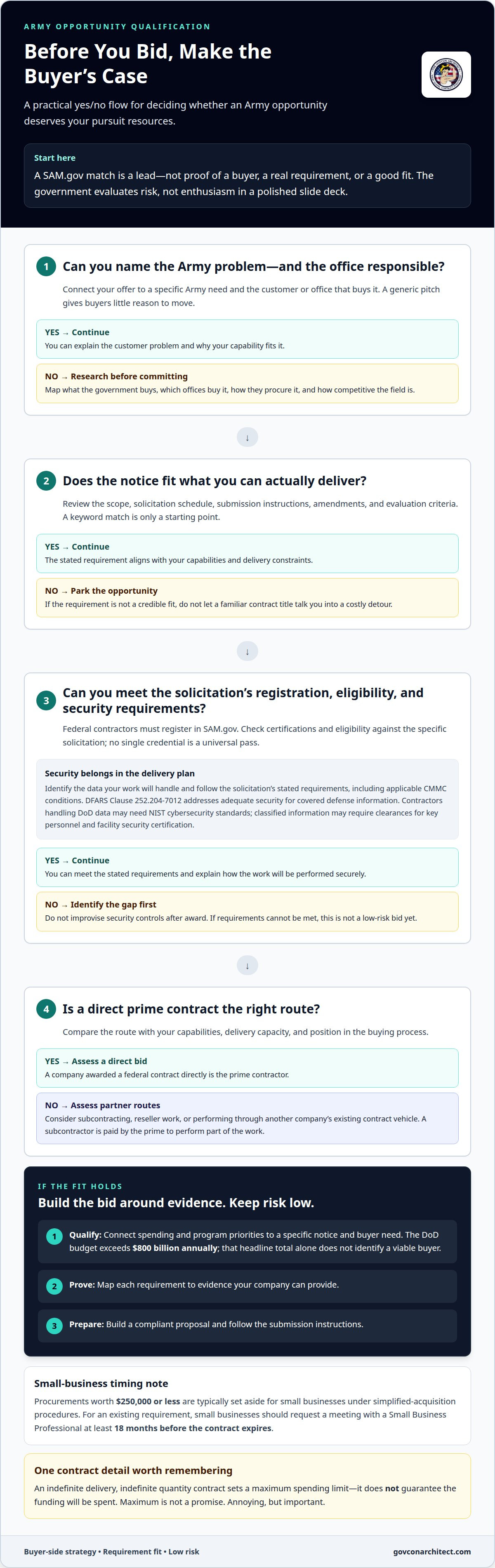
Researching opportunities through SAM.gov and industry events
Look for a requirement you can deliver, not just a contract title that sounds familiar. An advisor can turn notices, spending patterns, and industry conversations into a qualified pursuit.
-
Have a Federal Contracting Advisor Search SAM.gov for Opportunities
Have an advisor filter SAM.gov notices against your actual capabilities, target agencies, and delivery constraints. For each promising notice, the advisor examines the scope, solicitation schedule, submission instructions, amendments, and evaluation criteria. A keyword match is only a lead; the requirement and the buyer’s stated need determine whether it merits attention. Industry events and the Defense Acquisition Toolkit add useful context by identifying DoD touchpoints and events where companies can learn about acquisition priorities.
-
Work with an Advisor to Find Prime and Subcontracting Work
Ask an advisor to assess both direct federal opportunities and work available through established prime contractors. A direct award makes your company the prime; a subcontract means a prime pays your firm to perform part of its federal work. Resellers and subcontracting can also provide routes through another company’s existing contract vehicle. The advisor can compare each route against your capabilities, delivery capacity, and position in the buying process. For Defense Logistics Agency prospects, account for its role managing the global supply chain for military services, the Coast Guard, 11 Combatant Commands, and other customers.
-
Have an Advisor Track DoD Spending and Prepare Bids
Have the advisor connect spending and program priorities to specific notices, then assess whether the agency’s requirement aligns with your offer. The DoD budget exceeds $800 billion annually, but the headline total doesn’t identify a viable buyer. A disciplined bid process starts by qualifying the opportunity, mapping each requirement to evidence, building a compliant proposal, and submitting it as instructed. An indefinite delivery, indefinite quantity contract sets a maximum spending limit, but doesn’t guarantee that funding will be spent. That distinction matters. To structure this pursuit work, discuss a federal strategy advisory engagement.
Finding Army buyers and researching customers
A buyer map makes how to sell to the Department of Defense a targeted acquisition decision, not a tour of every Army office. The aim is to connect your capability to a real customer problem, not simply collect impressive-sounding acronyms.
-
Have an Advisor Research Markets and Target Customers
Have an advisor assess the market by identifying what the government buys, which offices buy it, how they procure it, and how competitive the field is. That’s how you separate a genuine fit from a keyword coincidence wearing a very official-looking badge.
For a firm considering how to sell to the Department of Defense, the next step is distinguishing a promising market from a pursuit worth resourcing. Compare your delivery record and capabilities with the target customer’s needs, likely acquisition route, and competing solutions. If the fit isn’t defensible, a polished pitch won’t make it one. It’s better to find out before committing your team.
-
Work with an Advisor to Identify DoD Buyers and Champions
Have an advisor trace the requirement to its Army customer, program office, and stakeholders who can explain the operational need. Program Executive Offices manage procurement and awards against predefined requirements; they aren’t browsing for interesting ideas like shoppers in a catalog. A relevant early conversation can clarify the problem and whether a potential solution fits an acquisition need.
Map each stakeholder’s role and relationship to the requirement. Separate the end user’s operational concerns from the program team’s acquisition priorities and the contracting office’s process. That map helps focus discussions and identify whose input matters at each stage. If a requirement is still developing, an RFI can provide an opportunity to inform it before a later RFP. Keep claims tied to evidence: explain the problem addressed, how your team will deliver, and why the approach lowers buyer risk. A federal market entry plan can organize this targeting into a coherent pursuit strategy.
Department of Defense budget and spending categories
- Start with the DoD’s annual budget, which exceeds $800 billion. Treat that total as context, not your addressable market. It combines different missions, organizations, and spending purposes. Your task is to identify which category supports the capability you deliver, then connect it to a buyer’s requirement. A giant top-line figure is impressive, but it won’t tell you who can buy your solution.
- Classify your offer against the spending function it serves. Personnel and readiness spending is approximately $300 billion; procurement spending is approximately $150 billion. Research, development, test, and evaluation spending is approximately $120 billion, while military construction and operations spending is approximately $50 billion. These categories describe different needs. A product supporting readiness has a different buyer case from equipment acquired through procurement.
- Use the budget category to sharpen your market position, not to assume funding is available. For example, a prototype may align with research, development, test, and evaluation, while an established product may fit procurement. Identify the program, mission need, and acquisition path behind the spending. Then establish whether the opportunity involves a contract, another transaction, or a grant. The authorities and terms differ, so don’t treat every funding announcement as a contract lead.
- Compare budget priorities with actual buying signals before committing proposal resources. A strategy priority indicates direction; a solicitation or program requirement points to a more concrete acquisition need. Check that the scope matches your capabilities, your team can deliver, and the buyer’s stated objectives support your solution. Federal acquisition regulations shape contract requirements, but a budget category alone cannot establish fit, competition, or award timing. Follow the evidence, not the headline.
The GovCon Architect
The GovCon Architect helps firms turn DoD market research into a disciplined pursuit strategy. Its advisory work connects Army priorities, buyer relationships, spending signals, and your capabilities to assess where you can compete with lower risk.
Turn to The GovCon Architect for a clearer federal market-entry plan, ongoing strategic guidance, or focused support for a specific opportunity. Its Fractional Federal Strategy Advisor and Federal Market Entry Engagement services structure that work around your position and pursuit needs. Avoid spray-and-pray bids. Buyers already have enough paperwork.
Bring your capabilities, target markets, and questions about current opportunities. Contact The GovCon Architect to discuss a practical next step.
Make Your Next Move Deliberate
A sound plan for how to sell to the Department of Defense starts with a decision your leadership can defend: which opportunity deserves focused investment now, and which should wait. Set a clear internal threshold for pursuing work. Consider strategic fit, delivery capacity, and the resources your team can commit without weakening current operations. A disciplined “not now” can protect the position you’ve worked to build.
When a specific opportunity meets that threshold, GovCon Architect’s Capture & Proposal Sprint can support a focused pursuit. The goal isn’t more activity for its own sake. It’s a defensible decision, a clear proposal, and a team aligned on what delivery requires. Federal sales rewards preparation, not frantic document marathons disguised as strategy.
You don’t need to chase every opening to build momentum. Choose the opportunity your team can pursue with discipline, then take the next step with confidence.
Frequently Asked Questions
What’s the primary reason most companies aren’t ready when selling to the DoD?
Firms often enter the market before they can show how their performance reduces a buyer’s risk. A strong commercial record helps only when it’s translated into evidence relevant to the specific requirement. For example, a company may describe a successful project but fail to explain how its delivery approach, management controls, and past results apply to an Army customer’s needs. Readiness means making that connection clear.
How can a federal contracting advisor help me register to sell to the U.S. Department of Defense through SAM.gov?
A federal contracting advisor can explain how registration fits into your federal pursuit strategy, but GovCon Architect does not provide SAM registration services. The registration itself is completed through SAM.gov. An advisor can help you understand how your business identity, target market, and planned opportunities fit together, so registration isn’t treated as a substitute for a buyer-focused strategy. Getting into the system is a prerequisite, not a sales plan.
How can a federal contracting advisor help me find DoD contract opportunities on SAM.gov and agency procurement sites?
An advisor can assess notices against your actual delivery strengths, target customers, and pursuit capacity. That means screening out opportunities that only match a keyword, then prioritizing notices whose scope and evaluation requirements fit your business. Agency procurement information can add context about the buying office and its programs. The result is a qualified pipeline and a clearer basis for deciding where to invest proposal effort.
What are the current small-business set-aside programs and eligibility rules for DoD contracts?
Set-aside eligibility depends on the solicitation and the applicable small-business program; small-business status alone doesn’t establish qualification for every opportunity. DoD seeks to expand small-business competition, and procurements worth $250,000 or less are typically set aside for small businesses under simplified-acquisition procedures. For a specific notice, assess its stated eligibility conditions and required representations before committing to a bid. Don’t confuse a possible set-aside with guaranteed access or award.
What are the DFARS clauses and other compliance rules for DoD suppliers?
DFARS adds DoD-specific terms to the Federal Acquisition Regulation, so review the clauses included in each solicitation and resulting contract. Pay particular attention to requirements affecting data handling, subcontractor responsibilities, and the proposed work. Build a compliance matrix linking every applicable requirement to an owner and supporting evidence. This makes gaps visible before submission instead of surprising the delivery team after award.
How can a small business work with an advisor to find a DoD prime contractor or subcontracting opportunity?
An advisor can identify primes whose programs and work packages align with your capabilities, then assess where your contribution could strengthen delivery. Prepare a concise record of relevant performance, capacity, and the work you can execute. The advisor can use that evidence to guide target selection and teaming discussions. Focus on a defined role and credible fit, not a vague offer to help with anything.