
Navigating SAM.gov: A Practical Search-to-Pursuit Guide

Article by
Nikki Gianni
Nikki Gianni is a seasoned business strategist and government contracts coach, dedicated to helping businesses successfully navigate the complexities of government contracting. With over 22 years of experience in Department of Defense contracting, including managing $20 billion in federal awards, Nikki has developed the innovative GovReady Blueprint™ Framework, a comprehensive 90-day program designed to prepare businesses to compete for and win lucrative contracts at the federal, state, and local levels. Nikki's approach emphasizes not just gaining contracts but also enhancing overall business profitability.
Before becoming a business owner, Nikki was active-duty Air Force for 10 years, then spent another 15 years as a civil servant with the DOD. Now she's an empty nester living in Southern California who loves spending time with her 22-year-old son, Lex and her 2 Mini Aussies, Tony & Carmela, doing home improvement and crafts projects, and networking.
A SAM.gov listing isn’t a command to spend your proposal budget. It’s a lead, and some leads look more promising than they are because the title sounds tailor-made. If navigating SAM.gov for opportunities feels like sorting signal from noise, you’re not missing a secret button. The platform shows notices. It doesn’t decide whether your firm should pursue them.
The government is buying against a need, a timeline, and a risk profile. A notice that sounds like a perfect fit can still include requirements or delivery expectations that make the pursuit a poor match. That’s not a reason to panic. It’s a reason to read the actual requirements before the proposal team starts rearranging its life.
This guide gives you a repeatable way to search, narrow results, and identify notices worth a closer look. You’ll learn how to assess fit and timing before committing capture or proposal resources, and how to treat discovery as market intelligence rather than a bid signal. The useful question isn’t just “Can we find it?” It’s “Can we deliver credibly, with low risk, and is this pursuit worth our effort?”
Key Takeaways
- When navigating SAM.gov for opportunities, start with a defined work scope and refine your searches instead of chasing every promising title.
- Recognize what different notice types signal, then review the notice details before treating one as a potential pursuit.
- Use solicitation documents to assess requirements, submission instructions, timing, and evaluation criteria.
- Record the opportunity, assign an owner, and make a deliberate go-or-no-go decision before committing proposal resources.
What SAM.gov opportunity listings show, and what a search result cannot tell you
A SAM.gov Contract Opportunities record is a federal procurement notice describing a government buying action. By itself, it cannot prove that an award is available, that your firm is eligible, or that your team can deliver successfully. That distinction matters. The government is communicating a requirement and managing acquisition risk, not certifying that every company matching a keyword is a sound bidder. A search result is a lead. The notice and its documents are what you assess.
Public search helps firms discover notices, while account-enabled functions can support ongoing monitoring, such as saving searches or following notices. These tools help manage information; they don’t make a pursuit more viable. For broader background on the platform’s purpose and history, see the System for Award Management (SAM.gov) Wikipedia overview.
Which SAM.gov notice types should a commercial firm recognize?
A pre-solicitation notice can signal an upcoming procurement and give industry an early view of the agency’s direction. A solicitation sets out the government’s requirements and tells vendors how to respond. An award notice reports an award action; it is not an open invitation to bid. A sole-source notice concerns a proposed action directed to one source, not a general competition. Labels and circumstances matter, so check each notice’s current status, linked documents, and stated dates. A familiar title is no substitute for due diligence.
Does finding a notice mean your company is ready to bid?
No. A matching keyword or category establishes topical relevance, nothing more. Read the mission and scope, then assess whether your firm can meet the delivery requirements with credible evidence, available resources, and a response plan that fits the timeline. Consider how the buyer will judge performance risk, not just whether your commercial offering sounds similar. A gap in delivery experience or a missed submission date won’t be fixed by an enthusiastic search result.
Before committing proposal resources, separate “we found it” from “we can make a defensible offer.” The same discipline applies to what firms need to bid on a federal contract. When navigating SAM.gov for opportunities, remember the reality check: discovery starts the evaluation; it doesn’t finish it.
How to search SAM.gov for opportunities without drowning in results
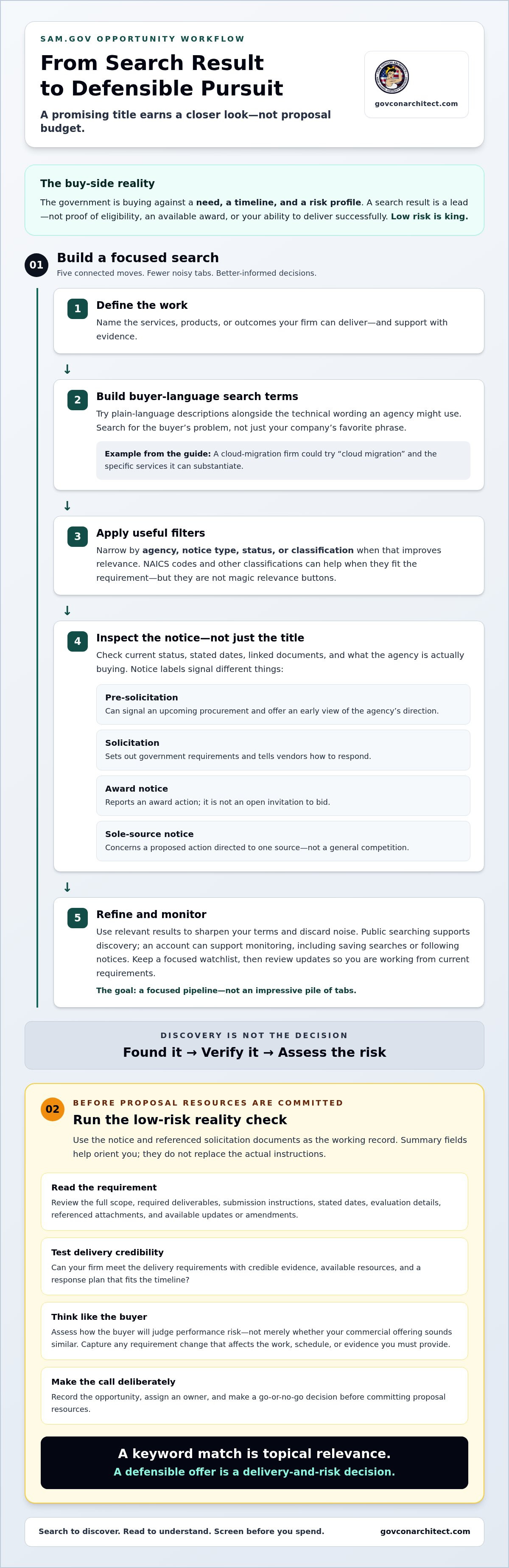
Search with the buyer’s problem in mind, not just your company’s favorite phrase. Agencies describe needs in the language of the work they must acquire. Matching that language helps surface relevant notices and reduces results that sound close but point to a different requirement. When navigating SAM.gov for opportunities, use the Official SAM.gov Website for current search tools and platform guidance. Interface labels and features can change.
- Define the work. Identify the services, products, or outcomes your firm can deliver and support with evidence.
- Build search terms. Try plain-language descriptions as well as the technical wording a buyer might use.
- Apply useful filters. Narrow by agency, notice type, status, or classification when doing so improves relevance.
- Inspect the notice. Review the record and documents to understand what the agency is actually buying.
- Refine the search. Use relevant results to sharpen your terms and discard noise. The goal is a focused pipeline, not an impressive pile of tabs.
Which search terms and filters help narrow Contract Opportunities?
Start with work your team performs, then test how an agency might describe the need. A firm delivering cloud migration could try that phrase alongside the specific services it can substantiate. NAICS codes and other classifications can help when they fit the requirement, but they’re not magic relevance buttons. Add agency or notice filters when they sharpen results without hiding a useful lead. Verify current filter names and behavior in SAM.gov.
How can you monitor newly posted or changed notices?
Public searching supports discovery; an account can provide opportunity-management functions such as saving searches or following notices. Use these tools to maintain a focused watchlist, then review notices and updates so you’re working from the current requirements. Monitoring helps you stay organized. It doesn’t tell you whether the buyer’s need matches your delivery strengths. Consult SAM.gov’s current help material for interface steps, which can change. For buy-side-informed perspective on turning discovery into a measured pursuit, see The GovCon Architect’s opportunity-screening support.
How to screen SAM.gov opportunities before committing bid resources
A compelling title earns a closer look, not an automatic place on the proposal calendar. The buyer needs a response that demonstrates understanding, delivery capability, and controlled risk. Your screen should test those same fundamentals before the team spends time and money developing a bid.
What should you verify in the notice and solicitation documents?
Use the official notice and its referenced documents as your working record. Read the full scope, required deliverables, submission instructions, stated dates, and evaluation details. Review referenced attachments and any updates or amendments available with the notice. Summary fields are useful for orientation, but they don’t replace the actual instructions. If a requirement changes the work, schedule, or evidence you need to provide, capture that impact before deciding whether to pursue.
Then compare the requirement with your operating reality:
- Mission and scope: Can your firm perform the work described, rather than just something with a similar label?
- Evidence: Do you have relevant past performance and supportable claims that address the buyer’s stated needs?
- Capacity and timing: Can your team meet the schedule while protecting existing delivery commitments?
- Execution risk: Are there material gaps, dependencies, or teaming needs that could weaken a credible response?
Evaluation details show what the government says it will assess. Use them to connect your evidence to the buyer’s decision, rather than polishing strengths that don’t answer the stated criteria. A buy-side guide to government bid evaluation criteria can help frame that review, but the solicitation’s specific instructions remain the ones to follow.
When is a SAM.gov opportunity a pass rather than a pursuit?
Pass, or pause for further analysis, when the scope sits outside your delivery record, essential evidence is thin, capacity is committed, timing is unworkable, or a major risk has no credible mitigation. A gap isn’t automatically fatal; wishful thinking isn’t a mitigation plan either. Use a consistent bid/no-bid decision framework to document the rationale and protect resources for pursuits where your response can be defensible.
GovCon Architect’s buy-side approach focuses on aligning your pursuit with how government buyers evaluate risk and proposals. Review your opportunity-screening approach with GovCon Architect before proposal effort begins.
From SAM.gov discovery to a disciplined federal pursuit
Finding a notice is the handoff from search to strategy. Before proposal work begins, turn discovery into a decision the team can explain and support. The government is evaluating whether a vendor can meet its need with controlled risk. Your pursuit plan should answer that concern with evidence, available resources, and a defensible response, not enthusiasm and a crowded calendar.
- Record the notice. Capture its identifier and current stated dates.
- Review the documents. Note the scope, instructions, evaluation details, and any referenced materials you reviewed.
- Assess fit. Compare the requirement with your delivery record, capacity, and material risks.
- Assign an owner. Make one person accountable for coordinating the review and next steps.
- Decide. Document whether to pursue, pass, or resolve a specific question before committing resources.
What belongs in an initial opportunity decision record?
Keep it concise and useful under pressure. Include the notice identifier, current dates, a short scope summary, documents reviewed, fit rationale, key risks, and decision owner. Record the pursue-or-pass decision and any unresolved issue that could change it. This is not a proposal in miniature. It’s a clear record that helps the team act consistently and prevents a promising notice from quietly becoming an unexamined commitment.
When can buy-side strategic guidance help?
For commercial firms with at least $5 million in annual revenue and five or more years of proven delivery, buy-side strategic guidance can help translate a promising opportunity into a controlled pursuit. The work is to align evidence and resources with what the government evaluates, then shape a credible response plan. GovCon Architect’s federal contract pursuit support brings direct buy-side perspective to the transition from discovery to execution. No search, strategy, or proposal can promise an award. Sound decisions help reduce avoidable risk.
Make the Next Pursuit a Deliberate One
The next step in navigating SAM.gov for opportunities isn’t adding more notices to a spreadsheet. It’s building a repeatable decision habit: pursue work you can substantiate, resource, and deliver in a way that gives the buyer confidence. A disciplined pass is progress too. It preserves capacity for a stronger fit instead of letting a tempting title commandeer the proposal team.
GovCon Architect aligns pursuit strategy with how government buyers evaluate risk. For an established commercial firm weighing a federal opportunity, Nikki Gianni’s buy-side experience as a government buyer, evaluator, awarder, and contract administrator can help clarify the decision before a search result becomes a major resource commitment. No promises of awards, just a sharper basis for choosing where to compete.
Keep your standards high and your decisions evidence-based. The right opportunity deserves a serious plan, and your team deserves the clarity to know when that opportunity is worth pursuing.
Frequently Asked Questions
Can I search SAM.gov for contract opportunities without an account?
Yes. SAM.gov allows anyone to search Contract Opportunities without an account. An account adds tools for managing the hunt, including saving searches and following notices. Handy when your watchlist starts breeding. Check current SAM.gov guidance for the latest steps and features, since platform functions can change. Public search helps you discover notices; it doesn’t establish eligibility, competitive strength, or readiness to perform.
How do I find relevant opportunities on SAM.gov?
Start with work your firm can already deliver, then test terms buyers might use to describe it. A broad phrase such as “facilities support” may bring mixed results; adding precise service language can make the list more useful. When navigating SAM.gov for opportunities, refine your searches based on what you find, not what sounds impressive. Then assess the actual requirement before committing bid resources.
Do I need to register on SAM.gov to view opportunities?
No. You can view and search Contract Opportunities without an account, according to SAM.gov. An account supports added management functions, including saving searches and following notices. Viewing listings is separate from any registration or eligibility steps a particular procurement may require. Think of public search as looking through the window, not completing every step needed to do business with the government.
What information should I review before pursuing a SAM.gov opportunity?
Review the notice’s current status, scope, stated dates, solicitation documents, submission instructions, and evaluation details. Then map each key requirement to evidence your firm can provide, such as a relevant project or qualified team member. If a requirement has no clear evidence behind it, flag the gap before proposal work begins. Confidence is useful; unsupported confidence is just expensive.
Does finding an opportunity on SAM.gov mean my company should bid?
No. Discovery means you have something to assess, not marching orders from the universe. Compare the opportunity’s demands with your firm’s delivery experience, available people, timing, and unresolved risks. If a material gap could undermine performance or the response, investigate it before proceeding or pass. A thoughtful no-bid decision isn’t a failure; it’s how you protect the capacity needed for a stronger opportunity.
To discuss your next federal pursuit, book a 15-minute get-to-know-you call with GovCon Architect.