

Creating a Federal Government Market Entry Plan: A Buy-Side Guide

Article by
Nikki Gianni
Nikki Gianni is a seasoned business strategist and government contracts coach, dedicated to helping businesses successfully navigate the complexities of government contracting. With over 22 years of experience in Department of Defense contracting, including managing $20 billion in federal awards, Nikki has developed the innovative GovReady Blueprint™ Framework, a comprehensive 90-day program designed to prepare businesses to compete for and win lucrative contracts at the federal, state, and local levels. Nikki's approach emphasizes not just gaining contracts but also enhancing overall business profitability.
Before becoming a business owner, Nikki was active-duty Air Force for 10 years, then spent another 15 years as a civil servant with the DOD. Now she's an empty nester living in Southern California who loves spending time with her 22-year-old son, Lex and her 2 Mini Aussies, Tony & Carmela, doing home improvement and crafts projects, and networking.
Federal buyers don't award points for confidence. They look for evidence that your company can deliver with low risk. That’s why creating a federal government market entry plan starts with a harder question than “Which agency should we target?” It starts with whether your delivery record, capabilities, and operating readiness support a credible offer. Commercial success matters, but it doesn’t automatically translate into buyer confidence. Federal acquisition has its own logic, and wishful thinking is a terrible capture strategy.
If you’re unsure which agencies fit, which requirements matter, or how to sequence research and pursuit decisions, you’re asking the right questions. A disciplined plan helps you decide whether federal contracting fits your growth priorities, focus on markets where your evidence is relevant, and avoid chasing opportunities you aren’t positioned to deliver. This guide explains how to test readiness, define a defensible market position, and turn research into deliberate action. Look at the market through the buyer’s lens: not “Can this vendor make a compelling pitch?” but “Can this vendor meet the need reliably, with manageable risk?” That’s the standard worth building toward.
Key Takeaways
- When creating a federal government market entry plan, treat it as a sequence of decisions, not a growing list of bids.
- Short-list markets by connecting documented capabilities and past performance to agency demand and realistic delivery capacity.
- Choose an entry path that fits your research maturity, evidence gaps, and leadership bandwidth. No need to make the plan harder than the acquisition process already does.
- Turn strategy into named owners, research actions, decision gates, and pursuit criteria, then revise the plan as market facts or business capacity change.
Creating a Federal Government Market Entry Plan Starts with Readiness
A federal market entry plan is a sequenced decision framework, not a bid list with hopeful deadlines. It helps leadership decide whether federal work fits the company, where its evidence is credible, and what must be strengthened before pursuing an opportunity. Creating a federal government market entry plan starts with fit: align growth goals with proven delivery, leadership commitment, and the capacity to take on new work without putting current customers or operations at risk.
This strategy is for established firms with at least $5 million in annual revenue and five or more years of proven delivery, not businesses looking for a shortcut. Commercial success is relevant, but buyers need to see how that success translates into evidence tied to the government’s requirements. Procurement exists to acquire needed goods and services through a structured process; this overview of government procurement provides useful context.
What readiness means before pursuing federal work
Test the operating reality before researching bids. Can the company deliver reliably, support the financial and operational demands, and assign leaders enough time to guide a new market effort? Then separate demonstrated performance from ambition. For each capability claim, identify the proof: completed work, relevant outcomes, and the team or processes that made delivery possible. If the evidence is thin, call it a gap to address, not a sentence to dress up.
Why the buyer’s risk perspective changes the plan
Government evaluators need a defensible basis for confidence. They assess whether an offer demonstrates an understanding of the requirement and a credible ability to perform. A strong commercial reputation helps only when the evidence clearly connects that record to the work being purchased. Review government bid evaluation criteria to understand how buyer priorities shape that judgment.
Readiness also affects what you pursue and how you prepare. A disciplined approach to low-risk pursuit management keeps enthusiasm from outrunning capacity. The buyer isn’t looking for confidence alone. They need a reason to trust the plan.
Choose a Federal Market by Matching Demand to Buyer Risk
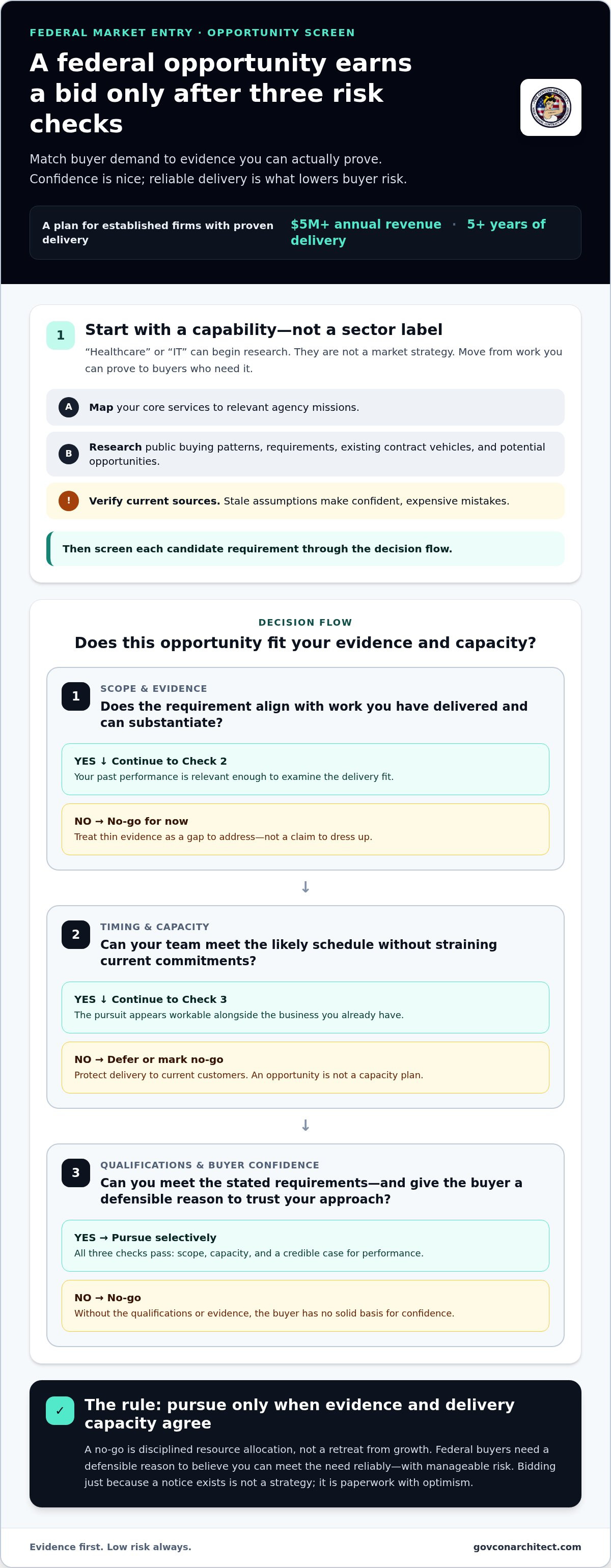
Once readiness is established, narrow the field. Creating a federal government market entry plan means matching documented capabilities to actual agency demand, not choosing a broad sector because it sounds lucrative. Start with work your company can prove it has delivered. Then identify agencies and requirements where that evidence matters and your team has realistic capacity to perform.
A practical sequence for narrowing the market
Move from capability to market, not the other way around. Map core services to relevant agency missions, then examine public procurement information for buying patterns, requirements, existing contract vehicles, and potential opportunities. Treat broad labels such as “healthcare” or “IT” as starting points, not a strategy. Verify details against current sources; stale assumptions make for confident, expensive mistakes. For a deeper research method, use this guide to federal market intelligence. The U.S. Small Business Administration’s federal contracting guide is another reference for understanding market research and contracting preparation.
Distinguish an attractive market from a viable opportunity
A market can look appealing and still be a poor fit. For each candidate, compare:
- Scope and evidence: Does the requirement align with work you’ve delivered and can substantiate?
- Timing and capacity: Can your team meet the likely schedule without straining current commitments?
- Qualifications and competition: Can you meet the stated requirements, and does your evidence give the buyer a defensible reason to trust your approach?
Pursue only opportunities supported by credible evidence and delivery capacity. A no-go decision isn’t a retreat from growth. It’s disciplined resource allocation, and it protects the business from bidding simply because an opportunity exists. If you’re weighing a market shortlist, structured market-entry guidance can help turn research into a defensible pursuit decision.
Build the Entry Strategy Before Committing to Federal Bids
Research should lead to a decision, not an automatic “let’s bid.” Choose an entry path based on leadership bandwidth, how much market research is complete, the strength of your evidence, and how many viable opportunities you’ve identified. The goal is to build a credible position, not manufacture confidence. Preparation can strengthen positioning and compliance discipline; it can’t guarantee an award. Buyers need a defensible case for performance, not a promise wrapped in polished formatting.
Build internal capability: This fits when leadership can assign accountable staff and the company needs to develop repeatable federal-market knowledge and processes.
Get support for a specific pursuit: This fits when research has surfaced a defined opportunity and the immediate need is opportunity-specific planning. See this guide to federal contract capture plan development.
Structure a market-entry engagement: This fits when the company needs broader direction, market focus, and a foundation for deciding which opportunities deserve investment. The PROJECT · 90-120 DAYS - Federal Market Entry Engagement is designed for this kind of structured planning.
When a targeted pursuit is different from market entry
Pursuit support addresses a defined opportunity. Market entry establishes the direction and repeatable foundation for future decisions, including which markets to prioritize and which evidence or capacity gaps to address. Treating one bid as an entire market strategy is like using one map pin to plan the whole trip. Ambitious, perhaps. Not especially useful.
What a useful entry plan should contain
Make the strategy operational. Document target markets, buyer-relevant evidence, capacity actions, decision gates, and an accountable owner for each action. Review the plan against what the business can actually support. That’s how creating a federal government market entry plan becomes disciplined execution instead of a binder no one opens.
For established firms weighing strategic fit, a focused conversation can help clarify the right path.
Turn the Federal Market Entry Plan into Disciplined Next Steps
A strategy earns its keep through decisions and follow-through. Translate the plan into actions with an owner, a clear evidence need, and a decision point. For example, assign someone to track relevant procurement information, identify proof that supports a capability claim, and bring findings to leadership before the company commits resources to a pursuit. If buyer demand or business capacity shifts, revisit the assumptions. A plan isn’t carved in stone. It’s a control system, not office décor.
- Research actions: Identify what market or opportunity information needs validation and who will gather it.
- Evidence improvements: Strengthen the connection between past delivery and the requirements buyers need addressed.
- Decision gates: Set criteria for continuing research, preparing for a pursuit, or pausing.
- Accountable owners: Assign responsibility for each action and review progress with leadership.
Choose support that matches the work ahead
The right support depends on the job to be done. RETAINER · MONTHLY - Fractional Federal Strategy Advisor supports sustained strategy and market alignment. PER-PURSUIT · PROJECT - Capture & Proposal Sprint focuses on a defined bid. PROJECT · 90-120 DAYS - Federal Market Entry Engagement provides a structured path for qualified firms building their federal entry plan. Match the approach to the work, not to the shiniest label.
Set expectations around progress, not promised awards
Measure progress through sharper market decisions, stronger buyer-relevant evidence, and disciplined choices about which pursuits merit investment. Creating a federal government market entry plan can improve preparation and positioning, but it can’t guarantee an award. Government buyers must make defensible decisions about performance risk. No advisor can remove that uncertainty, and anyone promising otherwise is selling certainty the process doesn’t provide.
Ready to discuss your firm’s federal entry strategy?
Build Your Federal Entry on Evidence
Creating a federal government market entry plan is a disciplined way to decide where your firm fits, what evidence supports your position, and which opportunities deserve your resources. Start with readiness. Match agency demand to proven delivery and available capacity. Then turn the strategy into owners, decision gates, and clear pursuit criteria.
That buyer-side discipline matters. Government evaluators need a defensible basis for confidence, not a pitch that asks them to take your word for it. Nikki Gianni brings 22 years of buy-side experience, including direct experience as a government buyer, evaluator, awarder, and contract administrator. Her guidance focuses on buyer risk, real acquisition insight, and alignment with evaluation criteria. The PROJECT · 90-120 DAYS - Federal Market Entry Engagement gives qualified firms a structured path to build an entry strategy, without pretending anyone can guarantee an award.
Federal contracting is a long-term growth channel. A clear plan helps you pursue it with focus, sound evidence, and respect for the buyer’s need to manage risk. You don’t have to guess your next move.
Bring your questions and growth priorities. A more deliberate federal strategy starts with one good decision.
Frequently Asked Questions
What is a federal government market entry plan?
A federal government market entry plan is a sequenced strategy for deciding where your firm can compete, what evidence supports its position, and what capabilities it may need to strengthen. It connects business goals to buyer needs and realistic opportunities. Unlike a bid list, it sets criteria for entering a market, pursuing an opportunity, pausing, or adjusting course. In short, it turns ambition into decisions.
How do you create a federal market entry plan?
Start by assessing delivery history, leadership commitment, and capacity to take on federal work. Then identify agency and requirement areas that match proven capabilities. Research those markets, test opportunities against buyer risk and your supporting evidence, and set priorities, owners, and decision gates. Revisit assumptions as procurement information or company capacity changes. Creating a federal government market entry plan is about directing resource decisions, not predicting awards.
How can a commercial company decide whether federal contracting is a good fit?
Compare the firm’s proven delivery and available capacity with relevant federal requirements and the risks a buyer must manage. Consider whether leaders can sustain the effort and whether the company can substantiate its capability claims. Established firms with at least $5 million in annual revenue and five or more years of proven delivery have a stronger basis for that assessment. A sound no-go decision can protect resources; federal revenue alone doesn’t establish fit.
What should a federal market entry plan include?
Include federal growth objectives, target markets, relevant buyer needs, evidence of delivery capability, capacity gaps, research actions, pursuit criteria, accountable owners, and review points. Make assumptions visible, too. Identify what new information could change them, such as a shift in procurement details or internal capacity. Keep the plan usable. A broad ambition without owners, evidence, and decision rules is a wish wearing a strategy costume.
Should a company bid on federal contracts before creating a market entry plan?
A company can evaluate an opportunity at any time, but it should test fit before committing proposal resources. Check the requirement, supporting evidence, delivery capacity, and the risk the buyer would accept. If those elements align, the pursuit can support a broader market strategy. If they don’t, pausing is a deliberate choice, not a failure. A bid deadline may be loud; that doesn’t make every opportunity right for your firm.