
Questions to Ask the Contracting Officer Before You Bid

Article by
Nikki Gianni
Nikki Gianni is a seasoned business strategist and government contracts coach, dedicated to helping businesses successfully navigate the complexities of government contracting. With over 22 years of experience in Department of Defense contracting, including managing $20 billion in federal awards, Nikki has developed the innovative GovReady Blueprint™ Framework, a comprehensive 90-day program designed to prepare businesses to compete for and win lucrative contracts at the federal, state, and local levels. Nikki's approach emphasizes not just gaining contracts but also enhancing overall business profitability.
Before becoming a business owner, Nikki was active-duty Air Force for 10 years, then spent another 15 years as a civil servant with the DOD. Now she's an empty nester living in Southern California who loves spending time with her 22-year-old son, Lex and her 2 Mini Aussies, Tony & Carmela, doing home improvement and crafts projects, and networking.
Guessing what a contracting officer needs is not a strategy. It’s how avoidable risk enters a bid. The questions to ask the contracting officer should clarify document requests, who owns each part of the requirement, what can be discussed before a solicitation, and how to handle questions beyond the formal Q&A period.
You’re right to be careful: government staff must protect a fair process, not give one bidder a private advantage. That doesn’t mean you should stay silent. Ask precise, procurement-aware questions to understand the requirement and prepare a compliant, low-risk response. This guide covers questions about additional documents, agency coordination, pre-solicitation communications, and post-release inquiries, including what to do when the formal Q&A window has closed. No guesswork or awkward fishing expedition, just sharper questions and a clearer understanding of the procurement.
Key Takeaways
- Make document requests specific: clarify what is needed, why it matters to the acquisition, and how the response will be used.
- Separate requirement questions from contracting-process questions so each reaches the right government contact.
- Keep pre-solicitation outreach informed, relevant, and fair. A capability pitch without a clear connection to agency needs is just noise.
- After release, use the formal Q&A process to resolve material uncertainties, and keep follow-ups professional when the window closes.
1. Potential government requests for additional documents
For an active opportunity, find the contracting officer’s name and contact details in the solicitation or its amendments. For an awarded contract, use the contract file and award documents to identify the assigned officer. Ask questions that clarify which document is requested, its purpose, the due date, and how the agency will use it. A request without context can turn into a paperwork scavenger hunt.
For a purchase request or early market-research exchange, clarify what information the agency needs to assess the requirement. The FAR calls for appropriate market research, which can help determine whether capable sources exist, commercial items meet the need, a set-aside is appropriate, or bundling makes sense. These questions support the government’s buying decision, not a vendor’s wish list. Ask whether the agency needs capability information, technical documentation, or evidence tied to a specific requirement. Keep your response relevant to the acquisition.
If an agency asks for documents connected to a contract transfer, identify the required package and submission process before assembling it. Federal government contract novation requirements appear at FAR Subpart 42.12, according to the Federal Acquisition Regulatory Council. A novation request can involve a broad array of documents, so clarify which entity must provide each item and whether the agency expects a particular format. If requested material supports past performance, organize examples around the evaluation needs reflected in Section B questions.
For a possible constructive change, ask what direction changed the work, when it occurred, and what records support the impact on cost or schedule. A contractor may be entitled to an equitable adjustment for a constructive change; a request for equitable adjustment often precedes a formal Contract Disputes Act claim. Preserve the direction, correspondence, and cost records. If a procurement concern may support a GAO protest, timing matters: according to the U.S. Government Accountability Office, protests often must be filed within 10 days after the protester knew or should have known the basis for protest.
2. Coordination with requiring activities
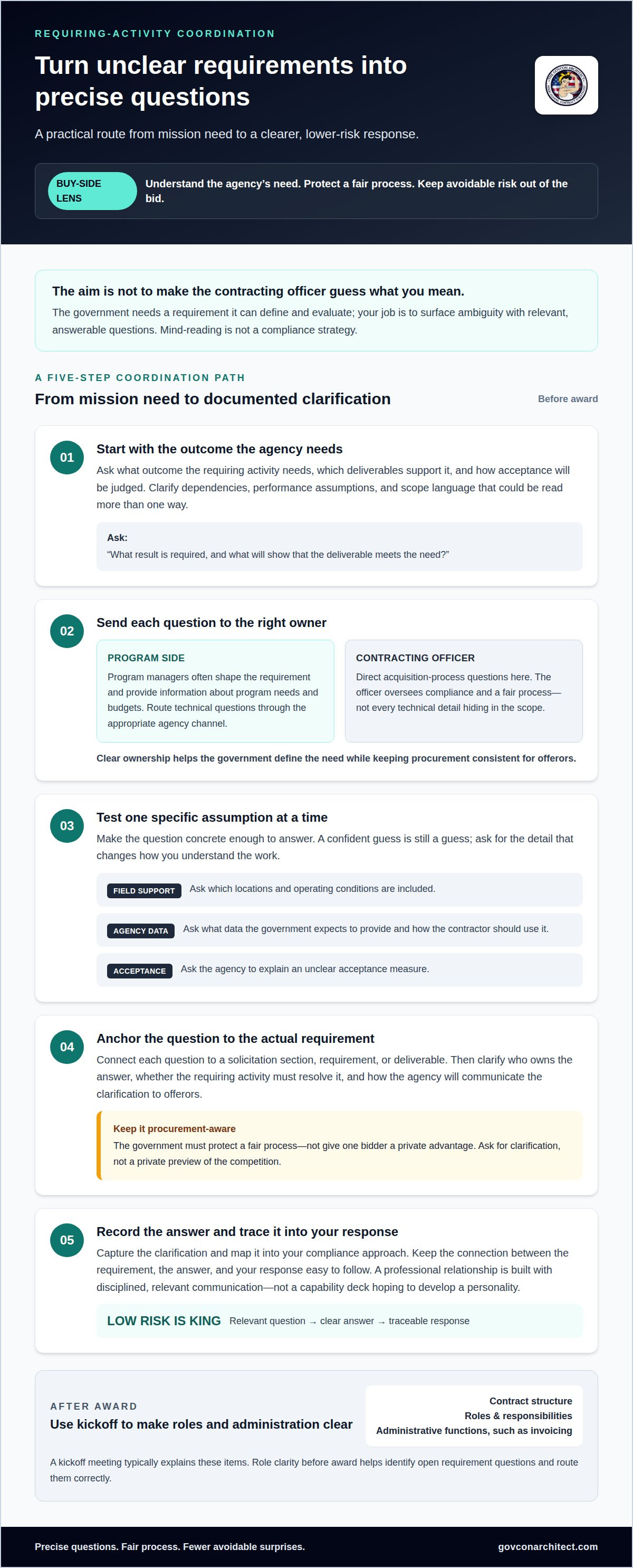
For solicitation requirements and scope, ask what outcome the requiring activity needs, which deliverables support it, and how acceptance will be judged. Clarify dependencies, performance assumptions, and any scope language open to different interpretations. These questions help distinguish the agency’s mission need from the contract’s administrative process.
Program managers often shape the requirement and provide information about program needs and budgets. Contracting officers oversee compliance and a fair process. Direct technical questions to the program side through the appropriate agency channel, and direct acquisition-process questions to the contracting officer. This division helps the government define the need while protecting a consistent procurement.
Make each question test a specific assumption. If the scope calls for field support, ask which locations and operating conditions it covers. If the work depends on agency-furnished data, ask what data the government expects to provide and how the contractor should use it. If a deliverable has an unclear acceptance measure, ask the agency to explain the standard. Don’t ask the contracting officer to invent technical details on the spot. Unclear requirements call for precise answers, not confident guesses.
For a useful coordination effort, connect each question to a solicitation section, requirement, or deliverable. Ask who owns the answer, whether the requiring activity must resolve it, and how the agency will communicate the clarification to offerors. Record the response and trace it into your compliance approach. A professional relationship with a contracting officer comes from disciplined, relevant communication, not from sending a capability deck and hoping it develops a personality.
After award, a kickoff meeting typically explains contract structure, roles, responsibilities, and administrative functions such as invoicing. Before award, use the same role clarity to identify open requirement questions and route them correctly. If agency coordination is part of your federal-market entry effort, map a lower-risk agency strategy before committing proposal resources.
3. Pre-solicitation communications and procurement integrity
A contracting officer holds a warrant authorizing negotiation on behalf of the United States Government. Only federal contracting officers may execute, modify, or terminate contracts for the government. Before a solicitation, ask who owns the requirement, what information the agency can share, and how it will keep exchanges fair. Procurement integrity doesn’t prohibit communication. It guards against giving one potential offeror an advantage.
Government officials can generally meet one-on-one with potential offerors if they provide no preferential treatment, according to a 2011 memorandum from the Office of Management and Budget’s Office of Federal Procurement Policy. Use those conversations to understand agency needs, not to fish for a private preview of the proposal competition. Ask whether the agency welcomes capability input, what channel it prefers, and whether it plans an RFI, market survey, or sources-sought notice.
Formal market-research responses matter. Agencies save RFI, market-survey, and sources-sought submissions in the procurement file. They may use them to assess capability and whether a small-business set-aside is appropriate. A focused RFI response connects your capabilities to the agency’s stated need. It shouldn’t read like a brochure that escaped its folder.
Ask whether evaluation factors are available and where the solicitation explains them. A contracting officer can clarify published criteria and point you to the controlling solicitation language. The officer cannot provide private scoring guidance that gives your proposal an edge. If acquisition information needed to prepare proposals is disclosed to potential offerors, the FAR says it must be made public as soon as practicable to avoid unfair advantage. Ask how the agency will share clarifications with all offerors.
Before outreach, research the agency’s mission, buying patterns, schedules, recompetes, and relevant contract vehicles. Check public information first. When appropriate, send capability statements to a small-business office or program manager rather than treating the contracting officer as a general inbox. Don’t draft specifications for a future procurement as contract work: that can create an organizational conflict of interest and bar your firm from competing. Clear boundaries protect both the agency and your bid.
4. Asking questions outside the formal period
The formal Q&A deadline isn’t a force field. After a solicitation is released, the contracting officer is the focal point for exchanges with potential offerors. You can ask questions after the stated period, but the agency must preserve fair treatment and equal opportunities for offerors to revise or fix proposals.
For deadlines, amendments, and submission rules, identify the solicitation section or amendment number, then ask for clarification in writing. Ask whether an amendment changes the due date, submission method, file requirements, or another instruction. Don’t rely on an informal conversation to override written solicitation terms. The government needs a defensible process, and your proposal needs a clear record.
For questions about pricing, payment terms, and funding, point to the relevant contract language. Ask how the agency expects offerors to structure pricing, which payment terms apply, and what funding information the solicitation provides. If the documents conflict or leave an assumption unclear, describe the specific discrepancy and ask the contracting officer to clarify it through the appropriate channel. Avoid requesting confidential budget details.
For contract type, period of performance, and options, ask which provisions control and how the agency expects the work to proceed. If an option period or performance date appears inconsistent across documents, cite both locations. Ask whether the agency will issue an amendment or another formal clarification. Specific references are more useful than “Can you explain the whole thing?” That question covers a lot, but lacks focus.
During an active federal solicitation, keep communication concise, professional, and tied to the procurement. Use the designated contact method, identify the opportunity, and ask one issue at a time. If you’re waiting for a proposal decision, ask whether evaluation is ongoing and whether the agency has an estimated completion time. Keep a copy of the exchange with your proposal records. No backchannel theatrics; clean communication lowers risk for everyone.
The GovCon Architect
The GovCon Architect helps commercial firms interpret federal buying decisions and prepare to compete as low-risk, compliant bidders. Turn to the firm when an opportunity looks promising but agency priorities, solicitation requirements, or your communication strategy remain unclear. Asking better questions matters, as does understanding what the government is protecting: a fair process, a defensible award, and a solution that meets its mission.
Through strategic and pursuit-focused support, The GovCon Architect helps you connect agency needs to your capture and proposal decisions. The goal isn’t more outreach for its own sake. It’s sharper positioning, fewer avoidable assumptions, and a bid the government can assess with confidence.
Contact The GovCon Architect to discuss your federal contracting strategy.
Turn better questions into a stronger bid
A useful exchange with a contracting officer should sharpen your next decision, not create another email thread. Use what you learn to assess whether the opportunity fits your capabilities, where your proposal carries risk, and what evidence the government needs to trust your approach. The strongest questions to ask the contracting officer connect directly to a disciplined bid decision.
GovCon Architect helps commercial firms make that connection through Fractional Federal Strategy Advisor: Monthly Retainer Support, Capture & Proposal Sprint...Win that Bid, and Break Into the Federal Market...Without Guessing. The right support depends on whether you need ongoing strategy, help with a specific pursuit, or a structured path into federal contracting. No magic words, just a clearer view of the buy-side and a more defensible next move.
Bring your opportunity, your open questions, and your current thinking. A sharper plan starts there.
Frequently Asked Questions
What questions should a contractor ask a contracting officer before bidding on a federal contract?
Ask questions that expose bid assumptions your team can’t resolve from the solicitation. Useful questions for the contracting officer include whether an apparent inconsistency affects the required deliverable, whether a stated dependency is the government’s responsibility, and how the agency will communicate a material clarification. Then decide internally whether the answers change your staffing, delivery approach, or go/no-go decision. Don’t mistake a government clarification for a reason to bid.
What should I ask the contracting officer about contract changes, disputes, and termination?
Ask how the agency will document direction that affects scope, schedule, or cost, and which contract terms govern notices and approvals. Keep written instructions, performance records, and cost support together. For termination, clarify whether the action is for convenience or default and what response process applies. A convenience termination may allow recovery of allowable costs and certain settlement expenses, while unperformed work generally does not generate lost profits. Default can carry additional financial and performance risks.