

Building Relationships With Contracting Officers: A Buy-Side Reality Check

Article by
Nikki Gianni
Nikki Gianni is a seasoned business strategist and government contracts coach, dedicated to helping businesses successfully navigate the complexities of government contracting. With over 22 years of experience in Department of Defense contracting, including managing $20 billion in federal awards, Nikki has developed the innovative GovReady Blueprint™ Framework, a comprehensive 90-day program designed to prepare businesses to compete for and win lucrative contracts at the federal, state, and local levels. Nikki's approach emphasizes not just gaining contracts but also enhancing overall business profitability.
Before becoming a business owner, Nikki was active-duty Air Force for 10 years, then spent another 15 years as a civil servant with the DOD. Now she's an empty nester living in Southern California who loves spending time with her 22-year-old son, Lex and her 2 Mini Aussies, Tony & Carmela, doing home improvement and crafts projects, and networking.
Contracting Officers don’t want to be your friend. They don't want to grab coffee, and they definitely don’t care about your "disruptive" vision board. Most contractors treat building relationships with contracting officers like a high school popularity contest, but the buy-side doesn't operate on vibes. It operates on the clinical avoidance of a GAO protest. If you feel ignored by federal agencies or you’re tired of burning thousands on proposals that get disqualified before the first round of evaluations, it's because you look like a liability. You’re a risky stranger in a system designed to reward stability, and that is a recipe for a very expensive headache.
It’s exhausting to play a game where the rules seem to change every time you get close to the finish line. We understand the frustration of staring at a "not selected" notice after weeks of late nights. This article promises to show you how to move from being a gamble to becoming a defensible solution by understanding the mechanics of buy-side risk evaluation. We’ll provide a clear roadmap for agency engagement that turns you into a low-risk option. By the end, you’ll see exactly how to use strategic capture to increase your win rate and stop guessing what the government actually wants.
Key Takeaways
Shift your mindset from selling features to providing risk mitigation. A Contracting Officer’s biggest priority is a "Quiet Life" where no one protests their award or makes them look bad to their superiors.
Learn the tactical timing for building relationships with contracting officers during the Market Research Phase. This is the golden window to influence requirements before the "Cone of Silence" shuts you out.
Stop wandering through generic networking events like a lost puppy. Use historical spending data to identify high-probability buyers who already have an appetite for your specific delivery model.
Rebuild your capability statement to focus on buy-side mechanics. You need to ensure your firm looks like a defensible, low-risk solution in the eyes of an evaluator who is looking for reasons to disqualify you.
Understand the logic behind government behavior so you can stop guessing. Moving from a "risky stranger" to a "defensible solution" is the only way to systematically increase your win rate.
Table of Contents
The Buy-Side Mechanics: What Contracting Officers Actually Want
Building a Contract-Ready Business with The GovCon Architect
Why Most GovCon Networking is a High-Risk Waste of Time
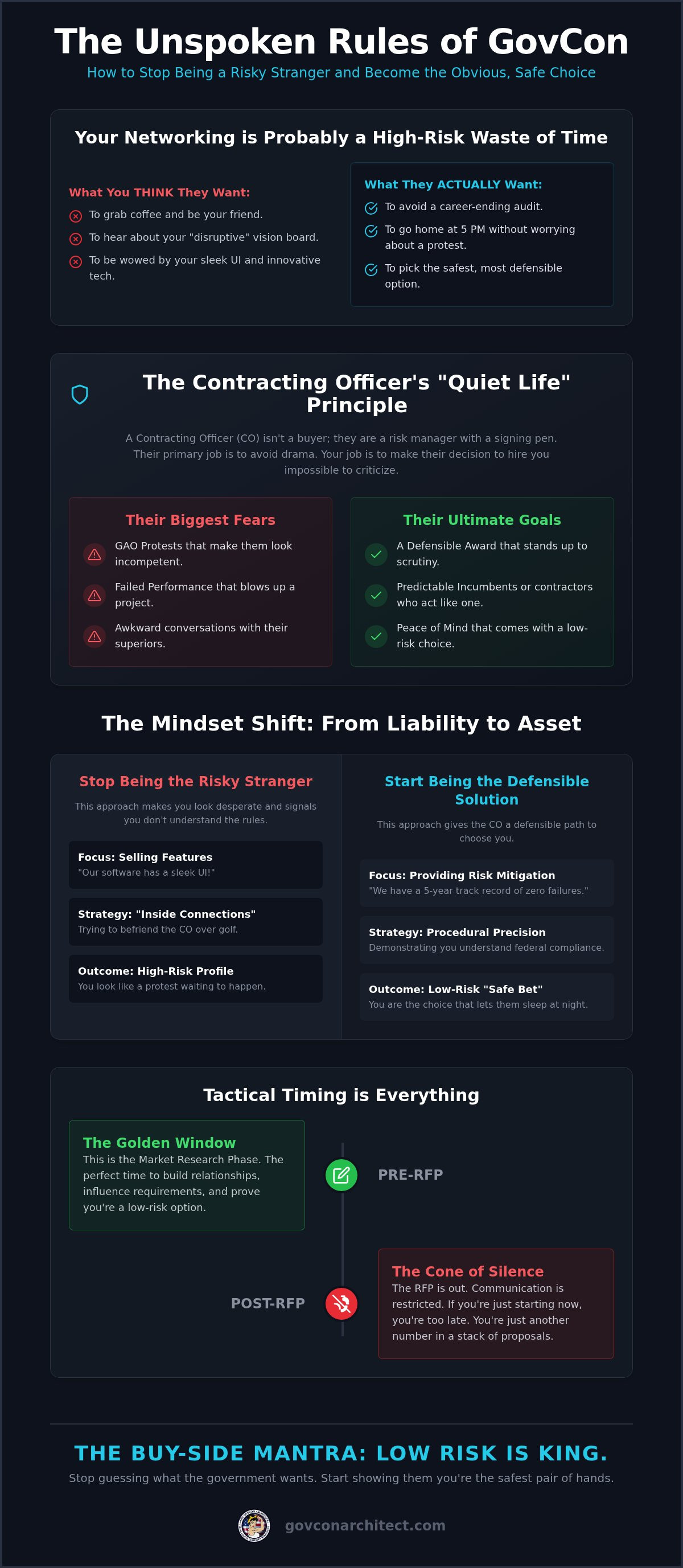
Networking in the federal space is often a masterclass in wasted motion. You’ve been told to "get out there" and "be seen," but here is the reality check: if you show up with the wrong approach, you aren't building a bridge; you’re building a dossier of reasons to ignore you. To a Contracting Officer, traditional sales tactics like cold calling or feature-pitching aren't just annoying. They’re red flags. These tactics signal that you don’t understand the Buy-Side. The CO's primary job isn't actually buying things. It is risk mitigation.
A Contracting Officer is a risk manager with a signing pen. They don't care that your software has a sleek UI or that your construction crew uses "innovative" techniques. They care that you won't default on the contract and trigger a career-ending audit. Many firms fall into the "Bad Advice" trap, thinking that a specific certification is a golden ticket to trust. It isn't. Trust is built on the clinical reality of your delivery, not a sticker on your website. building relationships with contracting officers isn't about being liked; it's about being safe.
The Risk Evaluation Reality Check
COs fear protests and failed performance far more than they desire "innovation." Every interaction you have either adds to or subtracts from your risk profile. If you sound like a desperate salesperson, you look like a protest risk. Successful building relationships with contracting officers requires you to provide a defensible path for them to choose you. You want to be the "safe" choice that allows them to go home at 5 PM without worrying about a legal challenge or a failed project. In this world, low risk is king, and your personality is a distant second to your performance data.
The Myth of the "Inside Connection"
"Who you know" is the most overused phrase in GovCon. In this high-stakes environment, what they can defend in the contract file matters infinitely more than your golf handicap. For established commercial firms with $5M+ in revenue and at least five years of delivery, the goal isn't to be the CO's best friend. It is to build a reputation for stability and procedural precision. At The GovCon Architect, we teach you to prioritize structural integrity over personality because we want you to actually win. If you want to stop guessing and start winning, you need a strategy that prioritizes how you win through systematic risk reduction.
The Buy-Side Mechanics: What Contracting Officers Actually Want
The government doesn't buy your services because they like your personality or your "disruptive" vision. They buy because they trust you won't blow up their afternoon. Contracting Officers (COs) are governed by the "Quiet Life" Principle. Their goal is to award a contract that results in zero protests, zero performance failures, and zero awkward conversations with their superiors. When people on social media claim the government only cares about the lowest bid, they’re usually showing you their own ignorance. In complex professional services and construction, the Buy-Side prioritizes a defensible trade-off over a bargain-basement price every single day.
Predictability is a currency in federal procurement. If you are an established commercial firm with over five years of delivery experience, you already possess what the CO craves: a track record of stability. The reason COs stick with incumbents isn't a shadowy conspiracy. It is a survival instinct. An incumbent represents a known quantity with a low probability of failure. To break that cycle, building relationships with contracting officers requires you to prove that you are an even safer bet than the status quo.
Becoming a Low-Risk Bidder
You must align your commercial success with federal evaluation criteria long before the RFP hits the street. This means demonstrating "Contract-Readiness" by showing you understand the administrative burden of a federal project. You aren't just selling a solution; you are selling the peace of mind that comes with compliant reporting and stable logistics. If you want to dive deeper into these mechanics, check out our Winning Federal Contracts: Insider Risk-Mitigation Guide for a breakdown of how to audit your own risk profile.
The Defensible File Strategy
Every decision a CO makes must be documented in an official contract file that can withstand a legal challenge. You can help them by providing high-quality market research and white papers that justify a specific acquisition strategy. When you focus on building relationships with government buyers through technical influence, your insights often become the foundation of their formal record. This isn't about "getting an inside track." It's about providing the data they need to defend choosing you as the most reliable option. If your current strategy feels more like guessing than architecture, you might need to rethink your approach with a professional briefing.
Timing the Engagement: Navigating the Procurement Lifecycle
Timing isn't just everything; in federal contracting, it's the difference between a strategic partnership and a legal restraining order. Most firms treat building relationships with contracting officers like a 24/7 open door policy. It isn't. There are specific legal windows where a CO is desperate for your input and other times when answering your email could literally cost them their job. If you show up late to the party, don't be surprised when the door is locked and the "Cone of Silence" is in full effect.
The Market Research Phase is your golden window. This is the period before a solicitation is finalized when the government is actively trying to figure out if the private sector can actually solve their problem. During this time, COs are encouraged to engage with industry. Once that solicitation hits the street, however, the shutters come down. They stop taking your calls because they have to maintain complete impartiality. If you haven't built the relationship before the RFP drops, you're just another risky stranger in a pile of paper. A 30-day shortcut to a relationship doesn't exist in this world; it's a marathon, not a sprint.
Responding to Sources Sought and RFIs
Requests for Information (RFIs) are the most overlooked relationship-building tools in your arsenal. Most contractors treat them like annoying homework, but the Buy-Side uses them to decide if a project should be a small business set-aside or full and open competition. When you write a response that highlights your specific technical strengths, you are helping the CO shape the final RFP. You want to make it easy for them to justify a requirement that aligns with your capabilities. For a deeper look at how they grade these efforts, read our guide on Government Bid Evaluation Criteria: The Buy-Side Reality Check.
The Industry Day Protocol
Industry Days are often a sea of amateurs passing out business cards like they’re flyers for a nightclub. As a firm with $5M+ in revenue, you need to stand out by acting like you’ve been there before. Ask questions that signal you understand their mission and their specific risks. Instead of asking "How do I win?", ask "How can we help you mitigate the transition risk from the incumbent?" That shift in perspective shows you care about their "Quiet Life." It’s a sarcastic but kind reality check: they don't want a vendor; they want a partner who won't make them look incompetent. True relationships are solidified post-award through flawless performance, proving that the CO was right to trust you in the first place.
Tactical Agency Engagement for Commercial Firms
Random acts of networking are for startups with nothing to lose. For a firm with $5M+ in revenue, your time is too expensive for aimless handshaking at generic conferences. Building relationships with contracting officers requires a surgical approach rooted in hard data. Step one is identifying the "right" COs. Don't guess based on a LinkedIn post. Use historical spending data to find the specific individuals who actually sign contracts for what you sell. If a CO hasn't touched your NAICS code in three years, they aren't a prospect; they’re a distraction.
Step two is ditching your standard commercial marketing deck. You need a "Buy-Side" Capability Statement. This document shouldn't just list your features. It should scream risk mitigation. Focus on your 5+ years of delivery and your commercial stability. Step three: stop the "just checking in" emails. If you aren't providing strategic value, like market research or a technical briefing, you’re just being a pest. Finally, leverage your past commercial performance. Your success in the private sector is the bridge that spans the federal trust gap, proving you won't collapse under the weight of a government project.
The Capability Briefing: A High-Level Briefing, Not a Pitch
A capability briefing is an elite insider's move, not a sales pitch. Structure the meeting to address the agency’s specific pain points and motivations. You are there to provide a clinical analysis of how you can make their life easier. Whatever you do, never ask, "What do you have for me?" It’s the fastest way to signal you’re a "risky stranger" looking for a handout. Instead, show them you understand their mission and their risks. If you want to refine this process, learn how to systematically improve your federal contract win rate through structured engagement.
Managing the Long-Term Capture Pipeline
Relationship building is a slow burn. It usually takes 6 to 12 months of consistent, high-value interaction to see optimum results. You need to track agency signals and recompete intel to time your outreach perfectly. This isn't something you do off the side of your desk. Many successful firms utilize a Fractional Federal Strategy Advisor to maintain this momentum. This ensures your pipeline stays full of defensible opportunities while you focus on delivery. We care about your growth, which is why we insist on a strategy that values logic over hope. Low risk is king, and a well-managed pipeline is how you wear the crown.
Schedule a strategic briefing to align your capture pipeline
Building a Contract-Ready Business with The GovCon Architect
Stop chasing participation trophies in the federal market. If your current plan for building relationships with contracting officers relies on a new certification and a prayer, you’re already lost in the black hole. We don't do hope here. We do architecture. The GovCon Architect provides the clinical, buy-side precision necessary to turn your commercial success into a defensible federal pipeline. Our Fractional Federal Strategy Advisor retainer isn't just another monthly bill. It is a $3,500 per month investment in structural integrity. We strip away the marketing fluff and replace it with a strategy that actually survives an evaluator’s scrutiny because, in this game, low risk is king.
We see too many firms with $5M+ in revenue wasting their talent on proposals that never had a chance. They get bad advice from "gurus" who have never sat on the buy-side of the table. We’re here to fix that. By focusing on how the government actually evaluates value, we help you move from being a "risky stranger" to a "defensible solution." This isn't about a 30-day shortcut. It is about building a business with The GovCon Architect that is structurally incapable of being ignored by the agencies that need your expertise.
Strategy, Structure, and Confidence
Success in GovCon requires a rhythm, not a random burst of energy. Our engagement includes weekly working sessions and monthly executive strategy reviews to keep your capture efforts on track. We implement rigorous Go/No-Go gate decisions. This process saves you from burning resources on building relationships with contracting officers who aren't actually buying or chasing contracts you aren't positioned to win. We specialize in helping established firms in Construction, IT, Engineering, and Staffing translate their commercial dominance into federal wins through methodical, clinical execution.
Your Next Strategic Move
We are blunt because we care about your bottom line. The GovCon Architect does not work with pre-revenue firms or those seeking a 30-day miracle fix. Real federal success requires a 3-month minimum commitment to transition your firm from commercial delivery to federal "contract-readiness." If you have 5+ years of experience and are ready to stop guessing and start winning, it’s time to change your approach. We provide the roadmap; you provide the delivery. It’s time to build something defensible.
Break Into the Federal Market...Without Guessing
Stop Guessing and Start Architecting Your Wins
Stop treating the federal government like a high school talent show. You don't win because you're the most popular; you win because you're the least likely firm to ruin a Contracting Officer's weekend. Successful building relationships with contracting officers requires a clinical shift from a "sales pitch" to a "risk mitigation" strategy. We've analyzed the mechanics of the Buy-Side, the legal windows of the procurement lifecycle, and why your commercial success is your greatest asset in proving that low risk is king.
You've worked hard to build a firm with $5M+ in revenue. Don't let that momentum die in a federal black hole because you followed generic, low-level advice. At The GovCon Architect, we leverage 22 years of buy-side acquisition experience to help established firms create defensible, risk-aware positioning. We know the system is complex, but it's also beatable when you stop guessing. It's time to build a business that evaluators can't find a reason to disqualify. You have the delivery expertise; now it's time to add the strategic architecture.
Start Your Fractional Federal Strategy Retainer for $3,500/month
The path to federal success is paved with logic, not hope. We're here to help you navigate the high stakes with strategic confidence and a much-needed reality check. Let's get to work.
Frequently Asked Questions
Can I talk to a Contracting Officer before an RFP is released?
Yes, and you absolutely should if you want to stop being a risky stranger. The Market Research phase is the only time building relationships with contracting officers is legally encouraged without the heavy restrictions of a live solicitation. This is your window to provide technical insights and shape the requirements to favor your firm's strengths. Once that RFP drops, the shutters come down, and they'll stop taking your calls to maintain impartiality.
What is the best way to introduce my firm to a new federal agency?
Stop cold calling and start using historical spending data to find the specific CO who actually signs checks for your NAICS code. A clinical, data-driven introduction that highlights your 5+ years of delivery and commercial stability beats a generic sales pitch every time. Focus on their mission-critical pain points and demonstrate that you understand the Buy-Side mechanics. You want to look like a defensible solution, not a desperate vendor looking for a handout.
Do I need a "Capability Statement" to build relationships with COs?
You need a document that justifies you as a low-risk option, but stay away from those generic templates you found on Google. While a capability statement is a standard requirement, it must be structured as a high-level briefing that focuses on risk mitigation and structural integrity. We don't provide templates here; we provide the strategy to ensure your document actually survives an evaluator's scrutiny. It’s about clinical analysis, not flowery marketing fluff.
How long does it typically take to build a relationship that leads to a win?
Real federal relationships typically take 6 to 12 months of consistent engagement to yield optimum results. Forget the 30-day shortcut nonsense that "gurus" try to sell you. You are building a long-term revenue channel, not ordering a pizza. For established firms with $5M+ in revenue, this process requires a methodical commitment to moving through the procurement lifecycle. It’s a marathon where the most stable and predictable firms eventually cross the finish line.
What should I do if a Contracting Officer stops responding to my emails?
Don't take it personally and definitely stop being a pest. They probably aren't ghosting you; they are likely buried in a blackout period or you haven't provided enough strategic value to warrant a response. Pivot your strategy to sending high-value market research or technical insights that help them build a defensible contract file. If you aren't making their life easier or their file safer, you are just background noise in their inbox.
Is attending industry days actually worth the time for commercial firms?
Industry days are only worth the effort if you stop acting like an amateur and start acting like a strategist. Use these events to ask pointed questions about transition risks and mission hurdles that signal your deep understanding of the Buy-Side. It’s a chance to stand out as a serious, $5M+ firm in a room full of people who just got certified yesterday. If you can't provide a clinical perspective on their risks, stay home.
How does a Fractional Federal Strategy Advisor help with relationship building?
We turn your random acts of networking into a clinical, repeatable strategy for building relationships with contracting officers. Our $3,500 per month retainer provides the structure you need through weekly working sessions and quarterly pipeline assessments. We manage the capture momentum and help you make tough Go/No-Go decisions so you don't waste time on dead-end leads. It’s about having a seasoned strategist ensure your firm remains the "low-risk" king in every interaction.
Why do Contracting Officers seem so risk-averse compared to commercial buyers?
In the commercial world, a bad buy might cost some profit, but in the federal world, a bad buy can trigger a GAO protest or an audit. COs are stewards of public funds and their primary goal is a "Quiet Life" where no one challenges their decisions. They stick with incumbents and known quantities because it’s the safest path for their career. To win, you must prove that hiring you is a defensible, low-risk move.