
How to Write a Past Performance Volume by Selecting Section B Questions

Article by
Nikki Gianni
Nikki Gianni is a seasoned business strategist and government contracts coach, dedicated to helping businesses successfully navigate the complexities of government contracting. With over 22 years of experience in Department of Defense contracting, including managing $20 billion in federal awards, Nikki has developed the innovative GovReady Blueprint™ Framework, a comprehensive 90-day program designed to prepare businesses to compete for and win lucrative contracts at the federal, state, and local levels. Nikki's approach emphasizes not just gaining contracts but also enhancing overall business profitability.
Before becoming a business owner, Nikki was active-duty Air Force for 10 years, then spent another 15 years as a civil servant with the DOD. Now she's an empty nester living in Southern California who loves spending time with her 22-year-old son, Lex and her 2 Mini Aussies, Tony & Carmela, doing home improvement and crafts projects, and networking.
A past performance volume isn’t a scrapbook of projects. It is evidence organized for the government’s evaluation. Knowing how to write a past performance volume starts with following the solicitation’s Section B instructions and selecting projects that let evaluators assess relevant, verifiable performance. Include everything indiscriminately, and you risk burying the strongest proof.
Treat project selection as a strategic decision. The government is assessing risk, not rewarding sheer volume or confident adjectives. A strong response connects the requirement to credible examples and presents performance clearly, without stretching the facts or crossing ethical lines.
This article explains how to prioritize Section B requirements, map supporting evidence to them, and handle sensitive or uncertain information carefully. You’ll also learn what makes a finished volume useful and what information your team needs to provide. The goal is simple: make relevant proof easy to evaluate, keep every claim defensible, and avoid introducing unnecessary risk.
Key Takeaways
- Put Section B questions that show relevant performance and manage risk first; not every prompt deserves equal billing.
- Build project descriptions with clear, supportable details showing what you delivered and the role your team played. No mystery, no fluff.
- Show relevance by connecting past work to the solicitation’s scope, size, and complexity, the closer the fit, the lower the risk.
- Back performance results with meaningful metrics, and keep every claim accurate, defensible, and easy for evaluators to assess. Buy-side confidence starts with proof.
3. What information should a professionally prepared past performance volume include?
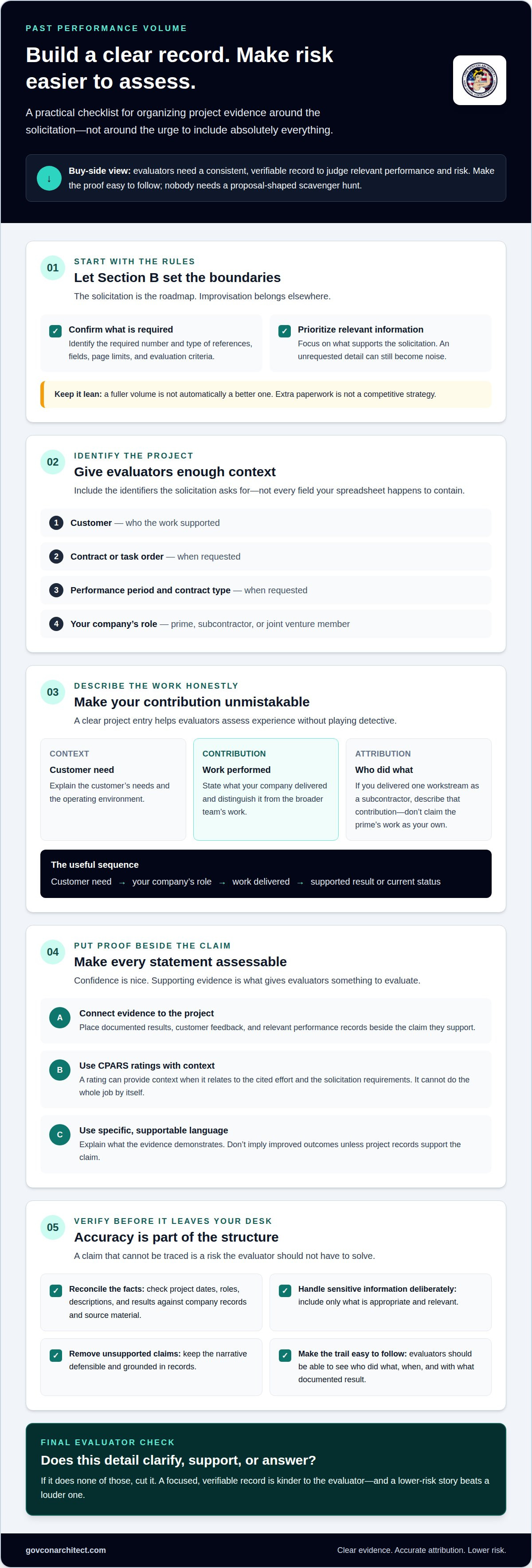
Start with the solicitation’s Section B instructions. They’re the roadmap; improvising is a fine hobby, but not a winning proposal strategy. Evaluators need a clear, consistent record, not a stack of unrelated project summaries. Identify the required number and type of references, fields, page limits, and evaluation criteria. Focus on information relevant to the solicitation. Even a useful detail can become noise if the solicitation didn’t ask for it. Keep the Buy-Side in mind: make the evaluator’s job easier and the risk picture clearer.
Each project entry should include the identifiers and context needed to understand the work. Depending on the solicitation, that may include the customer, contract or task order, performance period, contract type, and your company’s role. State whether the work was performed as a prime contractor, subcontractor, or joint venture member. If a field isn’t requested, leave it out; a fuller volume isn’t automatically a better one, and nobody needs extra paperwork for sport.
Explain the work performed, the operating environment, and the customer’s needs. Distinguish your company’s responsibilities from the broader team’s work. For example, if your company delivered one workstream as a subcontractor, describe that contribution accurately rather than implying the prime performed everything. Honest, clear attribution helps evaluators assess experience without playing detective, and gives them a more dependable basis for judging risk.
Put performance evidence beside the claim it supports. Connect documented results, customer feedback, and relevant performance records to the specific project. For example, CPARS ratings can provide context when they relate to the cited effort and solicitation requirements. Explain what the evidence demonstrates; a rating or a confident adjective can’t do the whole job, charming as that would be.
Accuracy is a structural requirement, not merely a final proofreading concern. Reconcile project dates, roles, descriptions, and results against company records and other source material. Handle confidential or sensitive information deliberately, and remove unsupported claims. Evaluators should be able to trace each statement to a specific project and supporting record without guessing who did what, when, or with what result. Make the trail easy to follow: that’s kinder to the evaluator and better for your low-risk story.
4. How does a proposal professional write a past performance project description?
A strong project description gives evaluators a fast, accurate picture, no fog machine required. Start with the customer’s need, then explain your company’s role and the work it delivered. For example, a logistics support project might involve coordinating deliveries across operating locations. Make clear what your company handled, rather than what the customer or teammates did. Those crisp boundaries help evaluators assess the evidence without guessing, and knowing how to write a past performance volume means making them unmistakable.
Translate technical activity into language tied to the solicitation. “Provided systems support” tells evaluators little; it’s a vague little shrug in sentence form. A clearer description identifies the supported function, users, and operational purpose, using details the project records substantiate. Keep necessary technical terms, but explain or remove internal shorthand. Evaluators need assessable evidence, not a decoder ring, and giving them clear evidence is simply good manners.
Give each project description a clear sequence: connect the customer’s challenge to the work performed, then explain the result or current status. For example, if your company maintained a service desk, describe its support process and operational purpose. Don’t imply improved response or customer outcomes unless records support that claim. Low risk is king: careful, supportable language protects your credibility and helps evaluators trust what they read. That discipline is central to writing a past performance volume evaluators can trust.
Use source material carefully. Reconcile the narrative with project documentation and input from the people responsible for delivery. If a project involved a prime contractor and subcontractors, distinguish each party’s contribution. If responsibilities changed during performance, explain the relevant roles without blurring who did what. The government needs a clear basis for its decision, and this precision reduces uncertainty for evaluators. Everyone wins; nobody has to play detective.
The final edit tests every sentence against the solicitation: does it clarify the project, establish the company’s contribution, or support an evaluation point? If not, cut it, your evaluators have enough to read already. A focused description makes review easier and keeps unsupported claims out of the proposal. For a deeper look at how evaluators interpret these records, explore this buy-side past performance strategy. If a proposal needs professional drafting support, discuss project-description support.
3. How does a proposal professional demonstrate relevance to the solicitation's scope, size, and complexity?
Compare each reference with the solicitation’s actual work, not its impressive-sounding title. Identify overlapping functions, deliverables, users, and operating conditions. If the solicitation seeks cybersecurity monitoring, a prior network-monitoring project may support relevance. But describe the services actually performed; similar labels aren’t magic words.
Size needs context. Identify the scale indicators that matter to the requirement, such as workload, staffing structure, geographic coverage, or supported locations. A project supporting a distributed workforce may show relevant operating scale for a solicitation with dispersed users. Explain the connection clearly. “Large project” is not evidence; specific, supportable context is. Buyers need proof, not a fog machine.
Complexity comes from the demands and dependencies within the work. Consider technical integration, stakeholder coordination, operational constraints, and the consequences of disruption. For example, connecting a customer’s legacy systems with a newer platform may demonstrate integration experience. Clarify your company’s role and the coordination the work required, no heroics-by-implication.
Connect the evidence directly to the solicitation’s evaluation language. If the requirement emphasizes continuity of operations, explain how the cited project addressed continuity demands. If it emphasizes multiple stakeholders, identify the coordination responsibilities your company actually performed. This is an argument for relevance, not a claim that the projects are identical. The government is trying to assess risk, not award points for creative matching.
A disciplined comparison also reveals gaps. A prior project may match the technical scope but differ in operating environment or scale. State the meaningful overlap, explain the difference plainly, and don’t imply experience your company did not perform. Candid framing helps evaluators judge risk instead of decoding salesmanship. Low risk is king, and a risk-focused proposal keeps the comparison grounded in the buyer’s decision.
For a pursuit with several possible references, a proposal professional can rank examples by how directly they address the solicitation’s stated priorities. Get support aligning past performance to a proposal when that comparison needs focused, professional execution, because even a good story deserves a sharp, buyer-focused edit.
4. How does a proposal professional present performance results with measurable outcomes and metrics?
A metric belongs in the volume when it proves something the solicitation values. Map each result to a stated requirement, then show the evidence behind it, because buyers deserve proof, not a number pulled from a hat. For a service desk project, that might include ticket resolution time, backlog movement, or service-level performance. Don’t invent a figure to fill a table; nobody needs that kind of excitement. Every result needs a reliable record and clear context.
Context makes a metric meaningful. Explain the measurement period, the work covered, and your company’s role. A claim about on-time delivery means little without identifying the deliverables it describes. If a project included several workstreams, attribute results to the relevant workstream instead of blending everything into one flattering fog. The buyer needs a clear picture, not a magic trick.
A baseline comparison can show change, but only when records support both sides. For example, a project might document a reduced backlog after a revised workflow. Clarify what was measured before and after, what work your company performed, and which records support the change. If the evidence establishes only current performance, report that level without implying improvement. Honest, well-supported results are the low-risk play, and buyers notice.
Define each metric. “Availability” can mean different things across systems, and “on-time” depends on which delivery milestones are counted. Use the project’s established definitions and preserve the relevant scope. Don’t mix reporting periods or combine results from separate contracts, which can create a misleading comparison. Evaluators need credible evidence of delivery risk, not metric theater. Keep it clear, keep it grounded, and let the records do the flexing.
Check each result against source records and the solicitation’s evaluation language. If the buyer values schedule control, place schedule evidence near the relevant claim. If the requirement emphasizes quality, documented rework or defect measures may be more relevant. A structured proposal review can catch unsupported figures, unclear definitions, and claims that go beyond the evidence before submission. That protects the buyer from guesswork, and your team from an avoidable own goal.
The GovCon Architect
The GovCon Architect helps federal contractors shape past performance evidence around what the government actually evaluates. No need to make every project sound like it invented sliced bread. The goal is to show relevant experience, supportable results, and your company’s real role, so evaluators can assess risk without decoding proposal theater.
For a specific federal pursuit, GovCon Architect’s PER-PURSUIT · PROJECT - Capture & Proposal Sprint helps align your past performance volume with the solicitation. For ongoing capture and proposal decisions, RETAINER · MONTHLY - Fractional Federal Strategy Advisor provides continuing strategic guidance. The right fit depends on whether you need help with one bid or your broader federal strategy. No pressure to buy the whole toolbox if you only need one wrench.
Bring the solicitation and project evidence to a discussion with GovCon Architect. They’ll help clarify which experience belongs in the volume and how to present it accurately, because low risk is king, and evaluators have enough riddles to solve already. Book a strategy call to discuss your federal proposal needs.
Make the Next Pursuit More Defensible
A past performance volume shouldn’t be treated as a one-time document. Evidence gathered for one proposal can inform future capture decisions, reveal experience gaps, and help your team assess which opportunities fit its record. That’s how knowing how to write a past performance volume becomes part of a disciplined pursuit strategy, rather than another deadline-driven scramble.
After submission, preserve the source records behind every claim and note which examples best addressed the solicitation. That gives your team a stronger starting point for the next bid. A clear record and careful judgment can also spare you a last-minute search through old project files.
If you want experienced support shaping past performance evidence for a federal pursuit, take the next step when it makes sense for your team.
Your experience has value, don’t make evaluators dig for it. Present it with the discipline they need to see, then head into the next opportunity with clarity, confidence, and fewer proposal-night fire drills. You’ve earned that.
Frequently Asked Questions
What is a past performance volume in a government proposal?
A past performance volume is the proposal section that gives the government evidence of an offeror’s prior work and execution record. It helps evaluators judge whether the company has delivered work relevant to their assessment of performance risk. For example, a proposal may include customer references or project records requested by the solicitation. The exact contents depend on its instructions, so follow them, not your inner improv artist.
How does a proposal professional select the best past performance references for a proposal?
Start with the solicitation’s reference rules, then compare eligible projects with its evaluation priorities. The strongest reference isn’t automatically the newest or largest; it’s the one that gives evaluators credible evidence relevant to the work being procured. For example, a smaller project with closely related operating demands may be more useful than a larger project with little connection to the requirement. Fit beats bragging rights, nice and low-risk.
How many past performance references should you include?
Include the number and type of references the solicitation requires. Select examples that best address its stated priorities. No bonus points for piling on extras.
How should contractors address negative past performance or performance problems?
Present performance information accurately, supporting claims with project records and relevant evidence. Explain meaningful gaps candidly, and remove unsupported claims rather than disguising problems. Own the facts; spin is a risky little gremlin.