

Understanding Federal IDIQ Contracts: How Awards, Orders, and Competition Work

Article by
Nikki Gianni
Nikki Gianni is a seasoned business strategist and government contracts coach, dedicated to helping businesses successfully navigate the complexities of government contracting. With over 22 years of experience in Department of Defense contracting, including managing $20 billion in federal awards, Nikki has developed the innovative GovReady Blueprint™ Framework, a comprehensive 90-day program designed to prepare businesses to compete for and win lucrative contracts at the federal, state, and local levels. Nikki's approach emphasizes not just gaining contracts but also enhancing overall business profitability.
Before becoming a business owner, Nikki was active-duty Air Force for 10 years, then spent another 15 years as a civil servant with the DOD. Now she's an empty nester living in Southern California who loves spending time with her 22-year-old son, Lex and her 2 Mini Aussies, Tony & Carmela, doing home improvement and crafts projects, and networking.
An IDIQ award can look like a pipeline. It isn’t. Understanding federal IDIQ contracts means separating access to compete from funded work: a place on the vehicle does not guarantee a single order. The ceiling value may look impressive on a slide. It still isn’t revenue. The government does not issue bonus checks for being on the roster.
If the terms and order mechanics feel murky, that’s understandable. The government uses IDIQs to establish a pool of contractors and a framework for ordering work as needs arise. Your real test is each order: fit, compliance, credible delivery, and whether the pursuit justifies the resources. This guide explains what an IDIQ award does, how task-order opportunities work, and what to assess before committing your team. The goal isn’t to chase every notice. It’s to make disciplined, buy-side-informed decisions about where your firm can compete with low risk and a defensible offer.
Key Takeaways
- Understanding federal IDIQ contracts starts with recognizing the vehicle as a framework for future orders, not a promise of a specific workload.
- Compare single-award and multiple-award structures to see where order competition happens and what that means for planning.
- Screen each task order for requirement fit, compliance, competitive position, delivery capacity, and pursuit cost before committing resources.
- Map evaluation factors to verifiable evidence, then use pipeline qualification and proposal readiness to focus on orders your firm can pursue credibly.
What Is an IDIQ Contract? Understand the Vehicle Before You Pursue It
IDIQ means Indefinite Delivery, Indefinite Quantity. The government uses this contract structure when it needs a way to order work over time, but the exact timing or quantity may not be set upfront. For anyone focused on understanding federal IDIQ contracts, the key distinction is simple: the award establishes a framework for future orders under stated contract terms. It does not, by itself, mean the agency will buy up to the ceiling.
An IDIQ vehicle sets the terms and limits for potential future orders; the orders themselves define the work the government actually directs. That’s the reality check. A large ceiling may signal room for orders, not a revenue forecast or a promise of demand. The Indefinite Delivery/Indefinite Quantity (IDIQ) contracts overview provides foundational context, but the solicitation and contract control the specifics.
What do minimum, maximum, and ordering period mean?
The minimum is the floor stated in the contract. Read the language closely to understand what, if anything, the agency commits to order. The maximum, often described as a ceiling, is the contract’s upper limit, not a prediction that the agency will reach it. Commitments and limits vary by vehicle, so read the specific terms rather than importing assumptions from another award.
The ordering period identifies when orders may be placed under that vehicle, as specified in its terms. Check the solicitation and awarded contract for the exact period, limits, and wording. Keep confirmed work separate from potential future orders in your forecast. A headline ceiling is not a business plan. That’s how spreadsheets become fiction.
How do task orders differ from delivery orders?
A task order is for services. A delivery order is for supplies. A contract may use one term or both, so follow its terminology rather than assuming every vehicle handles orders the same way. Each order sets out the specific requirement being pursued; the vehicle provides the governing framework.
Once work is awarded, execution becomes the next risk-control challenge. A post-award action plan for government contracts helps organize the transition from award to delivery.
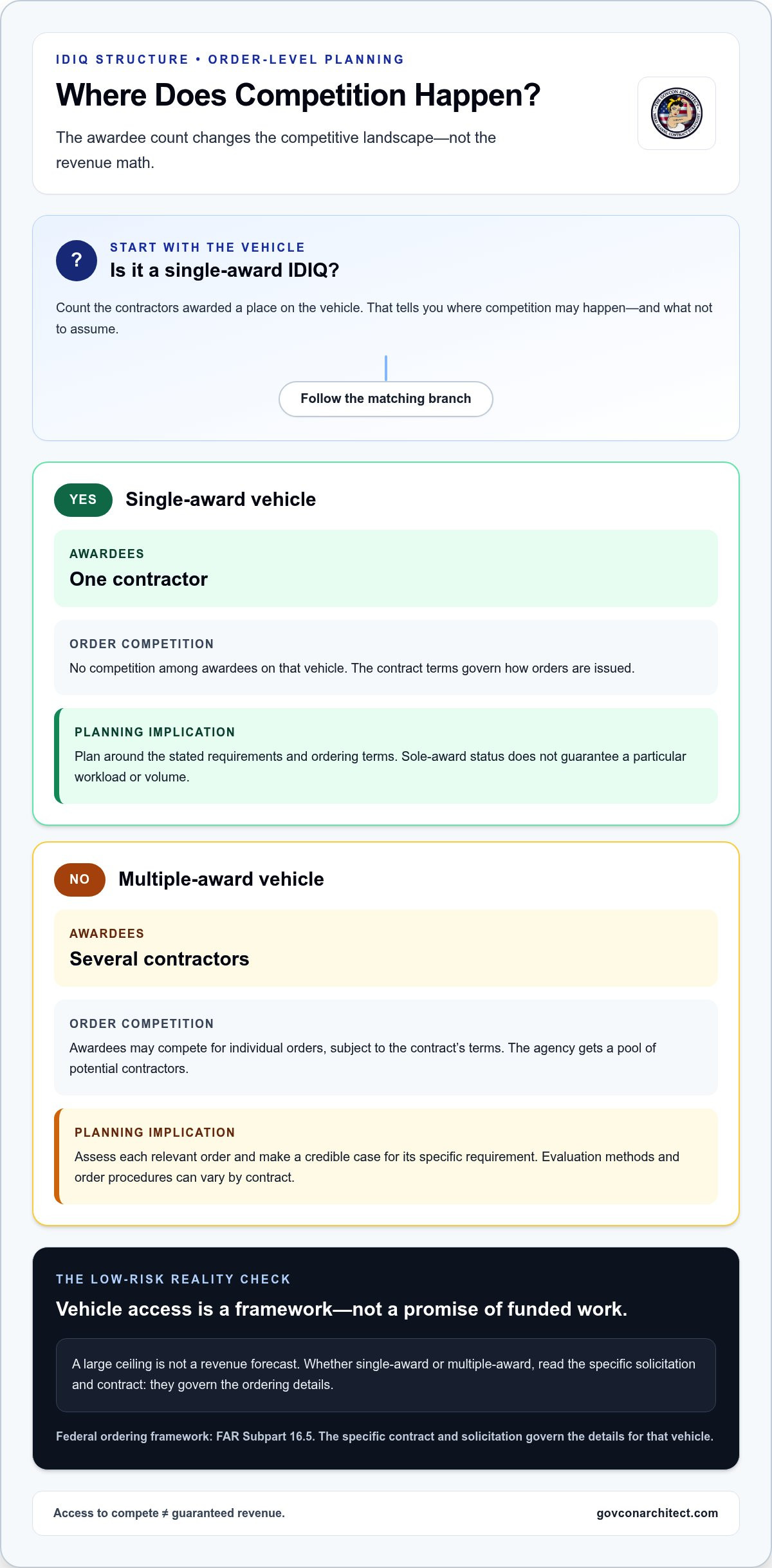
Single-Award vs. Multiple-Award IDIQ Contracts: Where Competition Happens
The number of awardees changes the competitive landscape, not the revenue math. A single-award vehicle has one contractor. A multiple-award vehicle has several. For the government, that structure affects how it can access contractors for future requirements. For your firm, it shapes where competition may occur and what pursuit planning needs to account for.
| Structure | Number of awardees | Likely order competition | Planning implication |
|---|---|---|---|
| Single-award | One | No competition among awardees on that vehicle, but the contract terms govern how orders are issued. | Plan for the stated requirements and ordering terms. Don’t assume a particular workload. |
| Multiple-award | Several | Awardees may compete for individual orders, subject to the contract’s terms. | Prepare to assess and pursue relevant orders, not just celebrate vehicle access. |
Vehicle structure affects access and competition, not guaranteed revenue. Keep that line in the forecast. The Federal Acquisition Regulation (FAR) Subpart 16.5 provides the federal ordering framework, while the specific contract and solicitation govern the details that apply to a particular vehicle.
What changes for a contractor on a single-award IDIQ?
Being the sole awardee removes competition from other contractors on that vehicle, which can simplify your competitive picture. It doesn’t make the agency’s requirements appear on schedule or guarantee any volume. Study the ordering terms to understand how work may be issued, then plan capacity around actual requirements rather than hopeful assumptions.
Why can a multiple-award IDIQ mean another competition?
A place on a multiple-award vehicle can position your firm to compete for later orders alongside other awardees. The agency gets a pool of potential contractors; your offer still has to make a credible case for the specific requirement. Evaluation methods and order procedures can vary by contract, so don’t assume the last vehicle’s playbook applies here. That shortcut is efficient right up until it isn’t.
Understanding federal IDIQ contracts means planning for order-level competition, not treating vehicle access as a win by itself. If you’re weighing a specific pursuit, assess the requirement, competition, and delivery demands before committing resources. Talk through the opportunity’s competitive position with a buy-side-informed perspective.
How to Assess an IDIQ Task-Order Opportunity Before Committing
Vehicle access doesn’t make every order a smart pursuit. Before committing proposal resources, run the opportunity through five gates. Understanding federal IDIQ contracts means recognizing that the real decision happens order by order: can you deliver the requirement, prove it, and compete without taking on avoidable risk?
- Requirement fit: Match the scope to work your firm has demonstrably performed. A nearby capability is not the same as a relevant one.
- Solicitation compliance: Identify every instruction, submission requirement, and stated evaluation factor. Build a compliance checklist and use it to track each required response. A strong solution can still fail if the offer misses the rules.
- Competitive position: Assess whether your evidence makes a credible case against likely alternatives. Hope is not a differentiator. Identify what sets your approach apart and where the proposal needs stronger proof.
- Delivery capacity: Confirm that people, partners, and other resources can support the required work and timing. A win you can’t execute is a risk, not a prize.
- Pursuit cost: Weigh the time and effort required to build a compliant, evidence-backed response against the opportunity’s strategic value. Include the demands on the people who would also deliver the work.
For each evaluation factor, map the requirement to specific, verifiable evidence in your offer. A practical way to do this is to list each factor, note the proposal section that answers it, and identify the proof that supports the claim. Past performance, technical approach, and staffing claims should directly support what the buyer is evaluating, not sit in the proposal like decoration. The Government Accountability Office (GAO) report on IDIQ contract usage offers an oversight perspective on how agencies use these vehicles.
What should an IDIQ order go/no-go decision test?
Compare the work scope with demonstrated capabilities and available delivery resources. Then test whether your team can answer each stated requirement with credible evidence. Check eligibility and mandatory instructions before investing heavily in a response. A useful federal bid no-bid framework keeps an attractive notice from being mistaken for a qualified bid.
How does the buyer's evaluation shape an order response?
The order solicitation’s criteria and instructions control the response. Read them closely, then organize evidence around what the buyer says it will evaluate. Use the evaluation factors as a working outline: make it easy to find the answer, see the supporting proof, and understand how your team will deliver. This government bid evaluation criteria guidance reinforces the buy-side question: does the offer make fit, compliance, and credible delivery easy to verify?
Turn IDIQ Access Into a Disciplined Federal Contracting Strategy
Vehicle access only matters if your firm can compete credibly for relevant orders. Connect the dots: qualify opportunities against your capabilities, build capture plans around the orders worth pursuing, and prepare proposals that give the buyer verifiable reasons to trust your delivery. No vehicle eliminates competition. No strategy guarantees selection. Good planning helps reduce avoidable risk and keeps effort focused.
What should an executive do after identifying an IDIQ?
Start with the vehicle’s scope and contract terms. Understand its order process, then assess likely requirements against your delivery capacity. For each order, work from the solicitation’s evaluation criteria and identify evidence that supports your response. A useful federal contract capture plan connects market understanding to a specific pursuit, rather than treating every notice as a must-bid.
Pipeline qualification determines which opportunities deserve attention. Capture planning clarifies how your firm can position itself for a relevant requirement. Proposal readiness ensures the team can translate that position into a compliant, evidence-based offer. Skip a step and the process gets expensive fast. The buyer is looking for fit and credible delivery, not enthusiasm in a nice font.
When can outside federal strategy support help?
Outside perspective can help established commercial firms sharpen pursuit selection and align proposals with how government buyers assess risk. The GovCon Architect brings buy-side experience evaluating and awarding contracts to strategic guidance for qualified firms. The fit is commercial firms with $5 million or more in revenue and at least five years of proven delivery. This support is for leaders ready to make deliberate federal pursuits, not chase a shortcut.
Understanding federal IDIQ contracts is ultimately about converting access into a disciplined order strategy. The GovCon Architect offers ongoing advisory support through Retainer · Monthly - Fractional Federal Strategy Advisor and focused pursuit support through Per-Pursuit · Project - Capture & Proposal Sprint. If your team wants experienced perspective on a federal pursuit, book a strategy call. The goal is a clearer, better-grounded decision, not a promise of an award.
Make Your Next IDIQ Pursuit a Deliberate One
Understanding federal IDIQ contracts is useful only when it changes the decisions your team makes next. Treat each order as a fresh strategic choice. Build from evidence, account for delivery risk, and protect your resources for opportunities where your firm can present a credible case to the buyer. That discipline won’t guarantee selection. It will help you pursue with clearer intent.
GovCon Architect brings a buy-side perspective informed by more than $20 billion in contracts awarded and managed and over 20 major source selections. That experience helps established commercial firms assess federal pursuits through the government’s lens: fit, defensibility, and confidence in execution. The point isn’t to bid more. It’s to make better-grounded decisions about where to compete.
Federal contracting rewards preparation and judgment. Choose your next move deliberately, and give your team a stronger foundation for the work ahead.
Frequently Asked Questions
What does IDIQ mean in federal contracting?
IDIQ stands for Indefinite Delivery, Indefinite Quantity. It gives the government a contract structure for ordering as requirements become clearer, within the contract’s stated limits and conditions. For example, an agency may establish a vehicle before it knows the precise timing of later needs. Understanding federal IDIQ contracts means distinguishing that ordering framework from the specific work authorized through an individual order.
Does winning an IDIQ contract guarantee task orders?
No. An award doesn’t guarantee that the agency will issue an order or that your firm will receive one. Before treating a vehicle as a revenue source, review its stated commitments and ordering provisions, then separate confirmed work from potential opportunities in your forecast. A pipeline entry is not a purchase order, no matter how impressive the ceiling looks.
What is the difference between a single-award and multiple-award IDIQ?
A single-award vehicle has one contractor; a multiple-award vehicle has several. The distinction affects the potential field for later orders, but it doesn’t tell you how much work will materialize. For planning, identify who can compete for each order and what the contract says about the process. Don’t carry assumptions from one vehicle into another.
Can a small business compete for an IDIQ task order?
Possibly, if it meets the eligibility requirements for that vehicle and order. Check the solicitation’s eligibility terms, required qualifications, and any conditions that apply to the specific opportunity. Then assess whether your team can support the work and substantiate its claims. A small-business status or prior vehicle award alone doesn’t establish eligibility for every later order.
How should a contractor decide whether to pursue an IDIQ order?
Make the decision against the actual requirement, not the vehicle’s headline value. Confirm eligibility, identify mandatory instructions, and test whether your evidence addresses the evaluation criteria. Then examine staffing, schedule, and other delivery commitments alongside the proposal effort required. If a material requirement has no credible answer, declining the pursuit may protect resources better than submitting a hopeful offer.