

Post-Award Action Plan for Government Contracts

Article by
Nikki Gianni
Nikki Gianni is a seasoned business strategist and government contracts coach, dedicated to helping businesses successfully navigate the complexities of government contracting. With over 22 years of experience in Department of Defense contracting, including managing $20 billion in federal awards, Nikki has developed the innovative GovReady Blueprint™ Framework, a comprehensive 90-day program designed to prepare businesses to compete for and win lucrative contracts at the federal, state, and local levels. Nikki's approach emphasizes not just gaining contracts but also enhancing overall business profitability.
Before becoming a business owner, Nikki was active-duty Air Force for 10 years, then spent another 15 years as a civil servant with the DOD. Now she's an empty nester living in Southern California who loves spending time with her 22-year-old son, Lex and her 2 Mini Aussies, Tony & Carmela, doing home improvement and crafts projects, and networking.
The award notice is not the finish line. It’s the moment your team inherits obligations, expectations, and moving parts that won’t organize themselves. Knowing what to do after a government contract award starts with the actual award documents, not a celebratory assumption that everyone knows what happens next.
You already know the win matters. The risk is losing control in the handoff from business development to operations, then making the government work harder to get answers or see progress. That’s not a great way to build a record as a low-risk contractor.
This article explains how to establish a shared understanding of the contract, assign owners for transition and communication, and set up disciplined performance from day one. You’ll also see why execution matters beyond this award. The Buy-Side reality is simple: reliable delivery builds a record. A messy start gives evaluators a reason to question the next bid. Let’s make the win count after the announcement.
Key Takeaways
- For what to do after a government contract award, start with the complete award documents. An announcement is not an operating plan.
- Transfer commitments and context from business development to a named delivery lead, and document unresolved questions before they become preventable surprises.
- Use routine performance reviews and timely records to catch delivery risks early and make decisions traceable.
- Capture what was promised, delivered, accepted, challenged, and learned so future positioning rests on evidence, not wishful thinking.
What a Government Contract Award Means, and What It Does Not
An award moves your team from competing for work to delivering against the executed contract. That shift is the starting point for what to do after a government contract award: establish what the government actually bought, what your company committed to deliver, and how the final documents define the work. The announcement is news. It is not the operating plan.
An award creates a performance obligation, not an automatic record of successful delivery. The government’s focus now shifts from comparing offers to managing performance and limiting risk. Reliable delivery, clear communication, and useful documentation shape its experience of your team. Congratulations are human. Execution is what gives the buyer a reason to trust your next update.
What should the team review before treating the award as final?
Read the award notice alongside the executed contract, incorporated documents, and any applicable modifications. Compare the final terms with the solicitation and your submitted proposal. A proposed approach, staffing assumption, deliverable, or schedule may not appear in the final contract as your team expects. Flag discrepancies and establish how they will be resolved before building work around an assumption.
There is no universal post-award checklist that replaces contract-specific language. Pull out the requirements, dates, reporting expectations, acceptance criteria, and points of contact that apply to your award. The Federal Acquisition Regulation (FAR) provides broader procurement context, but your team must verify its obligations against the specific contract documents.
Why does the award change how the buyer assesses risk?
Before award, the buyer evaluates your offer. After award, the buyer experiences your performance. Missed commitments, unclear updates, or undocumented decisions create uncertainty. Disciplined delivery makes oversight easier. Buyers need evidence that a contractor can meet requirements and manage issues responsibly, not just a polished proposal.
So don’t let the announcement replace verification. Reconcile the commitments, understand the contract’s terms, and ground the transition in what the government actually awarded. Low risk is built in the details, not the confetti.
How to Translate the Award into a Controlled Performance Handoff
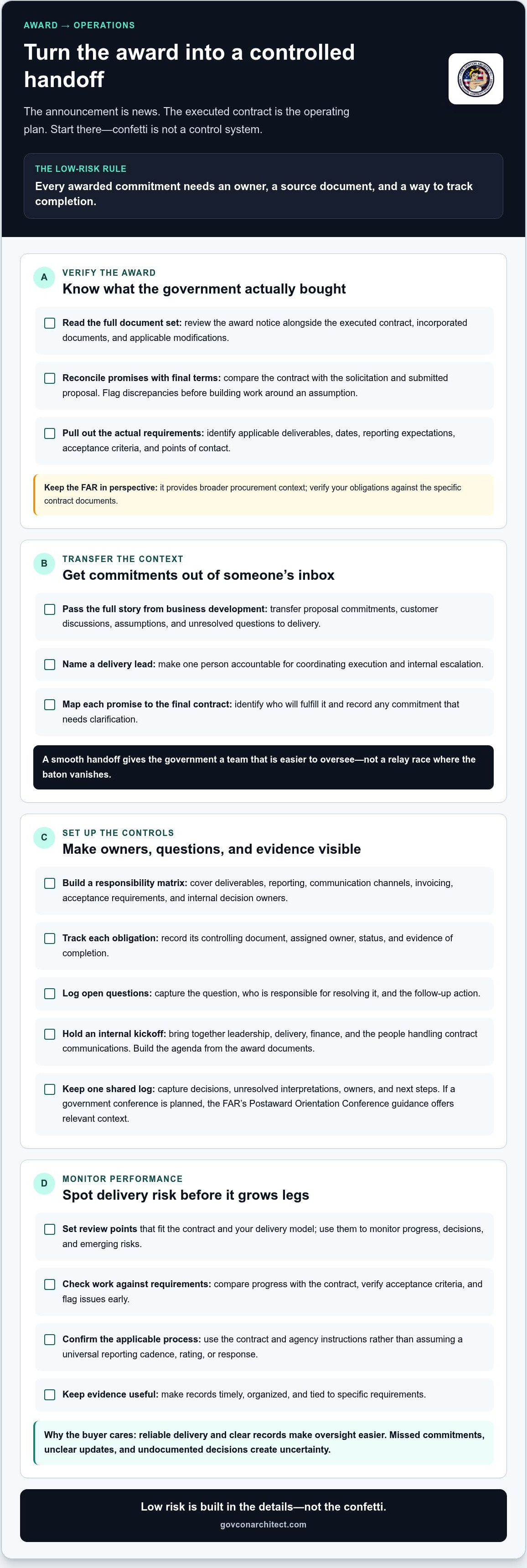
Award-to-operations handoffs fail when context stays in someone’s inbox. Business development should transfer proposal commitments, customer discussions, assumptions, and unresolved questions to the delivery team. Then make ownership explicit. The government needs a contractor that is easy to oversee, not a relay race where the baton disappears between departments.
Every awarded commitment needs an owner, a source document, and a way to track completion. Build the handoff in sequence:
- Assign a delivery lead. Name the person accountable for coordinating execution and internal escalation.
- Review obligations. Identify applicable deliverables, acceptance criteria, reporting, invoicing, and communication requirements in the contract and agency instructions.
- Map commitments. Connect proposal promises to the final contract and identify who will fulfill each one.
- Log open questions. Record the question, the person responsible for resolving it, and the follow-up action.
- Establish oversight. Set internal review points to monitor progress, decisions, and emerging risks.
How should a contractor organize the kickoff?
Hold an internal kickoff with leadership, delivery, finance, and the people handling contract communications. Build the agenda from the award documents rather than relying on a generic template. If a government conference is planned, the FAR’s Postaward Orientation Conference guidance offers relevant context. Record decisions, unresolved interpretations, owners, and next steps in one shared log.
What belongs in the contract obligations tracker?
Create a responsibility matrix covering each deliverable, reporting item, communication channel, and internal decision owner. Include applicable invoicing and acceptance requirements. For every entry, record the controlling document, assigned owner, status, and evidence of completion. A federal contract compliance checklist can help structure the review, but the awarded contract controls the specifics.
For established firms making federal-market decisions, The GovCon Architect offers strategic guidance through monthly retainer support and project support for specific pursuits. That buy-side perspective can inform your strategy without replacing your delivery team. Explore strategic guidance for your federal work.
How to Manage Government Contract Performance and Reduce Avoidable Risk
Performance risk rarely arrives with a dramatic soundtrack. It often starts as a missed commitment, an acceptance criterion nobody interpreted the same way, or a delivery issue that sat unreported until it became harder to contain. Routine monitoring helps leaders spot gaps early and decide what needs attention before the government has to chase an answer.
Set review points that fit the contract and your delivery model. Compare progress with the contract’s requirements, verify acceptance criteria, and flag emerging issues. Don’t assume a universal reporting cadence, rating, or agency response. Confirm the applicable process in the contract and agency instructions. The SBA’s guidance on managing government contract performance also discusses post-award responsibilities such as quality control, modifications, payments, and inspections.
How can teams keep performance evidence usable?
Keep records timely, organized, and tied to specific requirements. Track decisions, deliverables, communications, changes, approvals, and corrective actions with dates, responsible owners, and outcomes. Follow the contract’s acceptance process, and preserve related correspondence and approvals. A file dump at the end is not a performance control. It’s a scavenger hunt with worse snacks. A focused government contractor risk management approach helps make evidence easier to retrieve and act on.
What should leaders do when performance risks appear?
Document the issue, likely impact, decision owner, mitigation options, and next communication step. Escalate internally early, then communicate promptly and factually through the contract’s designated points of contact. The buyer needs enough clarity to understand the risk and how it is being handled, not confident-sounding guesses. Validate feasibility and authority before promising a corrective outcome. That discipline is central to what to do after a government contract award: protect delivery while keeping the government informed through the proper channel.
How to Turn a Government Contract Award into Future Strategic Value
A completed deliverable is more than a box checked. It can become credible evidence for future federal decisions if your team can show what it committed to, delivered, and learned. That record won’t guarantee another award. It can help leadership make better choices about positioning, capacity, and which opportunities deserve pursuit. A victory lap is nice. It’s not evidence.
How should a company capture lessons from the award?
Schedule internal reviews during performance and at meaningful milestones, not just when the contract is ending and everyone’s memory has gone soft around the edges. Compare proposal assumptions with delivery realities, buyer feedback, and documented outcomes. Record what was promised, delivered, accepted, challenged, and learned. Then identify which evidence supports future positioning, while protecting sensitive or restricted information and following applicable handling requirements.
Use those findings to assess whether the work fits your firm’s long-term federal strategy. Did delivery depend on capabilities you can sustain? Did the opportunity build relevant experience, or consume capacity better used elsewhere? Before pursuing adjacent work, use evidence to decide whether it fits. One award does not make every neighboring opportunity a natural fit. See how to approach leveraging a contract win for future bids.
When can buy-side strategic support help?
Strategic guidance can help established firms interpret performance lessons, evaluate federal-market decisions, and strengthen future positioning. It should inform the company’s choices, not replace the delivery team or become contract administration. GovCon Architect founder Nikki Gianni brings 22 years of buy-side experience as a government buyer, evaluator, awarder, and contract administrator. That perspective helps leaders consider how their decisions may look from the government’s side of the table. For teams working through what to do after a government contract award, the goal is disciplined learning and a credible record, not a promise of the next win.
Make This Award the Start of a Stronger Federal Record
The award is the starting point, not proof of success. Review the controlling documents, transfer proposal context to accountable delivery owners, and track obligations against evidence of completion. Then capture what was delivered, accepted, challenged, and learned. That’s what to do after a government contract award if you want disciplined execution to support future decisions, not just close out today’s task list.
The government is looking for low risk: clear communication, reliable follow-through, and records that make performance easy to understand. No fireworks required. Just consistent competence, which is less glamorous and considerably more useful.
Nikki Gianni brings 22 years of buy-side experience, including direct roles as a government buyer, evaluator, awarder, and contract administrator. That perspective can help established firms assess federal-market strategy and interpret how their decisions may look from the government’s side.
You’ve earned the opportunity. Now build a performance record that gives the next decision-maker a reason to see your firm as a reliable choice.
Frequently Asked Questions
What should a company do first after receiving a government contract award?
Start by reviewing the award notice and complete contract documents, then compare the awarded terms with the solicitation and your proposal. Identify contract-specific deliverables, acceptance conditions, communication requirements, and open questions. Assign an internal owner to each responsibility. The announcement alone may not include every term that governs performance, so treat document review as the first operational control, not paperwork to handle later.
Does receiving a government contract award mean the company can begin work immediately?
Not necessarily. Review the executed contract for its specific start conditions, instructions, and points of contact before beginning performance. The award notice may not provide the full operational picture. Confirm internally that responsibilities, resources, and any required approvals are understood. If material ambiguity remains, use the contract’s designated communication channels to resolve it before your team acts on an assumption.
How should a contractor prepare for a government contract kickoff?
Align leadership, delivery, finance, and business-development staff around the awarded requirements. Gather the controlling documents, prepare a responsibility tracker, identify decision owners, and list unresolved questions. Shape the kickoff around the contract and agency instructions. Assuming every agency uses the same format is a fine way to miss what matters. Record decisions and follow-up actions in a shared reference the team can use.
What records should a government contractor keep after an award?
Keep organized records linking contract requirements to delivery evidence, communications, decisions, approvals, and acceptance. For each commitment, make it easy to identify the source document, responsible owner, relevant date, and status. The exact recordkeeping obligations depend on the contract and applicable instructions, so a generic checklist is a starting point, not the final authority. Useful records help your team answer questions with evidence instead of guesswork.
Can strong performance on one federal contract help a company win future work?
Strong performance can contribute to relevant experience and inform future positioning, but it doesn’t guarantee another award. Capture what your team delivered, what evidence supports that record, and what it learned about its capabilities and risks. Use those findings to make more disciplined pursuit decisions and describe experience accurately in future proposals. Treat performance as evidence to assess, not a promise the next buyer must reward.