

How to Get Good CPARS Ratings: The Buy-Side Strategy for Low-Risk Performance

Article by
Nikki Gianni
Nikki Gianni is a seasoned business strategist and government contracts coach, dedicated to helping businesses successfully navigate the complexities of government contracting. With over 22 years of experience in Department of Defense contracting, including managing $20 billion in federal awards, Nikki has developed the innovative GovReady Blueprint™ Framework, a comprehensive 90-day program designed to prepare businesses to compete for and win lucrative contracts at the federal, state, and local levels. Nikki's approach emphasizes not just gaining contracts but also enhancing overall business profitability.
Before becoming a business owner, Nikki was active-duty Air Force for 10 years, then spent another 15 years as a civil servant with the DOD. Now she's an empty nester living in Southern California who loves spending time with her 22-year-old son, Lex and her 2 Mini Aussies, Tony & Carmela, doing home improvement and crafts projects, and networking.
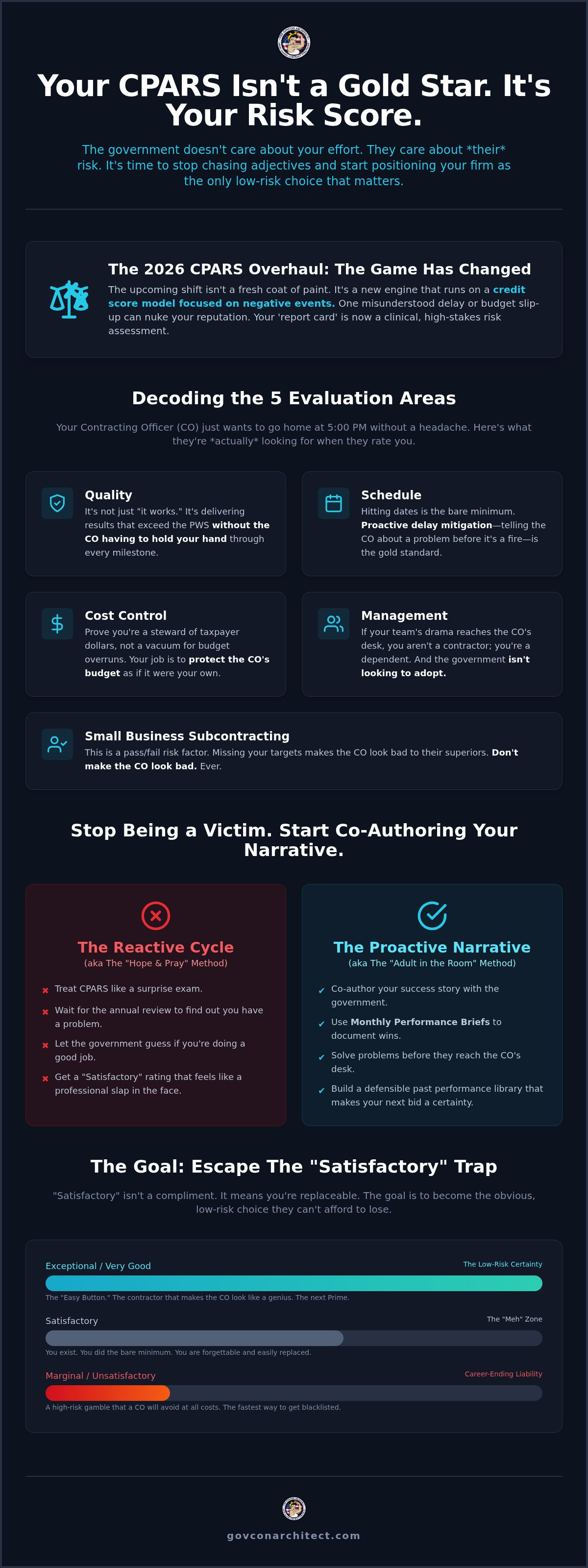
Your CPARS rating isn't a gold star for effort. It's a high-stakes risk assessment. With the 2026 overhaul shifting evaluations toward a credit score model focused on negative events, learning how to get good CPARS ratings is no longer about chasing adjectives; it's about avoiding the negative events that nuke your reputation. You're likely terrified that one misunderstood delay will kill your chances at a major prime contract. It's a valid fear. Most firms treat performance reports like a surprise exam rather than a strategic asset.
Stop the reactive cycle and start co-authoring a proactive Buy-Side narrative. We're going to show you how to think like a risk-averse Contracting Officer who values stability over slogans. This briefing covers the 2026 system changes, the specific triggers for negative reporting, and a repeatable process for building a defensible past performance library. Let's move past the hope and pray method and start positioning your firm as the only low-risk choice that matters. You've done the hard work. Now, let's make sure the government actually acknowledges it.
Key Takeaways
- Your CPARS isn't a participation trophy; it's a clinical risk assessment of your firm's stability. We'll help you view your contract through the Buy-Side lens because we actually want you to win the next one.
- Master the five evaluation areas and discover how to get good CPARS ratings by solving problems before they reach the Contracting Officer's desk. It's about being the adult in the room.
- Stop waiting for annual reviews and start co-authoring your success narrative with Monthly Performance Briefs. We'll show you how to document your wins so the government doesn't have to guess if you're actually doing your job.
- Move beyond the Satisfactory trap and build a defensible past performance library. We'll help you turn your current performance into a strategic engine that makes your next bid a low-risk certainty.
The Buy-Side Reality of CPARS: Why Your 'Report Card' is Actually a Risk Assessment
CPARS isn't a school report card for your fridge. It's a clinical risk assessment used by a bureaucracy that hates surprises. To a Contracting Officer (CO), you're either a mission-critical asset or a professional liability. They use the Contractor Performance Assessment Reporting System to document why they should trust you with taxpayer dollars again. This data is the backbone of the Government procurement process. For a $5M+ firm, one 'Marginal' rating can nuke your chances at a five-year IDIQ. It's high-stakes, and it's personal.
Risk is King: How Evaluators Use Your Past Performance
Look, we care about your growth, but the government only cares about its own skin. Evaluators don't care about your corporate mission statement; they care about their own career longevity. A high rating results in a high 'Confidence' score for future bids. COs want the 'Easy Button.' If you're the contractor who requires constant hand-holding, you're a high-risk gamble. Understanding how to get good CPARS ratings requires shifting your focus from 'doing the work' to 'mitigating the CO's stress.' If you make their life easy, they'll make your future easy. It's that simple.
The Thresholds of Accountability
Mandatory CPARS reporting typically triggers at $250,000 for services, but don't get comfortable if your task order is smaller. Unofficial feedback travels fast in federal circles. Commercial excellence doesn't guarantee federal success. In fact, assuming your private sector 'hustle' works here is one of the top reasons for losing government contracts. Whether you're above the threshold or not, low risk is king. Learning how to get good CPARS ratings means treating every milestone like a deposition. Every deliverable is an opportunity to prove you aren't a mistake they'll regret later.
Decoding the Five Evaluation Areas: What Contracting Officers Are Actually Looking For
Contracting Officers are human. They want to go home at 5:00 PM without a headache. If you want to know how to get good CPARS ratings, you must stop focusing on your deliverables and start focusing on the CO's blood pressure. The official CPARS website lists the categories, but the Buy-Side reality is simpler: are you making their life easier or harder? Low risk is king, and high-maintenance contractors are the first to get Satisfactory ratings that feel like a professional slap in the face.
- Quality: It isn't just "it works." It's delivering results that exceed the PWS without the CO having to hold your hand through every milestone.
- Schedule: Hitting dates is the bare minimum. Proactive delay mitigation, telling the CO about a problem before it happens, is the gold standard.
- Cost Control: Especially on cost-plus contracts, you need to prove you're a steward of taxpayer dollars, not a vacuum for budget overruns.
- Management: Your internal communication should reduce the government's administrative burden. If your team's drama reaches the CO's desk, you aren't a contractor; you're a dependent. And the government isn't looking to adopt.
The Small Business Subcontracting Factor
For many COs, subcontracting goals are a pass/fail risk factor. If you miss your targets, you're making the CO look bad to their superiors. That's a fast track to a Marginal rating. If a sub fails, document your good-faith efforts immediately. Show the government you're managing the risk, not just observing the train wreck. If you're struggling to align your performance with these high-stakes expectations, it might be time to schedule a strategy briefing.
Regulatory Compliance: The Silent Rating Killer
Labor laws, safety standards, and reporting requirements aren't just paperwork; they're the foundation of a Low Risk profile. Ignoring these is the fastest way to get blacklisted. Ensure your house is in order by reviewing our guide on Federal Contract Financial Responsibility Determination. A clean record here proves you're a stable partner, not a ticking legal time bomb.
Proactive CPARS Strategy: How to Co-Author Your Narrative
If you wait for the annual review to see your grade, you've already failed the course. Learning how to get good CPARS ratings is a year-round contact sport. You don't just react to a report; you co-author the narrative. The government is a massive, overworked machine. If you provide the grease, you get the win. Low risk is king, and nothing says "low risk" like a contractor who handles their own documentation.
Establish a Monthly Performance Brief. Don't let 365 days of effort be compressed into a single afternoon of the CO's fading memory. Maintain an Impact Log to document 'Exceptional' moments as they happen. Manage the relationship with your Performance Assessment Representative (PAR). They are the CO's eyes and ears on the ground. Finally, provide a Draft Narrative. Most COs will practically hug you for doing their paperwork for them. You can find the standard evaluation criteria on the Official CPARS Website.
Turning a 'Satisfactory' into an 'Exceptional'
The difference is 'Value Add.' Did you save the government time or money beyond the contract scope? Exceptional is performance that significantly exceeded contract requirements to the government's benefit. If you did exactly what you were paid for, you're Satisfactory. If you solved a problem they didn't know they had, you're a hero. We're here to help you move from being a vendor to being a necessity.
Handling the 'Marginal' Draft: Professionalism Over Protest
Getting defensive is a high-risk losing strategy. It signals to the Buy-Side that you're difficult to manage. Focus on a Corrective Action Plan instead. This proactive humility addresses the core reasons for losing government contracts by proving you can self-correct without a congressional inquiry. We want you to win, but you have to own your messes to stay in the game.
Building a Defensible Past Performance Record with The GovCon Architect
Treating your CPARS like a passive report card is a fast track to mediocrity. For firms with $5M+ revenue, your past performance isn't just history; it's the engine for your future growth. We don't do shortcuts or lottery tickets here. Our RETAINER · MONTHLY - Fractional Federal Strategy Advisor support is designed to manage the Buy-Side perception before the CO ever logs into the system. Low risk is king, and building a record that proves your stability is a 6 to 12 month marathon, not a last minute sprint.
Most contractors guess how to get good CPARS ratings while hoping the CO didn't notice their project manager's lack of communication. We replace that hope with a clinical structure. By aligning your daily performance with strategic management, we ensure your narrative positions you as the only logical, low-risk choice for the next award. It's about moving from reactive fire-fighting to a repeatable federal growth engine. We care about your win rate, which is why we're blunt about your performance gaps.
Aligning Performance with Capture Strategy
Your current performance must fuel your next pursuit. We use your documented wins to power our Capture & Proposal Sprint for your next $10M+ bid. It's not enough to have a good rating; your Section L&M responses must mirror the specific, verifiable data in your CPARS. If your proposal claims you're elite but your record says you're just Satisfactory, the CO will see the risk immediately. We close that gap by ensuring your bid matches your reality.
Ready for a Reality Check?
Stop playing the federal lottery and start controlling the narrative. We're direct because the stakes are too high for marketing fluff. Understanding how to get good CPARS ratings is the first step toward becoming a federal powerhouse. Let's audit your strategy before the next reporting cycle begins and ensure the government sees you as the stable partner they need.
Stop Reacting and Start Controlling Your Federal Reputation
You've spent years building a firm with $5M+ revenue. Don't let a single annual report card nuke your momentum because you treated it like a surprise exam. We've covered why the Buy-Side treats your performance as a clinical risk assessment and how co-authoring your narrative prevents Satisfactory death spirals. Learning how to get good CPARS ratings isn't about luck; it's about making the Contracting Officer's life so easy they'd be crazy to hire anyone else. With 22 years of buy-side experience, we know there are no shortcuts to a bulletproof record. We're here to offer fractional strategy for high-stakes firms who are tired of guessing. You've done the hard work of performing; now it's time to ensure the government's data reflects your actual value.
You're too good at what you do to be held back by a mediocre rating. Let's fix the narrative and win the next one.
Frequently Asked Questions
How long does a CPARS rating stay on my record?
A standard CPARS rating stays in the system for three years after the contract's completion, while construction and architect-engineer ratings linger for six years. Think of this as a long-term credit report for your business. Because evaluators look back at this window, one bad year can haunt your bids for half a decade. We help firms manage this timeline through our RETAINER · MONTHLY - Fractional Federal Strategy Advisor support.
Can I appeal a 'Satisfactory' CPARS rating if I believe I deserved an 'Exceptional'?
You have 14 days to submit a rebuttal, but arguing over "Satisfactory" is usually a waste of breath unless you have hard data. Contracting Officers hate being told they're wrong about their own observations. If you want to know how to get good CPARS ratings, focus on the "Impact Log" we discussed earlier. Proving value-add is always more effective than complaining about a grade after the draft is issued.
Do subcontractors get CPARS ratings in the federal system?
No, the official CPARS system is strictly for prime contractors. The government doesn't have a direct contractual relationship with you as a sub, so they won't grade you in the portal. However, your prime is definitely watching, and their assessment of you often influences their own reporting. If you're a $5M+ firm ready to jump to prime status, you need a strategy to translate those sub-wins into prime-ready past performance.
What happens if my Contracting Officer refuses to complete my CPARS report?
If your CO is ghosting your evaluation, they're technically violating FAR Part 42 requirements, but being a compliance cop rarely ends well. A missing report is often better than a bad one, but it leaves a hole in your records. We suggest providing them with a draft narrative to make their job effortless. When you do their paperwork, they're much more likely to hit that submit button and move on with their day.
How much weight does past performance carry in a Best Value Trade-Off evaluation?
In a Best Value Trade-Off, past performance is often the deciding factor that justifies a higher price tag. The government will pay a premium for a "Low Risk" contractor who won't blow the schedule. Learning how to get good CPARS ratings is the only way to escape the race to the bottom. If your record is bulletproof, you have the leverage to charge what your expertise is actually worth.