
What Contracting Officers Assess in a Technical Proposal

Article by
Nikki Gianni
Nikki Gianni is a seasoned business strategist and government contracts coach, dedicated to helping businesses successfully navigate the complexities of government contracting. With over 22 years of experience in Department of Defense contracting, including managing $20 billion in federal awards, Nikki has developed the innovative GovReady Blueprint™ Framework, a comprehensive 90-day program designed to prepare businesses to compete for and win lucrative contracts at the federal, state, and local levels. Nikki's approach emphasizes not just gaining contracts but also enhancing overall business profitability.
Before becoming a business owner, Nikki was active-duty Air Force for 10 years, then spent another 15 years as a civil servant with the DOD. Now she's an empty nester living in Southern California who loves spending time with her 22-year-old son, Lex and her 2 Mini Aussies, Tony & Carmela, doing home improvement and crafts projects, and networking.
A polished proposal that misses the solicitation is still an expensive way to say no. Understanding what contracting officers look for in a technical proposal starts with the evaluation criteria: under the Federal Acquisition Regulation, agencies assess competitive proposals using the factors and subfactors stated in the solicitation. They examine your technical approach, relevant experience, past performance, and compliance with submission instructions.
It makes sense to focus on whether your team can do the work. But capability alone does not carry a proposal. Evaluators need clear, solicitation-specific evidence that your approach meets the requirement and manages performance risk. Missing required documents or ignoring instructions can undermine an otherwise strong bid. The paperwork may not be glamorous, but preventable omissions can cost you the opportunity.
This guide explains how evaluators assess technical understanding, past performance, relevant experience, and solicitation compliance, plus the common failures that can get a proposal rejected. You’ll see what makes a response easier to evaluate and more defensible from the government’s buy-side perspective: clear evidence, controlled risk, and no guesswork.
Key Takeaways
- Build your technical approach around the solicitation’s evaluation factors, then make the evidence easy to find. Evaluators shouldn’t need a treasure map.
- Choose past-performance examples for relevance, not name recognition; show how the work supports this requirement and what results it demonstrates.
- Treat submission instructions as part of the evaluation strategy. Missing documents and avoidable compliance gaps can put a strong proposal at risk.
- Use the article’s checks to identify weak spots before submission, from unsupported capability claims to risks that lack a credible mitigation plan.
1. How do contracting officers evaluate technical approach and understanding of requirements?
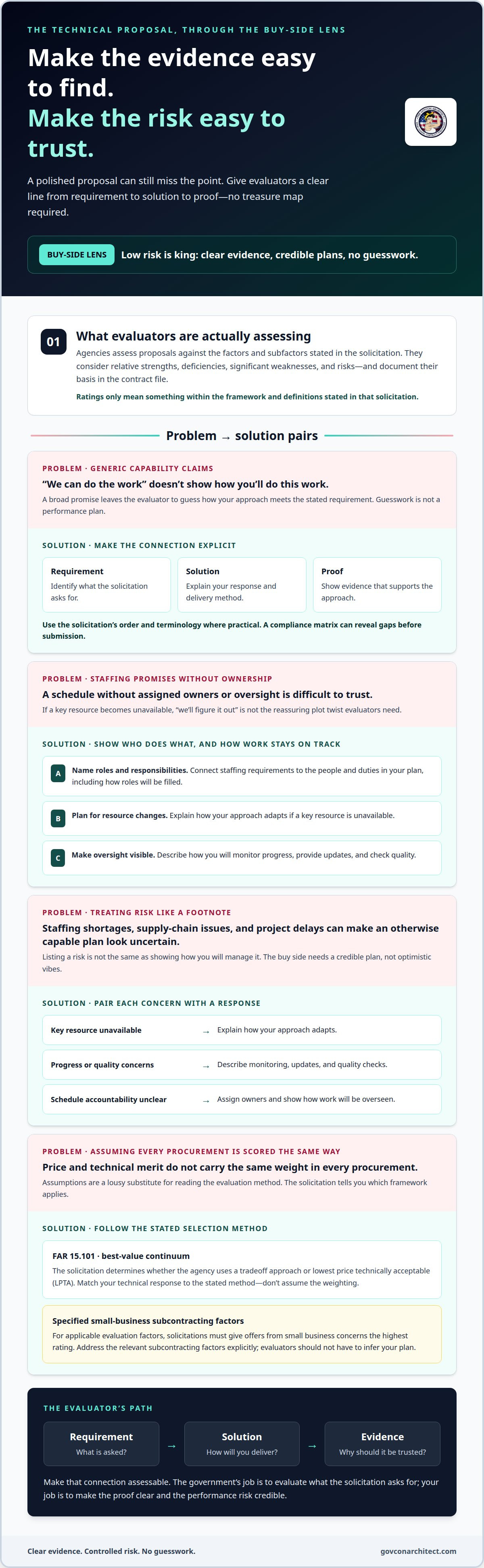
Agencies evaluate competitive proposals against the factors and subfactors stated in the solicitation. They assess relative strengths, deficiencies, significant weaknesses, and risks, then document their basis in the contract file. The practical answer to what contracting officers look for in a technical proposal is evidence tied directly to the requirement. Generic capability claims do not show how your team will perform this federal work.
Adjectival ratings describe how an offeror’s response meets the solicitation’s stated criteria, and their definitions depend on that solicitation. Agencies use the announced factors and subfactors to evaluate proposals, so a rating has meaning only within that framework.
Prepare the technical section by mapping every requirement to a response, supporting evidence, and delivery method. For example, connect a staffing requirement to named roles, responsibilities, and a plan for filling them. Use the solicitation’s order and terminology where practical. A technical proposal compliance matrix can expose gaps before submission. Make the evaluator’s path clear: requirement, solution, proof. That is what contracting officers look for in a technical proposal: an assessable connection between promise and performance.
Contracting officers assess risk by looking for credible plans to handle staffing shortages, supply-chain issues, and project delays. Explain how your approach can adapt if a key resource becomes unavailable, and describe how you will monitor progress, provide updates, and check quality. A schedule without assigned owners or oversight is difficult to trust.
According to the Federal Acquisition Regulation (FAR), FAR 15.101 describes the best-value continuum for negotiated federal contracts. The solicitation determines whether the agency uses a tradeoff approach or lowest price technically acceptable (LPTA). Section 880 of the John S. McCain National Defense Authorization Act for Fiscal Year 2019 is cited as a restriction on LPTA source selection. Match your technical response to the stated method; don’t assume price or technical merit carries the same weight in every procurement.
For specified small-business subcontracting evaluation factors, solicitations must give offers from small business concerns the highest rating under sections 15.304(c)(3)(ii) and (c)(4). Address the applicable subcontracting factors explicitly, rather than expecting evaluators to infer your plan.
2. How are past performance and relevant experience evaluated in government proposals?
Past performance is evidence, not a trophy shelf. Evaluators consider how closely prior work matches the current requirement, how recent it is, where the information came from, its context, and performance trends. The source selection authority determines relevance. A familiar agency name means little if the project does not show your ability to deliver this work.
Choose examples that demonstrate comparable scope, complexity, and outcomes. Identify the customer, work performed, your role, and results, such as delivery on time and within budget. Connect each example to a specific solicitation requirement. Relevant qualifications should also show who will perform major tasks, not just what the company has done before. A strong case links experience to the proposed team and execution plan.
Past performance records may include work by predecessor companies, key personnel, and subcontractors performing major or critical parts of the requirement. For a joint venture, agencies consider the venture’s record and, if it lacks a record for award, the past performance of each joint-venture party. Make every relationship and role clear. Evaluators cannot credit experience they cannot connect to the proposed effort.
Having no relevant record is not automatically the same as having a poor record. Under the evaluation approach stated in the solicitation, an offeror with no relevant past-performance information may receive neither a favorable nor an unfavorable past-performance rating. The solicitation must explain how offerors without relevant performance history will be evaluated. This does not remove the need to demonstrate technical capability through qualifications, staffing, and a credible delivery approach.
Review Contractor Performance Assessment Reporting System (CPARS) records before submission and align proposal claims with the documented history. CPARS absorbed the former Past Performance Information Retrieval System repository in 2019. If an identified contract had problems, address them accurately and explain corrective actions; agencies must consider offeror-provided information alongside information from other sources. Don’t let a polished narrative collide with the record. For a focused proposal-strategy discussion, talk through your past-performance approach.
3. Common causes of proposal rejection
Missing attachments and incomplete information can put a proposal at risk early. An omitted required form, an unanswered field, or a missing certification can create a compliance failure before evaluators weigh technical strengths. The solicitation defines what belongs in the submission. Treat each instruction as a requirement, not optional formatting advice.
Failure to follow submission instructions creates another preventable risk. For example, a response that ignores required page limits, file formats, or submission steps may not receive consideration as intended. Do not assume evaluators will fix the package or infer omitted information. A structured rejection-risk review can help identify process failures that threaten an otherwise sound opportunity.
Unsupported claims can also weaken an offer. If a proposal promises rapid staffing but gives no staffing method, the evaluator has little evidence to judge feasibility. Tie each capability statement to a specific approach, responsible role, or relevant project example. Consistency matters, too: conflicting staffing numbers or delivery dates make the plan harder to trust. The government is buying performance, not confidence in bold type.
Price can raise concerns when it is too high or too low without a compelling rationale. A low figure unsupported by a credible delivery approach may raise questions about feasibility; a high figure needs a clear connection to the proposed work. Price alone does not explain technical value. Keep the rationale aligned with the solicitation and the resources required to perform.
Before submission, conduct a structured rejection-risk review. Match every solicitation instruction to a completed response or attachment. Check that required information is present, claims agree across sections, and pricing aligns with the proposed approach. Then confirm the delivery method and deadline in the solicitation. The source selection authority may reject all proposals when doing so serves the Government’s best interest. A compliant, coherent offer reduces avoidable risk, but no checklist can substitute for answering the actual requirement.
4. Solicitation compliance and submission requirements
Compliance starts before drafting. Review the federal solicitation and its amendments, then record every instruction, required document, eligibility condition, and submission step. System for Award Management (SAM) registration is among the compliance requirements for government contractors. A technically strong response is still at risk if the offeror or submission fails an applicable requirement.
Build a compliance matrix that connects each instruction to a proposal section, an owner, and a completion status. For example, map a required technical response to its page location while tracking forms and representations separately. Then compare the final files against the solicitation’s format, organization, and delivery instructions. A federal proposal compliance matrix turns a dense document into a controlled review process.
Set the proposal schedule around the stated deadline and submission method. Allow time for drafting, review, file preparation, and delivery instead of treating the final hour as a project plan. Assign responsibility for each required component and reserve a final check for the exact files being submitted. A complete draft in someone’s inbox is not a submitted offer.
Eligibility details deserve their own review. For SDVOSB set-asides, self-certification ended in December 2024; certification through the SBA’s VetCert program is required. Match the opportunity’s set-aside conditions to the offeror’s applicable status and solicitation instructions. Don’t assume yesterday’s process still works. Federal requirements change, and stale assumptions make lousy compliance controls.
Before release, confirm that the submission follows the solicitation’s stated channel and deadline and that required information is complete and consistent. This final review helps the government evaluate offers fairly against announced requirements. It also protects your team from preventable submission risk. Precision is not bureaucracy for its own sake; it gives evaluators a clean, comparable record.
The GovCon Architect: Capture & Proposal Sprint...Win that Bid
GovCon Architect’s Capture & Proposal Sprint...Win that Bid is focused support for a specific federal opportunity that calls for a disciplined pursuit. The work connects the solicitation’s evaluation priorities to a proposal strategy built around evidence, compliance, and reduced buyer risk. The government needs a clear case for why your team can perform the requirement, not a generic list of capabilities.
Use the sprint when your team has identified an opportunity but needs sharper positioning, a coherent response, or stronger alignment between its technical approach and past-performance evidence. For ongoing federal strategy across multiple pursuits, Fractional Federal Strategy Advisor: Monthly Retainer Support offers a different engagement model. The right next step depends on the pursuit and the support your team needs.
Contact The GovCon Architect to discuss your proposal needs.
Make Your Next Pursuit More Deliberate
Knowing what contracting officers look for in a technical proposal should shape how you choose and prepare for your next pursuit. Treat the proposal as a decision document, not a writing exercise. Before committing, ask whether your team can support its claims, control delivery risk, and make its approach easy for evaluators to assess. If the evidence is thin, address that weakness early rather than dressing it up with confident adjectives.
The next step is to select an opportunity that fits your capabilities, assign clear ownership, and build the response around what the government needs to evaluate. This work can also reveal where your federal growth strategy needs more structure, before a deadline turns planning into a fire drill. Ambition is useful, but a defensible bid is better.
You do not need to solve every proposal challenge alone. Bring the pursuit into focus, identify the real gaps, and decide what support would strengthen the bid.
Build with intention. Compete with confidence.
Frequently Asked Questions
How are past performance and relevant experience evaluated in government proposals?
Evaluators look for proof that your team can handle this work, not a collection of unrelated contracts. Explain how a prior project’s complexity, customer needs, or delivery conditions connect to the new requirement. If performance had a rough patch, describe the corrective action plainly. Hoping evaluators will miss a documented issue is not a strategy; it is optimism in a suit.
How do contracting officers evaluate technical approach and understanding of requirements?
Evaluators assess whether your proposed method fits the requirement and explains how the work will get done. Understanding what contracting officers look for in a technical proposal means making the path from task to execution easy to follow. Clarify who owns key decisions, how teams coordinate, and how progress is tracked. Evaluators should not have to play detective to find the logic.
How do price and cost realism affect proposal evaluation?
Price evaluation depends on the contract type and solicitation. For cost-reimbursement contracts, the Federal Acquisition Regulation requires cost realism analysis to estimate the Government’s realistic expected cost and assess the offeror’s understanding and ability to perform. Cost realism may also apply to fixed-price incentive contracts and, in exceptional cases, other competitive fixed-price-type contracts under FAR 15.404-1(d)(3). A number without a credible work plan is not much of a case.
What Sets Top Contractors Apart?
Strong contractors make their offers easy to assess and credible to execute. They connect commitments to responsible people, workable processes, and evidence that supports performance. They also make deliberate bid decisions instead of chasing every opportunity. That restraint matters: the government is managing delivery risk, not rewarding the thickest proposal.
What makes a proposal compliant with an RFP’s instructions and submission requirements?
A compliant proposal follows the RFP’s stated content, format, attachment, and delivery instructions. Before submission, make sure the required files are complete, readable, and consistent with the requested package. For example, a form saved in a working folder but missing from the final upload is not included. The evaluator can assess only what arrives, not what your team meant to send.
What evaluation criteria do federal contracting officers use to assess technical proposals?
Evaluators use the factors and subfactors stated in the solicitation, not a universal checklist that fits every procurement. To understand what contracting officers look for in a technical proposal, read those criteria as the agency’s evaluation map. They show which distinctions matter for the opportunity, so organize your evidence around them. Guessing at hidden preferences is a poor substitute for following the stated framework.