
Government Contract Compliance Checklist 2026: A Buy-Side Risk Review

Article by
Nikki Gianni
Nikki Gianni is a seasoned business strategist and government contracts coach, dedicated to helping businesses successfully navigate the complexities of government contracting. With over 22 years of experience in Department of Defense contracting, including managing $20 billion in federal awards, Nikki has developed the innovative GovReady Blueprint™ Framework, a comprehensive 90-day program designed to prepare businesses to compete for and win lucrative contracts at the federal, state, and local levels. Nikki's approach emphasizes not just gaining contracts but also enhancing overall business profitability.
Before becoming a business owner, Nikki was active-duty Air Force for 10 years, then spent another 15 years as a civil servant with the DOD. Now she's an empty nester living in Southern California who loves spending time with her 22-year-old son, Lex and her 2 Mini Aussies, Tony & Carmela, doing home improvement and crafts projects, and networking.
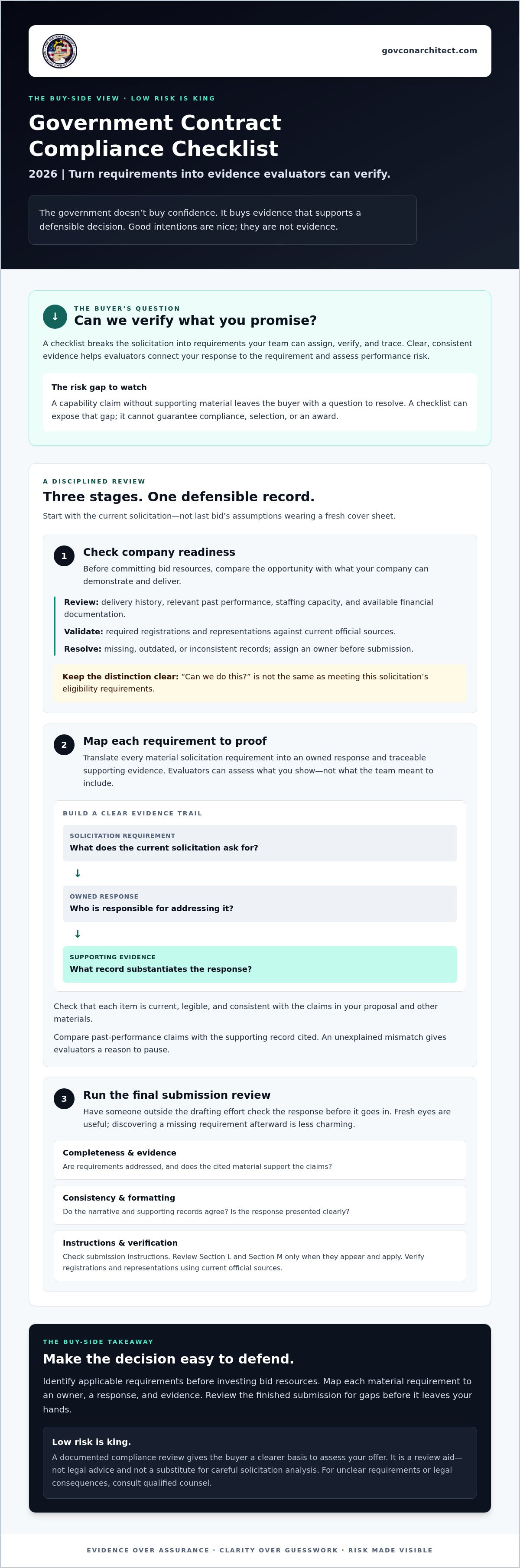
The government doesn’t buy confidence; it buys evidence that supports a defensible decision. A polished proposal can still raise concerns when requirements are scattered across the solicitation and attachments, or when required proof is missing. That is more than a paperwork nuisance. It is avoidable risk, and low risk is king. This government contract compliance checklist 2026 starts from the buy-side view: what must an evaluator verify before your team earns confidence?
Commercial strength does not automatically prove federal-buyer readiness, and a polished binder cannot rescue a missed submission requirement. Use this checklist to identify applicable requirements before committing bid resources, map each material requirement to traceable evidence, and review the response before submission. Start with the solicitation, then organize its instructions, performance requirements, supporting documentation, and internal checks into a disciplined process. The goal is not box-ticking. It is a clear record of how your offer addresses the requirement, and where your team needs to close a gap before submission.
Key Takeaways
- Use the government contract compliance checklist 2026 to assess whether the opportunity fits your delivery record, staffing capacity, and available documentation before committing bid resources.
- Translate each solicitation requirement into an owned response and supporting evidence. Evaluators can assess what you show, not good intentions.
- Review Section L and Section M only when they appear and apply. Verify registrations and representations against current official sources.
- Ask someone outside the drafting effort to check completeness, consistency, evidence, formatting, and submission instructions. Catching a gap before submission is better than discovering it afterward.
Government Contract Compliance Checklist 2026: Start With the Buyer's Risk View
A compliance checklist is a controlled way to compare solicitation requirements with your response and its supporting evidence. It breaks a large package of instructions into items your team can assign, verify, and trace. That matters because the Buy-Side evaluates what your submission demonstrates, not what your team intended to include. Good intentions are welcome, but they are not evidence.
Procurement has its own rules, roles, and decision process. For general background, see this overview of Government procurement in the United States. For a live opportunity, the current solicitation and applicable official instructions control. Requirements vary, so do not assume the checklist from your last bid fits this one. A prior response can be a useful reference, but its assumptions and attachments need to be checked against the new solicitation.
Why low risk matters in federal bids
Evaluators need to assess whether your approach is credible and supported. Clear, consistent evidence helps them connect a requirement to your response and judge the risk of performance. If your narrative claims a capability but the supporting material does not substantiate it, the buyer has a gap to resolve. A checklist can help expose that gap. It cannot guarantee compliance, selection, or an award.
Documented compliance shows what you can substantiate. An unsupported assurance asks the buyer to take your word for it.
What this checklist can and cannot do
Use the government contract compliance checklist 2026 as a review aid to identify requirements, track evidence, and flag questions for resolution. It is not legal advice or a substitute for careful solicitation analysis. When a requirement is unclear or carries legal consequences, consult qualified counsel. The checklist helps your team manage its review; it does not replace legal advice.
For another starting point, review the federal bid readiness checklist, then tailor your review to the actual opportunity. A disciplined verification process gives the buyer a clearer basis to assess your offer.
Check Company Readiness Before Investing in a Federal Bid
A compliant proposal cannot manufacture organizational capacity. Before committing bid resources, compare the opportunity with your delivery history, relevant past performance, staffing capacity, and available financial documentation. The Buy-Side needs evidence that your company can perform this requirement, not a confident paragraph about how your team will “figure it out.” Confidence helps, but proof carries the weight.
Review financial records against what the opportunity calls for, and use this federal contract financial responsibility review as a starting point. Government contracts have a distinct legal context, as Cornell Law School’s overview of the legal framework of government contracts explains. Confirm required registrations and representations through current official sources. This is a verification step for your team, not a registration service.
Evidence the team should locate and validate
Inventory the company records and performance evidence requested in the solicitation. Check that each item is current, legible, and consistent with the claims in your proposal and other materials. For example, compare a past-performance claim in the narrative with the supporting record cited for it. If records are missing, outdated, or inconsistent, assign an owner to resolve the issue before submission. An unexplained mismatch gives evaluators a reason to pause.
Readiness is not the same as eligibility
Internal confidence answers, “Can we do this?” It does not establish whether your company meets this solicitation’s eligibility requirements. Verify those requirements against the current solicitation and official instructions. For a Buy-Side perspective, review what you need to bid on a federal contract. The government contract compliance checklist 2026 should help distinguish evidence your firm already has from requirements it still needs to verify.
The GovCon Architect provides strategic consulting to commercial firms seeking federal contracts, including firms with at least $5 million in annual revenue and at least five years of proven delivery. If a pursuit looks viable but the evidence picture is messy, discussing your federal bid readiness can help clarify which questions to resolve before you invest further.
Map Every Solicitation Requirement to a Response and Evidence
Once you have assessed readiness, build the proposal around the solicitation, not a recycled response from another pursuit. Extract each requirement, assign an owner, draft the response, identify supporting evidence, and verify the connection. Check the Federal Acquisition Regulation (FAR) and other applicable official instructions when you need authoritative context, but use the current solicitation to determine what this specific bid requires.
Traceability is the visible link between a requirement, the response that addresses it, and the evidence that supports it. If one link is missing, the evaluator has to guess. Do not make guessing part of your proposal strategy.
Build a solicitation-specific compliance matrix
Use a technical proposal compliance matrix to make ownership and gaps visible. Include:
- Requirement reference: where the instruction appears in the solicitation.
- Response location: the section or attachment that addresses it.
- Evidence source: the record or document supporting the claim.
- Owner and review status: who is accountable and whether the item has been verified.
This structure can expose unanswered requirements, unsupported claims, and contradictions across sections before they become buyer concerns. For instance, if the matrix points to a response section but no evidence source, the claim needs review. The government contract compliance checklist 2026 should track the opportunity’s actual requirements, not assume every solicitation uses the same structure.
Check instructions and evaluation factors separately
Instructions govern how to prepare and submit the response. Evaluation factors explain what the buyer will assess. Review both against the current solicitation, including format, submission method, required attachments, and stated deadlines. Check Sections L and M only when present and applicable. Then test whether the response gives evaluators what they need to assess the stated government bid evaluation criteria. A complete submission that does not address the evaluation logic can still be weak.
GovCon Architect’s per-pursuit project support focuses on specific federal opportunities and bid submissions, with attention to the requirements contracting officers set for that opportunity. Read more about strengthening your solicitation-to-evidence strategy.
Run a Final Submission Review and Close the Risk Gaps
A final review is not a ceremonial lap around the proposal. It is the last chance to catch a missing attachment, unsupported claim, inconsistent figure, or instruction the team misread. The Buy-Side needs a response it can assess without solving a puzzle. Keep a record of unresolved issues and the decision made about each one.
A final review sequence before submission
Ask a reviewer who was not responsible for drafting the material to check completeness, consistency, evidence, formatting, and the solicitation’s instructions. Then confirm that every matrix row has a response location, evidence location, and accountable reviewer. A blank field is an open risk, not a minor administrative quirk.
Before sending, compare the package with the current solicitation again. Verify file integrity and follow the stated submission process, including any instructions for confirming receipt. Do not import a deadline, file format, or submission rule from another bid. If an issue remains unresolved, record its impact, owner, and escalation or bid/no-bid decision. Make the reasoning visible rather than leaving it in someone’s memory.
When buy-side advisory support is relevant
A second perspective can help when your team needs to test whether the response aligns with evaluator criteria or decide how to address a material gap. GovCon Architect offers ongoing strategic guidance through monthly retainer support and targeted support for specific federal opportunities. Its work is preparation and strategic guidance, not a substitute for reviewing the solicitation or seeking legal counsel. It does not guarantee compliance or an award. The government contract compliance checklist 2026 helps your team run a controlled review, while the final judgment still needs to fit the opportunity.
For qualified firms weighing pursuit-specific or ongoing strategic support, learn more about a focused review of the buyer’s view of risk.
Make Your Next Bid Easier for the Buyer to Trust
A disciplined government contract compliance checklist 2026 does more than catch missing paperwork. It helps your team decide whether the opportunity fits, connect each requirement to a credible response and evidence, and surface unresolved risks before submission. Evaluators can only assess what your proposal makes clear.
Use the current solicitation as your control document. Assign owners, verify the evidence, and ask someone outside the drafting effort to review the package. It is not glamorous, but neither is explaining why a required attachment never made it into the submission.
For qualified firms seeking a sharper Buy-Side perspective, GovCon Architect aligns bid strategy with how government evaluators assess proposals. Led by Nikki Gianni, the firm draws on 22 years of buy-side experience. That perspective can help your team challenge assumptions and make its case more clearly, without promises of an award.
Your team can control the quality of its preparation. Make the evidence count, close the gaps, and give the buyer a response they can evaluate with confidence.
Frequently Asked Questions
What should a government contract compliance checklist include?
A government contract compliance checklist should track each solicitation requirement, its response location, supporting evidence, assigned owner, and review status. Include company-readiness checks, required representations or attachments, formatting and submission instructions, and a final independent review. Tailor it to the specific opportunity. A checklist copied from another bid may look organized but still miss the requirements the buyer needs you to address.
Does the FAR apply to every federal contract bid in the same way?
No. The Federal Acquisition Regulation provides a government-wide framework, but requirements can vary by agency, procurement, and solicitation. Applicable agency supplements and solicitation terms may also matter. Do not assume a clause or instruction applies just because it appeared in a previous bid. Review the current solicitation and relevant official sources, and seek qualified legal advice if you need an interpretation of legal obligations.
How do you use a compliance matrix for a federal proposal?
Use a compliance matrix to connect each solicitation requirement to the proposal response and its supporting evidence. Record the requirement reference, response location, evidence source, accountable owner, and review status. Then use the matrix to find blank fields, unsupported claims, and inconsistencies across sections. It is a practical control tool, not a substitute for understanding the solicitation or applying judgment to the response.
Does The GovCon Architect provide SAM registration or guarantee contract compliance?
No. GovCon Architect does not provide SAM registration services and does not guarantee contract compliance or an award. The firm provides strategic consulting, including ongoing guidance and support tailored to specific federal opportunities. Teams should verify registration details through current official sources and review solicitation requirements directly. Advisory support can help align bid strategy with evaluator criteria, but it does not replace solicitation analysis or legal counsel.
Can a compliance checklist guarantee that a federal proposal wins?
No checklist can guarantee selection or an award. A well-maintained checklist can help your team identify requirements, organize evidence, catch inconsistencies, and reduce avoidable buyer concerns. The Buy-Side evaluates the submission it receives, not the effort behind it. Use the checklist to make your response clearer and easier to assess, while recognizing that the outcome depends on the specific opportunity and evaluation.
Book a 15-minute get-to-know-you call with GovCon Architect to discuss your federal bid strategy and the support that may fit your pursuit.