
Federal Contract Pursuit Support: The Buy-Side Strategy for Winning Bids

About the Author
Nikki Gianni is a seasoned business strategist and government contracts coach, dedicated to helping businesses successfully navigate the complexities of government contracting. With over 22 years of experience in Department of Defense contracting, including managing $20 billion in federal awards, Nikki has developed the innovative GovReady Blueprint™ Framework, a comprehensive 90-day program designed to prepare businesses to compete for and win lucrative contracts at the federal, state, and local levels. Nikki's approach emphasizes not just gaining contracts but also enhancing overall business profitability.
Before becoming a business owner, Nikki was active-duty Air Force for 10 years, then spent another 15 years as a civil servant with the DOD. Now she's an empty nester living in Southern California who loves spending time with her 22-year-old son, Lex and her 2 Mini Aussies, doing home improvement and crafts projects, and networking.
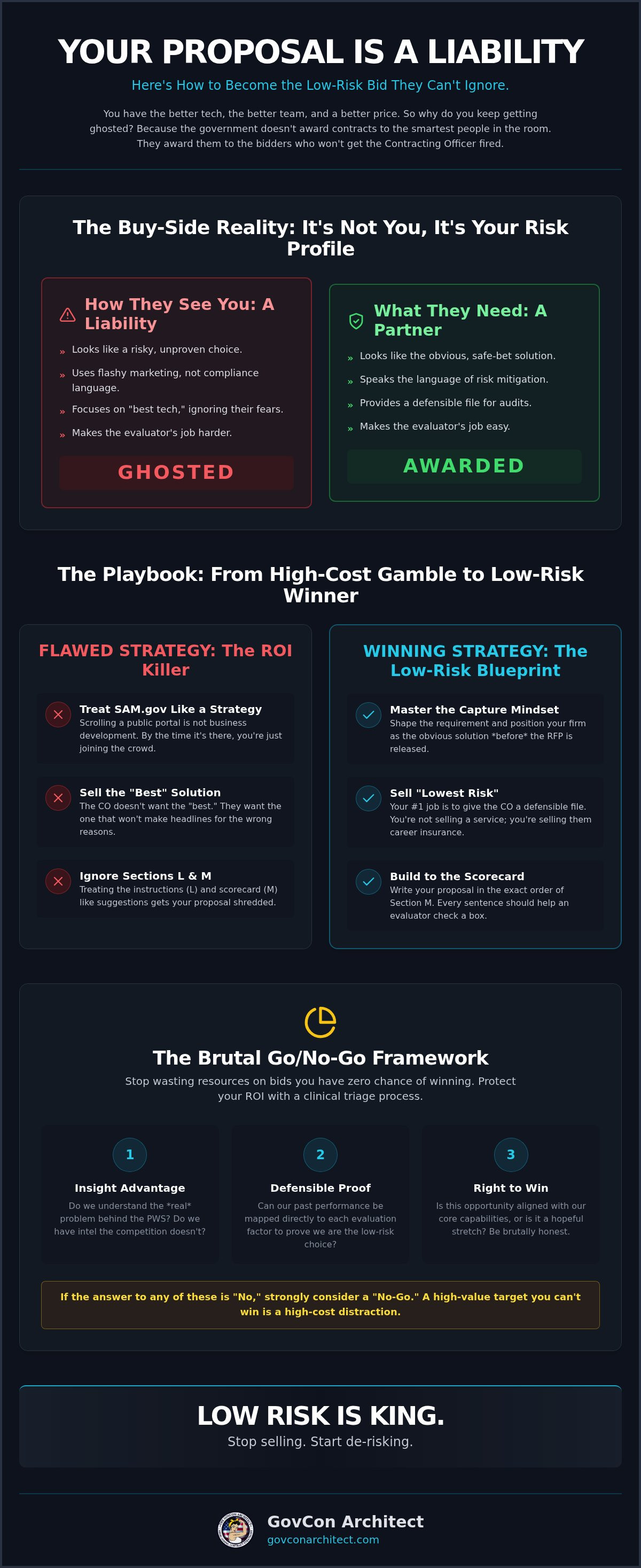
You are losing to incumbents who couldn't find their way out of a paper bag because you look like a liability, not a partner. It's frustrating. You have the better tech, the better team, and a better price, yet you keep getting ghosted. The federal government spent $793 billion in fiscal year 2025. They didn't hand it out to the smartest people in the room. They gave it to the bidders who didn't make the Contracting Officer break out in a cold sweat.
High proposal costs with zero ROI are a symptom of a broken strategy. Most firms treat Section L and M requirements like a puzzle they can't solve. The truth is simpler. You need federal contract pursuit support that understands the evaluator’s scorecard. I spent 22 years on the buy-side selecting winners. I'm here to tell you that low risk is king.
You deserve to win the work you're qualified for. This article provides a repeatable framework for Go/No-Go decisions and a clinical look at how to score 'Low Risk' on every evaluation. We're moving past the marketing fluff and into the structural integrity of a winning bid.
Key Takeaways
SAM.gov is where strategies go to die; stop treating a search bar like a business development plan and start focusing on the buy-side mechanics that actually win awards.
Contracting Officers don't want the "best" solution; they want the one that won't get them fired. Learn why positioning yourself as "low risk" is the only metric that matters.
High-level federal contract pursuit support transforms your proposal from a hopeful draft into a clinical, defensible document that makes the evaluator's job easy.
Implement a brutal Go/No-Go framework to protect your ROI and stop wasting resources on "high-value" targets where you have zero probability of winning.
Discover how a structured Capture & Proposal Sprint uses Red Team audits to identify disqualifying risks before the government does.
Table of Contents
The Buy-Side Reality: How Contracting Officers Score Your Risk
Strategic Triage: The Go/No-Go Framework for High-Stakes Pursuits
Executing the Proposal Sprint: Compliance, Red Teams, and Win Themes
Per-Pursuit Support: Professionalizing Your Federal Bid Engine
Beyond SAM.gov: Why Finding a Contract Isn't Winning It
If you're spending your mornings scrolling through SAM.gov like it’s a late-night social media feed, you’ve already lost. SAM is the graveyard of good intentions. By the time a requirement hits the public portal, the incumbents have already built their defensive moats. The "Buy-Side" evaluators already have a mental picture of what "low risk" looks like. If you found the opportunity there, so did every other firm in the country. You aren't finding a lead; you're joining a crowd.
Most firms treat federal contract pursuit support as a luxury or a last-minute polish. That is a mistake that kills your ROI. The government doesn't hire the "best" company in the traditional sense. They hire the company that is least likely to get the Contracting Officer fired. Evaluators aren't looking for reasons to love you. They are hunting for reasons to disqualify you. One misplaced decimal or one vague past performance reference is all they need to toss your proposal in the shredder. I'm telling you this because I want you to win, not just participate in the government's research fund.
The Illusion of the Open Market
The "Full and Open" label is a trap for the unprepared. It suggests a level playing field, but the field is tilted toward those who understand the U.S. government procurement process. If you are just reacting to RFPs, you are a "price taker" in a market that rewards "value shapers." You need to move from a bidding mindset to a capture mindset. Capture is the clinical process of shaping the requirement and positioning your firm as the obvious, low-risk solution before the official solicitation is ever released.
Why Commercial Firms Fail the 'Federal Test'
Stop looking for the 30-day shortcut. It doesn't exist. Commercial success is a great foundation, but the federal market is a different beast. You can't use flashy marketing language to win a contract. You need procurement-specific responses that speak the language of risk mitigation. This is why how you win depends on structural integrity. We only work with firms that have at least $5M in revenue and 5 years of delivery experience because you need that operational weight to survive the compliance layer. Without it, you aren't a bidder; you're a liability. Real federal contract pursuit support ensures your proposal isn't just a document, but a defensible shield against disqualification.
The Buy-Side Reality: How Contracting Officers Score Your Risk
The federal government doesn't buy things the way you buy a car. They buy things the way a large, terrified insurance company buys reinsurance. The person holding the pen, the Contracting Officer (CO), has one primary directive: don't make a mistake that ends up on the front page of the news. When you provide federal contract pursuit support, your primary mission is to provide the CO with a defensible file. You aren't selling a service; you're selling a "get out of jail free" card for their next audit. They need to be able to look their boss in the eye and say, "I picked this firm because they were the lowest risk."
You need to stop reading the RFP like a novel and start reading it like a legal summons. Section L tells you how to dress up and show up. Section M tells you exactly how they're going to judge you once you arrive. If you ignore the instructions in L, you’re disqualified before the first cup of coffee. If you ignore the criteria in M, you’re just wasting paper. Understanding how proposals are officially evaluated is the difference between a winning bid and a very expensive participation trophy. Evaluators are human. They are overworked, under-caffeinated, and looking for any excuse to stop reading. Give them a reason to keep going.
Decoding Section M: The Evaluator's Scorecard
Write your proposal in the exact order of the evaluation criteria. Period. If Section M lists "Technical Approach" then "Key Personnel," don't get creative and swap them because it "flows better." It doesn't. You want the evaluator to check boxes, not solve a mystery. Strategic alignment means every sentence in your technical volume is a direct answer to a scoring requirement. If a sentence doesn't help them give you a point, delete it. Your technical capability is only as good as your ability to prove it mitigates their specific fears. Creativity is for your marketing brochures; compliance is for your proposal.
Past Performance as a Risk Shield
Your 5+ years of commercial delivery isn't just a resume; it's a risk mitigation tool. The CO sees a new federal entrant as a ticking time bomb. You mitigate this by proving relevancy. It isn't enough to say you did the work. You have to prove you did the work in a high-stakes environment similar to the current scope. If you're new and facing a "neutral" rating, don't panic. Just double down on your management approach to show you have the infrastructure to handle the load. If you're unsure how your current contracts stack up against federal requirements, it might be time to talk about your capture strategy. Relevancy is the only metric that matters here.
Strategic Triage: The Go/No-Go Framework for High-Stakes Pursuits
Bidding on every RFP that hits your desk isn't a growth strategy. It's a suicide mission. Most firms treat proposal development like a lottery, hoping that if they buy enough tickets, they’ll eventually hit the jackpot. They don't. Each lost bid carries a massive hidden cost in overhead and morale. If you want to scale, you have to get comfortable with the word "No." Real federal contract pursuit support starts with a brutal, clinical assessment of your Probability of Win (PWin). If the math doesn't work, we walk away. It's better to save your ammunition for a fight you can actually win.
A "Go" decision requires more than just a capability match. We look at the incumbent status and the agency relationship through a cold, buy-side lens. If the current contractor is performing well and has a deep relationship with the program office, your "better solution" usually doesn't matter. The Contracting Officer sees a change in vendors as an unnecessary risk. Unless you can prove the incumbent is a liability, you're just providing a "third bid" to satisfy competition requirements. Don't be the government's free market research. It’s a waste of your time and mine.
Assessing the Competitive Landscape
You need to know who you’re fighting before you step into the ring. We use procurement data to look past the marketing and see who the agency actually awards money to. Is the incumbent failing their milestones? Is there a gap in their technical capability that you can exploit? The Buy-Side reality is that they only switch when the pain of staying with the current vendor outweighs the risk of moving to a new one. Teaming strategy is your secret weapon here. Sometimes the fastest way to a "Go" is to sub under a larger prime or bring in a specialized partner to bolster your risk-mitigation narrative. We don't guess; we verify.
Internal Readiness Audit
Before you commit thousands of dollars to a proposal effort, you need an honest look in the mirror. Does your firm have the $5M+ revenue infrastructure to actually deliver? Winning is only half the battle. If you can't meet the specific requirements of the Federal Acquisition Regulation (FAR), you’ll be disqualified or, worse, you’ll win a contract that bankrupts you. We prioritize structural integrity over optimism. You should take our Federal Bid Readiness Assessment to see if you’re actually prepared for a high-stakes pursuit. If you aren't ready, we’ll tell you. That’s not being mean; that’s being a partner who wants you to survive the process.
Executing the Proposal Sprint: Compliance, Red Teams, and Win Themes
Compliance is the floor, not the ceiling. Most firms treat a proposal like a creative writing assignment. They want to talk about their "innovative synergy" and "passion for excellence." I’m here to tell you that the Contracting Officer doesn't care about your passion. They care about their audit trail. If you miss one signature on one obscure form, your multi-million dollar deal is dead before it reaches the evaluator's desk. Effective federal contract pursuit support ensures that the boring stuff, the administrative hurdles, are cleared with clinical precision so your technical solution actually gets a chance to shine.
Your pricing strategy needs the same level of sobriety. The government isn't always looking for the cheapest option, but they are always looking for a "fair and reasonable" price. If you lowball the bid, you look like a performance risk. If you overcharge, you look like a bad steward of taxpayer funds. We review your numbers through the lens of the Buy-Side to ensure your price is defensible. You need to prove that you can deliver the work without a mid-contract price hike or a total collapse of service.
Win Themes: More Than Just a Slogan
A win theme isn't a catchy phrase you put on the cover page. It’s the connective tissue that links your technical capability to the government’s fear of failure. Every claim you make must pass the "So What?" test. If you say you have 22 years of experience, the benefit isn't just "we know a lot." The benefit is "we have seen every failure point in this industry and have already built the mitigations to prevent them on your watch." You are positioning your commercial track record as a proven, low-risk federal solution. We weave these themes into every volume so the evaluator can’t help but see you as the safest bet in the pile.
The Red Team: A Mock Evaluation
The Red Team review is where your feelings go to die. This isn't a peer review where your colleagues tell you what a great job you did. It’s a clinical, Buy-Side audit designed to find every weakness and deficiency in your draft. We simulate the actual evaluation process used by the agency. If we find a section that would score a "Marginal" rating, we don't just point it out; we fix it. The goal is to move your proposal into the "Exceptional" category by providing the specific data points and risk mitigations the CO needs to justify awarding you the contract. It’s a brutal process, but it’s how you win.
Professionalize your pursuit engine
Per-Pursuit Support: Professionalizing Your Federal Bid Engine
Stop treating your proposal team like a sweatshop for losing efforts. If you’ve spent 100 hours of your senior leadership’s time on a bid only to receive a "technical deficiency" notice, you didn't just lose a contract. You burned a massive hole in your balance sheet. Professional federal contract pursuit support isn't an overhead cost; it’s an insurance policy against your own optimism. Losing is expensive. Winning requires a clinical, strategy-first approach that most commercial firms simply don't have in-house.
Our Capture & Proposal Sprint is designed for firms that are tired of being the government's "third quote." This isn't a generic writing service. It is a tactical, high-stakes intervention for specific opportunities where the win is non-negotiable. Starting at $3,000 per pursuit, this investment professionalizes your engine by applying a buy-side filter to every page of your response. We bridge the gap between your commercial excellence and the rigid, risk-averse world of federal awards.
What to Expect in a Capture & Proposal Sprint
We don't do "fluff." We do results. When you engage in a sprint, we strip your pursuit down to its skeletal structure and rebuild it for maximum defensibility. Based on 22 years of buy-side experience, we provide:
A brutal Go/No-Go analysis to ensure you aren't chasing a ghost.
Win-theme development that speaks directly to the evaluator’s fear of risk.
A comprehensive proposal compliance review to catch the "hidden" disqualifiers in Section L.
A clinical Red Team evaluation that mirrors how the government will actually score you.
A pricing strategy review to ensure your bid is both competitive and profitable.
Taking the Next Step
If your firm has surpassed $5M in revenue and has been delivering for at least 5 years, you have the infrastructure to win. You just need the map. The federal market doesn't reward effort; it rewards structural integrity and risk mitigation. Moving from "guessing" to "winning" means admitting that your commercial marketing team isn't equipped to fight a buy-side evaluator. It’s time to stop acting like a startup and start acting like the elite partner the government actually wants to hire.
You have the capability. We have the insider's perspective. It is time to book a session with Nikki Gianni to audit your next high-value pursuit and stop leaving your revenue to chance.
Stop Guessing and Start Winning
You've been playing the federal game on hard mode for too long. Winning isn't about having the flashiest slides; it's about being the most predictable, low-risk option on the evaluator's desk. We've dissected why SAM.gov is often a trap, how to survive a brutal Red Team audit, and why a clinical Go/No-Go framework is your best friend. If you're serious about high-value targets, you need an insider who knows how the government actually scores the sheet.
Professional federal contract pursuit support moves you from being a "price taker" to a "value shaper." With 22 years of buy-side experience, I've seen exactly what makes a Contracting Officer sign a contract and what makes them reach for the shredder. Don't waste another 100 hours on a bid that's dead on arrival. Starting at $3,000 per pursuit, we can turn your commercial delivery success into a defensible federal award.
Professionalize your pursuit strategy with a Capture & Proposal Sprint
You already have the delivery expertise to do the work. Now you just need the strategy to prove it to a skeptical evaluator. You've got this.
Frequently Asked Questions
What is federal contract pursuit support?
Federal contract pursuit support is a clinical, strategy-first approach to winning government business. It isn't just about writing pretty sentences; it's about building a defensible case for why you're the lowest risk. We look at Section L and M through an evaluator’s eyes to ensure every claim you make maps directly to a scoring requirement. It’s the difference between guessing what the government wants and knowing exactly how they grade.
How much does professional federal proposal support cost?
Professional support varies based on the level of engagement. Our Capture & Proposal Sprint starts at $3,000 per pursuit, depending on bid complexity. For firms wanting ongoing advisory, our Fractional Federal Strategy Advisor retainer starts at $3,500 per month with a three-month minimum. These aren't costs; they are investments in protecting your ROI and stopping the bleeding of lost proposal development hours. We prioritize results over effort.
Can a consultant help me win a contract if I'm not in SAM.gov yet?
If you aren't in SAM.gov, you aren't ready for this level of support. We don't provide SAM registration services or 30-day shortcuts. We work exclusively with established commercial firms that have at least $5M in annual revenue and 5 years of proven delivery. You need to have your house in order before we can help you professionalize your federal bid engine and win high-stakes contracts. We value your time too much to guess.
What is the difference between a capture manager and a proposal writer?
A capture manager is the strategist who influences the requirement before the RFP drops. A proposal writer is the tactician who handles the document. Most firms hire writers when they actually need federal contract pursuit support that bridges both. We provide the buy-side perspective that ensures your capture strategy survives the proposal evaluation process. It's about making sure your win themes actually translate into scoring points for the evaluators who hold the pen.
Why do commercial firms often lose their first federal bids?
Commercial firms usually lose because they treat the government like a regular customer. They use flashy marketing language that evaluators ignore. The government doesn't care about your passion for innovation. They care about risk. If you don't speak the language of risk mitigation or follow the Section L instructions perfectly, you look like a liability. We help you fix that by aligning your commercial success with federal evaluation criteria. It's a reality check.
Is it possible to win a federal contract without being an incumbent?
Absolutely, but you can't just be better. You have to be safer. To unseat an incumbent, you must demonstrate through past performance and technical approach that the current vendor is a risk to the mission. You position yourself as the low-risk alternative that offers a more defensible solution for the Contracting Officer. It requires a clinical audit of the incumbent’s weaknesses and a superior alignment with Section M criteria. We help you find those gaps.
What are the most common reasons for federal bid disqualification?
Most disqualifications are self-inflicted wounds. One missing signature, a font size violation, or failing to address a single sub-factor in Section M can kill your bid. Evaluators are looking for reasons to toss your proposal so they have less work to do. We use Red Team reviews to find these administrative landmines before the government does. Compliance is the bare minimum floor, not the goal. We make your bid defensible and audit-ready.
How long does the federal pursuit process typically take?
This is a long-term revenue channel, not a quick fix. While a Capture & Proposal Sprint is a tactical burst for a specific bid, building a winning federal engine takes time. Our Federal Market Entry Engagement takes 90-120 days to lay the foundation. For optimum results, we recommend a 6-12 month commitment. Anyone promising you a contract in 30 days is selling you a fantasy you can't afford to buy. We play the long game.