
Mastering Federal Proposal Development Consulting: The Buy-Side Reality Check

Article by
Nikki Gianni
Nikki Gianni is a seasoned business strategist and government contracts coach, dedicated to helping businesses successfully navigate the complexities of government contracting. With over 22 years of experience in Department of Defense contracting, including managing $20 billion in federal awards, Nikki has developed the innovative GovReady Blueprint™ Framework, a comprehensive 90-day program designed to prepare businesses to compete for and win lucrative contracts at the federal, state, and local levels. Nikki's approach emphasizes not just gaining contracts but also enhancing overall business profitability.
Before becoming a business owner, Nikki was active-duty Air Force for 10 years, then spent another 15 years as a civil servant with the DOD. Now she's an empty nester living in Southern California who loves spending time with her 22-year-old son, Lex and her 2 Mini Aussies, Tony & Carmela, doing home improvement and crafts projects, and networking.
What if your last $30,000 proposal didn't fail because your technical solution was weak, but because you looked like a high-stakes liability on a bad date? Most federal proposal development consulting firms treat the RFP like a creative writing contest. They're wrong. In the federal market, the government isn't looking for a hero; they're looking for the person who won't get them fired. We know that low risk is king, and right now, you're likely wearing a crown of red flags that scares off even the most desperate Contracting Officer.
We understand how maddening it is to watch your $5M+ firm get sidelined by "safe" competitors who couldn't deliver half as well as you. You've spent years building a powerhouse, only to be treated like a novice by a bureaucracy that values stability over brilliance. This article ends the guessing game. You're going to master The Buy-Side reality by learning how evaluators actually score your bid. We are breaking down the mechanics of risk mitigation so you can finally stop hoping for a win and start architecting a defensible revenue engine.
Key Takeaways
- Stop treating RFPs like a lottery because the government isn't looking for a hero; they’re looking for the bidder who won't get them fired.
- Master the "Buy-Side" reality by decoding Sections L and M to ensure your federal proposal development consulting strategy prioritizes risk mitigation over marketing fluff.
- Transition from merely "writing" bids to "architecting" defensible solutions through a tactical Capture & Proposal Sprint that speaks the secret language of Contracting Officers.
- Build a sustainable federal revenue channel by replacing reactive, high-risk bidding with a proactive strategy that values structural integrity and long-term stability.
Why Commercial Success Fails in Federal Proposal Development
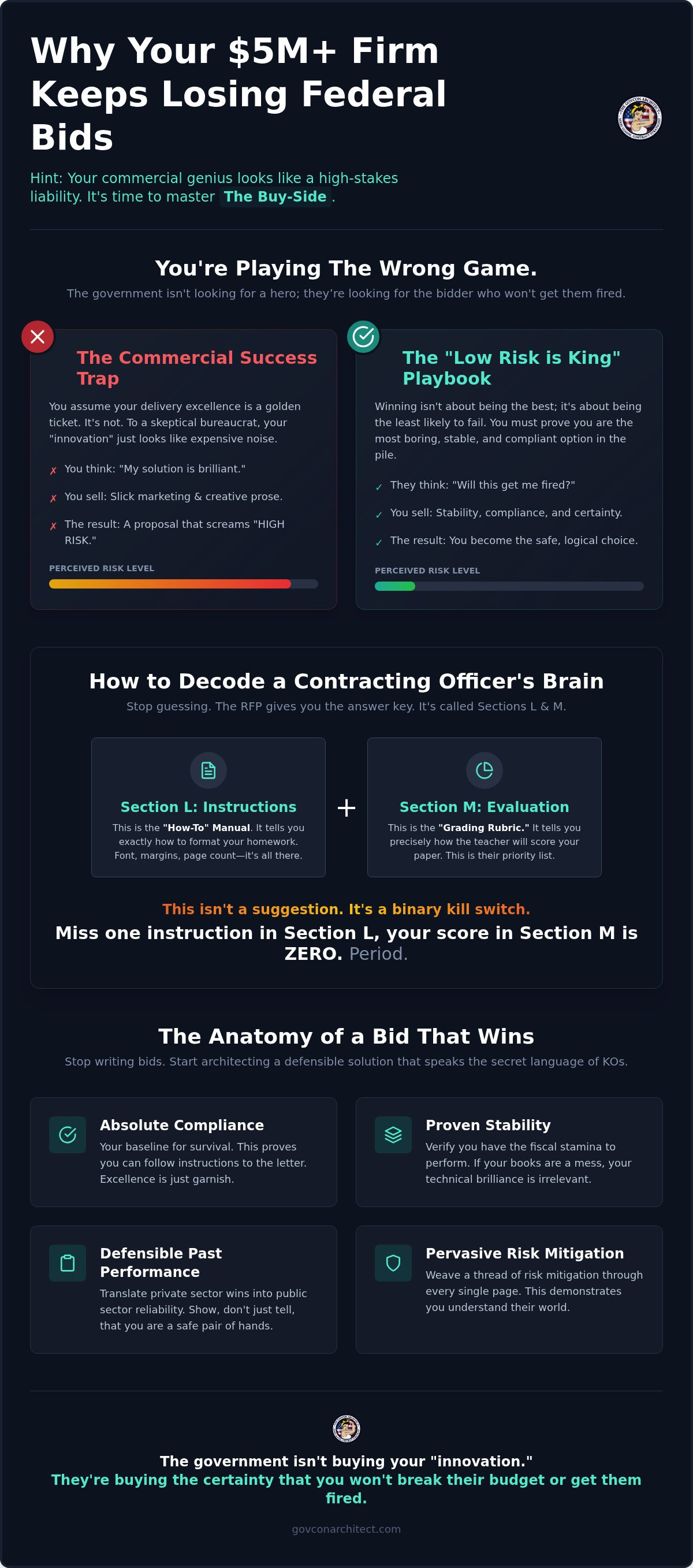
You’ve spent five years building a $5M powerhouse. You’re brilliant. Your clients love you. But the moment you submit a federal bid, the silence is deafening. Welcome to the Commercial Success Trap. Most established firms assume their delivery excellence is a golden ticket. It isn't. Federal contracting is not a lottery or a popularity contest; it is a high-stakes risk management exercise where your "innovation" often looks like a liability to a skeptical bureaucrat.
The Buy-Side Reality Check
The government doesn't care about your slick marketing deck or your office culture. They care about their own survival. Every Contracting Officer (KO) has a boss, a budget, and a deep-seated fear of ending up on the front page for a failed project. When you engage in federal proposal development consulting, you must stop selling and start architecting a defense. You need to understand the "why" behind their rigid requirements. If you don't align with their internal motivations, you’ll keep making Common Federal Proposal Writing Mistakes that scream "high risk."
Risk vs. Reward: The Government Perspective
The U.S. government procurement process is designed to find the safest bet, not the most creative one. The "Just Get Certified" trap is a classic distraction. Generic consultants tell you to stack certifications like they're merit badges, but without a strategy to mitigate risk, those badges are useless. To win, you must prove you are the most boring, stable, and compliant option in the pile. Low risk is king. If you can't prove you're a safe pair of hands, your commercial brilliance is just expensive noise.
The Buy-Side Evaluation: How KOs Score Your Proposal
Winning isn't about being the best; it's about being the least likely to fail. Professional federal proposal development consulting is the strategic alignment of your firm’s capabilities with the government’s risk-evaluation criteria. It is a clinical process of proving you won't break their system. I'm telling you this because I want you to stop wasting money on bids that are dead on arrival. You need to master the binary logic of Section L (Instructions) and Section M (Evaluation Factors). Section L tells you how to format your homework; Section M tells you how the teacher will grade it. This isn't a suggestion. It's governed by the Federal Acquisition Regulation (FAR). If you miss one instruction in L, your score in M is zero. Period.
The Anatomy of a Low-Risk Bid
Compliance is your baseline. Excellence is just the garnish. A low-risk bid follows a Low Risk Bidder Strategy that treats every requirement as a potential point of failure. Financial Responsibility Determination serves as a critical risk factor that verifies your firm has the fiscal stamina to perform. If your books are a mess, your technical brilliance is irrelevant. Low risk is king, and your proposal must reflect that stability.
Thinking Like a Government Evaluator
When a Contracting Officer (KO) opens your PDF, they aren't looking for reasons to hire you. They’re looking for reasons to disqualify you. It’s a defense mechanism. Your job is to weave a thread of risk mitigation through every single page. Use your commercial delivery records to solve the past performance paradox, showing that your private sector wins translate into public sector reliability. If this feels like a foreign language, you might need a high-level strategy briefing before your next submission.
Strategic Proposal Development: The Capture & Proposal Sprint
Stop thinking like a creative writer and start thinking like a master architect. Most firms treat a bid like a high school essay contest where the best prose wins. It doesn't. A winning bid is a blueprint for a $5M+ delivery engine that can survive a bureaucratic hurricane. Our PER-PURSUIT · PROJECT – Capture & Proposal Sprint is a tactical intervention designed to strip away the fluff. To win, you must embrace The Buy-Side perspective: the government isn't buying your "innovation," they are buying the certainty that you won't break their budget. Real federal proposal development consulting isn't about using fancy adjectives; it's about building a defensible structure because we know that low risk is king.
5 Steps to a Defensible Federal Proposal
- Step 1: The Go/No-Go Decision. We care too much about your capital to let you set it on fire. If you can't prove you're low risk, walk away.
- Step 2: Section L & M Deep Dive. We map every response to the official proposal evaluation criteria. If they asked for a blue circle, don't give them a "magnificent" red square.
- Step 3: Win Theme Development. Align your "Why" with the evaluator's deep-seated fear of project failure.
- Step 4: The Compliance Review. This is your shield. We verify every period, margin, and technical requirement to ensure the KO has zero excuses to toss your bid.
- Step 5: Post-Submission Strategy. Whether you win or lose, the debrief is where you mine the data for your next victory.
The Technical Proposal Support Framework
You need a Technical Proposal Compliance Matrix to survive the first round of cuts. This framework ensures your past performance isn't just a list of cool projects; it's a verified record of reliability. We help you move past the "30-day shortcut" mentality. Real success in this market is built on structural integrity and precision. You’re building a revenue channel, not buying a lottery ticket. Let’s treat it with the professional sobriety it deserves.
Transitioning to a Long-Term Federal Revenue Channel
Ad-hoc bidding is basically professional gambling, and frankly, your blood pressure is too high for that level of stress. You’ve spent years building a $5M+ commercial powerhouse; why treat your federal expansion like a lottery ticket? The government values stability because they’re terrified of project failure. To win at scale, you must internalize the primary governing principle of this market: low risk is king. This isn’t just a catchy phrase; it’s the mechanical reality of how these agencies operate. If you want a sustainable revenue channel, you have to stop acting like a one-hit wonder and start acting like a permanent fixture in the federal landscape.
The Fractional Strategy Advantage
Success requires continuous alignment with evolving procurement standards that change faster than your morning coffee gets cold. Most firms hire generic consultants who tell them to "get more certifications," but you need an insider briefing on The Buy-Side that addresses the hidden mechanics of risk. Our GovCon Retainer Services provide that high-level strategy. By utilizing federal proposal development consulting on a fractional basis, you ensure every bid you submit reinforces your position as a stable, compliant partner. We don't do "30-day shortcuts" because we value your structural integrity too much to lie to you.
Your Next Move in the Federal Marketplace
If you're serious about the construction or professional services sectors, establish a 6-12 month horizon for optimum results. Real change doesn't happen overnight, and we care too much about your bottom line to pretend otherwise. We require a 3-month minimum commitment because that’s how long it takes to scrub the "commercial success trap" out of your operations. It’s time to move from guessing to winning by architecting a system that makes you the safest bet in the room. Let’s see if we’re a fit to build that engine together.
Architecting Your Federal Future
Federal procurement isn't a dark art, but it is a cold, clinical machine. If your $5M+ firm is still treating bids like a creative writing project, you're just paying for the government’s electricity. Winning requires a total shift to the Buy-Side mindset. You must align your past performance with the exact evaluation factors in Section M. Prove that hiring you is the safest decision a Contracting Officer will make all year. Specialized federal proposal development consulting isn't about hope; it's about structural integrity and risk mitigation. We bring 22 years of direct buy-side experience to your corner, focusing on a clinical methodology that moves you from reactive bidding to a repeatable, defensible revenue engine.
You've already built a commercial powerhouse. Now, let’s make sure the government knows how to evaluate it without fear. It’s time to stop guessing why you're losing and start architecting the path to your next major contract award.
Frequently Asked Questions
Is federal proposal development consulting worth the investment for commercial firms?
Yes, it’s worth it if you’re a $5M+ firm that wants to stop treating the government like a high-stakes slot machine. Most firms burn thousands on generic advice that leads to disqualification. Professional federal proposal development consulting provides a clinical reality check. It shifts you from "hoping" to "architecting." We help you stop acting like a hero and start acting like a safe pair of hands so you don't get sidelined.
How does a Contracting Officer (KO) evaluate risk in a proposal?
A KO evaluates risk by looking for any reason to disqualify you. They aren't looking for brilliance; they're looking for stability. From the Buy-Side, a "good" proposal is one that makes the evaluator feel safe. They score you on technical compliance and financial responsibility. If your bid hints at a potential project failure, you're out. Low risk is king because the KO's primary motivation is avoiding a bureaucratic disaster.
What is the difference between a proposal writer and a federal strategy advisor?
A proposal writer is a wordsmith; a federal strategy advisor is an architect. Writers focus on filling pages. Our strategy advisors focus on risk mitigation and strategic management. We don't just "write" bids. We align your firm’s capabilities with the government’s internal motivations. While a writer might fix your typos, an advisor ensures your solution is defensible and compliant so you actually stand a chance at an award.
Can I win federal contracts if I have no past federal experience?
You can win if you have a proven commercial delivery track record of at least 5 years. We don't work with pre-revenue startups or firms with zero delivery history. However, we excel at translating commercial success into federal reliability. The key is proving that your private sector wins make you a low-risk option for the government. We help you use your commercial past performance to satisfy the skeptics on the Buy-Side.
How much does federal proposal development consulting cost?
Our PER-PURSUIT · PROJECT – Capture & Proposal Sprint starts @$3,000. For firms seeking long-term stability, our RETAINER · MONTHLY – Fractional Federal Strategy Advisor starts @$3,500 per month with a three-month minimum commitment. If you’re just breaking in, our PROJECT · 90-120 DAYS – Federal Market Entry Engagement starts @$12,000. We don't do "30-day shortcuts." You're paying for 22 years of elite, buy-side insight and structural defense.