
GovCon Retainer Services: Why Ad-Hoc Bidding is a High-Risk Strategy

Article by
Nikki Gianni
Nikki Gianni is a seasoned business strategist and government contracts coach, dedicated to helping businesses successfully navigate the complexities of government contracting. With over 22 years of experience in Department of Defense contracting, including managing $20 billion in federal awards, Nikki has developed the innovative GovReady Blueprint™ Framework, a comprehensive 90-day program designed to prepare businesses to compete for and win lucrative contracts at the federal, state, and local levels. Nikki's approach emphasizes not just gaining contracts but also enhancing overall business profitability.
Before becoming a business owner, Nikki was active-duty Air Force for 10 years, then spent another 15 years as a civil servant with the DOD. Now she's an empty nester living in Southern California who loves spending time with her 22-year-old son, Lex and her 2 Mini Aussies, doing home improvement and crafts projects, and networking.
Bidding on federal contracts without a foundational strategy isn't a business plan. It's a gamble. Most firms burn through thousands of dollars on ad-hoc proposals only to be labeled high risk by a Contracting Officer. The cycle is reactive. It creates an unstable pipeline and wasted overhead. Strategic growth requires a shift from chasing RFPs to establishing a defensible presence. Professional govcon retainer services allow you to stop gambling. It's time to start building a profile that procurement officials actually trust.
You already feel the sting of inconsistent opportunities and the high cost of failed proposals. You want a predictable sales cycle that doesn't rely on luck. We'll show you how to stop reacting and start positioning your firm as a low-risk bidder. This briefing breaks down the mechanics of risk evaluation. It provides a clear roadmap for strategic alignment with federal procurement standards so you can win with precision rather than hope.
Key Takeaways
- Understand why volume-based bidding is a tactical failure that signals high risk to federal evaluators.
- Identify how govcon retainer services create the structural alignment necessary to meet complex procurement standards.
- Analyze the cost-per-win ratio to see why a strategic partner model outperforms reactive, per-pursuit project support.
- Learn to evaluate advisory partners based on actual buy-side experience and the willingness to provide blunt reality checks.
- Shift from a project-based mindset to an integrated approach that builds a predictable, low-risk federal sales pipeline.
The Failure of Ad-Hoc Bidding: Why One-Off Proposals are High-Risk
Ad-hoc bidding is a tactical error. It's a reactive scramble to meet deadlines for RFPs you didn't see coming. In the complex system of Government procurement in the United States, this approach signals instability. You're treating the federal market like a high-volume sales floor. It isn't. It's a risk-mitigation environment. Commercial sales focus on persuasion; federal procurement focuses on verification. If you don't understand that distinction, you've already lost. You're playing a game of chance where the house always wins.
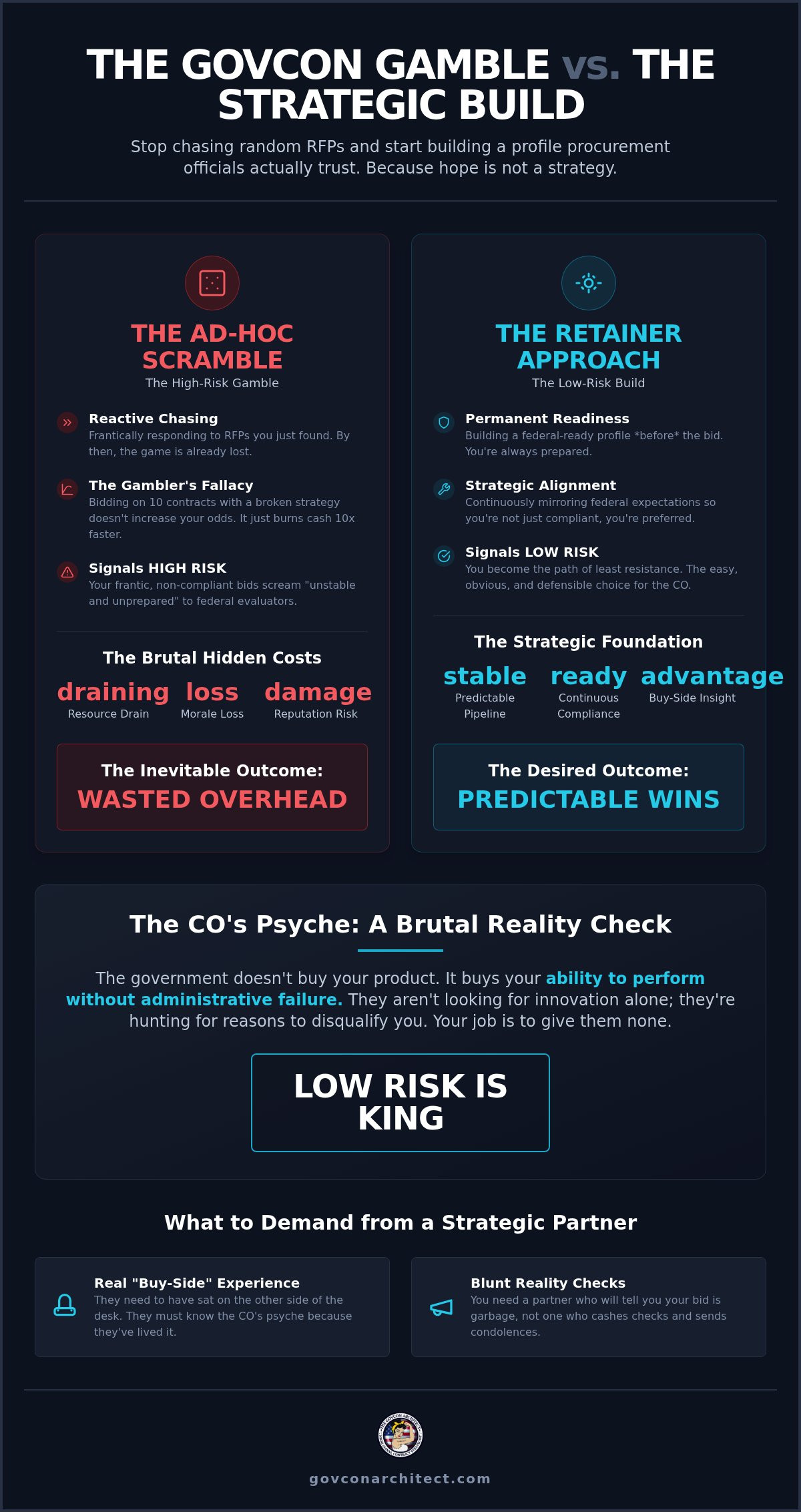
Many firms fall victim to the Gambler’s Fallacy. They believe that bidding on ten contracts instead of two naturally increases their odds. This is a dangerous misunderstanding of the mechanics. If your firm is fundamentally perceived as a high-risk entity, your win rate remains zero regardless of volume. Doubling down on a broken strategy just accelerates your burn rate. Strategic growth requires a shift toward govcon retainer services to fix the underlying structural flaws before the bid goes out. You don't need more bids. You need better alignment.
The hidden costs of this reactive approach are often ignored until the budget is depleted. These costs include:
- Resource Drain: Diverting your most expensive billable staff to unpaid proposal work.
- Morale Loss: Burnout from high-intensity, low-reward bidding cycles that yield nothing.
- Reputational Risk: Establishing a pattern of non-competitive or sloppy submissions with agencies.
The Disqualification Trap
Compliance isn't the goal. It's the bare minimum. When you bid ad-hoc, you're prone to small, technical errors. These aren't just administrative hiccups. To a Contracting Officer, a missing signature or a misaligned NAICS code is a red flag. It suggests you can't manage a federal contract if you can't manage a proposal. "Throwing noodles at the wall" doesn't just waste time; it leaves a trail of failed attempts on your profile. Agencies talk. Your reputation as an unprepared bidder can stick, making future wins even harder to secure.
The Resource Drain of Reactive Bidding
Reactive bidding kills morale. Your best engineers and project managers are pulled away from billable work to chase "no-win" pursuits. The ROI on this is abysmal. You're paying for the effort, but the market only pays for the result. By the time an RFP hits the street, the "Capture" window has already closed for the unprepared. Firms using govcon retainer services operate in that window months in advance. They aren't reacting; they're architecting the requirement. They understand that the real work happens before the solicitation is even drafted. Stop wasting your elite talent on administrative fire drills.
GovCon Retainer Services: Building a Low-Risk Federal Profile
The federal government does not buy your product. It buys your ability to perform without administrative failure. Most firms treat growth as a series of sprints. They wait for an RFP, panic, and then try to look "federal" in three weeks. It doesn't work. Govcon retainer services exist to move you from a state of constant reaction to a state of permanent readiness. This isn't an administrative expense. It's a strategic foundation. You're building a profile that survives the clinical scrutiny of a Contracting Officer (CO).
The goal is simple. You must become the path of least resistance. When a CO evaluates potential bidders on the official U.S. government website for contract opportunities, they aren't looking for innovation alone. They are looking for reasons to disqualify you. They want to ensure that awarding you a contract won't result in a performance failure or a protest. A retainer model ensures your commercial operations mirror federal expectations long before the pursuit begins. You aren't just bidding; you're positioning.
Continuous Alignment with Procurement Standards
Being "Contract-Ready" is not a status you achieve once. It's a perishable asset. Federal Acquisition Regulations (FAR) shift constantly. Compliance thresholds for cybersecurity and accounting are moving targets. If you only check your alignment during a bid cycle, you're already behind. Retainer advisory provides real-time adjustments to your internal controls. It turns market intelligence from a one-time search into a continuous feed. You stay ahead of the curve. You don't just find opportunities; you influence how they are written by engaging with the agency during the pre-solicitation phase.
The Buy-Side Advantage
Experience on the "Buy-Side" is the only way to predict objections. Nikki Gianni spent 22 years on the other side of the desk. She knows the CO’s psyche. They aren't looking for marketing fluff or optimistic projections. They are looking for structural integrity and defensibility. They want to know if you can handle the reporting, the oversight, and the delivery.
Our Monthly Retainer Support focuses on designing internal processes that mirror government risk-assessment frameworks. We teach you how to read between the lines of a draft solicitation. You learn to spot the hidden requirements that often lead to disqualification. This is the difference between "Proposal Support" and true "Pursuit Management." One helps you write a document; the other helps you manage a strategic win. You stop being a vendor and start being a low-risk solution.
Ad-Hoc Support vs. Retainer Advisory: A Reality Check
Ad-hoc support is a transaction. Retainer advisory is a transformation. Most commercial firms treat federal consultants like emergency room doctors; they only call when something is bleeding. This "Project" mindset is fundamentally flawed. It treats a complex, multi-year procurement cycle as a series of isolated events. In reality, federal success is cumulative. When you rely on one-off support, you're paying a premium for a temporary fix that fails to address the underlying structural weaknesses of your firm.
The cost-per-win ratio for ad-hoc firms is significantly higher than those utilizing govcon retainer services. Without a retainer foundation, every new pursuit carries a "learning curve tax." Your consultants must relearn your past performance, your internal capabilities, and your technical stack from scratch every time an RFP drops. This is inefficient. It's expensive. Worse, it leads to "Knowledge Leak." When an ad-hoc consultant finishes a bid, they take their institutional knowledge with them. They've fixed your document, but they haven't fixed your business. A retainer model ensures that every lesson learned stays within your organization, building a repository of strategic intelligence that compounds over time.
The government itself acknowledges the value of sustained expertise. The Federal Acquisition Regulation (FAR) policy on advisory services outlines how agencies leverage external specialists to improve their own decision-making and technical operations. If the government uses a structured advisory model to manage its risk, you should use one to manage yours. Professional govcon retainer services align your firm with this same level of procedural precision.
Strategic Readiness vs. Tactical Response
Tactical response is what happens after the RFP is released. It's reactive. It's desperate. Strategic readiness happens in the "Capture" phase. Industry data suggests that 70% of the win happens before the solicitation ever hits the street. If you are waiting for a proposal writer to save you, you've already missed the window of influence. A strategic advisor doesn't just write what's in the box; they help you shape the box. They identify the agency's pain points months in advance, allowing you to position your firm as the logical, low-risk choice before the competition even knows the opportunity exists.
The ROI of Long-Term Advisory
A retainer is an investment in your firm's structural integrity. It provides predictability in an inherently volatile market. Instead of unpredictable spikes in proposal spending, you establish a consistent, manageable budget for federal business development. This stability allows you to focus on high-probability wins rather than chasing every low-margin contract that appears on your radar. You stop paying for effort and start paying for positioning. The result is a more resilient firm that is built to win, not just to bid.
What to Evaluate in a GovCon Strategic Advisory Partner
Choosing an advisor is a high-stakes decision. Most commercial firms hire consultants who have only ever written proposals. This is a mistake. Writing a bid is easy. Evaluating risk from the perspective of a federal agency is difficult. You need a partner who has sat on the other side of the desk. Without buy-side experience, an advisor is just guessing. They are teaching you theory while you are playing with real capital. Professional govcon retainer services should provide a clinical analysis of your firm's standing, not a collection of templates.
Your advisor must focus on risk mitigation. If they position themselves as "grant writers" or offer "legal representation in protests," they are focused on the wrong end of the lifecycle. Success is built on strategic win-readiness. It requires an understanding of how external entities perceive your value. You don't need a cheerleader. You need a strategist who understands the hidden mechanics of a massive bureaucracy. This is how you transition from commercial success to federal stability.
Experience vs. Theory
Verification is key. Red flags include generalist consultants who lack specific agency insight. You need an advisor who has managed actual federal risk evaluations. They should understand the nuances of the Federal Acquisition Regulation (FAR) and how it applies to your specific industry. Theoretical knowledge doesn't win contracts. Proven past performance in the federal sector does. If your advisor hasn't seen the "Buy-Side" mechanics firsthand, they can't help you navigate them.
The "No-Bid" Discipline
The best advisors save you money by telling you what not to bid on. Reactive firms suffer from "Proposal Fatigue." They chase every RFP because they lack a strategic framework. A disciplined partner provides a "Reality Check." They evaluate opportunities against a rigorous bid/no-bid framework. This prevents your executive team from wasting resources on low-probability pursuits. If you are ready to stop guessing and start winning, explore our Monthly Retainer Support to build a defensible federal pipeline.
GovCon Architect: Monthly Retainer for Elite Commercial Firms
Elite commercial firms do not need another consultant. They need a dedicated federal department. GovCon Architect provides that infrastructure. We do not operate on the periphery of your business; we integrate into your leadership team. Our govcon retainer services act as the strategic anchor for your entire federal division. This model provides the necessary stability to move from reactive, ad-hoc bidding to a clinical, architected pursuit strategy. We don't just help you bid. We ensure your firm is fundamentally built to win.
There is a critical synergy between our Monthly Retainer Support and our Per-Pursuit Project Support. The retainer builds the foundation of structural integrity and risk mitigation. It ensures that when a high-value opportunity arises, your firm is already aligned with federal procurement standards. The per-pursuit support then acts as the tactical execution of that strategy. Without the retainer foundation, project support is just a temporary patch on a high-risk profile. With it, you become the low-risk choice that Contracting Officers are looking for.
The Architect Methodology
Our methodology is rooted in diagnostic precision. We begin by identifying the structural weaknesses in your current federal strategy that signal risk to an evaluator. This involves a cold, clinical look at your past performance, compliance protocols, and internal capture processes. We align your commercial value with the specific risk criteria used by federal agencies. We remove the variables that lead to disqualification. Results are the only metric that matters at GovCon Architect. We prioritize defensibility and competitive positioning over optimistic marketing fluff.
Next Steps for Strategic Growth
Transitioning from ad-hoc bidding to a retainer-based strategy is a move toward professional sobriety. It is a commitment to predictable growth rather than the "gambler's fallacy" of high-volume bidding. If you are tired of the high cost of failed proposals and the confusion of federal risk evaluation, it is time to change your architecture. You can learn more about our approach in our briefing on Why Your Federal Strategy Needs a Monthly Retainer.
The federal market is too expensive for trial and error. You need a partner who understands the hidden mechanics of the system and can guide you through the complexities of high-level competition. Schedule a briefing with GovCon Architect to evaluate your federal readiness. Stop gambling on individual bids and start building a defensible federal pipeline today.
Architect Your Federal Win
Ad-hoc bidding is a tactical dead end. It burns capital and damages your reputation with agencies before you even secure a win. Success in the federal market requires a shift from chasing RFPs to building a defensible, low-risk profile. By utilizing specialized govcon retainer services, you stop reacting to the market and start influencing it. You move from a vendor mindset to a partner mindset, ensuring your internal processes align with the clinical expectations of a Contracting Officer. This is the only way to achieve a predictable sales cycle in a high-stakes environment.
GovCon Architect, led by 22-year federal buy-side veteran Nikki Gianni, specializes in this commercial-to-federal transition. We don't offer generic advice or administrative fluff. We provide the strategic architecture necessary to position your firm as a low-risk bidder who understands the mechanics of the system. It's time to stop gambling on individual bids and start building a predictable pipeline based on structural integrity and professional sobriety.
Secure your federal future with GovCon Architect Monthly Retainer Support.
Your path to federal stability is ready. Let's begin the work.
Frequently Asked Questions
What is included in a GovCon retainer service?
Professional govcon retainer services provide a dedicated federal department for your firm. This includes continuous risk assessment, capture management, and real-time alignment with the Federal Acquisition Regulation (FAR). You aren't paying for a document; you're paying for a defensible strategic foundation that integrates into your leadership team.
How does a retainer improve our federal contract win rate?
A retainer improves your win rate by removing the variables that lead to disqualification. Contracting Officers are risk-averse by nature. They prioritize firms that mirror their own procedural precision. By aligning your commercial operations with their evaluation criteria, you stop being a vendor and start being the low-risk choice.
Is a retainer more expensive than hiring per-pursuit support?
Ad-hoc support carries a hidden "learning curve tax" that makes it more expensive over time. Every new pursuit requires your consultants to relearn your business from scratch. A retainer provides a predictable budget and ensures institutional knowledge stays within your firm. It turns federal business development from a series of expensive sprints into a managed, high-ROI process.
Can a strategic advisor help us if we have never won a federal contract?
Strategic advisory is essential for firms with zero federal past performance. It prevents you from damaging your reputation with agencies through sloppy, high-risk submissions. We help you build a "Contract-Ready" profile from day one. This allows you to compete effectively by meeting the clinical standards of a federal evaluator before you ever submit your first bid.
What is the difference between a GovCon consultant and a proposal writer?
A proposal writer is a tactical asset who fills in the blanks of an RFP. A strategic advisor is an elite partner who influences how those blanks are written. One focuses on administrative compliance; the other focuses on competitive positioning. You need a strategist to win, not just to submit a compliant document.
Do GovCon retainers include legal representation for bid protests?
No. GovCon Architect does not provide legal representation for bid protests or grant writing services. Our focus is on strategic win-readiness and risk mitigation. We ensure your bid is structurally sound and defensible so that the need for a protest is minimized from the start.
How long does it take to see results from a strategic retainer?
You see results immediately through the "No-Bid" discipline. You stop wasting resources on low-probability pursuits the moment the strategy is implemented. Long-term results, such as prime contract awards, typically follow the federal procurement cycle, which often ranges from six to eighteen months depending on the agency.
Why does GovCon Architect focus on "risk evaluation" instead of just "writing bids"?
The government buys based on risk, not just price. Contracting Officers look for reasons to disqualify bidders to protect their agency from performance failure. We focus on risk evaluation because that is the hidden mechanic of the system. If you solve the CO's risk problem, you solve your win-rate problem.