

In-House vs. Outsourced Proposal Writing: Which Model Fits Your Federal Bid Strategy?

Article by
Nikki Gianni
Nikki Gianni is a seasoned business strategist and government contracts coach, dedicated to helping businesses successfully navigate the complexities of government contracting. With over 22 years of experience in Department of Defense contracting, including managing $20 billion in federal awards, Nikki has developed the innovative GovReady Blueprint™ Framework, a comprehensive 90-day program designed to prepare businesses to compete for and win lucrative contracts at the federal, state, and local levels. Nikki's approach emphasizes not just gaining contracts but also enhancing overall business profitability.
Before becoming a business owner, Nikki was active-duty Air Force for 10 years, then spent another 15 years as a civil servant with the DOD. Now she's an empty nester living in Southern California who loves spending time with her 22-year-old son, Lex and her 2 Mini Aussies, Tony & Carmela, doing home improvement and crafts projects, and networking.
The safest choice in the in-house vs outsourced proposal writing debate may be a blend of both. Your team knows the solution. Outside support can add capacity and structure. Neither advantage matters if the proposal misses what evaluators are scoring. A polished bid that ignores the requirements is expensive decoration.
Internal staff may have to fit proposal work around their actual jobs. External support can produce clean copy that still misses the details of your technical approach. And no writer, in-house or outsourced, can take responsibility for your solution or commitments off leadership’s desk. The government needs to assess whether your offer is compliant, credible, and low risk. Make that easy to see.
This article compares the trade-offs and risks, then shows you how to choose a model based on your team’s capacity and federal experience. You’ll see where in-house ownership matters, when outside support can help, and how a blended approach can keep technical accuracy, executive review, and evaluator alignment intact. Proposal writing is not a last-minute typing contest.
Key Takeaways
- Use the in-house vs outsourced proposal writing comparison to assess bid frequency, team capacity, federal experience, and the technical input each pursuit requires.
- Build proposal structure around the solicitation’s instructions and evaluation factors. Polished language cannot make up for a response that leaves the evaluator guessing.
- Keep leadership accountable for the solution, pricing, and commitments, even when outside support helps develop the proposal.
- Match support to the need: PER-PURSUIT · PROJECT - Capture & Proposal Sprint for a specific opportunity, or RETAINER · MONTHLY - Fractional Federal Strategy Advisor for ongoing strategy.
In-House vs. Outsourced Proposal Writing: What Is Actually Being Compared?
In-house vs outsourced proposal writing is a decision about who develops the bid content and how the work gets done. In-house means employees lead the writing. Outsourced means an external professional adds writing capacity. A blended model combines internal ownership with outside assistance. A business proposal presents an offer, but a federal bid must also respond to the specific solicitation. That is not just a formatting exercise.
For firms with $5M or more in annual revenue and at least 5 years of proven delivery, the choice should reflect actual capacity and federal experience. Proposal writing is only one part of a bid. Capture strategy, compliance management, and technical solution design shape the work too. Hiring a writer does not make those responsibilities magically disappear.
| Factor | In-house | Outsourced | Blended |
|---|---|---|---|
| Ownership | Internal team leads | External writer drafts | Shared execution, internal accountability |
| Capacity | Depends on staff workload | Adds writing bandwidth | Scales support to the pursuit |
| Federal insight | Depends on team experience | Depends on the support’s expertise | Pairs company knowledge with outside perspective |
| Continuity and review | Knowledge stays inside; staff must be available | Requires clear inputs and company review | Internal leads preserve context and approve content |
What does an in-house proposal team control?
Internal staff can coordinate subject-matter experts, control technical content and approvals, and keep the company voice consistent. But access to experts is not the same as available capacity. Before assigning a bid, check whether the team has protected time to write and review, understands federal proposals, and can get timely input from the people who deliver the work. Otherwise, proposal work competes with everyone’s day job. The day job usually wins.
What does outsourced proposal support add?
Outside support can add writing capacity, but that alone does not provide sound judgment about buyer priorities or perceived risk. Leaders still own the accuracy and supportability of the content, including the proposed solution and commitments. An external writer can help articulate the offer. They cannot make an unsupported promise safe.
A blended model can preserve internal technical control while adding capacity or buy-side perspective for a specific pursuit. That broader approach to federal contract pursuit support keeps the writing connected to the strategy, rather than stranded in a document.
Why Federal Evaluator Alignment Matters More Than Polished Writing
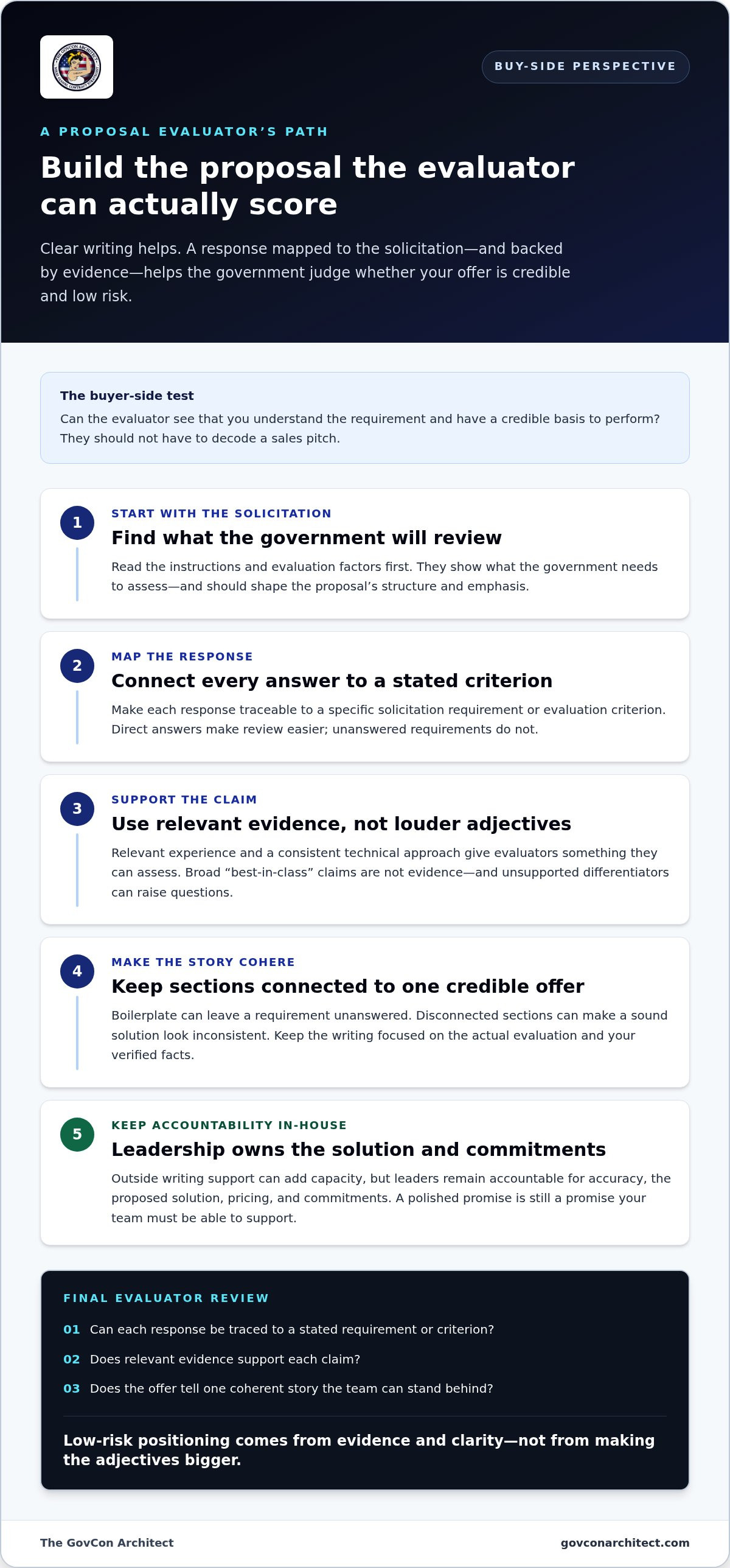
Federal evaluators need to assess whether an offeror meets the solicitation’s requirements and can perform the proposed work. The solicitation’s instructions and evaluation factors show what the government needs to review, so they should shape the proposal’s structure and emphasis. Clear writing helps. It cannot rescue a missing response, thin evidence, or a claim your team cannot support. The evaluator is not there to decode your sales pitch.
Evaluator alignment means making each response traceable to a stated solicitation requirement or evaluation criterion, with relevant evidence to support the claim. That is how writing helps the government assess the offer, rather than simply admire the prose.
How buyer-side thinking changes proposal decisions
From the buyer’s side, the question is practical: does this offeror understand the requirement, and does the proposal give the government a credible basis to judge its ability to perform? Broad claims about being “best-in-class” do not answer that. Relevant experience, a consistent technical approach, and direct responses give evaluators something they can assess. Low-risk positioning comes from evidence and clarity, not louder adjectives.
This changes the in-house vs outsourced proposal writing decision. Whoever drafts the content needs to work from the solicitation and the company’s verified facts, not just a generic pitch deck. For a closer look at how criteria shape the review, see this guide to government bid evaluation criteria.
Where writing support can fail without strategy
Writing capacity is useful. Strategy keeps the draft focused on the actual evaluation. Boilerplate can leave a requirement unanswered. An unsupported differentiator can raise questions instead of confidence. Disconnected sections can make a sound solution look inconsistent. Review the proposal as an evaluator would: Can each response be traced to a stated requirement or criterion? Does the evidence support the claim? Does the offer tell one coherent story?
With 22 years of buy-side experience, Nikki Gianni brings evaluator perspective to federal pursuit strategy. A focused discussion can help established firms consider how that perspective fits a specific bid. Explore a pursuit strategy discussion with The GovCon Architect.
How to Choose Between In-House, Outsourced, and Blended Proposal Writing
Choose the model that closes your actual gaps, not the one that sounds easiest to explain in a meeting. Use this framework to assess in-house vs outsourced proposal writing before assigning the next bid.
- Bid frequency: Is proposal work steady and repeatable, or does it surge around occasional pursuits?
- Internal capacity: Can staff produce and review a proposal without pulling critical people away from delivery?
- Federal experience: Does the team understand solicitation instructions and how to organize responses around evaluation criteria?
- Technical input: Can subject-matter experts provide accurate evidence and validate the solution on the proposal schedule?
If the work is routine, repeatable, and supported by trained staff and reliable reviews, internal ownership can preserve continuity and company knowledge. If a defined pursuit exceeds available capacity or needs buyer-side perspective, focused external support can reinforce the team. This is not about outsourcing accountability. It is about putting the right expertise on the right work.
When does in-house writing make sense?
In-house writing fits sustained proposal volume when trained staff have federal experience, protected time, and a review process that catches gaps before submission. Do not assume strong commercial writing transfers automatically. Federal bids follow solicitation-specific instructions. A persuasive sales narrative is no substitute for a direct, evidence-based response.
When can a blended model reduce proposal risk?
Keep technical facts close to the people who deliver the work. Internal subject-matter experts should validate evidence and solution details. External strategic support can help align the pursuit, structure the proposal, and review it through an evaluator’s lens. This division can reduce the risk of polished but disconnected content. See these common federal proposal writing mistakes.
Assign named owners before drafting begins: one for solicitation compliance, one for technical accuracy, an executive approver for commitments, and an internal lead accountable for final review and submission. A writer can shape the response. Your company owns what it says.
Match Proposal Support to the Pursuit, Without Surrendering Accountability
The right support depends on whether the need is concentrated in one bid or spans ongoing federal strategy. PER-PURSUIT · PROJECT - Capture & Proposal Sprint provides support tied to a specific opportunity. RETAINER · MONTHLY - Fractional Federal Strategy Advisor provides continuing federal strategy support across pursuits. These are distinct engagement models, not interchangeable labels for “someone else handles the proposal.”
Both can draw on buy-side perspective. Nikki Gianni has 22 years of experience as a government buyer, evaluator, awarder, and contract administrator. That lens keeps the work centered on what government evaluators need to assess: a clear, evidence-based case for a capable, low-risk offeror.
What should a company retain in its own hands?
Your company owns the truth behind the offer. Leadership and designated reviewers must validate technical facts, delivery evidence, pricing decisions, approvals, and final commitments. External support can help shape and align the proposal, but it cannot verify your operating reality or make executive decisions for you. Assign internal owners before drafting begins. Otherwise, accountability becomes a game of hot potato, and the government is not buying the potato.
For a deeper look at the buy-side approach, read this guide to federal contract pursuit support. For related guidance on proposal development, see federal proposal development consulting. The central point holds: choose support around the pursuit’s needs, then keep company leaders accountable for every claim and decision.
Established firms with $5M or more in annual revenue and at least 5 years of proven delivery can use a 15-minute get-to-know-you call to discuss whether pursuit-specific or ongoing support better fits their federal strategy.
Build a Proposal Model That Makes the Bid Easier to Trust
The right in-house vs outsourced proposal writing model is not a permanent allegiance to one camp. It is the setup that matches your bid workload, federal experience, and technical input needs. Internal teams bring company knowledge and control. Outside support can add capacity and evaluator perspective. A blended approach can connect the two.
Whichever model you choose, keep ownership clear. Your leaders remain responsible for technical facts, evidence, pricing decisions, approvals, and final commitments. The goal is not just a polished proposal. It is a compliant, evaluator-aligned offer that gives the government a clear basis to assess your ability to deliver with low risk.
Nikki Gianni of GovCon Architect brings 22 years of buy-side experience, including direct work as a government buyer, evaluator, awarder, and contract administrator. That experience informs proposal guidance aligned with how evaluators score submissions. No magic words. Just a clearer line between your evidence and the government’s decision.
You’ve built real delivery capability. With the right proposal model and clear accountability, you can put that experience in front of evaluators with confidence.
Frequently Asked Questions
Is outsourcing federal proposal writing worth it?
It can be when your firm needs focused writing capacity or federal acquisition insight that is not available internally. The value of in-house vs outsourced proposal writing depends on more than drafting hours. Consider pursuit strategy, solicitation compliance, technical review, and executive ownership. Before assigning work, assess the opportunity and your team’s capacity. Outside support can strengthen preparation, but it cannot supply your company’s evidence or guarantee an award.
Can we write a federal proposal in-house and use outside support for review?
Yes. A blended approach can keep technical facts and delivery evidence with your team while adding independent strategy or evaluator-focused review. Set responsibilities before drafting: name who tracks solicitation instructions, validates each response, approves claims, and controls submission. This model works when internal reviewers have the time and authority to do their jobs. An outside reviewer can sharpen the proposal, not replace the people who know the work.
What are the main risks of outsourcing proposal writing?
The main risks are unclear ownership, generic language, inaccurate technical content, and a draft that does not follow the solicitation’s instructions and evaluation factors. Reduce those risks by assigning internal reviewers, giving writers access to subject-matter experts, and checking claims against company evidence. External writing capacity does not replace pursuit strategy or company approval. A clean draft is useful. A clean draft that answers the wrong question is still the wrong draft.
How do I decide whether to hire an in-house proposal writer?
Start with your bid volume and cadence, available staff capacity, and federal proposal experience. Then assess whether your team can sustain solicitation tracking, technical input, and review without disrupting delivery work. An in-house writer may fit ongoing proposal needs when the workload and expertise are established. Outside support may better address a defined pursuit or temporary capacity gap. Choose based on the work your team can reliably own.
Does outsourcing proposal writing guarantee a federal contract award?
No. No writing model can guarantee an award. A proposal needs to follow the specific solicitation, present accurate evidence, and give evaluators a clear basis to assess the offer. Strategy and disciplined review can strengthen positioning, but the award depends on the procurement and its evaluation. Treat proposal support as preparation and risk management, not certainty. Anyone promising a guaranteed win is selling confidence, not control over the government’s decision.