
How to Win 8(a) Sole Source Contracts in 2026: A Buy-Side Playbook

Article by
Nikki Gianni
Nikki Gianni is a seasoned business strategist and government contracts coach, dedicated to helping businesses successfully navigate the complexities of government contracting. With over 22 years of experience in Department of Defense contracting, including managing $20 billion in federal awards, Nikki has developed the innovative GovReady Blueprint™ Framework, a comprehensive 90-day program designed to prepare businesses to compete for and win lucrative contracts at the federal, state, and local levels. Nikki's approach emphasizes not just gaining contracts but also enhancing overall business profitability.
Before becoming a business owner, Nikki was active-duty Air Force for 10 years, then spent another 15 years as a civil servant with the DOD. Now she's an empty nester living in Southern California who loves spending time with her 22-year-old son, Lex and her 2 Mini Aussies, Tony & Carmela, doing home improvement and crafts projects, and networking.
An 8(a) sole-source path removes competition. It doesn’t remove the buyer’s risk test. If you’re asking how to win 8(a) sole source contracts, start here: eligibility may open a door, but it doesn’t make an award inevitable. Certification isn’t a force field against questions about mission fit, execution, or whether the decision can be defended.
That distinction matters. The government buyer needs a sound reason to advance the opportunity and confidence that your firm can deliver without creating new problems. To assess the path from eligibility to award, look at the agency’s stated need, its acquisition approach, and the evidence that makes your pursuit credible. Hope is not an acquisition strategy. It’s barely a project plan.
This playbook breaks down the buyer’s decision path, the acquisition questions to resolve, and the proof your bid needs to reduce performance risk. You’ll also get a disciplined way to decide whether to pursue or walk away. The GovCon Architect’s Nikki Gianni brings 22 years of buy-side experience to that perspective. The goal isn’t to chase every opening. It’s to make the buyer’s low-risk decision easier to defend.
Key Takeaways
- Learn how to win 8(a) sole source contracts by building a pursuit around the agency’s requirement, not just your program status.
- Connect relevant delivery evidence and past performance to the buyer’s need so your approach is easier to assess.
- Before committing proposal resources, validate opportunity fit and verify the acquisition details and current program requirements.
- For complex or consequential bids, targeted pursuit support can sharpen positioning and preparation, but no advisor can guarantee an award.
How 8(a) Sole-Source Contracts Work, and Why Eligibility Is Not an Award
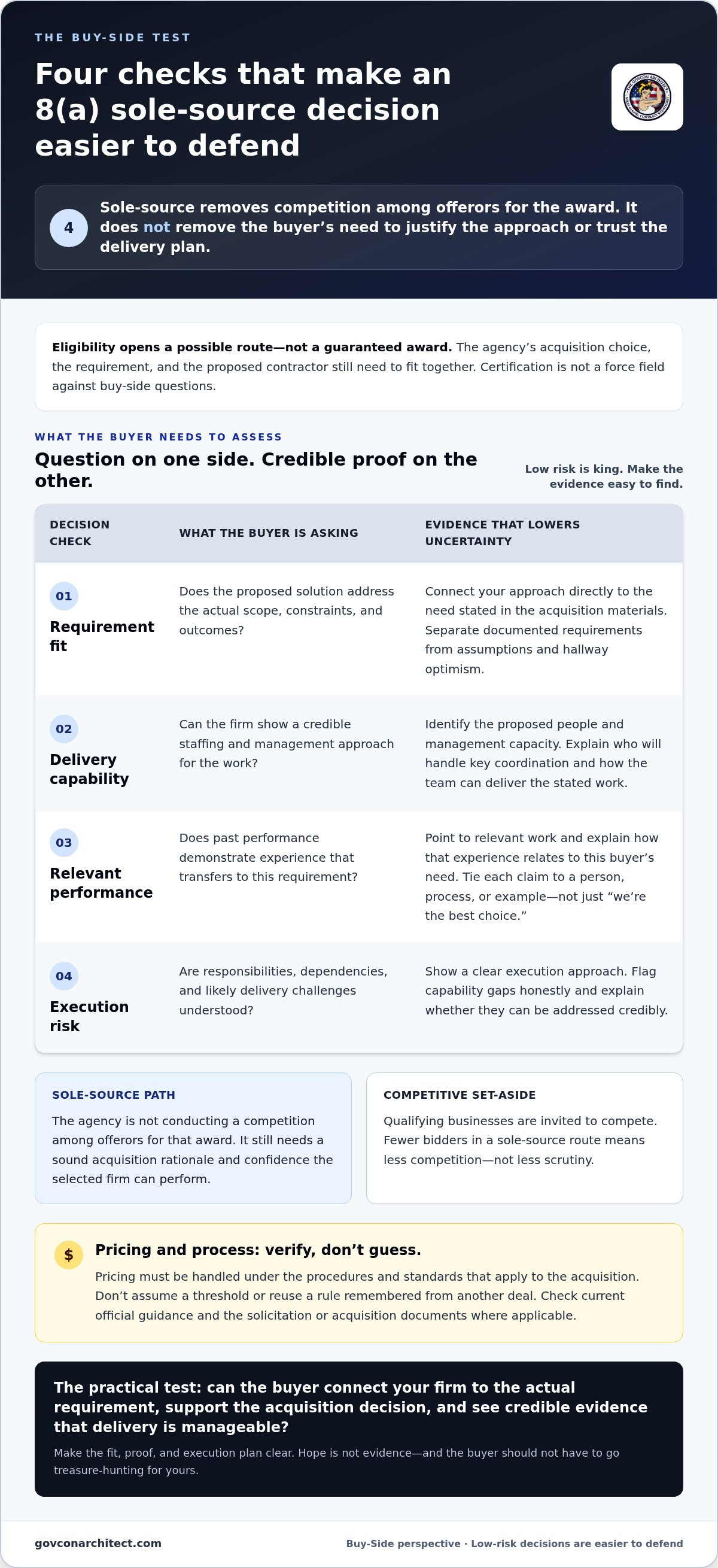
An 8(a) sole-source award is a federal contract awarded to an eligible 8(a) participant without competition among offerors for that requirement. A competitive set-aside, by contrast, invites qualifying businesses to compete. Fewer bidders does not mean no scrutiny. The government still needs a sound acquisition rationale and confidence that the selected firm can perform.
Eligibility opens a potential acquisition route. The agency’s acquisition choice determines whether that route is used, and the award decision depends on the buyer’s assessment of the opportunity and the proposed contractor. That distinction is the foundation of how to win 8(a) sole source contracts. The 8(a) Business Development Program provides background on the program, but being eligible is not a claim ticket for a contract. The buyer still has a job to do.
What sole-source means in an 8(a) pursuit
Sole-source means the agency is not conducting a competition among offerors for that award. It does not mean the agency must select a particular firm, or that acquisition procedures disappear. Agency and SBA roles depend on the applicable process, so use current official guidance to identify the requirements and approval steps for the opportunity. Guessing is not a process. It’s just risk with better stationery.
Why 8(a) status alone does not close the deal
The buyer must be able to connect your firm to the actual requirement, support the acquisition decision, and see credible evidence that delivery is manageable. Relevant past performance, available capability, and a clear execution approach help answer the question behind the paperwork: “Can this firm deliver without making my job harder?” That is the buy-side test.
8(a) certification establishes program eligibility; it doesn’t replace opportunity-specific positioning. For a broader view of what makes a pursuit credible to the buyer, use this buy-side approach to winning federal work. Certification gets you into consideration. Delivery credibility gives the buyer a reason to proceed.
What Government Buyers Assess Before an 8(a) Sole-Source Award
A buyer isn’t simply asking, “Is this firm eligible?” The real test is whether the requirement, the proposed contractor, and the acquisition rationale fit together in a way the agency can support. Sole-source changes the competition path. It does not erase the need to explain why this approach makes sense or why this firm can deliver.
- Requirement fit: Does the proposed solution address the actual scope, constraints, and outcomes?
- Delivery capability: Can the firm show a credible staffing and management approach for the work?
- Relevant performance: Does past performance demonstrate experience that transfers to this requirement?
- Execution risk: Are responsibilities, dependencies, and likely delivery challenges understood?
How the buyer evaluates delivery confidence
Specific evidence beats broad claims. If the work requires coordinated technical support, identify who will manage that coordination, explain how the team’s experience relates to the requirement, and point to relevant performance. “We’re the best choice” is a conclusion, not evidence. The buyer needs details that make the conclusion credible. Make it easy to connect each claim to a person, process, or example of relevant work.
Price needs the same discipline. The agency must handle pricing under the procedures and standards that apply to the acquisition. Don’t assume a threshold or reuse a rule remembered from another deal. Check current official guidance, including the SBA 8(a) Business Development Program, and the solicitation or acquisition documents where applicable.
Why acquisition trends do not replace opportunity analysis
Commentary about 2026 award patterns can prompt useful questions, but it is not a forecast for your opportunity. Verify the source, period, and method behind any trend before using it to shape a decision. Market headlines won’t tell you what this buyer needs or how this requirement will be assessed. The relevant government bid evaluation criteria are the ones tied to the actual acquisition.
A low-risk offer makes the buyer’s decision easier to defend because its fit, evidence, and execution plan are clear. That is the practical heart of how to win 8(a) sole source contracts. If a high-stakes pursuit has unclear priorities or consequential delivery risk, opportunity-specific strategy support can help sharpen the analysis before proposal effort is committed.
How to Position and Pursue an 8(a) Sole-Source Opportunity
A credible pursuit starts before proposal writing. The buyer needs a clear connection between the requirement and your ability to deliver. Use this sequence to test whether the opportunity deserves your resources:
- Validate fit. Compare the requirement with your delivery record, capacity, and strategic priorities. 8(a) status alone is not a bid/no-bid rationale.
- Understand the buyer’s need. Identify the outcomes, constraints, scope, and schedule stated in the acquisition materials. Separate documented needs from assumptions or hallway optimism.
- Test delivery evidence. Match relevant past performance, proposed personnel, and management capacity to the work. Flag gaps honestly and decide whether they can be addressed credibly.
- Plan the response. Organize the proposal around stated requirements and any evaluation factors the agency provides. Don’t invent criteria or make the buyer hunt for proof.
Validate the opportunity before building the bid
Before committing proposal resources, verify the acquisition path, scope, timing, pricing instructions, applicable eligibility requirements, and any required agency or SBA steps against current official guidance and acquisition documents. The Federal Acquisition Regulation on 8(a) sole-source acquisitions is a starting point, not a substitute for checking the rules that apply to this specific opportunity. If your capacity or evidence doesn’t hold up, walking away is a sound business decision.
Build a response the buyer can defend
Trace each claim to a requirement, evidence source, or specific delivery commitment. For example, if the work calls for coordinated project management, identify the responsible role and show relevant experience. “We can do it” is nice. It is not a management plan. Strong federal contract pursuit support can help structure the opportunity analysis and keep the response anchored in buyer priorities.
That discipline is central to how to win 8(a) sole source contracts: make the fit and delivery logic easy to follow, without promising what the evidence can’t support.
When Pursuit Support Makes Sense for an 8(a) Sole-Source Bid
Opportunity-specific strategy can help when the requirement is complex, the consequences of a weak response are high, or the buyer’s priorities aren’t clear from the available materials. Those are moments to slow down and test the pursuit, not throw more pages at it. The agency needs confidence in its decision and your ability to execute. Preparation can strengthen your positioning. It can’t guarantee an award, and anyone promising otherwise is selling theater.
For established firms with $5M+ in annual revenue and 5+ years of proven delivery, GovCon Architect’s PER‑PURSUIT · PROJECT - Capture & Proposal Sprint provides targeted support for a specific opportunity. The work focuses on strategic preparation: clarifying the buyer’s priorities, connecting your evidence to the requirement, and shaping a response around the acquisition’s stated evaluation and risk considerations. The project starts at $3,000 per pursuit, with pricing dependent on the complexity of the bid product or service.
What focused pursuit support should address
Useful support starts with the buyer’s perspective. It examines whether the pursuit makes sense, where your delivery evidence is strong, and where the proposal needs greater precision. Claims should map to requirements and substantiated experience; commitments should reflect what your team can actually deliver. The goal is not a louder promise. It’s a clearer, more defensible case for why your approach reduces execution risk.
Choose a clear next step
If the opportunity is consequential or the buyer’s priorities remain fuzzy, a focused conversation can help you determine what deserves attention before the proposal effort expands. Bring the acquisition details and the questions you can’t yet answer. A 15-minute get-to-know-you call is a practical first step to discuss the opportunity and whether targeted pursuit support fits.
Make Your Next Pursuit a Deliberate One
The next move isn’t automatically “write the proposal.” It’s deciding whether this opportunity deserves focused effort and whether your evidence can support a credible, deliverable commitment. That discipline protects your team’s resources and gives the buyer a clearer basis for confidence. No magic phrasing required. The work is in the alignment.
For firms weighing how to win 8(a) sole source contracts, GovCon Architect brings guidance shaped by 22 years of experience across government buying, evaluation, award, and contract administration. Pursuit strategy aligns with how government buyers assess proposals and risk, with the aim of strengthening preparation and positioning, not promising an award.
If you have a specific opportunity in view, use a short conversation to clarify the strategic questions before the pursuit gathers momentum.
A disciplined pursuit starts with a decision you can stand behind. You’re capable of making that decision with clear eyes and a buyer-focused plan.
Frequently Asked Questions
Can an agency award an 8(a) sole-source contract without a competitive solicitation?
Yes, an agency may use an 8(a) sole-source route without competition among offerors, subject to applicable acquisition procedures. That doesn’t make an award automatic: the agency still needs a supportable decision for the specific requirement. For anyone assessing how to win 8(a) sole source contracts, verify current SBA and agency requirements before relying on assumptions about approvals, limits, or exceptions.
Does 8(a) certification guarantee a sole-source contract?
No. Certification may make a firm eligible for certain opportunities, but it doesn’t require an agency to select that firm or choose a sole-source approach. An agency may determine that a different acquisition path better fits its requirement. Treat certification as one part of readiness, then assess whether your firm can address the actual scope, timing, and delivery demands.
How long does it take to win an 8(a) sole-source contract?
There’s no dependable timeline to promise. The path can vary with the agency’s acquisition planning, the requirement, current procedures, and how prepared the firm is to respond. To assess timing, map known milestones from the acquisition materials, identify unanswered questions, and verify applicable steps through current official guidance. Don’t build staffing or revenue plans around an assumed fast award.
Can an 8(a) company pursue competitive contracts as well as sole-source opportunities?
Yes, an 8(a) firm may pursue both competitive and sole-source opportunities, subject to the rules that apply to each acquisition. The route isn’t a permanent feature of the company; it depends on the specific requirement and agency approach. Compare the opportunity’s scope, competition, response demands, and your delivery capacity. Check current program guidance for eligibility details or restrictions before committing resources.
What should an 8(a) firm do if an agency isn’t pursuing a sole-source award?
Reassess the opportunity rather than assuming it’s lost or that the agency should change course. Review the stated procurement route, requirements, competitive demands, and your evidence of delivery capacity. Then decide whether a competitive pursuit fits your priorities and resources. Use current official guidance to understand the applicable process, and make the bid/no-bid call based on the opportunity, not disappointment.