

Government Contractor Risk Management: The Buy-Side Reality Check
What if the reason you're losing federal bids isn't your price, but the fact that you're accidentally terrifying the person holding the pen? To a federal contracting officer, your $5M commercial success doesn't always look like a win; it looks like a variable they can't control. In the world of government contractor risk management, being "good" is irrelevant if you aren't "safe."
You've spent years building a powerhouse firm. It's insulting to watch gurus tell you that a new logo or a SAM registration is the secret sauce. It isn't. The Buy-Side doesn't care about your hustle; they care about their own career survival. Low risk is king. If awarding you a contract makes an auditor look twice, you've already lost. I'm writing this because I'm tired of seeing elite firms get sidelined by bad advice. You deserve a seat at the table.
You will learn exactly how federal buyers evaluate your corporate DNA so you can position your firm as the most defensible choice available. We'll examine why the government behaves this way, how they view the $793 billion market, and how to engineer your business to eliminate buyer anxiety.
Key Takeaways
- Understand that "The Buy-Side" doesn't care about your hustle; they care about career survival, making government contractor risk management your most important competitive weapon.
- Learn why basic compliance is just the floor and how building a "defensible" infrastructure provides the Contracting Officer with a bulletproof justification for awarding you the win.
- Identify the "Three Pillars" of risk, specifically your financial stability and past performance, to prove your $5M+ firm has the staying power to finish what it starts.
- Discover how a 90-120 day alignment process maps your existing commercial success to the specific evaluation criteria found in Sections L and M of a federal solicitation.
- Realize why a $3,500 monthly retainer for a fractional advisor is a far safer bet than gambling on a million-dollar pursuit without a master architect behind the scenes.
The Buy-Side Perspective: Why 'Low Risk' is the Only Metric That Matters
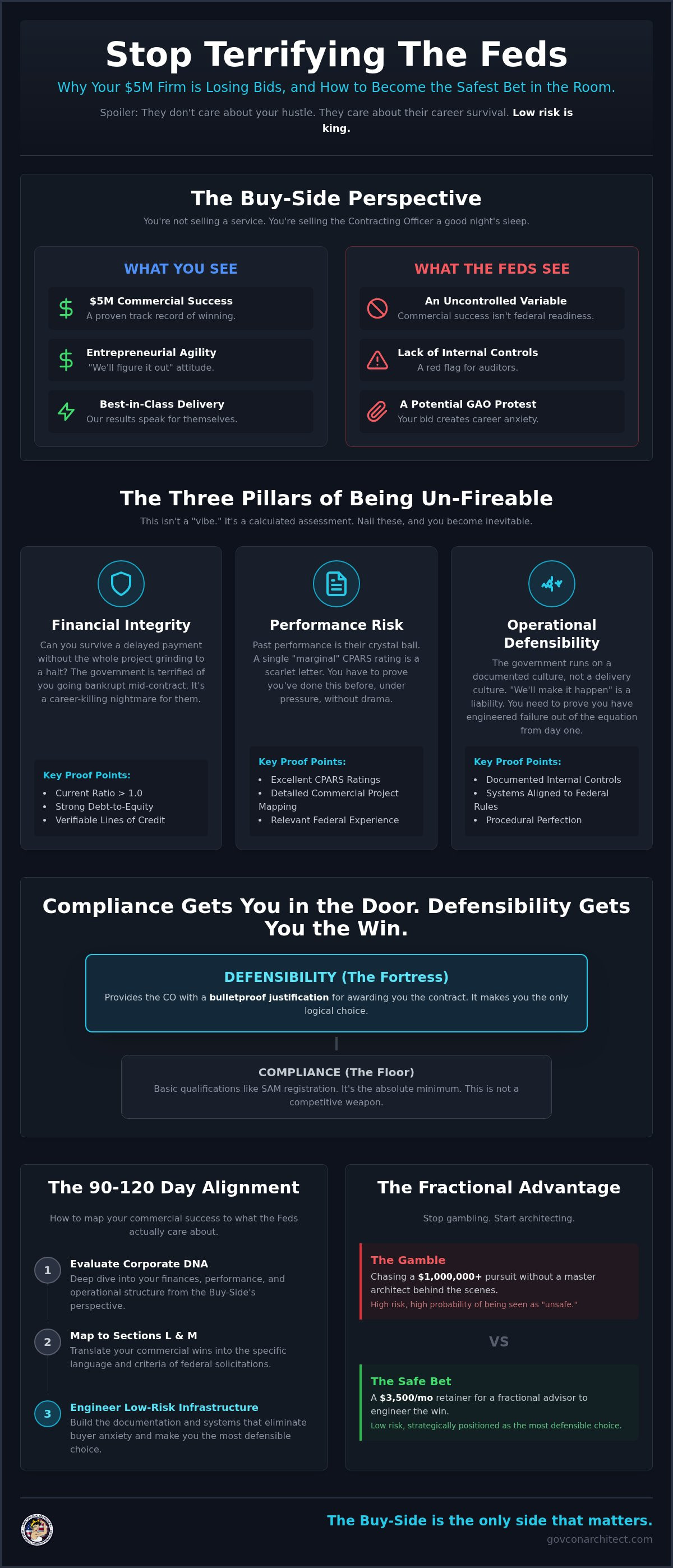
You think your $5M revenue and "best-in-class" commercial track record make you a shoo-in. You're wrong. In the government procurement process, the Contracting Officer (CO) isn't your cheerleader. They're a professional skeptic. Their primary objective isn't to find the most innovative solution; it's to avoid getting hauled in front of a supervisor because a contract blew up or a losing bidder filed a GAO protest. If your bid creates even a flicker of career anxiety for the person holding the pen, it's headed for the shredder.
We call this "The Buy-Side." It's the only perspective that matters. Effective government contractor risk management starts with realizing that "best value" is often just code for "the option that won't get me fired." You aren't selling a service. You're selling the CO a good night's sleep. If you can't prove that your firm is the safest, most defensible choice on the table, your technical superiority is irrelevant.
The Psychology of the Federal Evaluator
COs are risk-averse by design. Their performance isn't measured by how much money they saved the taxpayer. It's measured by contract stability, procedural perfection, and the absence of litigation. A "safe" bid is a defensible bid. When they choose a winner, they need a mountain of documentation to prove to an auditor that you were the only logical choice. There's a massive difference between being a capable firm and being a low-risk firm. Capability is about what you can do. Low risk is about proving you won't fail when the stakes are high. They don't want a partner who "figures it out" on the fly; they want a partner who has already engineered failure out of the equation.
Why Commercial Excellence Doesn't Equal Federal Readiness
Your commercial success might actually be your biggest liability. In the private sector, a handshake and a "we'll make it happen" attitude get deals done. In the federal world, that looks like a lack of internal controls. The government operates on a documented culture, not a delivery culture. Five years of commercial delivery is just a baseline. It doesn't prove you can handle the reporting requirements of a $793 billion bureaucracy. If your internal systems aren't aligned with federal evaluation criteria, the CO sees a "high risk" label where you see "entrepreneurial spirit." Don't mistake your commercial agility for federal readiness.
Buy-Side Risk is the gap between your actual performance and the CO's perception of it.
The Three Pillars of Government Contractor Risk Management
Risk isn't a vague "vibe" the government feels about your company. It's a calculated assessment based on three specific structural pillars. If any of these pillars are weak, the Contracting Officer (CO) will view your $5M+ firm as a liability rather than an asset. Mastering government contractor risk management means moving beyond "doing good work" and starting to document your stability with clinical precision. You have to prove that you aren't just capable; you're inevitable.
Financial Integrity and Staying Power
The government is terrified of you going bankrupt in the middle of a multi-year project. It's a logistical nightmare that kills careers. For firms with $5M+ in revenue, COs look for specific indicators of staying power. They aren't just checking your bank balance. They're looking at your current ratio, debt-to-equity, and your access to capital. If your current ratio is below 1.0, you're telling the Buy-Side you're one late payment away from a total shutdown. Your banking relationships and lines of credit aren't just business tools; they're evidence that you can weather the slow-moving gears of federal payment cycles without missing a deadline.
Performance Risk: The Power of Past Performance
Past performance is the government's favorite crystal ball. If you've already performed for the federal government, your CPARS (Contractor Performance Assessment Reporting System) ratings are your permanent record. You can't afford a single "marginal" rating; it's the professional equivalent of a scarlet letter. If you're a commercial powerhouse moving into federal, you must map your commercial projects to federal requirements with extreme detail. You don't just "provide construction services." You "deliver complex infrastructure projects under strict regulatory oversight." If you have a performance gap, use teaming partners strategically to shore it up. The Buy-Side values a team with zero gaps over a solo firm with "potential."
Compliance: FAR, DFARS, and Beyond
Compliance is a structural requirement, not a paperwork exercise. Don't listen to the "get certified" gurus who tell you a new badge on your website is the secret to winning. The CO knows the difference between a firm that bought a template and a firm that has built its infrastructure around the Government Bid Evaluation Criteria. Using a $99 capability statement template tells the buyer you're a hobbyist. Real compliance means your internal systems, from accounting to cybersecurity, are built to withstand an audit. If you're serious about aligning your infrastructure for federal competition, you need to treat the FAR and DFARS as your operational blueprint, not a checklist you finish right before a deadline.
The interplay between these pillars is what determines your fate in the RFP process. A firm with perfect compliance but shaky financials is still a high-risk bet. A firm with great financials but no performance history is a ghost. You need all three to build the "bulletproof" defensibility that COs crave.
Defensibility vs. Compliance: Why Being 'Qualified' Isn't Enough
Being "qualified" is the bare minimum. It's the cost of entry. In the federal market, thousands of firms are qualified; only one is defensible. Compliance is the floor, but defensibility is the ceiling that actually wins the contract. If you're a $5M+ commercial powerhouse, you're likely used to winning on merit, speed, and innovation. The government doesn't care. They care about whether the Contracting Officer (CO) can defend their decision to a hostile auditor six months from now. If your proposal doesn't provide that "bulletproof" justification, you aren't a contender; you're just background noise.
Effective government contractor risk management means moving beyond the checklist. It's about engineering your bid so that choosing you is the only logical, low-risk path for the agency. When the evaluation board sits down, they're looking for reasons to disqualify you to make their pile of work smaller. Your job is to make it impossible for them to find a hole. This requires a shift from "marketing" to "strategic defense."
Engineering a Defensible Bid
A defensible bid starts long before you open a Word document. It begins with a ruthless Go/No-Go gate. If you can't identify three specific ways your firm lowers the CO's career risk, you shouldn't be bidding. Your win themes must align with the agency's specific anxieties. Are they worried about supply chain transparency? Document your redundant vendor network. Are they concerned about the 4.75% interest rate on late payments? Show them your cash reserves. Use the "Red Team" review process to find the holes in your own story before the government does. A Red Team isn't a spell-check; it's a simulated "Buy-Side" interrogation designed to break your proposal.
The Cost of Bad Advice: Avoiding the 'Just Get Certified' Trap
Let's have a quick reality check. Getting a certification doesn't make you low-risk; it just makes you eligible. The "get certified" gurus love to sell you the dream that a new badge on your website will make the $793 billion federal market rain money on your head. It won't. A certification is just a ticket to the dance. If you show up with a generic capability statement template and no strategy, you're going to be a wallflower. Firms that focus on structural integrity over "quick fix" shortcuts have significantly higher success rates. Strategy eats templates for breakfast every single time. If you want to stop guessing and start winning, you need an Insider Risk-Mitigation Guide that focuses on how the Buy-Side actually thinks, not just how to fill out a SAM profile.
Thirty-day shortcuts lead to immediate disqualification because they lack the depth required for federal scrutiny. True defensibility takes time. It requires a 90-120 day alignment process to ensure your commercial delivery matches federal evaluation criteria. It's the difference between looking the part and actually being the safest choice on the table.
Operationalizing Risk Management: Building a Low-Risk Infrastructure
Most firms treat bidding like a frantic game of whack-a-mole. An RFP drops, everyone panics, and a proposal is slapped together with hope and caffeine. This isn't a strategy; it's a disaster waiting to happen. To the Buy-Side, this lack of structure is a glowing red flag. Real government contractor risk management requires you to build an infrastructure that identifies and neutralizes threats before they reach the Contracting Officer's desk. You need a systematic approach that moves your firm from ad-hoc bidding to a clinical, strategy-driven machine.
Step 1: The Federal Bid Readiness Assessment
You can't fix what you haven't diagnosed. A 90-120 day Federal Market Entry Engagement is the only way to identify the structural gaps in your current commercial operations. If you're doing $5M+ in revenue, you have the muscle, but you might be using it incorrectly for the federal space. We look for risk triggers: sloppy accounting, lack of documented quality controls, or a supply chain that's more "luck" than "resilience." The government isn't looking for a diamond in the rough. Firms with 5+ years of delivery are the government's preferred partners because they represent a proven, repeatable process rather than a desperate experiment.
Step 2: Strategic Capture and Pipeline Management
Chasing every RFP in the portal is the fastest way to burn out your team and destroy your win rate. You need a filter. A Fractional Federal Strategy Advisor acts as your gatekeeper, ensuring you only pursue contracts where you are the safest choice. Weekly working sessions keep the momentum focused on risk mitigation, not just page counts. We align your commercial delivery with the specific evaluation criteria found in Section L and Section M of the solicitation. If you can't map your past success to their current requirements, you don't bid. It's that simple.
Quarterly pipeline assessments are where the real work happens. You have to be willing to cut the noise. Chasing high-risk, low-reward bids is a vanity metric that feels like progress but leads to a zero percent return on investment. We focus on high-probability wins where your defensibility is unquestionable. Effective government contractor risk management is about being the architect of your own success, not a victim of the government's bureaucracy.
The Fractional Advantage: Strategy as a Risk Mitigation Tool
Trying to navigate the $793 billion federal bureaucracy without an insider is like performing surgery after watching a YouTube tutorial. You might have the tools, but you're going to make a mess. Commercial firms often treat federal contracting as a side hustle until a massive RFP drops. Then, it's a panicked, two-week sprint that ends in a rejection letter. Real government contractor risk management isn't built in a frenzy. It's built through steady, strategic alignment. You need a Master Architect who has spent decades on the other side of the desk to tell you exactly where your "commercial logic" is failing you.
Let's look at the math. A failed $1M+ bid doesn't just cost you the contract. It costs you hundreds of hours in wasted internal labor and the opportunity cost of chasing a win you were never positioned to get. Contrast that with a $3,500/month retainer. It's a rounding error compared to the price of a loss. The GovCon Architect leverages 22 years of buy-side experience to cut through the nonsense that "get certified" gurus sell you. We don't do 30-day shortcuts because the government doesn't trust shortcuts. We require a 3-month minimum commitment because that’s how long it takes to actually fix your structural gaps.
Why Retainer Support Beats Per-Pursuit Sprints
Most firms call for help when the deadline is 10 days away. That's not a strategy; it's an emergency. Retainer-based support allows for continuous alignment between your delivery and the government's evolving needs. We move away from the "emergency" culture and toward a "preparedness" culture. Monthly executive reviews and ongoing capture strategy ensure your pipeline is filled with defensible opportunities, not just noise. While we start with a 3-month minimum, the 6-12 month window is the sweet spot where your firm stops "trying to break in" and starts being a recognized, low-risk powerhouse in your niche.
Your Next Step: Becoming the Low-Risk Choice
The reality check is simple: the government wants to hire you, but they're scared of you. They're scared you'll fail, scared you'll sue, and scared you'll make them look bad. Moving from "guessing" to "knowing" how a Contracting Officer evaluates your firm is the only way to eliminate that fear. You have a superior track record. You have a $5M+ revenue stream. Now, you need the structural integrity to prove you belong at the federal table. It's time to stop acting like a visitor and start acting like an architect of your own revenue. If you're ready to stop the guesswork and start winning, let's get to work.
Stop Guessing and Start Engineering Your Wins
You've seen the guts of the system. You know why the person holding the pen is sweating. Federal success isn't about being the smartest person in the room; it's about being the one who doesn't cause a career-ending audit. By operationalizing your government contractor risk management, you transform from a "maybe" into a "must-have." You've got the $5M+ revenue and the five-year track record. Now, you just need to stop terrifying the evaluators with your commercial "handshake" culture and start giving the Buy-Side the defensibility they crave.
The GovCon Architect isn't here to sell you a shiny new logo or a capability statement template you could find on Google. Led by Nikki Gianni, a former federal buyer with 22 years of buy-side experience, we provide the clinical analysis required to win. Our retainer services start at $3,500/month because serious strategy takes a serious commitment. We're here to help you build a legacy, not a shortcut. You've built a powerhouse firm; it's time to let the federal market know that you're the safest bet they'll ever make.
Frequently Asked Questions
What is the most common reason the government disqualifies a commercial bidder?
The most common reason is career anxiety on the part of the Contracting Officer. If your bid looks like a variable they can't control, they'll cut you to protect their own reputation. They aren't looking for the most "innovative" firm; they are looking for the one that won't result in a GAO protest or a mid-contract bankruptcy. If you don't provide a defensible reason for them to pick you, you're high-risk by default.
How much does it cost to implement a government contractor risk management framework?
For established $5M+ firms, our Federal Market Entry Engagement starts at $12,000 for a 90-120 day deep dive into your infrastructure. If you need ongoing advisory to maintain that low-risk status, our fractional retainer starts at $3,500 per month. This is a strategic investment to ensure you aren't lighting money on fire by chasing bids you were never positioned to win. We don't do "cheap" because we don't do "risky."
Can a first-time bidder with no commercial track record win a federal contract?
Technically, anything is possible, but we don't work with them. First-time bidders with zero commercial track record are the definition of high risk to a Contracting Officer. The Buy-Side wants to see at least five years of proven delivery because they aren't interested in being your laboratory. We focus on firms with $5M+ in revenue because they have the structural muscle to actually perform once the contract is awarded.
Does The GovCon Architect provide SAM registration or capability statement templates?
No, we don't do administrative paperwork or "Mad Libs" templates. We don't provide SAM registration or capability statement templates because those are commodities that don't win contracts. The GovCon Architect focuses on the high-level strategy and structural integrity that makes your firm defensible. If you're looking for someone to fill out a form, you're looking for a clerk. If you're looking to engineer a winning pipeline, you're looking for an architect.
How long does it take for a commercial firm to become 'contract-ready' for the federal market?
It takes 90 to 120 days to complete a proper Federal Market Entry Engagement. This isn't a "30-day shortcut" scam. We need that time to identify your structural gaps and map your commercial success to federal requirements. While you'll be ready to bid after 120 days, we typically recommend a 6 to 12 month commitment to see optimum results. Real momentum in government contractor risk management is built on stability, not a frantic sprint.
What is the difference between compliance and defensibility in a government bid?
Compliance means you followed the instructions; defensibility means the CO won't get fired for picking you. Compliance is the bare minimum floor that keeps you from immediate disqualification. Defensibility is the strategic ceiling that provides the evaluators with a mountain of evidence to prove you are the lowest-risk option. You can be 100% compliant and still lose because you didn't give the evaluators the "bulletproof" narrative they need to survive an audit.
Why is 'low risk' more important than price in federal evaluations?
Because the Contracting Officer's primary goal is career survival. A low price is great until the contractor fails to deliver, at which point the CO has to explain the disaster to their supervisor. In government contractor risk management, "low risk is king" because it protects the agency's mission and the evaluator's sanity. They will happily pay a premium for a firm that guarantees a zero-anxiety performance over a cheap firm that might fail.
What industries does The GovCon Architect specialize in for risk mitigation?
We specialize in Construction, Specialty Trades, and Professional Services. This includes high-stakes niches like IT services, engineering, consulting, and staffing. We focus on these areas because they require a high degree of technical precision and documented performance. If your firm is doing $5M+ in revenue in these sectors, you have the delivery history the Buy-Side craves. We just help you translate that commercial success into a language the government actually trusts.

Article by
Nikki Gianni
Nikki Gianni is a seasoned business strategist and government contracts coach, dedicated to helping businesses successfully navigate the complexities of government contracting. With over 22 years of experience in Department of Defense contracting, including managing $20 billion in federal awards, Nikki has developed the innovative GovReady Blueprint™ Framework, a comprehensive 90-day program designed to prepare businesses to compete for and win lucrative contracts at the federal, state, and local levels. Nikki's approach emphasizes not just gaining contracts but also enhancing overall business profitability.
Before becoming a business owner, Nikki was active-duty Air Force for 10 years, then spent another 15 years as a civil servant with the DOD. Now she's an empty nester living in Southern California who loves spending time with her 22-year-old son, Lex and her 2 Mini Aussies, Tony & Carmela, doing home improvement and crafts projects, and networking.