
Winning Federal Contracts: Insider Risk-Mitigation Guide

Article by
Nikki Gianni
Nikki Gianni is a seasoned business strategist and government contracts coach, dedicated to helping businesses successfully navigate the complexities of government contracting. With over 22 years of experience in Department of Defense contracting, including managing $20 billion in federal awards, Nikki has developed the innovative GovReady Blueprint™ Framework, a comprehensive 90-day program designed to prepare businesses to compete for and win lucrative contracts at the federal, state, and local levels. Nikki's approach emphasizes not just gaining contracts but also enhancing overall business profitability.
Before becoming a business owner, Nikki was active-duty Air Force for 10 years, then spent another 15 years as a civil servant with the DOD. Now she's an empty nester living in Southern California who loves spending time with her 22-year-old son, Lex and her 2 Mini Aussies, doing home improvement and crafts projects, and networking.
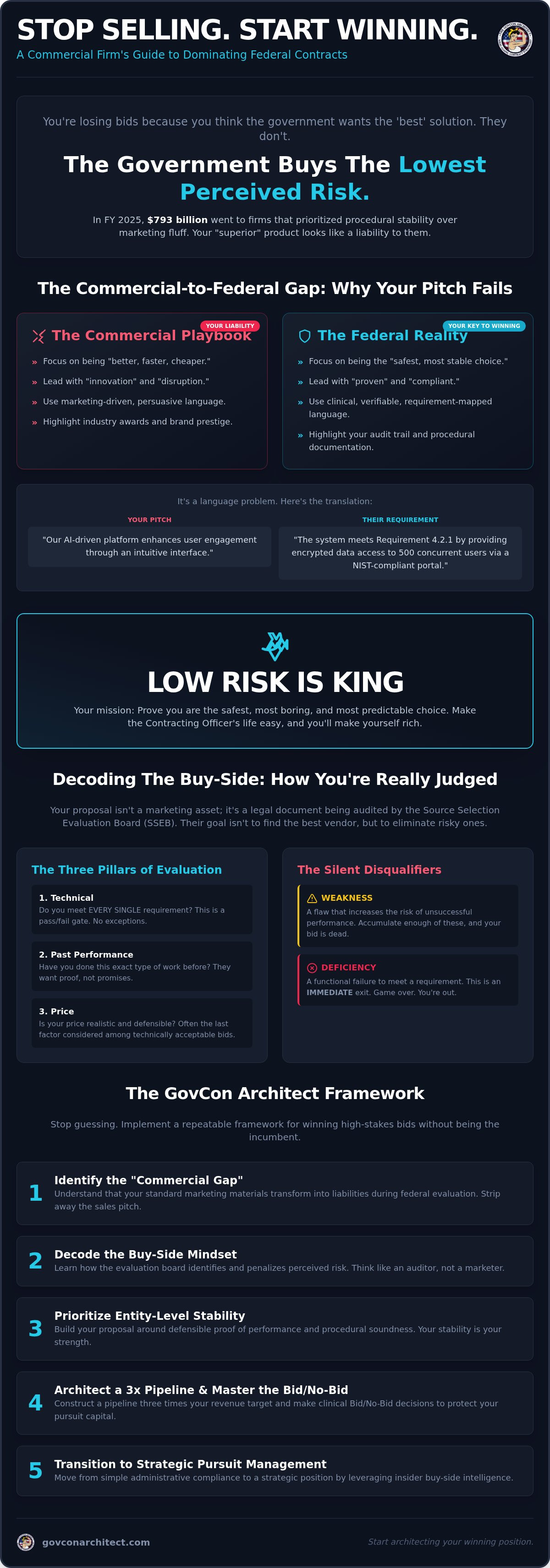
The federal government doesn't buy the best solution. It buys the lowest perceived risk. If you're struggling with winning federal contracts for commercial firms, it's because you're treating the government like a customer instead of a bureaucracy. In FY 2025, the federal government awarded $793 billion in contracts. Most of that capital went to firms that prioritized procedural stability over marketing fluff. You're losing because your "superior" commercial value looks like a liability to a Contracting Officer.
It's a common failure point. You spend six figures on a bid pursuit only to be sidelined by an opaque evaluation process. You know your product is better; the government thinks it's risky. This briefing shifts your perspective from commercial marketing to strategic risk mitigation. We'll show you how to strip away the sales pitch and replace it with clinical, defensible proof of performance.
This guide provides a repeatable framework for winning high-stakes bids without incumbent status. We'll analyze how to lower your firm's risk profile and align with the "Revolutionary FAR Overhaul" currently reshaping the market. Stop selling. Start architecting a winning position.
Key Takeaways
Identify the "Commercial Gap" where standard marketing materials transform into liabilities during federal evaluation.
Decode the buy-side mindset to understand how the Source Selection Evaluation Board identifies and penalizes perceived risk.
Implement a repeatable framework for winning federal contracts for commercial firms by prioritizing entity-level stability.
Construct a pipeline 3x your revenue target and master the clinical Bid/No-Bid decision to protect your pursuit capital.
Transition from administrative compliance to strategic pursuit management by leveraging insider buy-side intelligence.
Table of Contents
The Commercial-to-Federal Gap: Why Superior Solutions Lose
Commercial success is a poor predictor of federal victory. Most executives assume that a market-leading product will naturally dominate the public sector. This is a fatal misconception. In the commercial world, you win by being better, faster, or cheaper. In the federal world, you win by being the safest choice for the government's record. The gap between these two worlds is where most firms fail.
Winning federal contracts for commercial firms requires a total abandonment of traditional sales tactics. Your commercial value proposition is likely built on "innovation" and "disruption." To a Contracting Officer (CO), these words are synonyms for "untested" and "high-risk." The CO is the ultimate gatekeeper. Their primary objective is not to maximize your profit or even to find the most advanced technology. Their objective is to execute a contract that survives an audit and avoids a legal protest.
If your proposal focuses on how your product will change the world, you're signaling that you don't understand the mission. The mission is stability. The government doesn't care about your industry awards. It cares about your audit trail.
The Myth of the Best Product
The government rarely buys the best technology. It buys the technology that is most likely to work within the confines of a rigid administrative structure. If your solution is "cutting-edge," you've already introduced a variable the government cannot control. They prefer "proven" over "revolutionary" every time. They want to see that you've done exactly this, for exactly this type of customer, at exactly this scale.
Federal risk is the potential for administrative failure. It's the possibility that a vendor cannot meet a deadline, fails a security audit, or provides a deliverable that doesn't align with the Federal Acquisition Regulation (FAR). High-performing commercial products often fail this test because they lack the procedural documentation required to prove stability.
Commercial Marketing vs. Federal Proposal Logic
Your marketing deck is a liability. Flowery language and bold claims lead directly to technical disqualification. Commercial firms often treat a Request for Proposal (RFP) like a creative brief. This is a million-dollar mistake. The evaluation board isn't looking for inspiration. They're looking for compliance.
Winning requires a shift from selling features to verifying requirements. Consider the difference in logic:
Commercial: "Our AI-driven platform enhances user engagement through an intuitive interface."
Federal: "The system meets Requirement 4.2.1 by providing encrypted data access to 500 concurrent users via a NIST-compliant portal."
The tone must be clinical. It must be staccato. It must be verifiable. If a statement cannot be mapped to a specific requirement and backed by past performance data, it doesn't belong in the document. You aren't persuading an audience. You're providing a technical justification for a bureaucrat to sign a multi-million dollar check.
Decoding the Buy-Side: How Contracting Officers Evaluate Risk
The moment you hit submit, your proposal enters a sterile environment. It is no longer a marketing asset. It is a legal document under review by the Source Selection Evaluation Board (SSEB). These individuals are not your audience. They are your auditors. Their goal is not to find the best company. Their goal is to eliminate any bidder that presents a risk to the mission.
The roadmap for this process is hidden in plain sight. Section L (Instructions) and Section M (Evaluation Factors) of the RFP dictate the terms of your survival. Section L tells you exactly how to build the proposal. Section M tells you how the government will grade it. If you ignore a single instruction in Section L, your bid is discarded before Section M is even opened. Winning federal contracts for commercial firms requires understanding that compliance is the floor. It is the bare minimum required to stay in the room. It is not the strategy for the win.
The board is looking for a reason to say no. They are looking for inconsistencies. They are looking for gaps in your logic. Every claim you make must be tethered to a verifiable fact.
Risk Evaluation Criteria: The Silent Disqualifiers
The SSEB evaluates three primary pillars: Technical, Past Performance, and Price. For commercial firms, the danger lies in "Weaknesses" and "Deficiencies." A deficiency is a functional failure to meet a requirement. It is an immediate exit. A weakness is a flaw that increases the risk of unsuccessful performance. If you accumulate enough weaknesses, your technical score collapses, regardless of your product's quality.
Price evaluation is equally clinical. The government assesses "Price Reasonableness" to ensure they aren't overpaying. However, they also conduct a "Price Realism" analysis. If your bid is significantly lower than the independent government cost estimate, the CO assumes you don't understand the scope of work. You become a high-risk liability. Our Per-Pursuit Project Support helps firms calibrate these variables to ensure the price is both competitive and defensible.
The Defensibility Requirement
The Contracting Officer (CO) has one primary professional fear: a successful bid protest. If an unsuccessful bidder can prove the evaluation process was flawed, the CO’s work is undone and their reputation is damaged. Their career depends on an award that is beyond reproach. You must provide them with the audit trail they need to justify picking you.
While the SBA Contracting Guide provides the administrative framework for entry, winning requires providing the CO with the specific language they need to defend their decision. You are not selling a solution. You are selling a bulletproof record of decision. Position your firm as the safest choice for the government employee’s career. If awarding to you is the path of least resistance and highest defensibility, you have already won.
Strategic Architecture: Becoming a Low-Risk Bidder
You cannot win a high-stakes federal bid with a commercial infrastructure. The government evaluates the entity as much as the solution. Winning federal contracts for commercial firms requires a structural shift from "market-ready" to "audit-ready." This is the strategic architecture phase. You must align your internal operations with the rigid expectations of the bureaucracy. If your internal systems can't survive a federal audit, your bid won't survive the evaluation.
The differences between government and commercial markets are most visible in corporate governance. In the private sector, agility is prized. In GovCon, stability is mandatory. Your corporate policies must mirror Federal Acquisition Regulation (FAR) standards. If your firm lacks a DCAA-compliant accounting system, you're disqualified from cost-reimbursement contracts before the evaluation begins. You aren't just a vendor. You're a temporary extension of the government's executive branch.
Follow this 5-step framework for entity-level risk mitigation:
Gap Analysis: Audit your commercial policies against FAR requirements.
Governance Alignment: Codify ethics, procurement, and HR policies to federal standards.
Accounting Integrity: Implement DCAA-compliant timekeeping and cost allocation.
Supply Chain Verification: Ensure all vendors meet domestic content and security thresholds.
Security Certification: Achieve necessary CMMC or facility clearances before the RFP drops.
Building the Past Performance Fortress
The government buys what it has bought before. If you haven't held a federal prime contract, you have no CPARS record. You have no reputation in their system. You must translate commercial success into federal equivalents by focusing on scale, complexity, and regulatory pressure. Don't just say you've done the work. Show you've done it under high-stakes conditions.
Teaming is the tactical shortcut. Partner with an established incumbent to borrow their low-risk profile. Subcontracting is not a defeat. It's a strategic entry point. It allows you to build a performance record while the prime contractor absorbs the administrative risk. Secure the performance record today to win the prime contract tomorrow.
Technical Defensibility in Proposals
Your technical volume must mirror the RFP’s Work Breakdown Structure (WBS). If the government organizes their requirements 1.0 through 5.0, your response must follow that exact sequence. Do not make the evaluator hunt for information. Use a Problem-Diagnosis-Solution framework. Identify the agency's specific pain point. Diagnose the root cause. Offer a solution backed by verifiable data. Eliminating hope is the goal. Replace it with clinical logic and documented proof points.
Market Entry Strategy for Commercial New Entrants
Winning federal contracts for commercial firms is a volume game played with surgical precision. Most firms fail because they treat the federal market as a side hustle. They bid on random RFPs found on SAM.gov and hope for the best. This is a strategy for capital depletion. To succeed, you need a federal pipeline that is at least 3x your annual revenue target. If you want $10 million in federal revenue, you need $30 million in qualified, active pursuits under management.
The "Bid/No-Bid" decision is your most critical internal control. Commercial firms waste millions chasing contracts they have 0% chance of winning. If you didn't know about a requirement before the solicitation was public, you're already late. You're likely "column fodder." This is a bidder included only to provide the government with the three quotes required to award to the incumbent. You must move "Left of RFP." This means engaging with Small Business Liaison Officers (SBLOs) and Agency OSDBUs months before the draft is released to influence the requirements in your favor.
The Role of Competitive Intelligence
Stop guessing. The data is public. Use competitive intelligence to analyze incumbent spending patterns and identify expiring contracts. Every incumbent has a weakness. They become complacent. They lose focus on the agency's evolving mission. Your job is to identify the "Pain Points" in the current mission that the incumbent is failing to address. Use this intelligence to price for the win. In GovCon, pricing is not about your desired margin. It's about the "Price to Win" (PTW) based on historical award data and current budget constraints.
Teaming and Joint Ventures
New entrants rarely win as a Prime contractor on their first attempt. It's a hard reality. The strategic move is often to support as a Subcontractor first. This allows you to build a performance record while the Prime contractor absorbs the administrative risk. Consider Mentor-Protégé programs to form Joint Ventures with established firms. This is a force multiplier that allows you to pursue set-aside contracts you couldn't access alone. Understanding when to hire a GovCon strategic advisory firm can be the difference between a wasted pursuit and a market-entry win.
Success in this market requires constant alignment and aggressive pipeline management. Our Monthly Retainer Support provides the ongoing strategic oversight needed to build a defensible market position. Don't wait for the RFP to drop. Influence the market before the competition even starts.
Beyond Compliance: The GovCon Architect Methodology
Administrative bid writing is a clerical solution to a strategic crisis. If you hire a writer to fill out forms, you've already conceded the win to an incumbent. Winning federal contracts for commercial firms requires an architect, not an administrator. The government doesn't grade on prose. They grade on the structural integrity of your risk mitigation plan. At GovCon Architect, we apply 22 years of buy-side experience to your pipeline. We don't just write bids. We engineer defensible positions that make it impossible for a Contracting Officer to say no.
A "Buy-Side" advisor is your elite insider. We understand the hidden mechanics of the Source Selection Evaluation Board. We know what triggers a "Weakness" and what secures a "Strength." Most firms operate in a vacuum, guessing what the government wants. We provide a reality check. We prioritize professional sobriety over marketing fluff. Our Monthly Retainer Support ensures your firm remains in constant alignment with the shifting federal landscape. We move you from a reactive posture to a proactive market force. We help you build the internal governance and supply chain resilience required to compete at the highest levels. This is how you transition from a commercial firm with a federal interest to a true federal powerhouse.
Per-Pursuit Project Support
When a high-value RFP hits the street, the margin for error is zero. Our Per-Pursuit Project Support provides tactical optimization of your specific bid submission. We align every sentence of your technical and cost volumes with CO evaluation criteria. Our clinical review process identifies red flags before the government sees them. We find the inconsistencies that lead to weaknesses. We eliminate the gaps that lead to deficiencies. We treat your proposal like an audit because that's exactly how the SSEB will treat it. We don't value effort. We value results. Every sentence must serve a specific purpose in constructing a larger argument for your specialized expertise.
The Path Forward
The shift from commercial marketing to federal risk architecture is the only path to sustainable growth in this market. The federal government awarded $793 billion in contracts in FY 2025. This capital is reserved for firms that prove they are low-risk, stable, and procedurally sound. The long-term ROI of this transition is measured in decades of stable, non-dilutive revenue. You must move past the idea that a better product equals a win. In the federal system, the better process wins. Stop hoping for a win. Build the architecture that guarantees it. Secure your federal future with GovCon Architect advisory.
Dominate the Federal Landscape
The transition from a commercial entity to a federal powerhouse is not a matter of luck. It is a matter of architecture. You have seen the disconnect. You understand why superior products lose to inferior competitors who prioritize procedural stability. Winning federal contracts for commercial firms requires a clinical shift in how you perceive and present value. Stop selling features. Start documenting the removal of risk.
Led by Nikki Gianni, a 22-year federal buy-side veteran, GovCon Architect specializes in the risk-mitigation strategy required to survive the source selection process. We apply deep expertise in Contracting Officer evaluation logic to ensure your bid is the most defensible choice in the room. You don't need a better sales pitch. You need a better structure.
The path to high-stakes government revenue is open to those who value logic over hope. Build a firm that the government can trust with its mission and its budget. Architect Your Federal Success—Schedule a Briefing. Your market entry starts with a single, strategic decision. Let's build it.
Frequently Asked Questions
Can a commercial firm win a federal contract without prior government experience?
Yes, but the barrier to entry is high. You must translate your commercial success into federal risk metrics that a Contracting Officer understands. If you haven't held a prime contract, the government views you as a technical liability. Teaming with an established incumbent is the tactical shortcut to neutralize this perception and build your initial performance record.
What is the most common reason commercial firms lose federal bids?
The most common failure point is the "Commercial Gap." Firms try to sell features instead of verifying requirements. If your proposal reads like a marketing brochure, it's an immediate technical exit. The evaluation board wants clinical proof of stability and a defensible audit trail, not marketing inspiration or flowery language.
How long does it typically take for a commercial firm to win its first federal contract?
Expect an 18 to 24 month cycle for a first prime contract award. Winning federal contracts for commercial firms is a marathon of strategic alignment. You must build agency relationships and influence requirements long before the RFP is public. This is why maintaining a pipeline that is 3x your revenue target is a mandatory survival tactic.
Do I need a GSA Schedule to win federal contracts?
No. A GSA Schedule is a contract vehicle, not a requirement for entry. Many firms waste thousands of dollars obtaining a schedule they never use. You must first identify where your target agency spends its money. If they don't use GSA Schedules for your specific NAICS code, the vehicle is a worthless administrative burden.
What is Section L and Section M in a federal RFP?
Section L provides the instructions for proposal preparation. Section M defines the evaluation factors for award. Think of Section L as the pass/fail gate. If you miss a margin requirement or a page limit, your bid is discarded. Section M is the scorecard where you prove your technical superiority and entity-level risk mitigation.
How does the government evaluate "Risk" in a commercial bid?
Risk is evaluated through the lens of potential mission failure. The government identifies "Weaknesses" and "Deficiencies" in your technical approach and past performance. They want to know if awarding to you will jeopardize the project or the Contracting Officer's professional reputation. Stability is the primary metric for every evaluator on the board.
Is it better to be a prime contractor or a subcontractor for your first win?
Subcontracting is the superior entry strategy for most new entrants. It allows you to build a CPARS record and gain "insider" status without the massive overhead of prime contract administration. Use your first few wins as a subcontractor to architect the past performance fortress required to win as a prime in the future.
What is the difference between a bid writer and a GovCon strategic advisor?
A bid writer provides clerical assistance to fill out forms. A GovCon strategic advisor provides buy-side intelligence to win the pursuit. Our Per-Pursuit Project Support uses 22 years of buy-side experience to identify the red flags that lead to disqualification. One focuses on administrative compliance; the other focuses on strategic defensibility.