

Government Contract Proposal Team Structure: The Buy-Side Reality Check

Article by
Nikki Gianni
Nikki Gianni is a seasoned business strategist and government contracts coach, dedicated to helping businesses successfully navigate the complexities of government contracting. With over 22 years of experience in Department of Defense contracting, including managing $20 billion in federal awards, Nikki has developed the innovative GovReady Blueprint™ Framework, a comprehensive 90-day program designed to prepare businesses to compete for and win lucrative contracts at the federal, state, and local levels. Nikki's approach emphasizes not just gaining contracts but also enhancing overall business profitability.
Before becoming a business owner, Nikki was active-duty Air Force for 10 years, then spent another 15 years as a civil servant with the DOD. Now she's an empty nester living in Southern California who loves spending time with her 22-year-old son, Lex and her 2 Mini Aussies, Tony & Carmela, doing home improvement and crafts projects, and networking.
Most proposal teams are just expensive typing pools designed to fail. You’re burning your best people on 80-hour weeks. You’re still getting disqualified over a font size or a missed "shall" statement. It’s a special kind of hell, but I’m here to pull you out of it. You’ve realized your current government contract proposal team structure is just a collection of silos hoping for a miracle.
The government doesn’t care about your "passion" for the mission. They care about risk. If you look like a headache, you’re out. I’m giving you a reality check on what the buy-side actually looks for when they open your binder. Stop throwing bodies at RFPs and start building a risk-mitigation engine. We’re going to break down how to build a lean, high-impact team that mirrors the government’s own evaluation board. You’ll learn how to stop guessing and start engineering a win by becoming the most boring, low-risk, and defensible choice on the contracting officer’s desk.
Key Takeaways
Throwing more warm bodies at an RFP doesn't increase your win rate; it just increases the volume of mistakes for an evaluator to find.
Learn how to architect a government contract proposal team structure that mirrors the buy-side evaluation board to eliminate perceived risk before they even open your binder.
Identify the "Core Four" essential roles that move your proposal from a "maybe" to a "must-award" by focusing on technical compliance over creative writing.
Scale your team effectively based on your firm’s revenue tier, leveraging fractional expertise to stay lean while maintaining elite, high-stakes performance.
Table of Contents
The 'Staffing Up' Fallacy: Why More People Often Equals Higher Risk
The Strategic Pivot: From Proposal Writers to Low-Risk Bidders
The 'Staffing Up' Fallacy: Why More People Often Equals Higher Risk
Most firms treat a government contract proposal like a high school term paper. They assume that more writers equals more quality. It’s a lie. In reality, a bloated government contract proposal team structure is a liability, not an asset. The government isn't looking for your creative flair or your marketing department’s favorite adjectives. They are looking for reasons to disqualify you.
When you throw bodies at an RFP, you aren't building a content factory; you're building a noise machine. This "throw everything at the wall" approach is exactly why firms fall into common federal proposal writing mistakes. Every extra person without a strategic role is just another chance for a contradiction. The GovCon Architect understands that low risk is king. If your team structure doesn't signal stability and clinical precision, you’ve lost before the Contracting Officer finishes their first coffee.
The Evaluator's Perspective on Team Cohesion
Contracting Officers spot a "Franken-proposal" from a mile away. You know the one. Section L looks like it was written by an engineer, while Section M sounds like a glossy brochure. These uncoordinated silos scream internal chaos. From The Buy-Side perspective, evaluators score based on the weakest link in your team's logic. If your team isn't a single, cohesive risk-mitigation engine, you’re telling the government that you’re a management nightmare waiting to happen.
Why Commercial Marketing Teams Fail in GovCon
Your $5M+ commercial success is great, but it doesn't mean anything to a federal evaluator. Commercial marketing is about selling a dream. Federal bidding is about substantiating a reality. Your marketing team wants to be clever; the government wants you to be defensible. A winning government contract proposal team structure prioritizes compliance over charisma every single time. We want the evaluator to feel safe, not entertained.
The Core Four: Structuring Your Team for Evaluator Approval
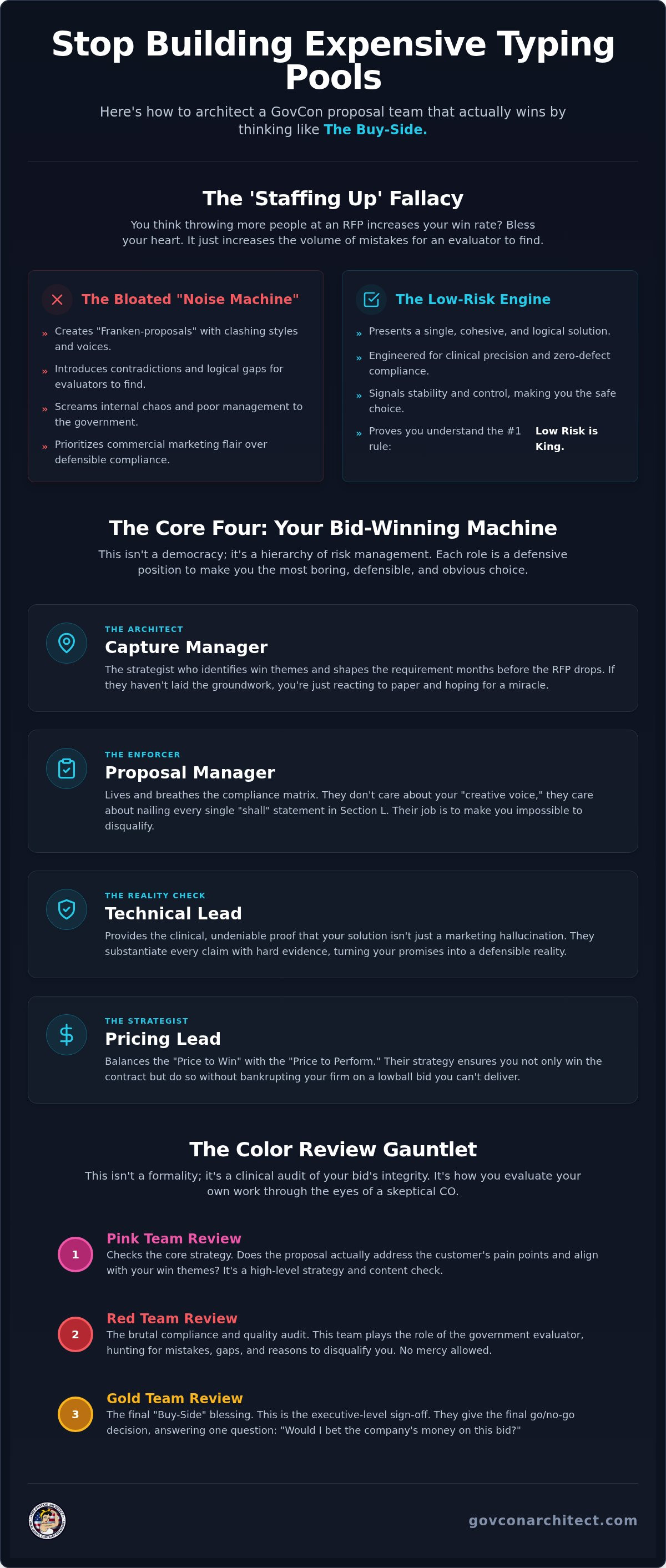
A winning government contract proposal team structure isn't a democracy; it's a hierarchy of risk management. You need four distinct pillars to satisfy the Buy-Side evaluators who are looking for any excuse to throw your bid in the trash. These roles aren't just job titles; they are defensive positions designed to make you the lowest-risk option on the table. If you're missing even one, you're leaving a gap for a competitor to exploit.
The Capture Manager: The Architect. They identify "win themes" months before the RFP drops. If they haven't shaped the requirement or understood the pain points, you're just reacting to paper.
The Proposal Manager: The Enforcer. They live for Technical Proposal Compliance. They don't care about your "creative voice"; they care about every "shall" statement in Section L.
The Technical Lead: The Reality Check. They prove you can actually deliver. They provide the clinical evidence that your solution isn't just a marketing hallucination.
The Pricing Lead: The Strategist. They balance the "Price to Win" with the "Price to Perform" so you don't win a contract that bankrupts your firm.
Capture vs. Proposal Management: The Critical Divide
Don't make the mistake of merging these roles. Capture is about positioning and relationship building; Proposal is about tactical execution. If you’re a firm with 5+ years of delivery, asking one person to do both is a high-risk move that leads to sloppy bids and burnt-out leaders. To win consistently, you need someone looking at the horizon while someone else is focused on the page. If you're feeling overwhelmed by this architecture, you might need to briefly consult with a strategist to align your resources.
The Role of the Color Review Team
Color reviews aren't a formality; they are a clinical audit of your bid's integrity. The Pink Team checks strategy. The Red Team checks for compliance and quality. The Gold Team gives the final "Buy-Side" blessing. This structured review process is the only way to Systematically Improve Your Win Rate. It forces your team to stop "writing" and start evaluating their own work through the eyes of a skeptical Contracting Officer who is looking for reasons to say no.
Scaling the Architecture: Team Structures for $5M+ Firms
Scaling your federal footprint isn't about adding more desks; it's about upgrading your engine. Many $5M+ firms fall into the "Lottery Ticket" mindset, treating every RFP like a scratch-off card. They hope for the best but invest nothing in the process. This is why Ad-Hoc Bidding is a High-Risk Strategy. It drains your resources without building any repeatable intelligence or structural integrity.
For firms in the $5M to $20M range, a "Lean and Mean" government contract proposal team structure is the only way to win without killing your margins. You don't need a $250,000 a year Federal Director sitting in a corner office doing crossword puzzles. You need access to The Buy-Side logic that actually moves the needle. The GovCon Architect advocates for this lean approach because bloated overhead is just a slow way to go out of business before you even get a notice to proceed.
The Fractional Advantage for Commercial Firms
You can get elite strategy without the executive-level price tag. The "RETAINER · MONTHLY – Fractional Federal Strategy Advisor" model allows you to bake federal expertise directly into your leadership meetings. It’s about consistent growth, not desperate scrambles. The government wants to see stability. A fractional advisor provides that professional sobriety, ensuring your government contract proposal team structure looks like a safe bet to a Contracting Officer every single month.
When to Bring in the 'Sprint' Team
Sometimes you hit a must-win opportunity that’s too big for your internal crew. That’s when you deploy a "PER‑PURSUIT · PROJECT – Capture & Proposal Sprint." This isn't about replacing your delivery team; it's about augmenting them with high-stakes specialists who know how to de-risk a complex bid in real time. It’s surgical, fast, and designed to win without breaking your existing workflow or sanity.
Schedule your federal strategy briefing today
The Strategic Pivot: From Proposal Writers to Low-Risk Bidders
Stop asking "Who can write this?" and start asking "Who can de-risk this?" A government contract proposal team structure built solely on writers is just a fancy way to lose money with style. On the Buy-Side, your team is your first past-performance indicator. If you can't manage a proposal without internal chaos, the government assumes you'll manage their project the same way. The GovCon Architect focuses on firms with $5M+ revenue and 5+ years of delivery because you already have the "meat" of a great business. We provide the structural "bone" to make that business a defensible choice.
Building Your Federal Roadmap
Real market entry requires a 6-12 month commitment to building a "Low-Risk Architecture." Ignore the consultants who tell you that "just getting certified" is a strategy. That’s like saying a driver’s license makes you a Formula 1 racer. It’s bad advice that leads to expensive losses. Actual strategic positioning involves aligning your commercial success with the clinical criteria a Contracting Officer uses to evaluate stability. You aren't just bidding; you're proving you're the safest bet in the room.
Next Steps for the Ready-to-Grow Firm
It's time to audit your current team’s "Buy-Side" IQ. Are they just checking boxes, or are they systematically eliminating every reason a Contracting Officer has to say no? If you're ready to stop guessing and start winning, let's have a professional conversation. You can book a 15-minute "get-to-know-you" call to assess your bid readiness. We'll look at your structure and tell you if you're ready to compete or if you're just donating your time to the federal government’s archives.
Stop Playing the RFP Lottery and Start Engineering Wins
Federal contracting isn't a writing contest; it's a high-stakes risk assessment. If you're still treating your government contract proposal team structure like an ad-hoc collection of available employees, you're just burning cash to be ignored. I've spent 22 years on the buy-side watching elite firms lose because they lacked structural integrity. You have the delivery expertise and the $5M+ track record. Now, you need a blueprint that speaks the government's language of defensibility.
Whether you need a fractional advisor starting at $3,500 per month to guide your strategy or a surgical sprint to win a high-value pursuit, the goal is simple: become low-risk. You've done the hard work of building a successful business. Don't let a Franken-proposal stand between you and the revenue you deserve. Move beyond hope and execute with clinical precision. You’ve got the talent. Now, let’s build the engine to prove it.
Ready to build a low-risk proposal engine? Book your 15-minute Get-To-Know-You call.
Frequently Asked Questions
What is the difference between a Capture Manager and a Proposal Manager?
Capture Managers are the architects who shape the deal before it is even public. They find the win themes and build the relationship so the government knows you exist. Proposal Managers are the enforcers who ensure every shall statement is answered with clinical precision. On the Buy-Side, the government sees the Capture Manager as the person who understands their pain, while the Proposal Manager proves you won't be a compliance nightmare.
Does a $5M commercial firm need a full-time federal proposal team?
Absolutely not. Hiring a full-time federal director for $250,000 a year is a fast way to kill your margins. Most $5M firms are better served by a lean and mean government contract proposal team structure using fractional experts. This allows you to scale up for a Capture and Proposal Sprint when a big bid drops without carrying heavy overhead when the pipeline is quiet. It is about being smart, not big.
Why do commercial firms often lose their first few federal bids?
Most commercial firms lose because they treat the government like a regular customer. They try to sell with marketing fluff instead of substantiating their claims with data. The government doesn't care about your passion; they care about risk. If you follow the bad advice to just get certified without building a strategic, low-risk architecture, you’ll get disqualified for technicalities before an evaluator even reads your price. Low risk is always king.
What roles are essential for a small business proposal team structure?
You need the Core Four to survive any federal pursuit. This government contract proposal team structure includes a Capture Manager for strategy, a Proposal Manager for compliance, a Technical Lead to prove delivery, and a Pricing Lead to ensure profitability. Even in a small firm, these roles must be distinct. Merging them creates silos and contradictions that scream high risk to a skeptical Contracting Officer looking for reasons to say no.
How do I structure a proposal team for a multi-million dollar federal contract?
You must mirror the government’s own evaluation board to win at this level. High-stakes bids require a full-scale architecture with dedicated color review teams to audit your work. Use a Pink Team for strategy, a Red Team for compliance, and a Gold Team for the final Buy-Side blessing. This structured approach ensures your bid is defensible, stable, and clinical, which is exactly how you win multi-million dollar contracts without losing your sanity.