
GovCon Strategic Advisory: The Buy-Side Reality Check for Commercial Firms

Article by Nikki Gianni
Nikki Gianni is a seasoned business strategist and government contracts coach, dedicated to helping businesses successfully navigate the complexities of government contracting. With over 22 years of experience in Department of Defense contracting, including managing $20 billion in federal awards, Nikki has developed the innovative GovReady Blueprint™ Framework, a comprehensive 90-day program designed to prepare businesses to compete for and win lucrative contracts at the federal, state, and local levels. Nikki's approach emphasizes not just gaining contracts but also enhancing overall business profitability.
Before becoming a business owner, Nikki was active-duty Air Force for 10 years, then spent another 15 years as a civil servant with the DOD. Now she's an empty nester living in Southern California who loves spending time with her 22-year-old son, Lex and her 2 Mini Aussies, Tony & Carmela, doing home improvement and crafts projects, and networking.
You've been told that a fancy certification is your golden ticket to the federal treasury. It's not. In reality, it's just an expensive way to get ignored by people who have $813 billion to spend and zero patience for your learning curve. If you're tired of throwing five-figure bid budgets into a black hole because you lack high-level govcon strategic advisory, you're not alone. It's a brutal cycle that wastes your time and insults your intelligence. We hate seeing elite firms get chewed up by a system they don't understand simply because they were given "just get certified" advice by people who have never sat in the buyer's chair.
The truth is that federal buyers don't care about your passion; they care about their own job security. Success isn't about growth hacks. It's about understanding the Buy-Side logic and systematically removing every reason a Contracting Officer has to disqualify you. This article will show you how to stop guessing why you're losing and start building a low-risk, federal-ready business using actual insider intelligence. We are going to peel back the curtain on how the government actually evaluates commercial firms so you can finally become the safest, most predictable choice on the desk.
Key Takeaways
Real govcon strategic advisory is about fixing your business structure to meet federal risk standards, not just filling out SAM forms and hoping someone notices you.
Shift your focus to the "Buy-Side" logic where the Contracting Officer's primary goal is avoiding a bad award, making low risk the ultimate competitive advantage.
Ditch the "spray and pray" bidding strategy for a 90 to 120 day framework that targets the specific agencies and vehicles where your firm is actually competitive.
Choose the right support model, whether it's a fractional strategy advisor for your pipeline or a per-pursuit sprint to win that one high-stakes contract.
Stop letting bad advice burn your budget and start using 22 years of buy-side intelligence to become the safe, elite choice for federal buyers.
Table of Contents
The Buy-Side Perspective: How Contracting Officers Evaluate Your Firm
The GovCon Architect: The Insider's Path to a Defensible Award
What is GovCon Strategic Advisory (And What It Isn't)?
Most firms treat federal contracting like a high-stakes lottery. They fill out their SAM registration, buy a capability statement template from a self-proclaimed "guru," and wait for the phone to ring. It won't. That isn't strategy; it's administrative hygiene. Genuine govcon strategic advisory is the clinical, structural alignment of your entire business with the federal government's risk criteria. It's the process of auditing your operations to ensure you don't just look the part, but actually possess the stability a buyer demands. If you're still guessing why your bids are failing, you're missing the architecture required to support a federal revenue channel.
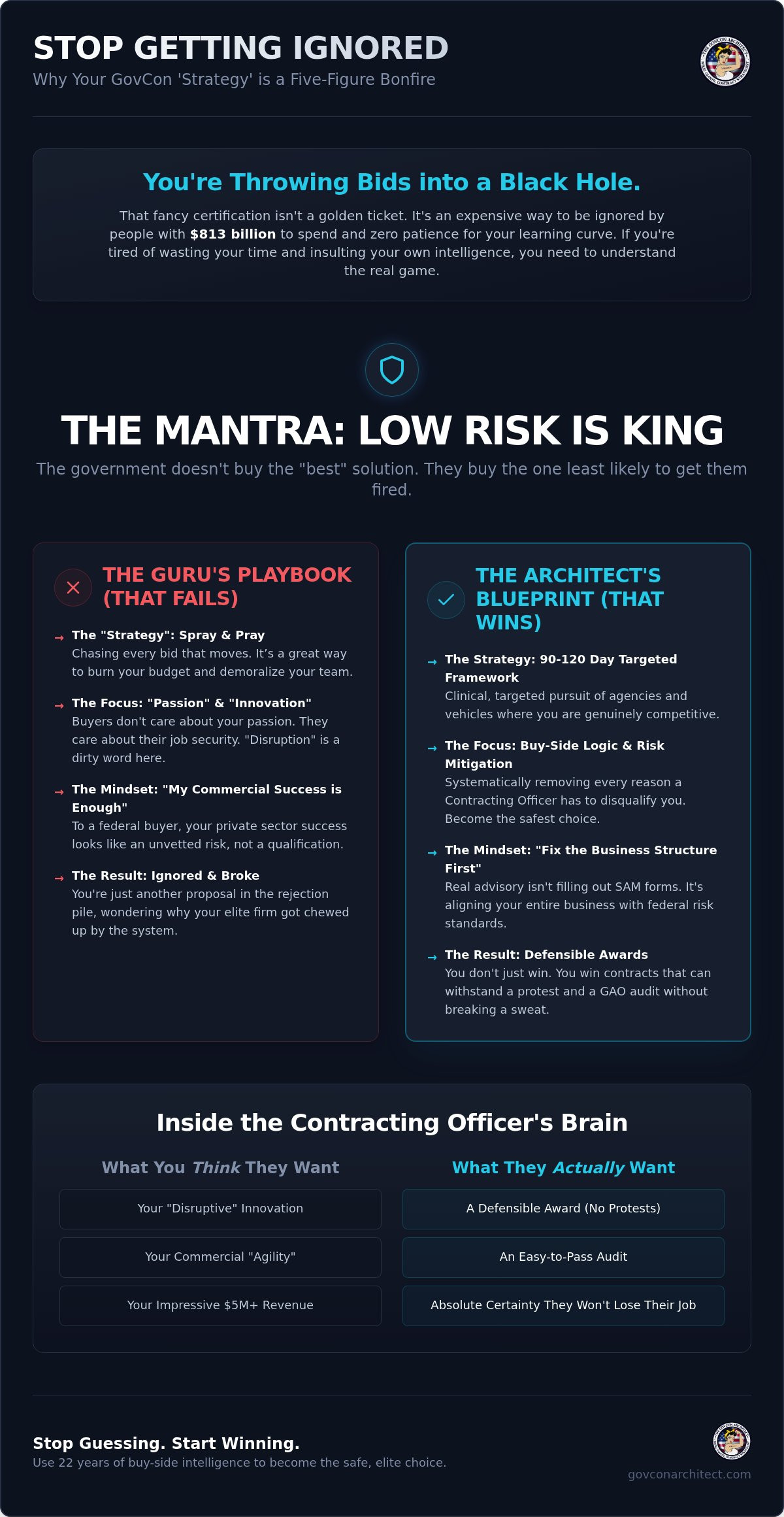
We need to be clear about the roles here. A bid writer is a glorified stenographer. They take your existing content and polish it until it meets the page count. A strategic advisor is an architect. At The GovCon Architect, we look at your $5M+ revenue firm and identify the structural vulnerabilities that make a Contracting Officer (CO) lose sleep. We operate on one non-negotiable principle: Low Risk is King. If you aren't the safest choice on the desk, your technical expertise is irrelevant. The government doesn't buy the "best" solution; they buy the one that is least likely to result in a protest or a failed audit. Without targeted govcon strategic advisory, you're just throwing money at a black hole.
The Difference Between Compliance and Strategy
Compliance is the floor. It's the bare minimum required to keep your proposal from being shredded in the first five minutes. Strategy is the ceiling. It's the deliberate positioning that allows you to unseat an incumbent who has grown lazy. Just following instructions won't win you the award. To win, you must understand the government procurement process well enough to see the motivations behind the regulations. You can view the specific steps required to move from compliant to competitive on our how-you-win roadmap.
Why Commercial Success Doesn't Automatically Translate to Federal Wins
The commercial market loves "disruption" and "agility." The federal market hates them. To a federal buyer, your commercial success is a double-edged sword. They see your $5M+ revenue and wonder if you have the patience for their bureaucracy. They see your five years of delivery and wonder if you can handle the specific oversight of a federal contract. This is the "Commercial Firm" trap. You assume your track record speaks for itself, but without a specific commercial firm government contracting strategy, you just look like an unvetted risk. The government acts the way it does because the CO's career depends on avoiding failure, not maximizing your profit. We bridge that gap by teaching you to speak the language of risk mitigation.
The Buy-Side Perspective: How Contracting Officers Evaluate Your Firm
The U.S. government obligated a record $813 billion for contracts in Fiscal Year 2025. That is a staggering amount of capital, but don't mistake that volume for generosity. Every dollar is attached to a Contracting Officer (CO) who is, quite frankly, terrified of making a bad award. While you are focused on your profit margins and technical "innovation," the CO is focused on one thing: defensibility. If they award a contract to your firm and you fail, it's their career on the line. If they award it to a safe, boring incumbent who fails, they can blame the system. This is why govcon strategic advisory is essential for commercial firms. You have to stop selling your "value" and start selling your lack of risk.
Most commercial leaders walk into the federal arena assuming their $5M+ revenue makes them an obvious choice. It doesn't. To a buyer, your success in the private sector is unproven noise. They are looking for "Risk Gaps" in your proposal; things like shaky supply chains, lack of federal past performance, or a corporate structure that looks too "agile" to handle a rigid audit. A defensible award is one that can withstand a protest and a GAO audit without breaking a sweat. If your proposal doesn't proactively close these gaps, you've already lost. We help you look at your business through the "Buy-Side" lens to ensure you aren't just another name in the rejection pile.
Risk Evaluation: The Only Metric That Matters
The government uses a hidden scorecard that most firms never see. They aren't grading you on how much you want the work; they are grading you on performance certainty. Capability is just the ticket to enter the room. Performance certainty is the proof that you can deliver under the crushing weight of federal regulations without needing your hand held. "The Buy-Side" is the perspective of the person holding the checkbook, and that person values stability over brilliance every single time. If you want to know if your firm is actually ready for this level of scrutiny, it might be time to get a clinical assessment of your current positioning.
The $813B Opportunity vs. The Reality of Failure
There is a massive disconnect between the money available and the number of firms actually winning it. Most commercial companies fail because their "Win Themes" are built on commercial logic. They talk about "disrupting the industry" while the evaluator is looking for "standardized procedural compliance." High-level govcon strategic advisory identifies the specific themes that resonate with federal evaluators. You need to understand the government bid evaluation criteria to realize that the "why" behind the RFP is always risk mitigation. If you can't articulate how you reduce the government's burden, you are just wasting paper.
Federal Market Entry: A Strategic 90-120 Day Framework
If you think you can conquer the federal market in thirty days, you're the reason consultants buy boats. True market entry isn't a sprint; it's a structural overhaul. For commercial firms with $5M+ in revenue and at least five years of delivery, we utilize a clinical 90 to 120 day Federal Market Entry Engagement. This is a foundational investment, starting at $12,000, designed to stop the bleeding of wasted bid costs and start the process of actually winning. We don't guess. we execute based on the Buy-Side logic that governs every decision a Contracting Officer makes.
The framework is broken down into four non-negotiable stages of govcon strategic advisory:
Step 1: Target Agency and Vehicle Identification. Stop bidding on everything. We identify the two or three agencies where your commercial past performance actually mitigates their specific risks.
Step 2: Competitive Landscape Mapping. We don't just look at who won the last contract. We look at why they are vulnerable now.
Step 3: Teaming Strategy. We identify the partners who fill your risk gaps. If you lack federal past performance, we find the "safe" partner who needs your technical edge.
Step 4: The First 3-5 Capture Plans. This is where we move from theory to clinical execution, building a pipeline that is defensible and high-probability.
Mapping the Competitive Landscape
Most firms see an incumbent and walk away. That's a mistake. Incumbent status isn't the death knell it used to be, especially if that incumbent has become "soft" or complacent. Using market intelligence, we find the contracts where the buyer is frustrated but lacks a low-risk alternative. Our govcon strategic advisory focuses on positioning you as that alternative. You can see how this fits into a broader Federal Contract Capture Plan Development strategy that turns "incumbent advantage" into "incumbent vulnerability."
The 90-120 Day Reality Check
The "30-day shortcut" is a myth that keeps businesses stuck in a cycle of losing bids. You need time to align your internal operations with federal expectations. Before you ever hit "submit" on a major proposal, you must pass a Proposal-Readiness Assessment. This is the final gate. It ensures that your firm isn't just capable of doing the work, but is capable of surviving the oversight. We treat your market entry with professional sobriety because the government values results over effort and logic over hope. If you aren't ready to commit to the timeline, you aren't ready for the $813 billion opportunity.
Retainer vs. Per-Pursuit: Choosing the Right Advisory Model
If you're still treating federal bidding like a series of desperate one-night stands, you're doing it wrong. Professional firms don't just "bid" on things; they architect a revenue stream. Choosing between a Fractional Federal Strategy Advisor and a Capture & Proposal Sprint depends entirely on whether you're trying to build a sustainable channel or just trying to survive a high-stakes collision with a specific RFP. This decision is the cornerstone of high-level govcon strategic advisory. We hate seeing elite firms get chewed up by the system simply because they lacked a guide to help them choose the right level of support. You've worked too hard on your business to let a technicality in a proposal kill your growth.
The retainer model, starting at $3,500 per month with a three-month minimum, is designed for firms that have realized "spray and pray" is a hobby, not a business strategy. It provides the consistent, clinical oversight needed to manage an ongoing pipeline and keep your team focused. Conversely, the per-pursuit model, starting at $3,000 per pursuit, is a surgical intervention. It's for when you've already identified a must-win contract and need to ensure your proposal doesn't just meet the requirements, but actually survives the "Buy-Side" risk gauntlet. The government creates these rigid evaluation gates because they need a paper trail that justifies their choice to their superiors; we make sure that paper trail leads directly to you.
The Fractional Advantage: Weekly Working Sessions
Weekly working sessions are the antidote to "bid fatigue." Most teams start the year strong and end it exhausted, submitting lower-quality work as the months pass. A fractional advisor provides the external discipline needed to maintain high standards. Through Quarterly Pipeline Assessments, we ensure you are only chasing winnable work that fits your low-risk profile. This is the difference between having a "list of leads" and a defensible strategy. You can explore why ad-hoc bidding is a high-risk gamble in our breakdown of GovCon Retainer Services.
Capture & Proposal Sprints: Surgical Bid Support
Sometimes you don't need a long-term partner; you need a tactical strike team. Our sprints focus on win-theme development and Red-Team reviews that actually hurt your feelings so the government doesn't have to. We scrutinize your pricing strategy to ensure it's defensible and profitable, because winning a contract you can't afford to execute is just a slow way to go out of business. The most critical part of this sprint is the "Go/No-Go" gate. If the data shows you can't win, we'll tell you. We value your results over your effort, and sometimes the best strategic move is to keep your powder dry for a better fight.
Schedule a strategy briefing to determine your best engagement model
The GovCon Architect: The Insider's Path to a Defensible Award
Nikki Gianni spent 22 years on the other side of the desk. She knows exactly what makes a Contracting Officer reach for the "reject" stamp before they even finish their coffee. This isn't theoretical; it's clinical. The GovCon Architect exists to dismantle the "just get certified" nonsense that has cost commercial firms millions in lost opportunity. If you're looking for someone to hold your hand while you fill out SAM forms or pick out a pretty font for your capability statement, you're in the wrong place. We provide the govcon strategic advisory that builds a defensible, audit-ready business. We value results over effort. We prioritize logic over hope.
We focus on established leaders. Specifically, commercial firms with $5M+ in revenue and at least 5 years of proven delivery. Why the high bar? Because the government is a creature of habit and fear. They need to see a track record that proves you aren't a flight risk. While the initial entry takes 90 to 120 days, we recommend a 6 to 12 month engagement for optimum federal channel results. This timeline allows us to move beyond the first win and into the structural stability required for a multi-million dollar federal portfolio. Success in this arena is about building a fortress, not just winning a single battle.
Why We Don't Work with Everyone
We are blunt because we care about your bottom line. We don't work with pre-revenue businesses or first-time bidders who lack a commercial track record. It's not elitism; it's risk management. If you don't have a proven history of delivery, the government sees you as a liability. We won't take your money just to watch you get shredded by the "Buy-Side" logic we spent two decades enforcing. Our commitment at The GovCon Architect is to provide a senior-advisor perspective and honest reality checks. If your business isn't ready for the federal stage, we'll tell you exactly what needs to change before you waste a dollar on a bid.
Next Steps: Moving from Guesswork to Strategy
Stop guessing why you're losing. The federal market is too expensive for trial and error. You can book a strategy session to get a clinical look at your current positioning and identify the gaps in your risk profile. For most firms, the "Federal Market Entry" engagement is the necessary first step to align your commercial success with federal risk standards. This process eliminates the "Commercial Firm" trap and sets the foundation for a predictable revenue stream. It's time to stop acting like an outsider and start building like an architect.
Explore our strategic engagements
Stop Guessing and Start Architecting Your Federal Success
The federal market is a relentless machine that rewards stability and punishes the unprepared. If you've spent the last year chasing every RFP that hits your inbox, you've likely discovered that passion doesn't pay the bills in this arena. Success requires a clinical shift from selling your commercial brilliance to proving your lack of risk. We've established that the person holding the checkbook values their own career security over your innovation. By aligning your $5M-plus revenue business with the Buy-Side logic we spent two decades enforcing, you move from being a gamble to being a defensible award.
High-level govcon strategic advisory is the structural integrity your business needs to survive federal oversight. You have the delivery track record. You have the commercial success. Now you just need the insider architecture to make you the safest choice on the desk. It's time to stop acting like a visitor in the federal market and start building like an owner who understands the system.
Build Your Federal Strategy with The GovCon Architect
You've built an elite business. Now let's make sure the government knows exactly how to buy from it without the Contracting Officer fearing for their job. We've got your back.
Frequently Asked Questions
What is the difference between a GovCon consultant and a strategic advisor?
A consultant usually gives you a generic "to-do" list; a strategic advisor builds a business that is actually winnable. Most consultants operate on hope and "industry best practices," but govcon strategic advisory operates on the cold, hard logic of risk mitigation. We don't just help you write words. We architect your operations so that when a Contracting Officer looks at your firm, they see a safe bet rather than a potential career-ending mistake.
Does The GovCon Architect help with SAM registration or capability statements?
No, because we aren't administrative assistants, and you're too smart to pay us for clerical work. The GovCon Architect focuses on the high-level strategy that actually moves the needle. SAM registration is a floor; a capability statement is just a brochure. While they are necessary, they won't win you a $10M contract. We spend our time on the "Buy-Side" intelligence that identifies exactly why the government is buying and how you can be their lowest-risk solution.
Why does my commercial firm need 5 years of delivery history to work with you?
Because the government is allergic to uncertainty, and we value your budget too much to let you waste it. A five-year track record is the clinical proof a Contracting Officer needs to justify an award to their superiors. If you're a startup, you're a high-risk gamble. We care about your success, which means being blunt: you need to prove you can survive the commercial world before you try to survive the federal oversight gauntlet.
How much does GovCon strategic advisory cost for a mid-sized firm?
We keep our pricing as direct as our advice. Our Federal Market Entry Engagement is $12,000 for a 90 to 120 day deep dive. Ongoing support via our Fractional Federal Strategy Advisor retainer starts at $3,500 per month. If you need a surgical strike on a specific bid, our Capture & Proposal Sprints start at $3,000 per pursuit. No hidden fees or "consultant fluff," just actual strategic architecture for firms with $5M-plus in revenue.
Can you guarantee that we will win a federal contract within 30 days?
Only if you're buying a lottery ticket, and we don't sell those. The federal market doesn't have a 30-day shortcut, and anyone promising one is likely trying to buy a boat with your retainer. True market entry takes 90 to 120 days of structural alignment. We value your results over your effort, which means we won't lie to you about the professional sobriety and timeline required to become a low-risk, federal-ready business.
What industries do you specialize in for federal contracting?
We focus our govcon strategic advisory on Construction, Specialty Trades, and Professional Services like IT and engineering. These sectors are the backbone of federal spending. We work with established firms because they have the infrastructure to handle the government's rigid compliance demands. Our goal is to take your existing commercial success and translate it into a language that federal evaluators actually understand, respect, and, most importantly, trust.
What is the minimum time commitment for a fractional retainer?
The minimum commitment is three months because you can't fix a broken strategy overnight. However, for firms serious about a predictable revenue channel, we recommend 6 to 12 months. This allows us to move through multiple capture cycles and refine your positioning based on actual "Buy-Side" feedback. We're building a fortress for your business, and that requires a methodical, clinical approach to market dominance rather than a series of desperate, ad-hoc bids.
How do you help with 'Go/No-Go' decisions on specific bids?
We act as your internal "Red Team" to identify the risk gaps that will get you disqualified before you even hit submit. If a bid doesn't align with your core competencies or the government's specific risk criteria, we'll tell you to walk away. It's better to save your pursuit budget for a fight you can actually win. We prioritize your long-term stability over short-term activity because, in this game, low risk is king.