
GovCon Business Development Strategy: A Buy-Side Reality Check for 2026
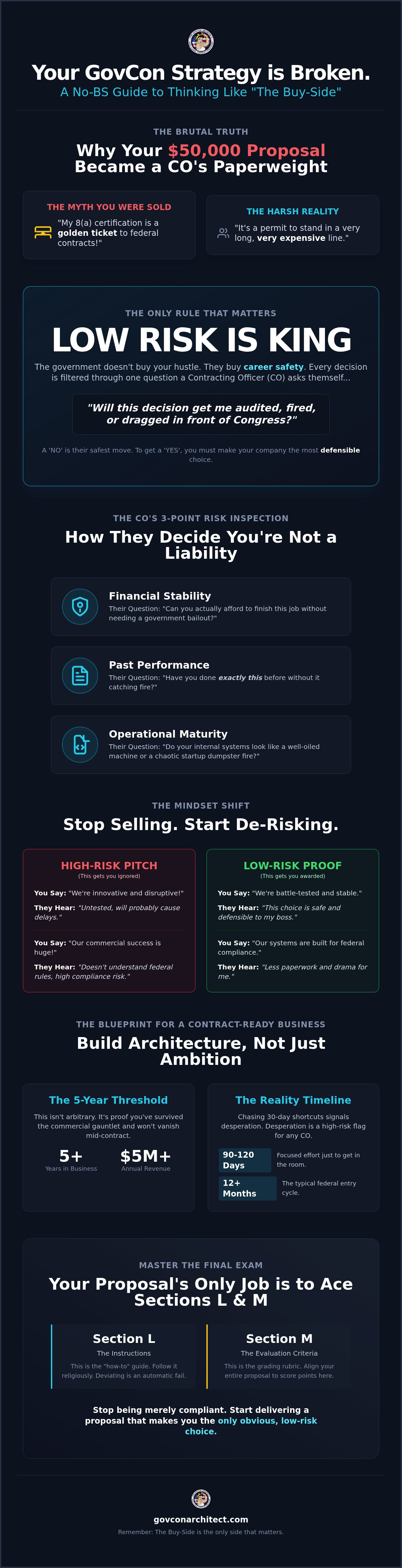
Why are you spending $50,000 on a proposal just to watch a Contracting Officer toss it in the "too risky" pile before they even finish their morning coffee? It’s a brutal question, but someone has to ask it. You’ve probably been told that getting your certifications is a golden ticket. It isn’t. It’s just a permit to stand in a very long, very expensive line.
I get it. You’re frustrated with high bid costs and zero ROI. You’re tired of the "just get certified" nonsense that leads to dead ends. The truth is, the government doesn’t care about your hustle; they care about their own career safety. In the federal market, low risk is king. If you want to stop guessing and start winning, you need a govcon business development strategy built on how the Buy-Side actually thinks. This article will show you how to align your operations with federal risk evaluation. We’ll dive into the 2026 reality of the Revolutionary FAR Overhaul and provide a repeatable blueprint to make your firm the obvious, low-risk choice for every CO.
Key Takeaways
Understand that the Buy-Side is driven by a deep fear of failure, meaning "low risk is king" when a Contracting Officer evaluates your firm.
Stop lighting your bid budget on fire and adopt a govcon business development strategy that filters opportunities through a clinical Go/No-Go framework.
Realize that certifications are just a permit to stand in line; the real winners build a structural architecture that proves they can actually handle the work.
Master Sections L and M to move past basic compliance and start delivering proposals that make you the only safe choice for the government.
See how a Fractional Federal Strategy Advisor can help you scale your federal footprint for a fraction of the cost of a full-time executive.
Table of Contents
The Buy-Side Mantra: Why Low Risk is King in GovCon
Federal contracting isn't a sales contest. It’s an audition for stability. The government awards over $700 billion annually, but they don't give it to the company with the flashiest pitch. They give it to the safest one. If your govcon business development strategy focuses on how great your product is, you've already lost. You need to focus on how you won't fail. Low risk is king. It's the only rule that matters when the ink dries.
The Contracting Officer’s Perspective
The Contracting Officer (CO) isn't your friend. They aren't your enemy, either. They are a bureaucrat with a high-stakes job and a very low tolerance for drama. Every time they sign a contract, they are betting their professional reputation on your ability to perform. They want to see stability. They want to see a history of staying within the lines. If you want to understand how you win, you have to stop looking at your own capabilities and start looking at the CO’s fears.
A "no" is the safest move for a CO because it requires zero explanation to their superiors. They aren't being mean; they’re just trying to make it to retirement without a Congressional inquiry. To get a "yes," you must provide a mountain of evidence that choosing you is a defensible decision. The Buy-Side evaluates risk through three primary lenses:
Financial Stability: Can you actually afford to finish the job without a bailout?
Past Performance: Have you done exactly this before without catching fire?
Operational Maturity: Do you have the systems to handle federal compliance?
Ultimately, the Buy-Side is the only perspective that matters for winning.
Why Commercial Success Does Not Guarantee Federal Wins
Your $5M+ commercial track record is a great start, but it’s just noise to a CO unless it’s translated into federal terms. The U.S. Government Procurement Process is built on a foundation of stability and defensibility. Commercial firms often lead with "innovation" or "disruption." To a CO, "disruption" sounds like a protest, a budget overrun, or a career-ending audit. It’s a red flag, not a selling point.
Winning requires a total shift in perspective. You have to move from a "commercial sales" mindset to a "federal risk-mitigation" mindset. Your govcon business development strategy must be a risk-mitigation plan, not a marketing brochure. If you keep acting like a commercial vendor, you'll keep looking like a high-risk liability. We’re here to make sure that doesn't happen.
Building a Contract-Ready Business Architecture
Don't fall for the "get certified and get rich" lie. It's the GovCon equivalent of a "get thin quick" pill. Certifications like the SBA 8(a) Business Development Program are powerful tools, but they aren't a business model. A winning govcon business development strategy requires a structural foundation that can withstand the weight of a federal audit. If your internal operations look like a chaotic startup, a Contracting Officer will smell the risk from a mile away. You need architecture, not just a label.
The 5-Year Threshold
The Buy-Side isn't looking for potential. They’re looking for proof of survival. If you’ve been delivering for 5+ years and hitting $5M+ in revenue, you’ve already survived the commercial gauntlet. That matters. It proves you aren't going to vanish in the middle of a contract. Specialized trades and professional services must frame this history as "battle-tested" reliability. The federal market has a 12-month entry cycle. Looking for 30-day shortcuts is a waste of time. It signals desperation. Desperation is a high-risk trait that scares away the best opportunities.
Beyond the Capability Statement
Stop downloading templates. A capability statement without a strategy is just a brochure for the trash can. You need to align your business structure with Section L and Section M requirements before the RFP even hits the street. This means having your past performance data, compliance systems, and financial reporting ready for scrutiny. Federal entry takes 90 to 120 days of focused effort just to get in the room. If you aren't prepared for that timeline, you're just playing house.
Winning here is about architecture, not luck. You have to prove you can handle the administrative burden as well as the actual work. For a deeper dive into how to position yourself, check out our Winning Federal Contracts: Insider Risk-Mitigation Guide. If you're ready to build something that actually wins, let's talk about your roadmap and get your govcon business development strategy on the right track.
Strategic Capture: The Go/No-Go Decision Framework
A full pipeline isn't a strategy; it's a liability. If you're chasing every RFP like a golden retriever after a tennis ball, you're lighting your Bid and Proposal (B&P) budget on fire. A disciplined govcon business development strategy starts with the clinical ability to walk away. You have to protect your resources for the fights you can actually win. The government doesn't award points for effort. They award contracts to the firm that presents the lowest risk to their mission. If you can't prove you're the low-risk choice before you even open the proposal software, you've already lost.
While the SBA's guide to winning contracts gives you the procedural basics, the real win happens in the capture phase. This is where you diagnose the competitive landscape and decide if the juice is worth the squeeze. If you’re tired of losing, learn how to systematically improve your federal contract win rate by tightening your filters and only bidding on work that fits your architectural DNA.
The 5 Steps of a Buy-Side Capture Plan
Winning isn't accidental. It’s engineered. Follow these five steps to ensure you aren't wasting your time on "ghost" opportunities that were written for an incumbent:
Step 1: Identify the target agency and vehicle. Don't just look for work; look for the right lane, like GSA Schedules or agency-specific IDIQs.
Step 2: Assess the incumbent. Is the current contractor failing, or are they best friends with the CO? If they're perfect, move on.
Step 3: Develop win-themes. These must address specific agency pain points. "We're great" is not a win-theme.
Step 4: Teaming strategy. Identify partners who fill your gaps. If you lack a specific past performance nugget, find a partner who has it.
Step 5: Final Go/No-Go. This is the clinical kill switch. If the risk is too high or the win-probability is too low, kill the bid.
Win-Theme Development
Your win-themes need to echo the evaluator’s scoring criteria. The CO isn't looking for your "passion" or your "commitment to excellence." They're looking for a reason to go home at 5 PM without a lawsuit or a project failure. Move beyond the "we are great" fluff. Focus on "we solve your specific mission risk." Use market intelligence to out-position larger incumbents by showing you are more agile, more specialized, and significantly less likely to cause a headache. In the federal market, being the "safe" choice is the ultimate competitive advantage.
Proposal Development: Aligning with Section L & M
The RFP is not a suggestion. It is a legal boundary. If you treat Section L and Section M as "guidelines" rather than the absolute law of the land, you’re signaling to the Contracting Officer that you are a high-risk liability. Section L tells you exactly how to format your response. Section M tells you exactly how you will be scored. Your govcon business development strategy lives or dies by your ability to map every single sentence of your proposal to these two sections. If the government asks for a 12-point font and a specific page limit, and you provide a 10-point font to cram in more "innovation," you’ve already failed the first test of compliance.
Compliance is just the entry fee. It gets you in the room, but it doesn't win the contract. To win, you must be compelling. This means translating your commercial success into the clinical language of federal risk mitigation. The government uses Section M evaluation criteria to protect themselves. They need a defensible reason to pick you, one that can withstand a legal protest from your competitors. If your proposal doesn't give them that ironclad defense, they’ll pick the safer, more boring option every single time.
The Red-Team Review Process
Government evaluators are tired, overworked, and looking for a reason to stop reading. A Red-Team review is your chance to find those reasons before they do. This isn't a spell-check. It’s a clinical simulation of the government evaluation panel. You need to scrub your proposal for commercial fluff, vague adjectives, and "disruptive" marketing speak that annoys evaluators. Every claim you make must be backed by defensible proof. If you say you’re "the best," you better have the CPARS rating or the data to prove it. If you can't prove it, delete it.
Tactical Proposal Management
Managing the timeline for a Capture & Proposal Sprint is a high-stakes operation. You can't just copy-paste your commercial proposals into federal bids. It looks lazy, and it screams "high risk." Established firms need dedicated per-pursuit support to ensure they aren't missing the nuance of agency-specific requirements. You’re balancing profit with the "Price to Win" reality. If your pricing is too high, you’re a risk to the budget. If it's too low, you’re a risk to the mission. Finding the sweet spot requires a strategist who understands the hidden mechanics of the Buy-Side.
Schedule a Capture & Proposal Sprint
Scaling with a Fractional Federal Strategy Advisor
You don't need a $200,000-a-year BD executive who spends more time on the golf course than reading the FAR. Most $5M+ firms think a "Rolodex guy" is the secret to federal success. It isn't. Relationships are great, but they won't save you when an evaluator sees a high-risk gap in your technical volume. A Fractional Federal Strategy Advisor provides the senior-level perspective you need without the bloated payroll. It’s about building a govcon business development strategy that works while you sleep, not one that relies on who you know at a happy hour.
The Buy-Side wants to see structural integrity. They want to know that your business is built to handle the unique pressures of federal delivery. Weekly working sessions and quarterly pipeline assessments ensure you aren't just "bidding to bid." We look at your pipeline through the clinical lens of a Contracting Officer. If an opportunity looks like a trap, we tell you. We care about your P&L enough to tell you when your current strategy is a dumpster fire. This isn't a quick fix; it's the architectural foundation for a long-term revenue channel.
The Monthly Retainer Advantage
Hiring an expert on a monthly retainer is the most cost-effective way to maintain continuous alignment with shifting procurement standards. For $3,500/month, you get an elite insider who has spent 22 years on the Buy-Side. We require a 3-month minimum because you can't fix years of "commercial habits" in a single afternoon. Real structural change takes time. While you’ll see the shift in your approach quickly, we recommend a 6 to 12-month term for optimum results. This allows us to move through several procurement cycles and refine your position as the ultimate low-risk choice.
Next Steps for the $5M+ Firm
If you’ve reached $5M in commercial revenue, you’ve proven you can deliver. Now you have to prove you can comply. The 90 to 120-day engagement path for serious firms is designed to move you from "guessing" to "winning" with clinical precision. We assess your federal market entry readiness and build the architecture required to scale. The government is going to spend nearly $800 billion this year. They want to give some of it to you, but only if you stop being a liability and start being the solution.
Ready to Win? Explore our Retainer Support.
Stop Guessing and Start Engineering Your Wins
The federal market obligated $793 billion in FY2025. That's a massive pie, but the government doesn't share with firms that look like a liability. You've learned that low risk is king, certifications aren't a strategy, and Section L and M are the only rules that matter. Winning isn't about hope; it's about building a business architecture that makes a Contracting Officer feel safe.
A high-level govcon business development strategy requires the steady hand of an insider. Nikki Gianni brings 22 years of buy-side experience to your corner, cutting through the "just get certified" nonsense to focus on clinical risk-mitigation. You've already built a $5M+ powerhouse. It's time to stop being the best-kept secret and start being the defensible choice for the agencies that need you most.
Book a strategy briefing with Nikki Gianni
You have the track record and the delivery expertise. We have the blueprint to navigate the bureaucracy. Let's stop the guessing game and start winning together.
Frequently Asked Questions
How much does a GovCon business development strategy cost?
A professional govcon business development strategy starts with a commitment to structure rather than luck. At The GovCon Architect, our Fractional Federal Strategy Advisor retainer starts at $3,500 per month with a three-month minimum commitment. If you need a per-pursuit Capture & Proposal Sprint, pricing starts at $3,000 per bid. For firms ready for a full Federal Market Entry Engagement, the 90 to 120-day project starts at $12,000. We don't do "cheap"; we do "effective."
Why do most commercial firms fail in the federal market?
Most firms fail because they try to "disrupt" a system that values stability above all else. They treat federal buyers like commercial customers, ignoring the fact that a Contracting Officer's primary goal is not getting fired. They waste money on high bid costs because they lack a Go/No-Go framework. If you're seeking a 30-day shortcut, you're already halfway to the exit. Real success requires a structural shift in how you present your firm.
What is the "Buy-Side" perspective in government contracting?
The Buy-Side perspective is the clinical understanding of the government's internal motivations. It’s the realization that the evaluator isn't looking for the "best" company; they're looking for the one that won't cause a headline-grabbing disaster. In this world, low risk is king. Every decision the government makes is about defensibility. If your proposal doesn't give them an ironclad reason to pick you over an incumbent, you're just noise in the system.
Do I need a special certification to win federal contracts?
No, certifications like the 8(a) program are tools, not a govcon business development strategy. While they can provide a competitive edge, they won't save a high-risk firm from a disqualification. The GovCon Architect focuses on firms with $5M+ revenue because we see too many businesses fall for the "just get certified" nonsense while their internal operations are a mess. You need a solid track record and proven delivery to be taken seriously.
How long does it take to win your first federal contract?
Winning in the federal space is a marathon, not a sprint. A serious market entry engagement typically takes 90 to 120 days just to identify the right agencies and build your first capture plans. We recommend a six to 12-month commitment for optimum results. Anyone promising a "30-day solution" is lying to you. The government's buying cycle is slow, and your strategy must be patient enough to outlast the competition.
What is the difference between capture management and proposal writing?
Capture is the strategic architecture where you decide if an opportunity is worth the effort; proposal writing is the tactical execution of that decision. Capture involves assessing the incumbent, mapping the competitive landscape, and identifying teaming partners. Proposal writing is about strict compliance with Section L and M. If your capture strategy is weak, even the most beautiful proposal won't win because you're fighting a battle you shouldn't have entered.
Can a small business compete with large incumbents?
Absolutely, but you won't win by trying to out-scale the giants. Small businesses win by being more specialized and presenting lower mission risk in specific niches. By using a Fractional Federal Strategy Advisor, established firms can leverage senior-level expertise to out-position incumbents. Large contractors often get complacent; a lean, battle-tested small business that speaks the language of risk-mitigation can easily peel away high-value contracts.
Why is "low risk" more important than "low price"?
A Contracting Officer would rather pay a premium for a guaranteed result than save a few bucks on a firm that might fail. A cheap failure is a career-killer for a federal buyer. They prioritize stability and defensibility over the lowest price because their mission depends on performance. When you position your firm as the lowest-risk option, you move the conversation away from a race to the bottom and toward high-value, long-term revenue.