

Getting Executive Buy-In for Federal Bids: A Practical Guide

Article by
Nikki Gianni
Nikki Gianni is a seasoned business strategist and government contracts coach, dedicated to helping businesses successfully navigate the complexities of government contracting. With over 22 years of experience in Department of Defense contracting, including managing $20 billion in federal awards, Nikki has developed the innovative GovReady Blueprint™ Framework, a comprehensive 90-day program designed to prepare businesses to compete for and win lucrative contracts at the federal, state, and local levels. Nikki's approach emphasizes not just gaining contracts but also enhancing overall business profitability.
Before becoming a business owner, Nikki was active-duty Air Force for 10 years, then spent another 15 years as a civil servant with the DOD. Now she's an empty nester living in Southern California who loves spending time with her 22-year-old son, Lex and her 2 Mini Aussies, Tony & Carmela, doing home improvement and crafts projects, and networking.
A federal bid doesn’t become strategic just because the opportunity looks big and the deadline is looming. That’s not a business case. It’s a calendar event with potentially expensive consequences. Getting executive buy-in for federal bids starts with showing why the opportunity fits, what it will take to compete, and whether the company can deliver without putting established revenue at risk.
Leaders are right to ask hard questions. Federal pursuits can consume skilled people, disrupt commercial priorities, and expose gaps in delivery readiness. Hope is not a resource plan, and “we’ll figure it out” is rarely soothing to anyone holding the budget.
This guide shows you how to build a concise, evidence-based case to pursue or decline a bid. You’ll learn to connect the opportunity to business strategy and buyer risk, align leadership on ownership and resources, and address delivery exposure before the deadline turns a decision into a scramble. The goal isn’t to promise an award. It’s to compete deliberately, with a credible case for why your company is a capable, compliant, low-risk choice.
Key Takeaways
- Make getting executive buy-in for federal bids a structured decision, not a last-minute vote of confidence.
- Use five checkpoints to test strategic fit, solicitation demands, supporting evidence, capacity, and go/no-go accountability.
- Replace “we can do it” with proof of delivery capacity and specific controls that reduce risk for the government buyer.
- Turn approval into named owners, decision rights, and review points so proposal promises stay aligned with what the company can deliver.
Getting executive buy-in for federal bids starts with a defensible pursuit case
Getting executive buy-in for federal bids means securing an informed decision to commit leadership attention, proposal resources, and delivery capacity. It’s not a cheerleading session, and it’s not permission to chase every solicitation that appears in the pipeline. Treat federal work as a potential long-term revenue channel that must fit the company’s capabilities and strategy, not as a lottery ticket with a proposal attached.
A defensible case connects five things: strategic fit, solicitation requirements, evidence of relevant performance, buyer risk, and the effort required to compete and deliver. The government buyer needs a proposal that supports a sound, defensible evaluation. Understanding the Federal Acquisition Regulation (FAR) provides context for the procurement framework, but the specific solicitation should guide the pursuit decision. Start with its actual requirements and evaluation factors, not a general idea of what federal buyers might want.
What should leadership decide before approving a federal bid?
Show why this opportunity fits what the company can deliver and where it intends to build federal business. Name an executive sponsor and a business owner accountable for moving the decision forward. Then define the decision on the table: whether to authorize pursuit planning and commit initial resources. That is distinct from later decisions about proposal submission or accepting an award. Approval can mean pursue, pursue only after specified gaps are resolved, or decline. “Approved” should not mean “bid no matter what.” For a practical view of how pursuit support can structure the work, see federal contract pursuit support.
Which evidence belongs in the executive case?
Bring the solicitation’s requirements and evaluation factors, then map each one to verifiable company evidence. Summarize relevant delivery experience, available capacity, and gaps that could affect compliance, performance, or the schedule. For each gap, state what needs to happen, who owns it, and whether it can be resolved before the proposal is due. Label assumptions as assumptions. Don’t pad the case with broad market-size claims that say nothing about this contract or your ability to perform it.
The evaluation context matters because the buyer assesses the offer against the solicitation, not your enthusiasm. Use the current opportunity’s stated factors and learn how government bid evaluation criteria shape a credible, low-risk case. If the evidence doesn’t support the pursuit, leadership has its answer. That’s disciplined decision-making, not a missed lottery ticket.
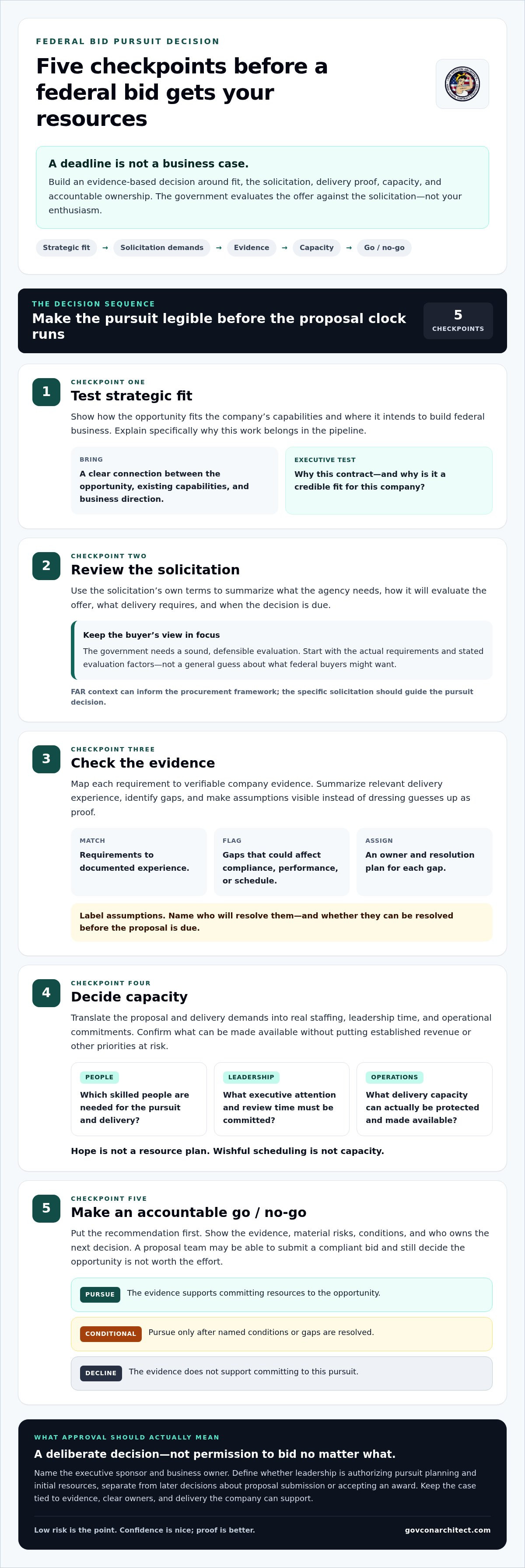
Secure Executive Buy-In for Federal Bids in Five Steps
Make the decision legible before the proposal clock starts running. Use this sequence to separate “we can submit” from “this pursuit is worth our resources.” Keep claims tied to evidence, and label anything unresolved. A confident guess is still a guess, just wearing a nicer suit.
- Test strategic fit. Explain how the opportunity supports the company’s capabilities and federal direction. Be specific about why this work belongs in the pipeline.
- Review the solicitation. Summarize the requirement, evaluation approach, delivery expectations, and decision deadline using the solicitation’s own terms.
- Check the evidence. Match requirements to documented experience and identify gaps. Mark assumptions clearly and assign someone to resolve each one.
- Decide capacity. Translate proposal and delivery demands into staffing, leadership time, and operational commitments. Confirm what can be made available without relying on wishful scheduling.
- Make an accountable go/no-go. State the recommendation, its conditions, and who owns the next decision.
How do you make the opportunity legible to executives?
Lead with what the agency needs and how it plans to evaluate the offer, then spell out what that means for the business. For each major requirement, show the relevant company evidence, the person or team responsible, and any unresolved dependency. A technical requirement may call for specific expertise, leadership review, or delivery capacity. Separate confirmed solicitation requirements from assumptions that still need an internal owner. This gives executives a usable decision brief, not a document-length scavenger hunt.
How should you frame the go/no-go recommendation?
Put the recommendation first: pursue, pursue only if named conditions are met, or decline. Then show the supporting evidence and material risks. State what must be true for the bid to remain viable, using the solicitation’s language. For example, if a requirement depends on a particular resource, identify that dependency and who will confirm the resource is available. That makes the recommendation testable, not a vote for whoever sounds most optimistic in the room.
Bid readiness and pursuit merit are separate questions. A team may be capable of producing a compliant proposal and still decide the opportunity doesn’t justify the effort. For a deeper look at exposure, review this federal bid risk assessment and the guidance on federal procurement risk mitigation. If leadership needs help structuring a specific pursuit decision, discuss the bid’s strategic and delivery risks.
Address the executive objection: federal bids can consume capacity without reducing buyer risk
The objection is valid. A pursuit takes leadership attention and skilled people away from other work. A proposal that drains capacity but gives the government no clear reason to trust the company is not a sound investment. Buyers need to assess whether the offer is capable, compliant with the solicitation, and credible to deliver. Leadership should test those same things before authorizing the effort.
Unsupported claim
“We can do it.” The proposal leans on confidence, generic commercial success, and promises to fill gaps later. Staffing is assumed. Risks have no owner.
Evidence-backed case
Relevant delivery examples map to stated requirements. Named staff and delivery leads have defined roles. Gaps are disclosed, with mitigation the company can actually execute.
How can leaders separate confidence from evidence?
Match past performance and delivery examples to the solicitation’s requirements. Commercial success matters, but it doesn’t automatically prove federal readiness or fit for this work. Identify gaps plainly. If the proposed mitigation depends on a resource, partner, or internal decision, name it and confirm the company can secure it. “We’ll sort it out later” is not a control. It’s a risk wearing a confident grin.
What resource questions should executives resolve?
Before approval, name proposal contributors, decision owners, and delivery leads. Review their competing commitments and the operational exposure if this work moves forward. Be clear about what leadership is committing: who will contribute, what responsibilities they will own, and which existing priorities could be affected. Don’t manufacture cost or win-rate estimates to make the case look precise. Instead, record the conditions that would trigger a pause or no-bid decision, such as losing access to a critical resource or failing to resolve a material requirement gap.
That discipline helps leadership judge whether the proposal reduces buyer concern or merely relocates risk onto the agency. For more on common failure points, read reasons federal bids are lost.
Turn executive approval into accountable federal bid execution
Approval is the start of controlled execution, not permission to let the proposal team improvise. Getting executive buy-in for federal bids only has value if the decision becomes clear ownership, committed resources, and checks that keep the pursuit aligned with what the company can deliver. The government buyer needs a defensible basis to evaluate your offer. Your internal governance should make the same claims defensible.
What should the executive approval record capture?
Document the go/no-go decision, its rationale, the accountable sponsor, the business owner, and the resources leadership committed. Record unresolved risks and assumptions, including who owns each one and when it needs resolution. Set review points to revisit material conditions, such as a change in available delivery capacity or new information that affects the solicitation response.
Connect proposal ownership to delivery ownership. The people shaping a commitment should know who would be responsible for carrying it out. Give each decision-maker clear authority: who can approve proposal claims, resolve internal conflicts, or recommend pausing the pursuit? This is not paperwork for its own sake. It prevents a polished promise from outrunning operational reality.
When can outside strategic support help?
Buy-side insight can help leadership assess how the opportunity’s evaluation criteria and perceived performance risks shape a credible pursuit. The GovCon Architect’s RETAINER · MONTHLY - Fractional Federal Strategy Advisor provides ongoing strategic guidance, while PER-PURSUIT · PROJECT - Capture & Proposal Sprint helps The GovCon Architect shape federal strategy for a specific bid. Both support preparation and positioning. Neither guarantees an award, because the decision rests with the government buyer.
Keep the standard straightforward: proposal claims must match solicitation requirements, available evidence, and delivery capability. If a material assumption changes, bring it back to the people who approved the pursuit. That’s how leadership stays informed without turning every bid decision into a meeting that could’ve been an email.
Make the Next Bid a Deliberate Decision
Getting executive buy-in for federal bids works best when leaders can see the logic, the resource commitment, and the delivery risks before the proposal effort begins. A disciplined pursuit case separates strategic fit from bid readiness, tests claims against evidence, and makes room for a conditional go or a clear no-go.
Approval must also lead to execution: named owners, committed capacity, decision points, and proposal claims that match what the company can deliver. That’s how you help the government buyer evaluate a credible, lower-risk offer, not just a confident one.
Nikki Gianni brings 22 years of buy-side experience, including work as a government buyer, evaluator, awarder, and contract administrator. That perspective helps GovCon Architect shape federal strategy around how the government assesses risk. It can strengthen preparation and positioning, not promise an award.
Your team doesn’t need to chase every opportunity. It needs a sound reason to pursue the right one, and the confidence to make that call deliberately.
Frequently Asked Questions
How do you get executive buy-in for a federal bid?
Getting executive buy-in for a federal bid starts with a concise case grounded in the opportunity, not optimism. Show how the work fits company strategy, what the solicitation requires, which evidence supports your ability to perform, and what capacity the pursuit will use. Identify material risks and their owners. Then ask leadership to make a clear pursue, conditional-pursue, or no-bid decision.
What should an executive bid approval brief include?
An approval brief should summarize the requirement, stated evaluation approach, delivery expectations, and decision deadline. Include relevant company experience, available proposal and delivery capacity, known gaps, and assumptions that still need validation. Name the executive sponsor and accountable business owner. State the requested decision and the conditions that could change it. Keep it concise; executives need a decision brief, not a proposal-shaped paperweight.
Why do executives hesitate to approve federal bids?
Executives hesitate because a bid can divert skilled people and leadership attention from established work without guaranteeing revenue or an award. They may also see unclear requirements, untested delivery assumptions, or risks that could make the company harder for the government to evaluate confidently. Those concerns are reasonable. A credible case addresses them with evidence, specific resource commitments, and clear conditions for pausing or declining.
How can a company show that a federal bid is worth pursuing?
Show that the opportunity fits the company’s strategy and that its documented experience maps to the solicitation’s requirements. Explain what resources proposal development and delivery would require, which gaps remain, and what practical mitigation is available. Avoid relying on broad market-size claims or commercial success alone. The stronger case is specific: it shows why this company can present a capable, low-risk offer for this requirement.
Who should approve a federal bid inside a company?
The executive with authority to commit leadership attention and business resources should approve the pursuit, with a named business owner accountable for the decision and next steps. Relevant proposal and delivery leads should validate their capacity and responsibilities before approval. The precise approval structure depends on the company, but ownership shouldn’t be a mystery solved during deadline week. Clear decision rights keep pursuit commitments tied to delivery reality.