

Federal Proposal Management for Executives: The Buy-Side Reality Check

Article by
Nikki Gianni
Nikki Gianni is a seasoned business strategist and government contracts coach, dedicated to helping businesses successfully navigate the complexities of government contracting. With over 22 years of experience in Department of Defense contracting, including managing $20 billion in federal awards, Nikki has developed the innovative GovReady Blueprint™ Framework, a comprehensive 90-day program designed to prepare businesses to compete for and win lucrative contracts at the federal, state, and local levels. Nikki's approach emphasizes not just gaining contracts but also enhancing overall business profitability.
Before becoming a business owner, Nikki was active-duty Air Force for 10 years, then spent another 15 years as a civil servant with the DOD. Now she's an empty nester living in Southern California who loves spending time with her 22-year-old son, Lex and her 2 Mini Aussies, Tony & Carmela, doing home improvement and crafts projects, and networking.
The federal government spent $793 billion in fiscal year 2025, yet many firms still treat federal proposal management for executives like a high-stakes lottery. You are burning through overhead while praying for a win. It's a mess, and frankly, it's embarrassing. You think your technical "secret sauce" is the hero of the story. It isn't. To a government evaluator, your brilliance is just another potential point of failure. The Buy-Side doesn't want your genius; they want a good night's sleep.
If you want to stop lighting money on fire, you need to see your firm through a clinical lens. I care about your growth, which is why I'm telling you to stop selling and start de-risking. In this briefing, we'll reveal why low risk is king and how to align your strategy with actual scoring criteria. You'll learn to move beyond marketing fluff toward a structural, repeatable framework that makes your firm the only safe bet for a Contracting Officer. We are replacing hope with logic.
Key Takeaways
- Stop treating RFPs like marketing brochures and accept that the Buy-Side is allergic to risk. If you look like a liability, your technical brilliance is irrelevant.
- Master federal proposal management for executives by shifting from high-volume bidding to a clinical strategy that aligns with how evaluators actually subtract points from your score.
- Use a ruthless "No-Bid" filter and Section L and M deconstruction to ensure your firm only chases high-complexity contracts where you are the lowest-risk option.
- Replace the "per-pursuit" panic with a fractional strategy retainer that builds a stable, winning infrastructure instead of relying on ad-hoc gambles.
The Commercial Hangover: Why Great Firms Lose Federal Bids
You’ve built a successful firm by being "innovative" and "disruptive." In the private sector, that gets you a steak dinner. In the federal market, it often gets you a rejection letter. This is the commercial hangover. It’s what happens when you treat a federal RFP like a private sector sales pitch. The government doesn't care about your marketing fluff or your glossy brochures. They care about one thing: stability.
The U.S. Government Procurement Process is designed to protect the taxpayer, not to reward your creativity. Effective federal proposal management for executives requires understanding that you aren't selling a solution; you are selling the absence of risk. If you fail to align with the Contracting Officer’s risk threshold, you’ve already lost. There are specific reasons for losing government contracts, and most of them start with your ego.
The Buy-Side Reality: What the Evaluator Actually Sees
Evaluators are not your fans. They are overworked bureaucrats looking for a reason to disqualify you so they can go home. They don't want to hire the "best" firm. They want to hire the firm that won't cause a protest or a news scandal. If you think "just getting certified" is the secret to winning, you've been lied to. Certification is the baseline. It’s the cover charge for a club you haven't learned how to dance in yet.
Commercial Success vs. Federal Compliance
Your commercial value is irrelevant if you aren't "responsive." Responsiveness is defined as the baseline for even being considered, meaning you met every administrative and technical requirement without exception. If they asked for blue ink and you used black because it looked more "professional," you're out. Federal proposal management for executives is about clinical precision, not creative flair. Compliance is your only path to the scoring table.
Low Risk is King: The New Executive Management Metric
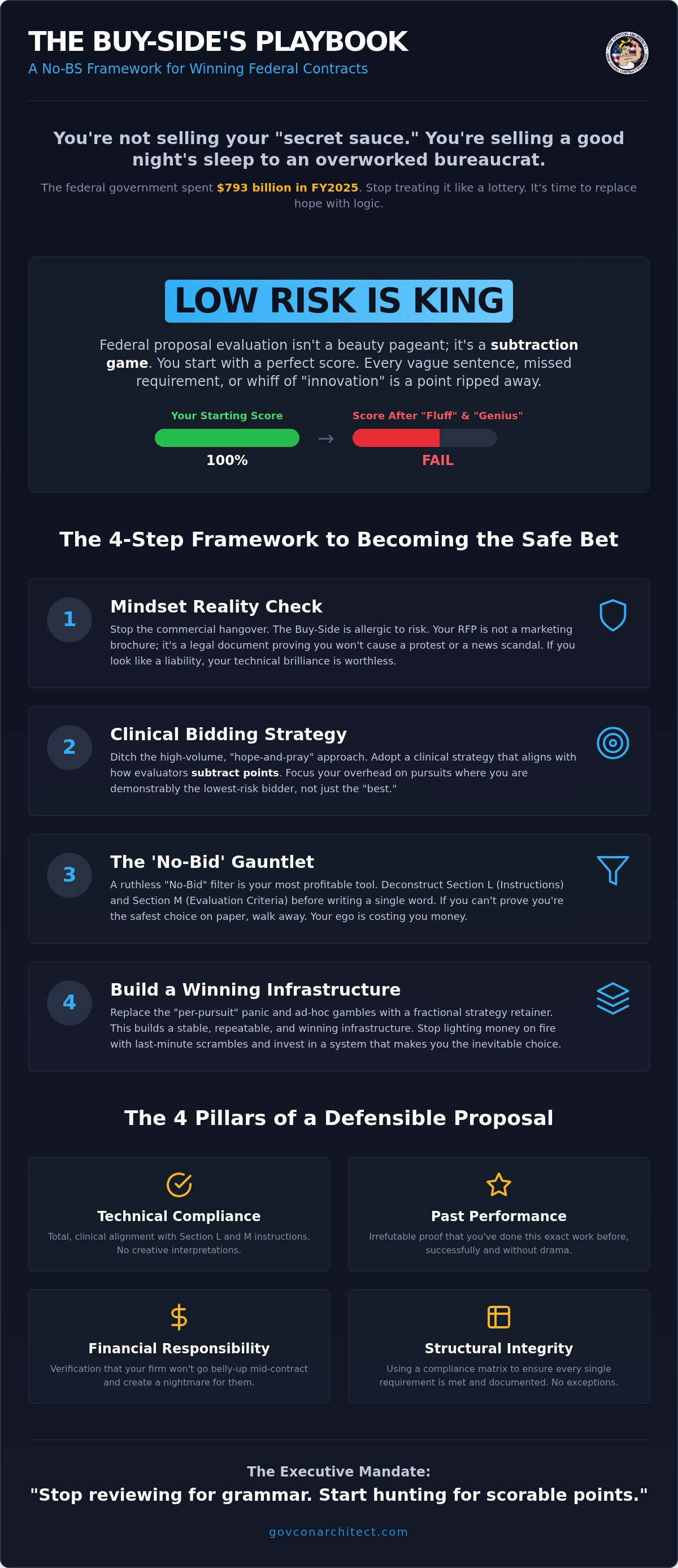
The government is allergic to risk. While you’re focused on "winning," the evaluator is focused on not getting fired. Effective federal proposal management for executives isn't a beauty pageant; it's a subtraction game. You start with a perfect score, and every vague sentence or missing detail is a point ripped away. Your proposal is a legal shield for the Contracting Officer. If they pick you, they need a paper trail that proves you won't fail, because their reputation is on the line.
To play this game, you must understand the Federal Acquisition Regulation (FAR) and how it dictates the rules of engagement. Adopting a low risk bidder strategy means shifting your focus from "how good are we?" to "how safe are we?" It’s a clinical pivot that separates the hobbyists from the heavy hitters. When you master federal proposal management for executives, you stop being a salesman and start being a partner in the government's mission.
The 4 Pillars of a Low-Risk Federal Proposal
Success rests on four structural supports that evaluators use to verify your stability:
- Technical Compliance: Total alignment with Section L and M instructions.
- Past Performance: Proof that you’ve done exactly this before, without the drama.
- Financial Responsibility: Verification that your firm won't go belly-up mid-contract.
- Structural Integrity: Using a technical proposal compliance matrix to ensure no requirement is left behind.
Executive Oversight: Moving Beyond "Does it Look Good?"
Stop reviewing for grammar. I don't care if a comma is missing; I care if the scorable points are present. Your proposal kickoff meeting is the most critical hour of the pursuit. If you aren't setting the risk-mitigation tone there, your team will default to commercial fluff. If you are ready to stop guessing and start winning, you might want to review our strategic framework.
A 4-Step Framework for Managing Federal Proposals
Winning isn't about working harder; it's about being more clinical than your competition. Effective federal proposal management for executives requires a framework that removes emotion from the equation. You aren't "trying your best." You are executing a sequence designed to satisfy a bureaucrat's checklist. By following these four steps, you stop being a gambler and start being an architect of your own success.
Step 1: Implementing a Brutal Bid/No-Bid Process
For firms with $5M+ revenue, chasing the wrong contract is a fiscal suicide mission. You must calculate the "Cost of Pursuit" against the "Probability of Win." If the pursuit doesn't align with your long-term revenue strategy, kill it. Stop chasing lotteries and start chasing wins that actually scale your business. I care about your bottom line, so I'm telling you: walking away is often the smartest executive move you'll make.
Step 3: The Buy-Side Review
Step 2 requires deconstructing Section L and M to map your proposal exactly to the evaluator's score sheet. Once that's done, you need a Buy-Side Reality Check. A legal overview of the FAR shows that evaluators are bound by strict scoring rules, not artistic preference. While a "Red Team" review often misses the actual risk factors the government hates, a Buy-Side review identifies the triggers that lead to reasons for losing government contracts. We look for the gaps that make you look like a liability.
Finally, Step 4 involves managing post-submission intelligence. Don't just sit by the phone. Use the debrief to refine your technical proposal compliance matrix for the next pursuit. This disciplined approach to federal proposal management for executives ensures every loss is a data point, provided you're professional enough to listen to why you were too risky. The government buyer wants you to succeed, but only if you can prove you won't make their life difficult.
Retainer vs. Ad-Hoc: Why Fractional Strategy Wins in 2026
Ad-hoc bidding is the professional equivalent of a panic attack. You wait for an RFP to drop, then scramble to find a writer who doesn't understand your delivery model. This "per-pursuit" panic is exactly why ad-hoc bidding is a high-risk strategy. It guarantees inconsistency and high overhead. Effective federal proposal management for executives requires a shift from emergency response to structural stability.
The RETAINER · MONTHLY advantage isn't about having a writer on call. It's about building a low-risk infrastructure over six to twelve months. The Buy-Side rewards firms that demonstrate continuous readiness, not those that look like they just woke up. When you invest in a long-term strategy, you align your firm’s operations with how the government actually buys. You stop being a vendor and start being a predictable, low-risk asset.
The Fractional Federal Strategy Advisor
You don't need a template-pusher; you need an elite insider who knows why evaluators say "no." Real strategy takes time, which is why we require a three-month minimum commitment. There are no 30-day shortcuts to federal dominance. We are building a defensible position, not a temporary fix. It’s clinical, it’s blunt, and it’s the only way to protect your firm from wasting capital on losing pursuits.
Scaling Your Federal Revenue Channel
Stop trying to "get a contract." Start building a federal business. A contract is a transaction; a federal revenue channel is an enterprise asset. If you are serious about moving beyond the "lottery" phase of federal proposal management for executives, you need a partner who values results over effort. We provide the clinical oversight necessary to turn your technical excellence into a scorable, low-risk advantage.
Book a 15-minute Get-to-Know-You Call
Stop Bidding Like a Gambler
Federal proposal management for executives isn't about being the smartest person in the room; it's about being the most boringly predictable firm on the evaluator's desk. You've seen why the "Commercial Hangover" kills bids and why low risk is the only metric that matters in 2026. Transitioning from ad-hoc panic to a structural strategy is how you protect your $5M+ firm's overhead and turn federal bidding into a real revenue channel. I've spent 22 years on the Buy-Side watching firms sabotage themselves with marketing fluff. It’s time to stop the bleeding because I actually want to see you win.
You've built something impressive in the commercial world. It's time to apply that same clinical discipline to your federal pursuits. Let's build a strategy that doesn't just chase RFPs but actually wins them. You're ready for this.
Frequently Asked Questions
How is federal proposal management different from commercial proposal management?
Commercial bids are beauty pageants, but federal bids are legal depositions. In the private sector, you win by being flashy and "innovative." In the federal world, you win by being invisible to risk. Federal proposal management for executives focuses on clinical compliance rather than marketing magic. The government doesn't want to be impressed; they want to be protected from protests and performance failure. If you sell like a commercial firm, you lose.
Do I need a full-time proposal manager for my $5M firm?
Hiring a full-time proposal manager for a $5M firm is usually a waste of capital. You aren't bidding enough to keep an elite expert busy, so you end up hiring a junior who just pushes templates. You need strategy, not a babysitter. A fractional approach provides Buy-Side insight without the massive overhead, allowing you to scale your federal revenue channel without unnecessary payroll bloat.
What is the most common reason executives lose federal bids?
Executives lose because they treat the U.S. government like a private client. They focus on their own technical brilliance instead of the evaluator's scoring matrix. The most common failure point is ignoring the Buy-Side reality: evaluators are looking for reasons to say no. If your proposal doesn't explicitly remove every technical and financial risk, you're just donating your proposal costs to the government's recycle bin.
How much does professional federal proposal support cost?
Professional support varies based on the complexity of your pursuits. Our RETAINER · MONTHLY – Fractional Federal Strategy Advisor starts @$3,500/month with a three-month minimum commitment. If you are chasing a specific, high-stakes contract, a PER‑PURSUIT · PROJECT – Capture & Proposal Sprint starts at $3,000 per pursuit. Real strategy isn't cheap, but losing a multi-million dollar bid because you tried to save a few bucks is much more expensive.
What are Section L and Section M in a federal RFP?
Section L contains instructions for preparing your proposal, while Section M details how the government will score it. Think of Section L as the rules of the road and Section M as the judge's scorecard. Successful federal proposal management for executives requires mapping every sentence of your draft to these sections. If you ignore them, you aren't bidding; you're just writing expensive fan fiction that nobody wants to read.