

Developing a Government Contract Compliance Plan: A Buy-Side Framework for 2026

Article by
Nikki Gianni
Nikki Gianni is a seasoned business strategist and government contracts coach, dedicated to helping businesses successfully navigate the complexities of government contracting. With over 22 years of experience in Department of Defense contracting, including managing $20 billion in federal awards, Nikki has developed the innovative GovReady Blueprint™ Framework, a comprehensive 90-day program designed to prepare businesses to compete for and win lucrative contracts at the federal, state, and local levels. Nikki's approach emphasizes not just gaining contracts but also enhancing overall business profitability.
Before becoming a business owner, Nikki was active-duty Air Force for 10 years, then spent another 15 years as a civil servant with the DOD. Now she's an empty nester living in Southern California who loves spending time with her 22-year-old son, Lex and her 2 Mini Aussies, Tony & Carmela, doing home improvement and crafts projects, and networking.
A compliance binder can look immaculate and still fail the test that matters: can your team show who owns each obligation, how it is controlled, and where the evidence lives? Developing a government contract compliance plan means building that proof into day-to-day operations, not giving a policy document a nice cover and hoping nobody asks questions.
If requirements seem scattered across procurement, security, finance, and delivery, you’re not imagining the problem. Requirements can vary by contract, and stale guidance or informal handoffs create avoidable risk. The government scrutinizes compliance for a practical reason: it needs confidence that public funds, sensitive information, and mission delivery are protected. That’s the Buy-Side lens. Clear, verifiable controls make your approach easier to assess.
This article walks through a practical framework for identifying applicable obligations, assigning accountable owners, establishing repeatable controls, and keeping evidence retrievable as requirements change. It also separates operational planning from legal interpretation, so the plan is useful without pretending to replace qualified counsel. The goal is a credible, lower-risk operating posture, not a promise of an award.
Key Takeaways
- Start with each contract’s actual terms and applicable clauses. Prioritize obligations by exposure, operational dependencies, and the proof needed to demonstrate performance.
- When developing a government contract compliance plan, turn each obligation into a control with a named owner, retained evidence, and a review process.
- Train people for their roles and real workflows. Generic box-checking won’t show whether a control works.
- Use contract changes, incidents, audit findings, and updated authoritative guidance as review triggers. Track exceptions through documented closure.
Why a Government Contract Compliance Plan Is More Than a Policy Binder
A policy binder explains what the company believes. A compliance plan shows how work gets done. It connects obligations that apply to the contract with practical controls, employee responsibilities, accountable owners, and records of what happened. Without those connections, a polished policy can become corporate wallpaper: impressive from across the room, not much help when someone needs to verify a process.
For a government buyer, unsupported assurances leave basic questions unanswered. Who performs the control? What happens when it fails? Can the company show a consistent record? Buyers assess performance and risk, not the elegance of a document library. A credible plan helps the organization answer with specific, traceable practices. It supports risk management; it doesn’t guarantee compliance, secure an award, or replace legal advice.
What makes federal contract compliance different from general business policy?
Organization-wide ethics principles set a baseline for conduct. Contract-specific obligations are narrower: they depend on the agreement’s terms and the clauses that apply to the work. The Federal Acquisition Regulation (FAR) provides broader procurement context, but don’t assume every requirement applies to every contract. Map the actual terms and route legal interpretation to qualified counsel. Guessing is not a control.
Why does the government buyer care about compliance evidence?
Consistent records help buyers and company leaders understand whether responsibilities were carried out, exceptions were addressed, and accountability was clear. The government is protecting public resources and needs a clear view of performance risk. Evidence-backed compliance connects an applicable obligation to a working control and records showing how that control operates. It makes the company’s posture assessable, not magically risk-free.
That distinction should shape the work from the start. Developing a government contract compliance plan isn’t about claiming perfection; it’s about making obligations operational and showing honestly how the organization manages them. When practice and documentation align, leaders can spot gaps sooner and respond with discipline. Keep the binder. Just don’t mistake it for the whole plan.
Build the Plan Around Applicable Obligations, Risk, and Ownership
Start with the contract, not a generic compliance spreadsheet copied from a file called “Final_v7.” Review the award documents and applicable clauses with qualified contract or legal support, then identify the processes each obligation touches. A requirement affecting invoicing needs a different operational owner from one affecting staff access or subcontractor oversight. Developing a government contract compliance plan means tracing each obligation to the people and processes that can carry it out.
How should a contractor identify which obligations apply?
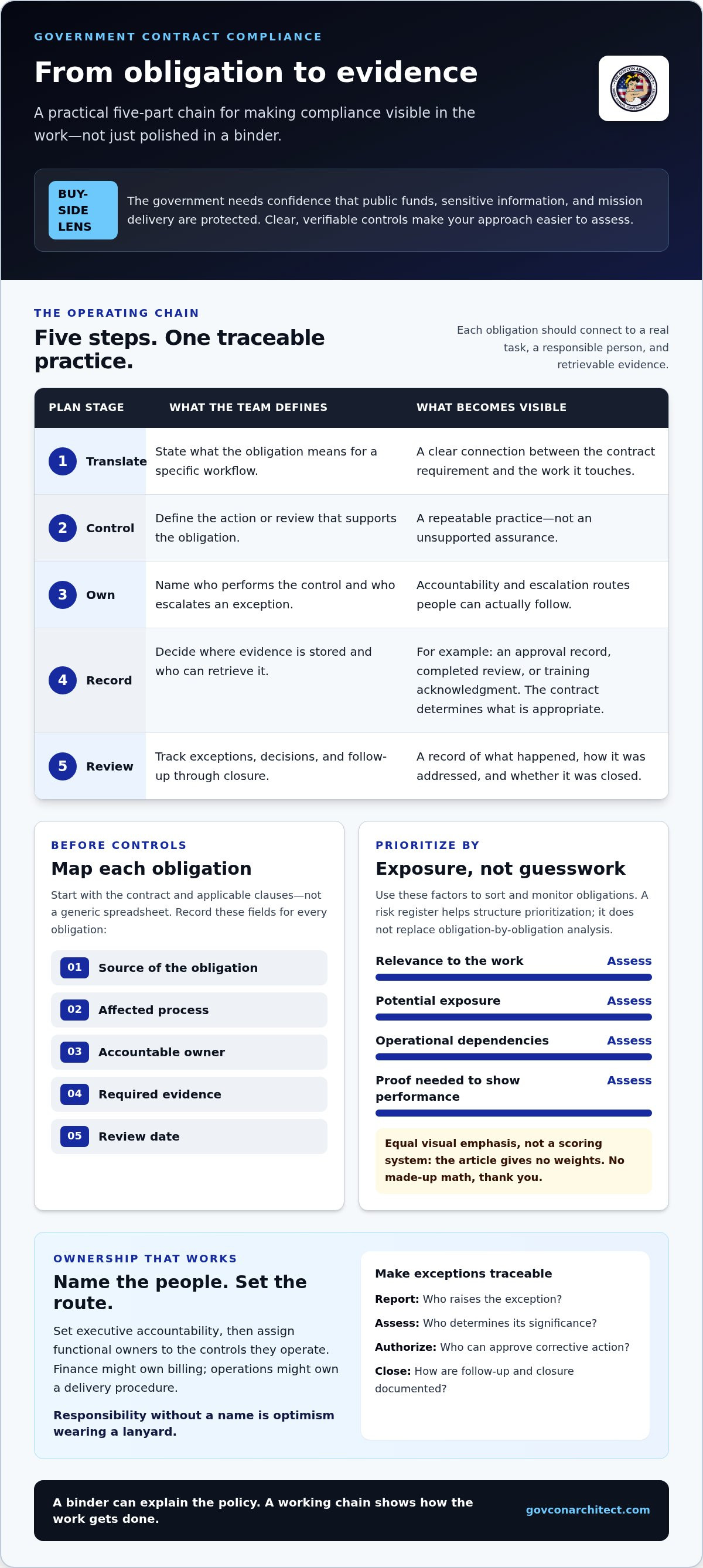
For each obligation, record its source, the affected process, the accountable owner, the required evidence, and the review date. Prioritize by relevance to the work, potential exposure, operational dependencies, and the proof needed to demonstrate performance. A risk register can help sort and monitor these items, but it can’t replace obligation-by-obligation analysis. A government contractor risk management framework can help structure that prioritization. The Government Contracts Compliance Handbook by Seyfarth Shaw LLP offers broader legal context; your contract still determines what needs to be assessed for your work.
Who owns the compliance plan inside the company?
Set executive accountability, then assign functional owners to the controls they operate. Finance might own a billing control; operations might own a delivery procedure. Define who reports an exception, who assesses its significance, and who can authorize corrective action. Every material obligation needs a named owner. Responsibility without a name is optimism wearing a lanyard. Make escalation routes clear before a problem lands in someone’s inbox and starts touring the company.
Review the register with the people who perform the work. Confirm owners understand their roles, evidence can be retrieved, and unresolved issues have a path to decision and closure. Buy-Side strategy can help leaders make their posture clearer and more credible. For support aligning federal strategy with buyer-side risk considerations, learn about a strategy discussion.
Turn the Compliance Plan into Controls, Training, and Evidence
A mapped obligation matters only if it changes how work gets done. Build an operating chain: translate the obligation into a task, design a control, assign an owner, retain evidence, and review exceptions. That’s what turns developing a government contract compliance plan from paperwork into repeatable execution.
- Translate: State what the obligation means for a specific workflow.
- Control: Define the action or review that supports it.
- Own: Name the person responsible for performing and escalating the control.
- Record: Identify where evidence will be stored and who can retrieve it.
- Review: Track exceptions, decisions, and follow-up through closure.
Evidence might include an approval record, a completed review, or a training acknowledgment. These are examples, not universal requirements. The contract and applicable requirements determine what evidence is appropriate. A federal contract compliance checklist can support a related risk review, but it doesn’t replace contract-specific analysis.
How do you connect obligations to repeatable controls?
Consider a hypothetical obligation affecting how a team approves deliverables. The control could document who reviews the work and how exceptions are escalated. Record the control owner, frequency, evidence location, and exception path. Keep proposal-stage requirement tracking distinct from post-award operating controls. A federal proposal compliance matrix supports the former; it isn’t a substitute for the latter.
What should training and escalation actually accomplish?
Train employees on the responsibilities relevant to their roles: the actions they perform, the records they preserve, and how they raise a concern. Managers should document the report, response owner, decisions, and corrective-action follow-through. Training isn’t a box to tick and forget. It should help people act consistently in real workflows. Legal reporting and disclosure decisions belong with qualified counsel and authorized company leadership.
For help aligning federal strategy with buyer-side considerations, explore a focused strategy discussion.
Keep the Plan Current, and Make Compliance Part of Your Buy-Side Positioning
A plan can be accurate on Monday and out of step after a contract or process changes. Set a periodic review cadence with company leadership and counsel, then add event-driven reviews when contract terms, operations, incidents, audit findings, or authoritative guidance change. The scheduled review catches drift. The event-triggered review responds to it.
How often should a government contract compliance plan be reviewed?
Choose a defined interval that fits the company’s operations and counsel’s guidance. There’s no universal schedule that suits every contract. Assign someone to monitor review triggers and record what changed, which obligations or controls may be affected, and what decision followed.
Routine reviews test whether the plan still works; change-triggered reviews ask what the change just broke.
Keep exceptions visible until they’re resolved. Track the issue, response owner, corrective action, and evidence supporting closure. Don’t claim “perfect compliance” because the spreadsheet has no red cells. A defensible record shows what was reviewed, what needs attention, and how the company responded. That candor supports a more credible low-risk posture without promising selection or an award.
When can buy-side strategy strengthen the compliance story?
In a proposal, describe controls accurately and connect them to the work being offered and the evaluation criteria. Unsupported claims invite questions. Clear, supportable descriptions help evaluators understand how the company manages performance risk. That’s not a shortcut to selection; it’s disciplined positioning grounded in what the organization can demonstrate.
The GovCon Architect’s strategic advisory draws on buy-side experience to help firms align federal strategy and proposal positioning with evaluator considerations. For ongoing federal strategy support, RETAINER · MONTHLY - Fractional Federal Strategy Advisor provides monthly retainer support. Qualified counsel remains essential for interpreting legal obligations and advising on contract-specific decisions.
Make Your Compliance Posture a Leadership Decision
Treat compliance as part of how you run and position the business, not as paperwork delegated and forgotten. Start with one upcoming contract or operating change. Can your team explain its approach clearly, support its claims, and identify where judgment or escalation is needed? That discipline helps leaders make informed decisions before uncertainty becomes operational friction.
For firms ready to sharpen that approach, Nikki Gianni brings 22 years of buy-side experience to strategic advisory focused on practical acquisition insight and alignment with evaluator considerations. GovCon Architect helps businesses build federal-market strategy and position their capabilities with the buyer’s risk lens in mind. The aim is a clearer, more credible posture, not a promise of selection.
Developing a government contract compliance plan is serious work, but it doesn’t have to be guesswork. Build deliberately, keep claims supportable, and give your team a structure it can use with confidence.
Frequently Asked Questions
What should a government contract compliance plan include?
Include a clear scope, a controlled record of applicable obligations, assigned responsibilities, operating procedures, training references, evidence locations, and a process for documenting updates. Developing a government contract compliance plan also means controlling the plan itself: identify its version, approval authority, and effective date. That helps employees avoid relying on an old procedure pulled from a shared drive and mistaken for the current one.
Does every government contractor need the same compliance plan?
No. The plan should reflect the company’s contracts, work, and internal structure. A firm performing different kinds of work across separate awards may need distinct procedures or control records, even if some company-wide policies remain consistent. The goal isn’t to build a bespoke universe for every contract. It’s to distinguish shared practices from contract-specific responsibilities instead of assuming one template fits everything.
Does having a written compliance plan guarantee compliance?
No. A document can’t perform a control, notice that a process has drifted, or resolve an exception. For example, a procedure may require a manager’s approval, but the approval record could be missing or the workflow could have changed. Periodic testing of selected records and conversations with the employees doing the work can reveal whether written procedures match actual practice. The plan supports oversight; it isn’t a guarantee.
Who should be responsible for a government contract compliance plan?
Senior leadership should remain accountable, while functional managers own the procedures their teams perform. A designated coordinator can maintain the plan’s records and prompt scheduled reviews, but shouldn’t become the default owner of every control. Name backups for key roles, too. If one employee is unavailable, the process should still have a clear path for decisions, documentation, and escalation.