

Creating a Federal Proposal Color Team Review Process: A Buy-Side Guide

Article by
Nikki Gianni
Nikki Gianni is a seasoned business strategist and government contracts coach, dedicated to helping businesses successfully navigate the complexities of government contracting. With over 22 years of experience in Department of Defense contracting, including managing $20 billion in federal awards, Nikki has developed the innovative GovReady Blueprint™ Framework, a comprehensive 90-day program designed to prepare businesses to compete for and win lucrative contracts at the federal, state, and local levels. Nikki's approach emphasizes not just gaining contracts but also enhancing overall business profitability.
Before becoming a business owner, Nikki was active-duty Air Force for 10 years, then spent another 15 years as a civil servant with the DOD. Now she's an empty nester living in Southern California who loves spending time with her 22-year-old son, Lex and her 2 Mini Aussies, Tony & Carmela, doing home improvement and crafts projects, and networking.
What if your color-team calendar is packed, your reviewers are exhausted, and the proposal still has a compliance gap? That’s not a review process. It’s an expensive way to discover risk late. Creating a federal proposal color team review process means giving each review a distinct job: test the strategy, expose gaps in the draft, challenge the evaluator-facing case, and verify corrections before submission.
Reviews need to happen early enough to matter. The harder part is making feedback useful. Conflicting opinions, unsupported comments, and edits without clear owners create motion, not control. Government buyers assess whether your proposal meets the stated criteria and provides credible evidence that you can deliver with low risk. They don’t award points for a color-coded calendar. This guide lays out a practical review sequence, defines reviewer roles and feedback standards, and assigns correction ownership. You’ll also see how to make the final go/no-go decision based on resolved risks, not the comforting fiction that everything will work out.
Key Takeaways
- Build a federal proposal color team review process around distinct decisions at each stage, not color labels that merely decorate the calendar.
- Use Blue to test strategy and Pink to catch structural and content gaps while there’s still time to correct them.
- Make review comments actionable by tying each finding to an instruction, evaluation factor, proposal location, and specific risk.
- Balance internal knowledge with outside independence, while keeping proposal leadership accountable for decisions and fixes.
Why a Federal Proposal Color Team Review Process Must Test Risk, not Just Polish
A color review is a staged test of proposal readiness. Its job isn’t to make a draft look busy or give every reviewer a turn with the red pen. It’s to find out whether the proposal answers the solicitation with clear, credible evidence. A buyer assessing a Government Contract Proposal needs to understand what you’re offering and why the evidence supports confidence in performance. Unclear claims or unresolved requirements can make delivery look riskier than it is.
That’s the point of creating a federal proposal color team review process: test risk before the government finds the gap for you. Each review should test a defined risk against solicitation requirements. A substantive finding identifies a missing response, unsupported claim, contradiction, or unclear proof. “I’d phrase this differently” is a preference, not a finding. Formatting matters, but it shouldn’t outrank whether the proposal actually answers the requirement.
How reviews become meetings without decision value
Reviews lose value when they happen too late for meaningful changes, comments say “needs work” without pointing to a requirement, or feedback arrives without evidence. Then the team burns time debating taste while real gaps remain. Repeating the same broad review at every checkpoint doesn’t add control. Assign each pass a distinct question, and ask reviewers to anchor concerns to the solicitation and the draft. A proposal compliance risk review can help teams identify what needs an evidence-based check.
The evaluator’s perspective is the control point
Review the proposal as a buyer would. Is each claim understandable? Does the evidence support it? Does the response address what the solicitation asks? This is not a writing-style popularity contest. The government needs a defensible basis to assess whether your approach meets its needs. Low risk isn’t a slogan. It’s buyer confidence built from credible, relevant evidence that’s easy to follow. If reviewers can’t trace a claim to proof, the evaluator may not be able to either.
What Each Federal Proposal Color Team Review Should Decide
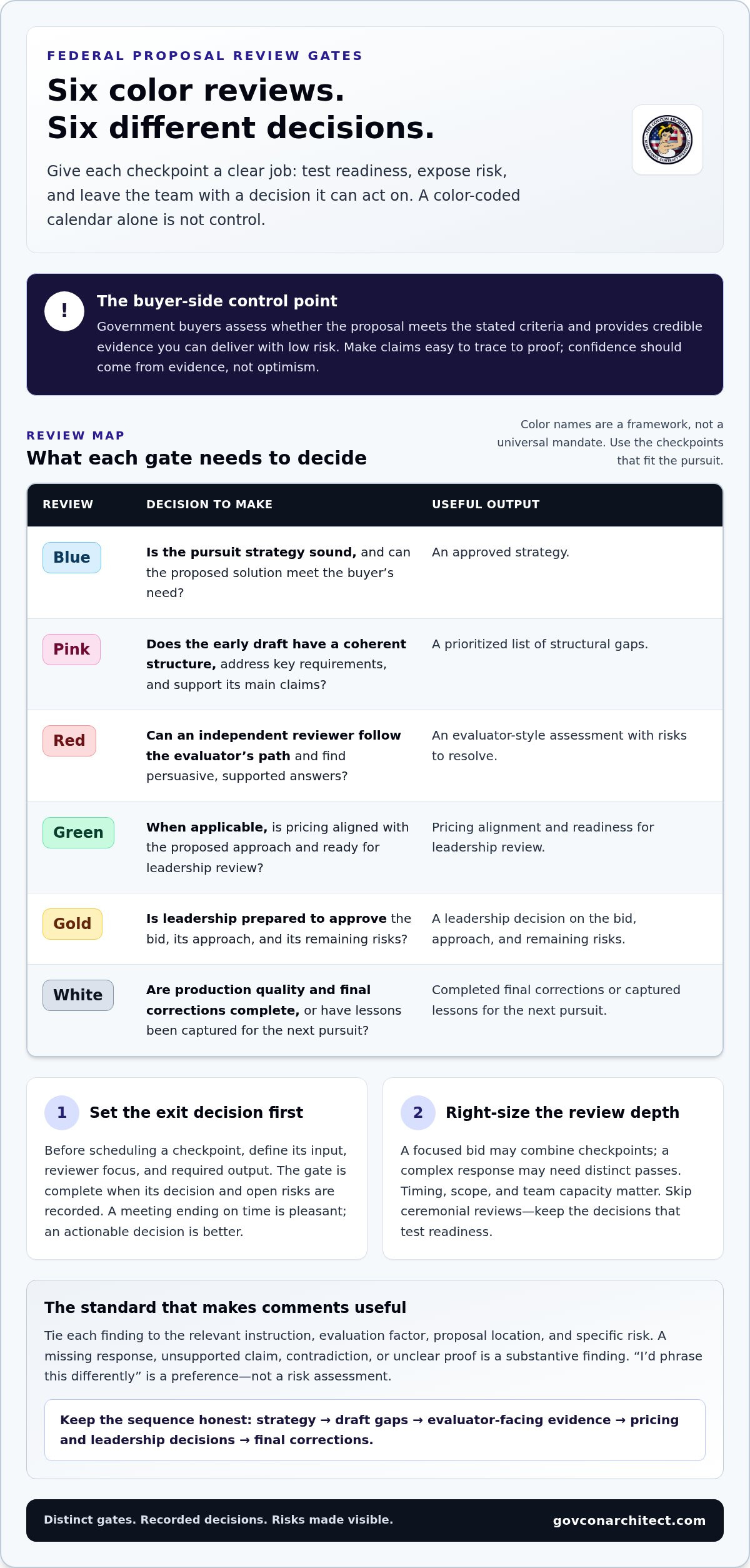
Color names are a framework, not a universal mandate. Use the checkpoints that fit the pursuit, then define the decision each one must produce. Otherwise, the team gets a tidy calendar and no reliable signal about readiness.
| Review | Decision to make |
|---|---|
| Blue | Is the pursuit strategy sound, and can the proposed solution meet the buyer’s need? |
| Pink | Does the early draft have a coherent structure, address key requirements, and support its main claims? |
| Red | Can an independent reviewer follow the evaluator’s path through the proposal and find persuasive, supported answers? |
| Green | When applicable, is pricing aligned with the proposed approach and ready for leadership review? |
| Gold | Is leadership prepared to approve the bid, its approach, and its remaining risks? |
| White | Are production quality and final corrections complete, or have lessons been captured for the next pursuit? |
Set a clear exit decision for every review
Before scheduling a checkpoint, specify its input, reviewer focus, and required output. Blue might produce an approved strategy, Pink a prioritized list of structural gaps, and Red an evaluator-style assessment with risks to resolve. A review gate is complete when its decision and open risks are recorded. A meeting ending on time is nice. A decision you can act on is better.
Match review depth to proposal maturity
Don’t force every color into every pursuit. Timing, scope, and team capacity matter. A focused bid may combine checkpoints; a complex response may need distinct passes. Keep requirements traceable with a federal proposal compliance matrix. For evaluator context, consult the Federal Acquisition Regulation (FAR) on Proposal Evaluation. If you’re shaping a pursuit-specific sequence, a strategic proposal review discussion can help clarify the decisions each gate needs to deliver. That’s the discipline behind creating a federal proposal color team review process: right-sized reviews, with no ceremonial checkpoints.
How to Run Reviews, Resolve Comments, and Verify Proposal Fixes
A review creates value only when findings become controlled corrections. Set the rules before reviewers open the draft, then track every accepted action through verification. That discipline is the working core of creating a federal proposal color team review process. Without it, comments multiply, ownership blurs, and “fixed” becomes a hopeful guess.
Prepare reviewers and control the review environment
Assign reviewers by expertise and perspective. A technical expert can test whether the solution is credible; an evaluator-minded reviewer can assess whether the response is clear and persuasive. Don’t ask everyone to review everything. Provide one controlled draft, a shared comment method, clear deadlines, and written instructions that define the review question. Align roles early with a federal proposal kick-off agenda.
Use this repeatable sequence:
- Issue review instructions that identify the purpose and criteria.
- Provide the controlled draft and supporting solicitation materials.
- Collect findings tied to the relevant instruction, evaluation factor, proposal location, and specific risk.
- Have the proposal lead adjudicate comments and record acceptance or rejection with a rationale.
- Assign each accepted correction to an owner, with a status and due point.
- Verify the corrected text in context and update the finding’s status.
Turn review findings into accountable corrections
Separate evidence-based findings from preferences. “The response doesn’t explain how the approach meets the requirement” identifies a risk. “I’d use a punchier verb” may be a style preference. The proposal lead resolves conflicting comments, records why a recommendation was accepted or rejected, and assigns the fix to a named owner. No critical finding is closed until the corrected text is checked in context. A focused re-review confirms the change didn’t create a contradiction elsewhere. An independent perspective can strengthen that check; see how government contract proposal review services can support a pursuit.
When to Use Internal or Outside Review Support for a Federal Proposal
Internal reviewers know the solution, delivery record, and proposal history. That familiarity is valuable, but it can also make weak assumptions harder to see. Outside reviewers bring distance and may spot where the evaluator-facing logic is unclear. The practical tradeoff is that internal reviewers may have deeper pursuit knowledge, while outside support can add independence or expertise the team lacks. Timing matters too. A review that arrives after decisions are locked is a postmortem wearing a calendar invite.
Choose support based on the risk you need to test
Use internal subject-matter experts to verify technical accuracy and whether delivery evidence supports the claims. Consider independent buy-side insight when compliance concerns remain unresolved, the evaluator’s path through your argument feels weak, or internal feedback conflicts without a clear basis. The government needs credible evidence to assess performance risk, not a chorus of people defending their favorite paragraph.
Outside review should sharpen the team’s judgment, not take it over. Proposal leadership remains accountable for decisions, corrections, and the final submission. For a defined pursuit, PER‑PURSUIT · PROJECT - Capture & Proposal Sprint provides support tailored to that bid. That’s a practical option when creating a federal proposal color team review process exposes a risk your current reviewers can’t resolve with confidence.
Make the next step specific and low-friction
Before bringing in added perspective, identify the opportunity, current proposal stage, and most pressing review concern. Is the issue traceability, evidence, evaluator logic, or conflicting feedback? Naming the problem makes the discussion useful from the start. Keep the objective grounded: strengthen preparation and alignment, reduce avoidable risk, and make decisions with clearer information. No one can responsibly promise an award. That’s not how federal buying works, and pretending otherwise helps nobody.
Make Your Next Review a Decision Point
Your next pursuit is a chance to make review discipline part of how the team works, not a ritual dusted off when a deadline starts breathing down everyone’s neck. Creating a federal proposal color team review process is valuable when it helps leadership see what is ready, what remains exposed, and what must change before submission.
That calls for honest judgment. A proposal can be polished and still leave the buyer working too hard to understand the evidence. Give reviewers permission to identify the uncomfortable gap, and give the team a clear path to resolve it. Low risk is built through credible preparation, not optimism in a nice font.
Led by Nikki Gianni, The GovCon Architect brings 22 years of buy-side experience in government buying, evaluation, award, and contract administration. Its perspective can help commercial firms with $5M+ in annual revenue and 5+ years of proven delivery examine whether a pursuit’s evidence and arguments are clear from the buyer’s side, while leadership retains ownership of the final decisions.
Bring the pursuit’s real questions to the table. Book a 15-minute get-to-know-you call to discuss your proposal review strategy. A stronger, more defensible proposal starts with the next decision you’re willing to make clearly.
Frequently Asked Questions
What is a color team review in federal proposal development?
A color team review is a checkpoint for deciding whether proposal content or strategy is ready to advance. For example, reviewers assessing a staffing approach can trace promised roles to the solicitation’s needs and the evidence in the draft. The value of creating a federal proposal color team review process is a decision the team can act on, not another round of opinions about wording.
What is the difference between a Pink Team and a Red Team review?
A Pink Team review typically examines an early structure or draft, while a Red Team review tests a more developed proposal as an evaluator might. The early review could expose a missing response area before writers invest in detailed narrative; the later one can test whether the finished explanation is convincing and supported. Define each review’s scope for the pursuit, because color labels don’t set it for you.
Does every federal proposal need Blue, Pink, Red, Green, Gold, and White reviews?
No. Choose checkpoints based on the opportunity, schedule, maturity, risk, and reviewer capacity. A focused proposal team might use a strategy decision, a substantive draft challenge, and a final production check, adding a separate pricing review when pricing needs its own scrutiny. The useful test is whether a checkpoint catches something distinct. If it only repeats another review, simplify the sequence and preserve time for corrections.
Who should participate in a federal proposal color team review?
Choose participants according to the risk under review. A delivery lead can validate whether staffing and past-performance examples reflect actual capability; a compliance lead can trace requirements across the response; and a pricing lead can examine cost assumptions when pricing is in scope. Keep the reviewer group focused. Invite specialists to assess the portions they understand, rather than giving every participant an all-access pass to every comment.
How should a proposal team handle conflicting color team review comments?
Resolve conflicts by testing recommendations against the solicitation, proposed solution, and available evidence, not by holding a comment popularity contest. For example, if one reviewer wants a broader claim and another questions its proof, preserve the narrower defensible wording unless stronger evidence supports the change. Record unresolved material disagreements for leadership attention, so a consequential risk doesn’t disappear just because the draft has moved on.