
GovCon Pursuit Management: A Buy-Side Strategy for Low-Risk Wins

Article by
Nikki Gianni
Nikki Gianni is a seasoned business strategist and government contracts coach, dedicated to helping businesses successfully navigate the complexities of government contracting. With over 22 years of experience in Department of Defense contracting, including managing $20 billion in federal awards, Nikki has developed the innovative GovReady Blueprint™ Framework, a comprehensive 90-day program designed to prepare businesses to compete for and win lucrative contracts at the federal, state, and local levels. Nikki's approach emphasizes not just gaining contracts but also enhancing overall business profitability.
Before becoming a business owner, Nikki was active-duty Air Force for 10 years, then spent another 15 years as a civil servant with the DOD. Now she's an empty nester living in Southern California who loves spending time with her 22-year-old son, Lex and her 2 Mini Aussies, doing home improvement and crafts projects, and networking.
Most federal pursuit management is nothing more than expensive guessing. High costs. Zero results. Low visibility.
You believe you're selling a capability. The Contracting Officer believes they're managing a liability. If you aren't architecting your bid to be the lowest-risk option, you've already lost. Even with a perfect technical score, hidden evaluation criteria often leave superior firms in second place. It is a systemic failure of strategy, not talent.
It's a high-stakes reality check. You've felt the sting of unsuccessful bids and the confusion of a debrief that explains nothing. You want predictable win rates. You want to stop burning capital on hope and start aligning with how the government actually buys, especially as firm-fixed-price contracts become the mandatory default in 2026. You need a method that prioritizes structural integrity over marketing fluff.
This briefing will show you how to master govcon pursuit management by adopting a clinical, buy-side strategy. We'll show you how to look through the lens of the Contracting Officer to eliminate perceived risk and secure the award. We will analyze the mechanics of federal buying habits and provide a roadmap to becoming the government's safest bet.
Key Takeaways
Shift your perspective from being the "best" vendor to becoming the lowest-risk choice for the Contracting Officer.
Modern govcon pursuit management is the strategic orchestration of resources to eliminate bid risk well before the submission stage.
Master the "No-Bid" decision as a clinical tool to protect your firm's capital and focus only on high-probability opportunities.
Implement early engagement and risk mapping to influence RFP criteria and neutralize competitors before the solicitation goes live.
Transition from tactical, compliance-only responses to an elite pursuit architecture that prioritizes structural integrity and federal buying habits.
Table of Contents
The Failure of Standard GovCon Pursuit Management
Standard govcon pursuit management is broken. Most firms treat it as an administrative duty. They hire managers who focus on font sizes and margin widths. They track deadlines on a calendar. They check boxes on a compliance matrix. This is not strategy. It is clerical survival.
Effective pursuit management is the strategic orchestration of resources to eliminate bid risk before submission. It is a clinical process. It requires an insider's understanding of how decisions are actually made behind closed doors. The reality check is simple. If you are discovering opportunities on SAM.gov, you are already late. You are reacting to a game where the rules were written six months ago by a competitor who was in the room.
Technical excellence is no longer a differentiator. Many "good" proposals fail because they solve the problem but ignore the risk. The Contracting Officer (CO) is not looking for the most visionary solution. They are looking for the path of least resistance. They want a vendor who won't end up as a performance report failure. If you haven't diagnosed the CO's specific fears, your technical brilliance is irrelevant.
The "Checklist" Trap in Federal Bidding
Compliance is the floor. It is not the ceiling. Meeting every requirement in a government contract proposal is a prerequisite for entry, not a reason for selection. When you treat pursuit management as a clerical task, you're playing a game of "don't get disqualified." You aren't playing to win.
Winning requires moving from "Proposal Support" to "Strategic Architecture." You must build a bid that is structurally sound from the foundation up. This means identifying evaluation gaps before the RFP is even drafted. It means understanding the hidden criteria that never make it onto the page. If you are not influencing the requirement, you are merely a spectator.
The Cost of Chasing Without Strategy
The ROI of a failed federal pursuit is always negative. It's not just the lost Bid and Proposal (B&P) funds. It's the opportunity cost. Every hour spent on a low-probability bid is an hour stolen from a winnable contract. The psychological toll on Business Development teams is equally high. Repeated "non-selects" breed a culture of defeatism. They turn elite strategists into jaded paper-pushers who no longer believe the system can be mastered.
Pursuit management is a clinical risk-elimination exercise.
To succeed in govcon pursuit management, you must stop chasing and start architecting. You must recognize that the government buys to avoid failure, not to achieve greatness. Align your pursuit with that reality, or continue to fund your competitors' victories with your own unsuccessful bids.
Risk Evaluation: The Lens of the Federal Contracting Officer
The Contracting Officer (CO) is not your customer. They are your gatekeeper. While your team obsesses over technical innovation, the CO is scanning your proposal for reasons to say "no." They aren't looking for the best solution. They're looking for the one that won't get them fired. In the clinical world of govcon pursuit management, success is defined by the absence of risk.
The government defines risk through three primary lenses: past performance, financial stability, and technical feasibility. These aren't just checkboxes. They are defensive barriers. If your past performance isn't an exact match for the current scope, you're a risk. If your balance sheet shows volatility, you're a risk. Even a "revolutionary" technical approach is a risk if it hasn't been proven at scale. The SBA contracting guide provides the regulatory framework, but it doesn't teach you how to neutralize these perceived threats.
Decoding the Buy-Side Perspective
COs use specific filters to eliminate bidders early. A common failure point for commercial leaders is assuming that private-sector success translates to federal reliability. It doesn't. To a CO, a firm that grows 300% in a year looks unstable, not successful. They fear you'll outgrow their contract or lose focus. You must use capture intelligence to pre-emptively solve these anxieties.
This involves identifying the "invisible evaluators" on the technical committee. These individuals often have hidden biases based on previous project failures. If they once had a bad experience with a specific software stack, and you propose it, you've lost before the scoring begins. Our per-pursuit project support helps firms identify these landmines before they step on them.
Section L and M: Your Architectural Blueprint
Section L and Section M are the only documents that matter. Section L tells you how to provide the data. Section M tells you how that data will be graded. Most firms treat these as separate instructions. Elite firms treat them as a single architectural blueprint. If your govcon pursuit management strategy doesn't map every sentence of your proposal to a specific point in Section M, you are wasting ink.
Section L is your data requirement. It's the "what." Section M is the scorecard. It's the "how." A compliance matrix isn't just a tracking tool. It is a strategic map. It ensures that every response you provide is a direct counter to a risk the CO is trying to mitigate. If you aren't writing to the scorecard, you aren't playing the same game as the evaluators. Winning requires you to build a bid that makes it impossible for the CO to find a reason for disqualification.
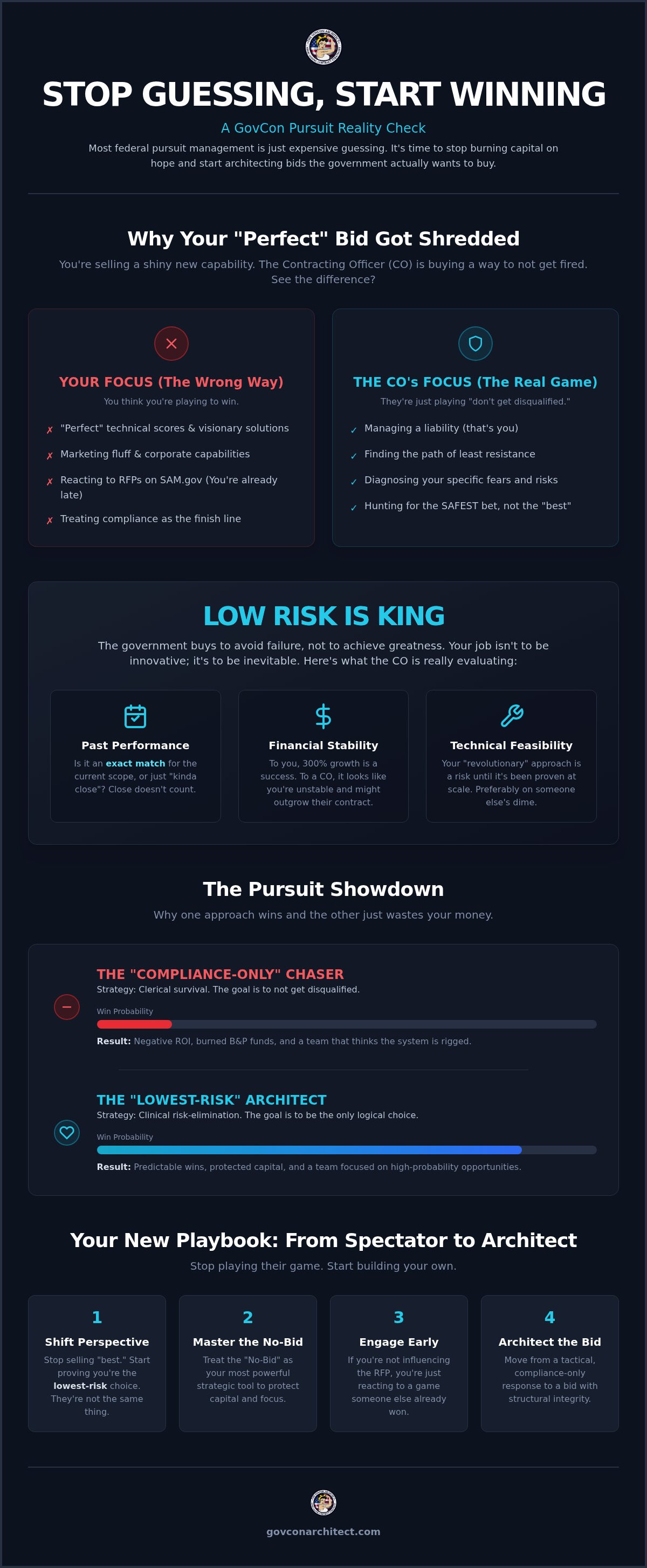
Strategic Capture vs. Compliance-Only Proposals
Proposals are tactical execution. Capture is the strategic foundation. If you wait for the RFP to start your strategy, you're submitting a compliance-only document. Compliance-only documents rarely win. They simply avoid disqualification. Winning requires positioning. It requires being an insider before the solicitation drops. Commercial firms often fail here because they treat federal sales like private sector transactions. In the private sector, you sell a solution. In the federal sector, you sell the mitigation of a specific agency's pain. If you haven't identified that pain during the capture phase, your proposal will be a generic response to a technical requirement.
The Art of the Bid/No-Bid Decision
The "No-Bid" decision is the most critical tool in govcon pursuit management. It preserves your most valuable asset: time. Commercial firms often struggle with this discipline. They see every RFP as a "fair shot." In reality, an RFP you didn't help shape is often a trap. You need a clinical framework for evaluating your Probability of Win (P-Win). This isn't a gut feeling. It's a calculation. When evaluating a pursuit, consider these factors:
Relationship depth: Have you met with the program manager and the CO?
Budget alignment: Is the funding secured for this specific fiscal year?
Past performance: Do you have a CPARS rating that matches the scope?
Structural advantage: Were you involved in the RFI process to influence the requirements?
If the requirements are written so specifically that only one firm can meet them, the contract is "wired." Walk away. Your goal is to prioritize resources for high-probability pursuits where you are the architect of the solution, not just a respondent to a document.
Building Competitive Intelligence
Building competitive intelligence requires more than just reading a competitor's website. You need Black Hat Analysis. This is a clinical breakdown of competitor moves and incumbent weaknesses. If the incumbent has had a recent CMMC 2.0 compliance issue or is under scrutiny by the Department of Justice's Civil Cyber-Fraud Initiative, that is your entry point. You position your firm as the stable, low-risk alternative. Strategic govcon pursuit management also leverages teaming agreements. Don't try to own 100% of a losing bid. Secure a smaller percentage of a winning one by partnering with firms that fill your specific past performance gaps. This creates a combined entity that is structurally superior to the competition.
Stop treating capture as a secondary task. It is the engine of your growth. Without strategic capture, your proposal is just expensive paper. With it, your proposal is the final step in a pre-determined victory. Focus on the structural integrity of your bid before you write the first word of the executive summary.
Building an Elite Pursuit Architecture
Effective govcon pursuit management is not about writing. It is about building. An elite pursuit architecture is a five-step structural framework designed to withstand the scrutiny of a cynical evaluator. It moves beyond the administrative and into the clinical. You are not just filling out a form. You are constructing a defensible argument for your firm's selection.
Step 1: Early Engagement. If you are reading the RFP for the first time on the day it drops, you have already failed. Influence the requirements before they are codified.
Step 2: Risk Mapping. This is a cold, objective identification of every possible reason the government could disqualify you. Address these vulnerabilities before they reach the evaluator's desk.
Step 3: Theme Development. Stop selling "innovation." The government fears the unknown. Sell stability. Sell the fact that you are the lowest-risk choice.
Step 4: Technical Alignment. Your solution must map exactly to the agency's pain points. Not your generic capabilities. Their specific, documented headache.
Step 5: Review Cycles. Clinical verification. Red. Gold. White Glove.
Shaping the Opportunity
Industry feedback is a weapon. Use Requests for Information (RFIs) to suggest evaluation criteria that favor your specific strengths. If you have a proprietary process that reduces cost or risk, suggest that the government prioritize that metric. At Industry Days, don't just listen. Set the agenda. Ask questions that force competitors to reveal their weaknesses without exposing your own. Your goal is to shape a solicitation that makes your firm the only logical choice. This is the essence of proactive govcon pursuit management.
The Review Process: Clinical Verification
The review process is where most bids fall apart. Standard firms use these cycles for proofreading and minor edits. Elite firms use them for structural testing. They treat the proposal like a building under a stress test.
Red Team: This is a brutal assessment. It is not about grammar. It is about compliance and strategy. The Red Team acts as the opposing force. If they don't find fatal flaws, they aren't looking hard enough.
Gold Team: The final executive check. This is where the value proposition is weighed against the pricing. It ensures the bid is a strategic match for the firm's long-term goals and that the profit margins are defensible.
White Glove: Professionalism matters. This is the final check for flawless delivery. No broken links. No formatting errors. Total precision. In a high-stakes environment, a single typo can signal a lack of attention to detail that the government cannot afford.
Elite pursuit architecture requires an insider's perspective. If your current process feels like a scramble, you need a structural overhaul. Secure your next win with our Per-Pursuit Project Support to ensure your bid is architected for success.
Executing the Win with GovCon Architect
Hope is not a strategy. In federal procurement, it is a liability. You've seen the cost of unsuccessful bids. You've felt the frustration of meeting technical requirements only to lose on "risk." Standard proposal firms offer clerical help. We offer structural integrity. Winning requires a clinical approach to govcon pursuit management led by those who have actually sat on the other side of the table.
GovCon Architect provides the strategic advisory needed to transform your firm into the government's lowest-risk choice. We don't just write. We architect. Led by Nikki Gianni, a veteran with 22 years of buy-side experience, we understand the hidden mechanics of federal evaluation. We diagnose the failure points in your strategy before the Contracting Officer does. This is the difference between a compliant bid and a winning one.
Per-Pursuit Project Support
Some opportunities are too high-stakes to leave to chance. Our Per-Pursuit Project Support is a targeted strike on a specific, must-win contract. We provide intensive assistance to optimize your proposal for the exact requirements of the Contracting Officer. We don't guess what the evaluators want. We know.
Direct Alignment: We map your response sentence-by-sentence to Section L and M criteria.
Risk Neutralization: We identify and resolve perceived weaknesses in your past performance or technical approach.
Insider Review: We subject your bid to a clinical assessment that mirrors the government's own evaluation process.
The Monthly Retainer Advantage
One win is a milestone. A predictable win rate is a business model. Our Monthly Retainer Support provides ongoing strategic guidance for firms serious about long-term federal market alignment. We don't just fix one bid. We fix your entire pursuit architecture. We provide continuous risk assessment and mitigation for your entire pipeline. This ensures you're always strategically aligned with federal buying habits and regulatory shifts, such as the 2026 increases to CAS thresholds.
Stop reacting to the market. Start shaping it. The path to becoming an elite federal contractor requires more than effort. It requires specialized expertise. Schedule a high-level briefing with GovCon Architect to move from a hopeful bidder to a strategic winner. Let's build a govcon pursuit management strategy that makes your success a logical certainty.
Secure the Award Through Structural Integrity
Winning in the federal market isn't a matter of luck. It's a matter of architecture. You've seen why technical excellence alone isn't enough. The Contracting Officer doesn't want the most innovative solution; they want the one that won't fail. Master govcon pursuit management by shifting your focus from administrative compliance to clinical risk mitigation. Align your strategy with Section L and M before the first word of the proposal is written.
Elite commercial firms don't just bid. They influence. They use capture intelligence to pre-emptively solve CO anxieties and map every response to the government's scorecard. You have the technical capability. Now you need the insider perspective to protect your B&P funds and secure the win. GovCon Architect is led by Nikki Gianni, a 22-year federal buy-side veteran. We provide the strategic advisory necessary to navigate high-stakes procurements with professional sobriety.
Stop guessing. Start winning. Architect Your Next Federal Win with GovCon Architect. The system is complex, but the path to victory is logical. Your next strategic win is within reach.
Frequently Asked Questions
What is govcon pursuit management?
Govcon pursuit management is the clinical process of architecting a path to victory before a solicitation is even released. It involves identifying agency pain points, influencing the RFP requirements, and mapping resources to eliminate perceived risks. This isn't about finding opportunities on a website. It's about engineering the solution so your firm is the only logical choice for the Contracting Officer long before the submission deadline.
How does pursuit management differ from proposal management?
Proposal management is the tactical act of responding to an existing RFP. Pursuit management is the strategic foundation that determines the RFP's content. If you're reacting to a document on SAM.gov, you're doing proposal management and you're likely late. Pursuit management ensures your firm has already shaped the requirements and neutralized competitors before the game officially begins. It's the difference between following rules and writing them.
Why is the "buy-side" perspective important in federal bidding?
The buy-side perspective reveals the hidden scorecard used by the Contracting Officer. COs prioritize stability and defensibility over innovation. By looking through their lens, you can identify invisible evaluation criteria that don't appear in the RFP. This insider knowledge allows you to address specific agency fears. It transforms your proposal from a basic technical response into a sophisticated risk-mitigation briefing that evaluators can easily defend.
What are the most common reasons for federal bid disqualification?
Disqualification often stems from a failure to satisfy the rigid data requirements in Section L. However, most good proposals lose because they fail the risk test in Section M. Common landmines include weak past performance matches, unstable financial indicators, or technical solutions that haven't been proven in a federal environment. Compliance is simply the prerequisite. Risk elimination is the actual differentiator that secures the award.
How can a commercial firm become a low-risk bidder?
You become low-risk by proving structural integrity in every section of your bid. This means providing verified past performance data that mirrors the current scope and demonstrating financial stability. Effective govcon pursuit management involves using capture intelligence to find out what the agency fears most. Once you know their specific pain, you architect a solution that makes failure impossible. You must move from a sales mindset to a clinical advisory mindset.
When should I hire a govcon pursuit management consultant?
Hire an expert when the stakes are high and the internal expertise is low. If you're chasing a must-win contract or entering a complex federal agency, you need a strategist who understands the buy-side mechanics. Strategic advisory is most effective during the pre-RFP phase. This is when you have the greatest opportunity to influence the requirement and establish your firm as the safest bet for the government.
What is a P-Win and how is it calculated?
P-Win is a clinical calculation of your Probability of Win based on hard data, not optimism. It factors in your relationship with the program office, your technical alignment with the requirement, and your competitive standing. A low P-Win should trigger a No-Bid decision. This discipline protects your Bid and Proposal funds. It ensures you only commit resources to pursuits where you have a clear, documented structural advantage.
Does GovCon Architect provide legal representation in protests?
No. GovCon Architect does not provide legal representation in protests. Our mission is to prevent the need for a protest by helping you win the contract outright. We offer specialized advisory through Monthly Retainer Support and Per-Pursuit Project Support. We focus on making firms low-risk, compliant bidders who align with Contracting Officer requirements from the very beginning of the pursuit lifecycle. We value results over litigation.