

Winning Federal Contracts for Commercial Firms: The Buy-Side Reality Check

Article by
Nikki Gianni
Nikki Gianni is a seasoned business strategist and government contracts coach, dedicated to helping businesses successfully navigate the complexities of government contracting. With over 22 years of experience in Department of Defense contracting, including managing $20 billion in federal awards, Nikki has developed the innovative GovReady Blueprint™ Framework, a comprehensive 90-day program designed to prepare businesses to compete for and win lucrative contracts at the federal, state, and local levels. Nikki's approach emphasizes not just gaining contracts but also enhancing overall business profitability.
Before becoming a business owner, Nikki was active-duty Air Force for 10 years, then spent another 15 years as a civil servant with the DOD. Now she's an empty nester living in Southern California who loves spending time with her 22-year-old son, Lex and her 2 Mini Aussies, Tony & Carmela, doing home improvement and crafts projects, and networking.
Your $10 million commercial portfolio is currently your biggest liability. You think it proves you’re a winner. The government thinks it proves you’re a wild card. Winning federal contracts for commercial firms isn’t about being the "best" at your craft. It’s about being the most predictable choice for a bureaucrat who’s terrified of a GAO protest. If your RFP responses are getting ghosted, it’s because you’re speaking "Growth" while they’re listening for "Stability." Low risk is king, and right now, you look like a gamble.
It’s frustrating to watch inferior competitors land contracts while you waste time on lottery ticket bids. You’ve built a powerhouse business over the last five years. You deserve a seat at the table. We’re going to stop the guessing games. You’ll learn how to translate your commercial success into the clinical, low-risk language that contracting officers actually reward. This is a Buy-Side reality check on the hidden mechanics of the system. We’re moving past the marketing fluff to show you how to architect a repeatable revenue channel by becoming the safest bet in the room.
Key Takeaways
- Stop treating federal RFPs like a high-stakes lottery. Your $10M commercial portfolio is just noise until you translate it into the specific, low-risk language that evaluators are legally required to score.
- Embrace the "Buy-Side" reality where being the "best" matters less than being the safest. We will show you how to identify the hidden fears of contracting officers so you can position your firm as the most predictable and defensible choice.
- Implement a strategic 4-step architecture for winning federal contracts for commercial firms. This includes a brutal audit of your bid readiness and a total alignment with federal evaluation criteria.
- Transition from chaotic, one-off pursuits to a sustainable revenue channel. Build a strategic foundation through a dedicated monthly retainer that prioritizes structural integrity and long-term positioning over desperate, ad-hoc bidding.
The Commercial-to-Federal Gap: Why Proven Firms Fail
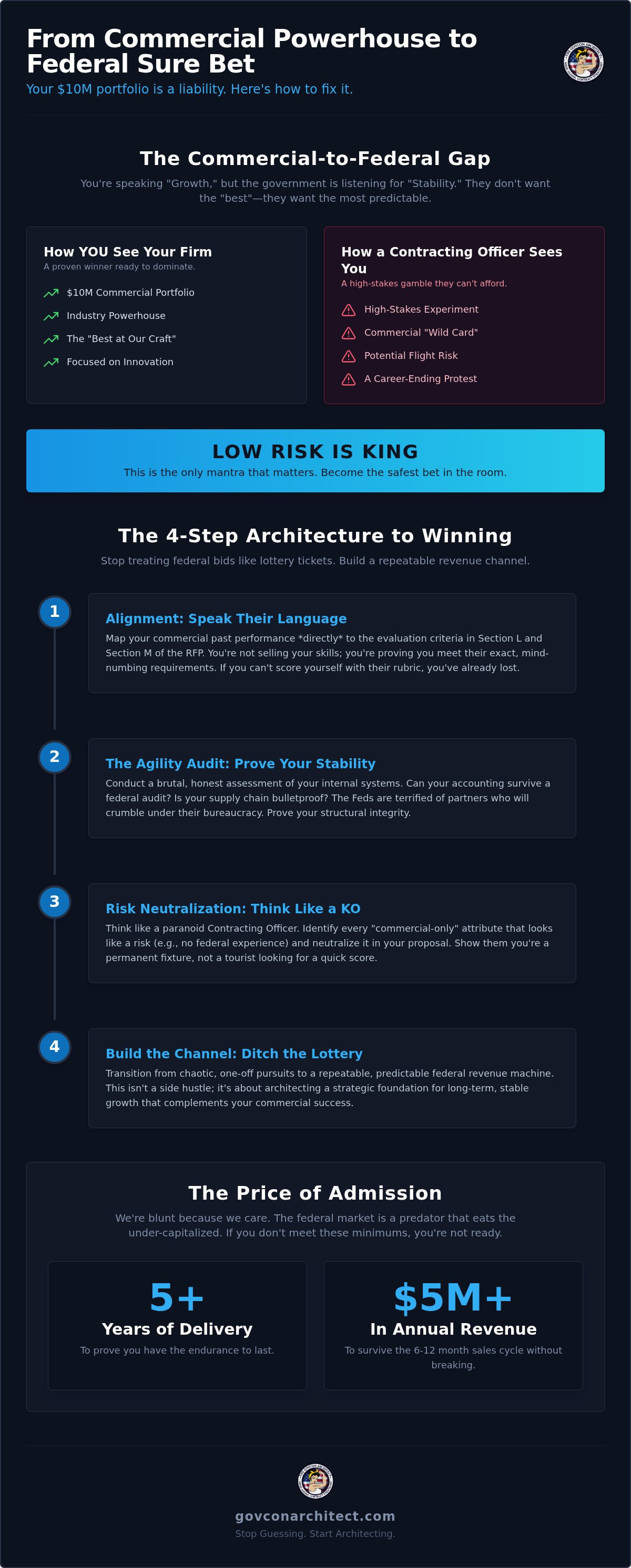
Your $10 million commercial portfolio is impressive to your banker. It's noise to a federal evaluator. The "Commercial-to-Federal Gap" is the distance between your actual capability and the government's perception of your risk. You think a $1M federal contract is a step down from your $10M portfolio. The government thinks you're a high-stakes experiment. The U.S. Government Procurement Process isn't designed to find the coolest solution. It's designed to protect the buyer from a career-ending protest. In this world, low risk is king.
Stop treating federal bids like a Saturday night in Vegas. This "lottery ticket" fallacy is why most firms fail. Winning federal contracts for commercial firms is a clinical, structural exercise. It's about building a repeatable revenue channel. If you're bidding on random RFPs to "see what sticks," you're just lighting money on fire. The government’s definition of "proven delivery" isn't about your fancy client list. It's about your ability to survive their bureaucracy without a glitch. If you don't speak their language, you'll be reading a long list of reasons for losing government contracts instead of an award notice.
The 5-Year/ $5M Threshold
We don't work with pre-revenue firms. We don't work with startups. Why? Because the federal market is a predator that eats the under-capitalized. You need 5+ years of delivery and $5M+ in revenue to survive the 6 to 12-month sales cycle. This isn't a 30-day shortcut. It's a high-stakes, long-term play. If you don't have the structural integrity to wait for the win, you're not ready for the Buy-Side reality. We care about your success, which is why we're blunt about the entry price.
The Buy-Side Reality: Why Low Risk is King
The federal government isn't looking for a "disruptor" to shake things up. They want a partner who won't end up on the front page of the news for a procurement failure. This is the "Buy-Side" mantra. While you're obsessed with your "unique value proposition," the evaluator is checking if your insurance and accounting systems will collapse under the weight of a federal audit. Their primary goal isn't choosing the best; it's choosing the safest. In this world, low risk is king. Every sentence in your proposal is either a stabilizer or a landmine. If you look like a gamble, you've already lost.
We use a "Risk as Evaluator" framework to score bids. If you're a commercial firm with $5M+ in revenue, you might actually look like a flight risk. Why? Because you aren't dependent on government money. To a Contracting Officer (KO), that means you might walk away if a better commercial deal comes along. You need a low risk bidder strategy that proves your commitment to the mission. Winning federal contracts for commercial firms requires you to prove that your success is a foundation, not a distraction. If you don't align with their evaluation criteria, you're just another "lottery ticket" bid destined for the shredder.
Thinking Like a Contracting Officer (KO)
When a KO looks at your firm, they see a "commercial-only" wild card. They see potential instability in your accounting or your supply chain. You must neutralize these hidden risk factors before they hit the scoring sheet. Winning federal contracts for commercial firms means proving you are a permanent fixture, not a tourist. If you're ready to stop guessing and start thinking like a buyer, you should book a brief discovery call to see how we architect your defensibility. We've got your back, but you've got to bring the structure.
Winning Federal Contracts for Commercial Firms: A 4-Step Architecture
Winning federal contracts for commercial firms isn't a dark art. It is structural engineering. If you’re still treating this like a side hustle, you’re the prey. We don't do "hope" as a strategy. Instead, we use a clinical four-step architecture to transform your commercial momentum into federal revenue.
- Step 1: Alignment. Map your commercial past performance directly to Section L and Section M of the RFP. If you can’t score yourself using their rubric, the evaluator won't do it for you.
- Step 2: The Agility Audit. Conduct a brutal assessment of your internal systems. If your team cannot pivot and produce a compliant response in a 24-hour window, you are dead on arrival.
- Step 3: Low-Risk Architecture. Design every pursuit around the government’s fear. Don’t tell them how great your product is. Show them why your delivery is impossible to disrupt.
- Step 4: Strategic Consistency. Stop the ad-hoc "lottery ticket" bidding. Shift to a RETAINER · MONTHLY – Fractional Federal Strategy Advisor model to build a permanent, defensible market position.
Beyond the Capability Statement
Capability statement templates are the participation trophies of the GovCon world. They are bad advice for serious firms because they signal you don't understand the rules of the game. The Buy-Side Advantage replaces generic templates by focusing on the evaluator's scoring manual rather than your marketing department's ego. You aren't here to look pretty; you're here to be high-scoring and defensible.
Past Performance as a Shield
Your commercial wins are only valuable if they act as a shield against federal risk. You must package your successes to prove you’ve already solved the government’s specific problem in a high-stakes environment. Before you burn another hour on a proposal, verify what do you need to bid on a federal contract to ensure your foundation is solid. We help you translate your $5M+ delivery into the clinical language of federal stability.
Implementing a Sustainable Federal Revenue Channel
Ad-hoc bidding is a slow death. If you're treating the federal market as a "side project," you're just subsidizing your competitors' wins. Winning federal contracts for commercial firms requires a shift from desperate pursuit to structural dominance. You don't need more "leads." You need a repeatable revenue channel built on clinical logic and the Buy-Side reality. This isn't about working harder; it's about building a machine that the government trusts.
A "Capture & Proposal Sprint" is a powerful tactical fix when you have a specific target in sight. It helps you win that bid. But it won't build a business. For a sustainable channel, you need the "RETAINER · MONTHLY – Fractional Federal Strategy Advisor." This is the strategic solution for firms that are done with the "lottery ticket" mindset. Expecting a win in 30 days is a fantasy. A 6 to 12-month commitment is the baseline for optimum results in this market. If you can't commit to the timeline, don't start the clock.
The Fractional Federal Strategy Advisor
This isn't about marketing fluff or polished slide decks. It’s about professional sobriety. An ongoing advisor ensures your internal systems are continuously aligned with shifting procurement standards. We move you from "guessing" to "knowing" through a structured Federal Market Entry Engagement. When you understand the "why" behind government actions, you stop reacting and start architecting. Low risk is king, and stability is your most persuasive sales tool.
Stop guessing. Stop wasting your team's time on bids you're destined to lose. If you’re a $5M+ firm ready for a real strategy, it’s time to Break Into the Federal Market...Without Guessing. Start thinking like a buyer, or stay on the sidelines. We’re here to make sure you’re the safest bet in the room.
Stop Gambling and Start Architecting Your Federal Future
You didn't build a $5 million business by accident. You built it with structural logic. It's time to apply that same professional sobriety to your federal pursuits. Winning federal contracts for commercial firms requires more than just a SAM registration and a prayer. It requires a total alignment with the evaluator's fear of risk. We've spent 22 years on the Buy-Side seeing exactly why great firms fail and how elite insiders win. We know the "why" behind every rejection.
With direct KO-confidential insights, we specialize in helping established firms like yours bridge the gap between commercial delivery and federal stability. You don't have to guess anymore. You just need a better blueprint. We've seen the hidden mechanics of the system, and we're ready to show you the path to a defensible market position.
We genuinely want to see you succeed because the government needs your expertise. Let's stop the lottery ticket bidding and build a revenue channel that actually lasts. You've got the delivery. We've got the architecture. Let's get to work.
Frequently Asked Questions
How much revenue does my firm need to win federal contracts?
You need at least $5 million in annual revenue and 5 years of proven delivery to be a fit for our strategy. Winning federal contracts for commercial firms requires a financial cushion because the sales cycle is a marathon, not a sprint. If you're pre-revenue or scraping by, the government will see you as a high-risk gamble. We care about your survival, so we only work with firms that have the structural integrity to play the long game.
Is a 30-day win possible for a new commercial firm in the federal market?
Absolutely not, and anyone telling you otherwise is selling magic beans. The federal market is a 6 to 12-month commitment for optimum results. A 30-day shortcut doesn't exist in a system governed by complex procurement laws. We focus on building a sustainable revenue channel, not chasing "quick wins" that lead to burnout. If you aren't ready to invest the time, you aren't ready for the Buy-Side reality.
What is the difference between a capability statement and a low-risk proposal?
A capability statement is a generic marketing flyer that usually ends up in the trash. A low-risk proposal is a clinical document architected to survive a GAO protest. While templates focus on your ego, a winning bid focuses on the evaluator's scoring criteria. Our Fractional Federal Strategy Advisor support helps you move past the "just get certified" bad advice and into a position of defensible market dominance.
Do I need to be a small business to win federal contracts?
You don't need a specific small business certification to win, but you do need a track record of commercial excellence. While set-asides exist, many large-scale opportunities are won by firms that simply prove they are the safest bet. Winning federal contracts for commercial firms is about leveraging your $5M+ success to show the government that you’re stable, scalable, and unlikely to fail them when the stakes are high.
Why does the government care more about risk than price?
The government cares about risk because a failed contract can end a Contracting Officer's career. Price is secondary to the fear of a protest or a performance glitch. When you understand the "Buy-Side" mantra, you realize they aren't looking for the cheapest option; they’re looking for the one that won't get them audited. Low risk is king because it provides the clinical certainty bureaucrats need to sleep at night.