

Training Your Team for Government Sales Transitions

Article by
Nikki Gianni
Nikki Gianni is a seasoned business strategist and government contracts coach, dedicated to helping businesses successfully navigate the complexities of government contracting. With over 22 years of experience in Department of Defense contracting, including managing $20 billion in federal awards, Nikki has developed the innovative GovReady Blueprint™ Framework, a comprehensive 90-day program designed to prepare businesses to compete for and win lucrative contracts at the federal, state, and local levels. Nikki's approach emphasizes not just gaining contracts but also enhancing overall business profitability.
Before becoming a business owner, Nikki was active-duty Air Force for 10 years, then spent another 15 years as a civil servant with the DOD. Now she's an empty nester living in Southern California who loves spending time with her 22-year-old son, Lex and her 2 Mini Aussies, Tony & Carmela, doing home improvement and crafts projects, and networking.
Your best commercial closer can still lose a federal pursuit before the proposal is written. In transitioning commercial sales to government contracting, the problem usually isn’t effort. It’s assuming a strong relationship and a polished pitch will outweigh how the government evaluates offers and performance risk. The buyer isn’t grading charisma.
Commercial teams already know how to uncover needs and explain value. That’s a real advantage. But federal buyers must justify decisions, follow defined evaluation criteria, and choose an offer they can defend. Training should help the team see the purchase from the buyer’s side of the table, not simply encourage more persuasive selling.
This guide lays out a practical approach to preparing your people to assess buyer needs, qualify opportunities before committing resources, and present credible offers with clear evidence. You’ll learn how to assign roles across market research, capture, and proposal work, while setting realistic pursuit expectations. The goal isn’t to chase every solicitation. It’s to build a disciplined team that knows when to compete, what the buyer needs to assess, and how to make that assessment easier.
Key Takeaways
- Transitioning commercial sales to government contracting means adapting how your team engages buyers, qualifies pursuits, and supports claims with credible evidence.
- Train sellers to connect customer needs to solicitation requirements and show how your company can deliver, not just why it’s enthusiastic.
- Use real opportunities and past company work to build a staged training plan, then review what the team learned before the next pursuit.
- Repeated, coordinated practice builds readiness. Buy-side perspective can help sharpen training priorities without replacing your team’s delivery expertise.
Transitioning Commercial Sales to Government Contracting Starts with a Different Buyer
Commercial sales strengths still matter. Customer discovery, clear communication, and a sharp understanding of operational needs can help a team identify where its offer fits. Federal buyers assess value within a defined acquisition context, with attention to stated requirements, evaluation criteria, and performance risk. A strong relationship can open a conversation, but it can’t replace a compliant, well-supported offer. Buyers need decisions they can explain and defend.
A federal-market-ready sales team aligns buyer needs, opportunity choices, and credible delivery evidence with the requirements of the acquisition. That is the real work of transitioning commercial sales to government contracting: adapting market engagement, opportunity qualification, and proof of performance to the buyer’s process. More outreach is not the objective. Better-grounded pursuit decisions are.
Which commercial sales skills transfer, and which need adjustment?
Keep the fundamentals: ask useful questions, communicate plainly, and understand how the customer operates. Adjust the instinct to treat relationship-building as the strategy. Federal pursuits demand disciplined attention to what the solicitation states and how offers will be evaluated. Commercial success is relevant experience, not automatic proof of federal fit. A past project is useful when the team can explain how its scope and results relate to the buyer’s stated need.
Why does the government buyer prioritize risk?
The buyer needs confidence that the offeror can perform as proposed and meet the stated requirements. Claims without supporting evidence create questions. Consistent answers, relevant delivery examples, and clear alignment make an offer easier to assess. That’s risk reduction in practice, not a request for prettier adjectives. The U.S. government procurement process provides context for the formal environment commercial teams are entering. For a closer look at how buyers assess offers, see government bid evaluation criteria. The team’s job is to make the buyer’s evaluation clearer, not make the buyer guess.
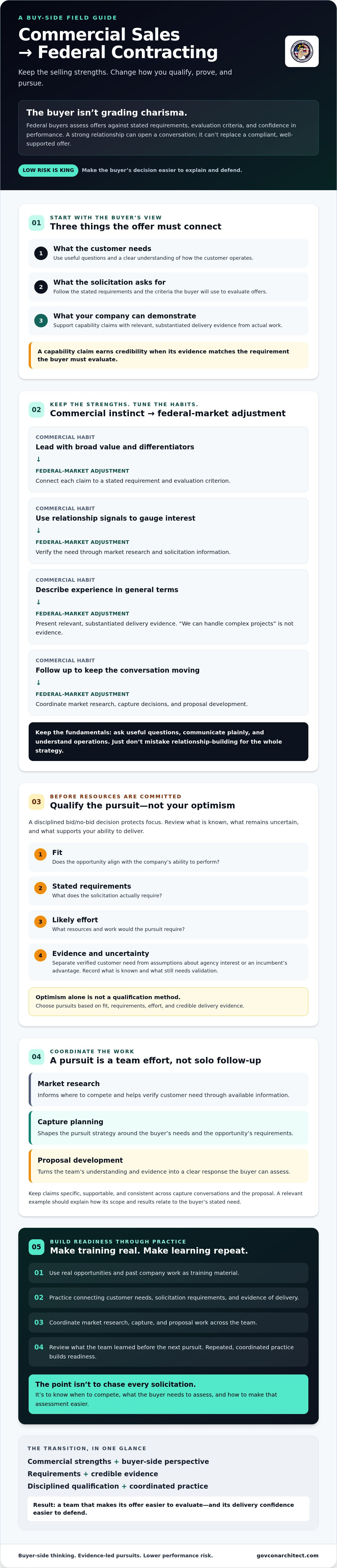
Train the Team to Translate Commercial Selling into Buy-Side Evidence
Federal pursuits require more than adapting the pitch deck. Teams need a repeatable way to turn customer understanding into claims a buyer can verify against the solicitation. That’s the difference between sounding persuasive and making an offer easier to evaluate when transitioning commercial sales to government contracting.
| Commercial sales habit | Federal-market adjustment |
|---|---|
| Lead with broad value and differentiators | Connect each claim to a stated requirement and evaluation criterion |
| Use relationship signals to gauge interest | Verify the need through market research and solicitation information |
| Describe experience in general terms | Present relevant, substantiated delivery evidence |
| Follow up to keep the conversation moving | Coordinate market research, capture decisions, and proposal development |
A capability claim earns credibility only when its evidence matches the requirement the buyer must evaluate. Train staff to connect three things: what the customer needs, what the solicitation asks for, and what the company can demonstrate from its actual work. Keep claims specific, supportable, and consistent across capture conversations and the proposal. “We can handle complex projects” is not evidence. A relevant example that explains comparable scope and delivery is more useful.
How should the team learn to qualify federal opportunities?
Before committing proposal resources, review fit, stated requirements, likely effort, and the firm’s ability to perform. Separate verified customer need from assumptions about agency interest or an incumbent’s advantage. For each opportunity, document what is known, what remains uncertain, and what evidence supports the company’s ability to deliver. A disciplined bid/no-bid decision protects focus. Optimism alone is not a qualification method. Use this bid-no-bid decision framework to structure that assessment.
How do capture and proposal responsibilities differ from sales follow-up?
Market research informs where to compete. Capture planning shapes the pursuit strategy. Proposal development turns that strategy into a response aligned with the solicitation. Sales leaders can coordinate subject-matter experts and verify claims, while technical staff validate delivery details. No one needs to pretend to be every technical authority in the room. For teams assessing their proposal approach, Federal Proposal Development Consulting: A Reality Check for Commercial Firms offers a relevant next read. The GovCon Architect provides targeted support for individual opportunities through PER-PURSUIT · PROJECT - Capture & Proposal Sprint, as well as ongoing strategic guidance through RETAINER · MONTHLY - Fractional Federal Strategy Advisor. To discuss which kind of support fits your priorities, explore a strategy discussion.
Build a Practical Federal Sales Training Plan Around Real Pursuits
Training sticks when it’s tied to work the team may actually pursue. For transitioning commercial sales to government contracting, use relevant solicitations and your company’s past performance as the curriculum. Keep the sequence practical:
- Establish foundations: Clarify how buyers use stated requirements and evaluation criteria. Assign ownership for research, technical input, messaging, and proposal coordination.
- Analyze opportunities: Review fit, requirements, effort, and the company’s ability to perform before investing in a response.
- Practice evidence-based messaging: Connect buyer needs and solicitation requirements to substantiated company experience.
- Review: Capture lessons from the pursuit and decide what to adjust next time.
Real materials expose practical gaps. A team can use a past project and a relevant solicitation to check whether its claims are specific, supported, and responsive. Generic role-play won’t reveal whether the team can substantiate a claim with relevant delivery evidence.
What should the team practice before pursuing an opportunity?
Use a relevant solicitation to map each stated requirement to company evidence and the personnel responsible for validating it. Have the team rehearse concise explanations of capability, approach, and performance credibility. Then conduct a mock review: flag unsupported claims, unclear answers, and requirements with no clear owner. The point isn’t to make every answer sound impressive. It’s to make the response supportable and coherent.
How can leaders assess whether training is working?
Look for process discipline, not a made-up win-rate target. Can staff explain why an opportunity fits, identify evidence gaps, and describe who owns each proposal contribution? After each pursuit, review what was clear, what created risk, and what should change. A lesson from one pursuit is not a universal law. For common proposal pitfalls, read common federal proposal writing mistakes.
Sustain the Transition with Disciplined Advising and Clear Next Steps
Federal-market readiness doesn’t arrive in a single training session. It develops through coordinated pursuit work: researching opportunities, assigning owners, testing evidence, and reviewing what each bid revealed. One solicitation can expose a process gap, but it can’t write the company’s permanent playbook. That takes disciplined learning over time.
Internal leaders can direct learning when they understand the organization’s capabilities, capacity, and strategic priorities. They can identify relevant delivery examples, clarify who owns technical input, and decide whether federal contracting is a deliberate revenue channel or an occasional gamble. Hope is not a staffing plan.
When can outside federal strategy support help?
Specialized buy-side perspective can help leadership interpret how a buyer may view performance risk, spot gaps in pursuit logic, and set practical priorities. An advisor can strengthen strategy and proposal alignment, but cannot replace the company’s subject-matter experts or deliver the work on its behalf. GovCon Architect’s ongoing strategic support is RETAINER · MONTHLY - Fractional Federal Strategy Advisor. Target customers are established commercial firms with $5M+ in annual revenue and 5+ years of proven delivery.
What should leadership decide before committing resources?
Before building a pursuit pipeline, make three decisions:
- Is federal contracting a deliberate revenue channel, with sustained leadership attention?
- Who owns opportunity research, buyer-focused messaging, technical evidence, and proposal coordination?
- Which delivery examples support the company’s claims, and what capacity can it realistically commit to pursuit work?
These answers give your team a sound basis for transitioning commercial sales to government contracting with realistic expectations and clear accountability. If buy-side guidance could help clarify your next step, start with a brief conversation about fit and priorities.
Build Federal Readiness One Disciplined Pursuit at a Time
Commercial sales skills give your team a strong starting point. But transitioning commercial sales to government contracting means changing how people qualify opportunities, connect requirements to evidence, and communicate in terms that help buyers assess performance risk.
Make training practical: use real solicitations and your company’s delivery record, assign clear pursuit responsibilities, and review each effort for lessons. The goal isn’t more activity. It’s better-informed decisions and offers the buyer can evaluate with confidence.
When your team needs an outside perspective, Nikki Gianni brings 22 years of buy-side experience. GovCon Architect’s advisory support focuses on aligning bids with government evaluation and risk considerations. That guidance can sharpen strategy, while your people remain responsible for the expertise and delivery your company brings to the work.
Federal readiness takes commitment, but it doesn’t require guessing your way forward. A focused conversation can help you identify the right next step for your team.
Frequently Asked Questions
How is selling to the federal government different from commercial sales?
Federal sales depends more directly on how an offer addresses stated requirements, evaluation criteria, and buyer concerns about performance risk. Commercial strengths such as discovery and clear communication still matter, but relationship-building alone won’t establish that an offer is a sound choice. The buyer needs an offer they can assess against the opportunity, not just a persuasive conversation. Make confidence easier to verify.
What should a commercial sales team learn first before pursuing federal contracts?
Start by learning how to read an opportunity, assess fit, and connect buyer needs to requirements and credible company evidence. In transitioning commercial sales to government contracting, staff should also understand their roles in market research, capture, technical input, and proposal coordination. Teach the team to distinguish confirmed information from assumptions about agency interest. A disciplined opportunity review comes before a polished pitch, not after the proposal team is already scrambling.
Can commercial sales experience count as federal past performance?
Commercial delivery experience can provide relevant evidence of your company’s capabilities, but it isn’t automatically equivalent to federal past performance. Its usefulness depends on the opportunity’s requirements and evaluation approach. Help the team describe the work accurately: what the company delivered, how the effort relates to the requirement, and what evidence supports the claim. Don’t present commercial experience as federal work. Clear context is more credible than inflated labels.
How long does it take to train a sales team for government contracting?
There’s no universal timeline. Training needs depend on the team’s federal-market familiarity, the roles involved, and the complexity of the opportunities it plans to pursue. Treat readiness as an ongoing process, not a one-and-done seminar with a certificate and a celebratory muffin. Use real solicitations and company work to practice, then review each pursuit for gaps and lessons. That gives leadership a practical basis for deciding what the team needs to learn next.
Should a company hire a federal contracting advisor to train its sales team?
An advisor may help when leaders need buy-side perspective to set training priorities, assess risk, or align bids with evaluation considerations. GovCon Architect is led by Nikki Gianni, who brings 22 years of buy-side experience. Its RETAINER · MONTHLY - Fractional Federal Strategy Advisor supports ongoing strategy, while PER-PURSUIT · PROJECT - Capture & Proposal Sprint provides targeted support for a specific opportunity. Advisory guidance complements, rather than replaces, your team’s delivery expertise. The firm’s stated fit is commercial businesses with $5M+ annual revenue and 5+ years of proven delivery.