
Tailoring Your Capabilities Statement for an Agency: The Buy-Side Reality Check

Article by
Nikki Gianni
Nikki Gianni is a seasoned business strategist and government contracts coach, dedicated to helping businesses successfully navigate the complexities of government contracting. With over 22 years of experience in Department of Defense contracting, including managing $20 billion in federal awards, Nikki has developed the innovative GovReady Blueprint™ Framework, a comprehensive 90-day program designed to prepare businesses to compete for and win lucrative contracts at the federal, state, and local levels. Nikki's approach emphasizes not just gaining contracts but also enhancing overall business profitability.
Before becoming a business owner, Nikki was active-duty Air Force for 10 years, then spent another 15 years as a civil servant with the DOD. Now she's an empty nester living in Southern California who loves spending time with her 22-year-old son, Lex and her 2 Mini Aussies, doing home improvement and crafts projects, and networking.
Your current capability statement is likely a glorified grocery list that Contracting Officers use as a digital coaster. It’s harsh, but someone has to tell you. You’ve spent five years or more building a powerhouse firm with at least $5M in revenue, yet your federal outreach feels like shouting into a void. We know the frustration. It’s exhausting to have a proven commercial track record that seems to mean nothing once you hit the government gatekeepers.
The problem isn’t your experience. It’s your delivery. Most firms treat their documents like a "best of" album, but the government only cares about one thing: risk mitigation. By tailoring your capabilities statement for an agency, you stop pitching and start solving. This article will show you how to dismantle your generic template and rebuild it into a strategic, low-risk asset that demands attention. We’re moving past the "black box" and into the buy-side reality where logic beats hope every single time. Let’s get your engagement rates out of the gutter and position you as the only safe bet in the room.
Key Takeaways
Stop treating your capability statement like a generic menu; the government isn't hungry for everything, they're starving for a low-risk solution to one specific problem.
Discover why tailoring your capabilities statement for an agency is the only way to avoid the "trash bin of broken dreams"; you've worked too hard for five years to be ignored now.
Learn to hunt for agency pain points in forecasts and budget documents so you can speak the language of a Contracting Officer who is tired of hearing about your "passion" for excellence.
Pivot your past performance descriptions from a list of chores to a clinical breakdown of risks mitigated, proving you're the safest bet in the federal market.
Understand that a tailored statement is just the ticket to the dance; you need a capture strategy that aligns with the buy-side reality to actually get on the floor.
Table of Contents
Why Your Generic Capability Statement is Heading for the Trash
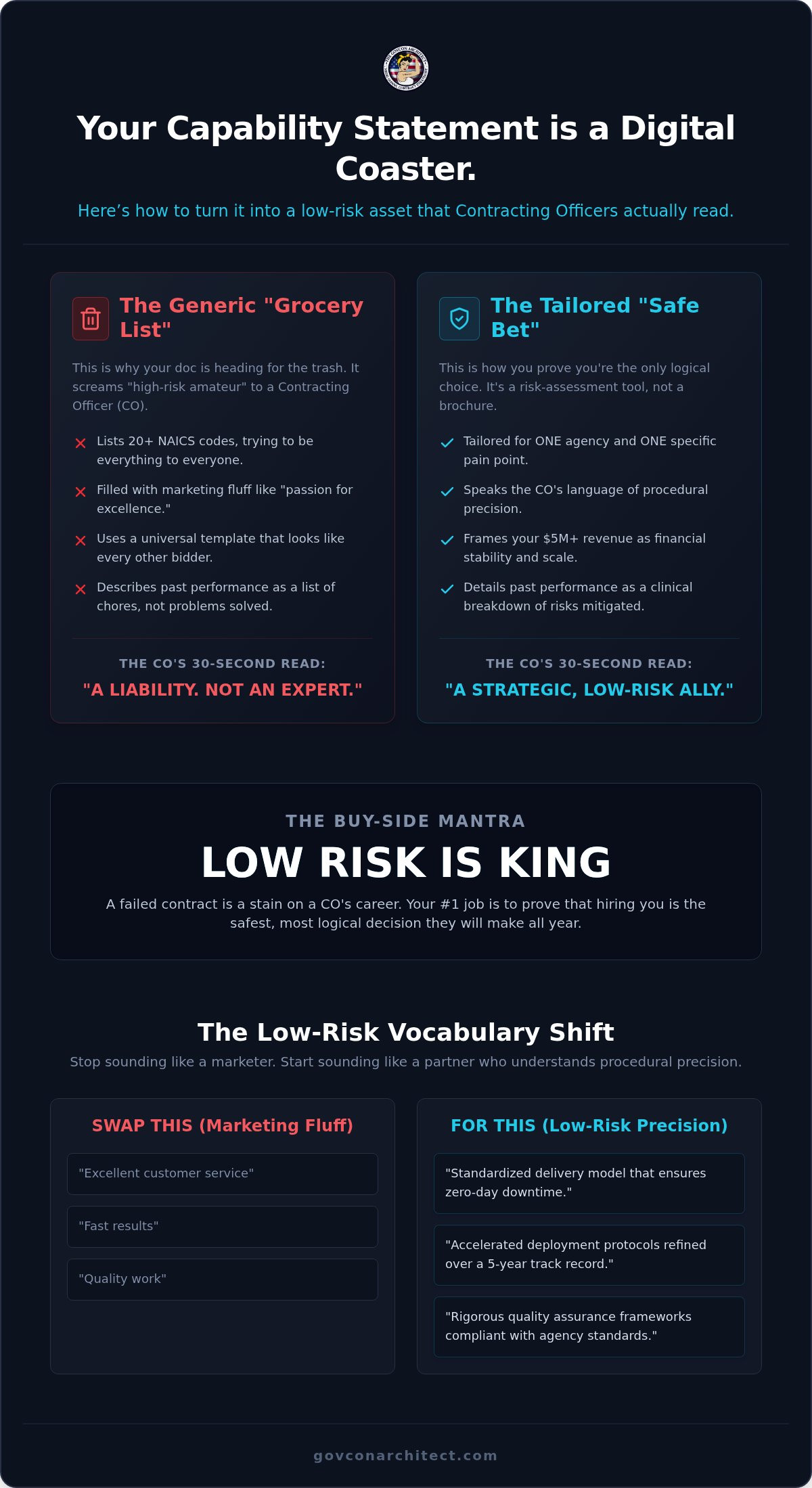
Your capability statement is not a marketing brochure. It is a risk-assessment tool. If you're treating it like a shiny flyer for a commercial trade show, you've already failed. A Contracting Officer (CO) doesn't care about your mission statement. They don't care about your "passion" for excellence. They care about their own job security. In the federal market, "Low Risk is King."
Listing 20 different NAICS codes makes you look like a liability, not an expert. This "grocery list" approach signals that you're desperate for any contract rather than being a master of one. When you neglect tailoring your capabilities statement for an agency, you're asking the CO to do your job for you. They won't. They have 30 seconds to scan your document. If they don't see a mirror of their specific pain, you're out. If your statement looks like everyone else’s, you’ve already lost the bid before it even started.
The Buy-Side Perspective on "The Pile"
COs deal with "The Pile" every day. This is a mountain of generic PDFs from firms claiming to be "the best." To survive the cut, you must understand the business capability requirements from the agency’s specific viewpoint. Being "capable" is the baseline. Being "low-risk" is the winning edge. Commercial success is a nice start, but it doesn't translate to federal trust without the right framing. If you haven't done your homework, it shows immediately. COs filter out firms that haven't bothered to learn their mission language.
The Trap of the Universal Template
Using a standard template is the fastest way to look like an amateur. It screams that you're a first-time bidder. Many firms hide behind "certification-heavy" messaging, hoping a set-aside status will carry the weight. It won't. Without a clear alignment to the agency's current mission, those certifications are just background noise. You need to understand The Buy-Side Reality Check. If your document looks like everyone else’s, you’ve already lost. Success requires tailoring your capabilities statement for an agency to prove you're a strategic ally, not just another vendor trying to win the federal lottery.
The Low-Risk Framework: Shifting from What to How
In federal contracting, Low Risk is King. This isn't a suggestion. It is the primary lens through which every Contracting Officer views your firm. They don't care about your "passion" for the mission. They care about their own job security. A failed contract is a stain on their career. Your job is to prove that hiring you is the safest decision they will make all year. Shifting your mindset from a list of services to a framework of risk mitigation is the foundation of tailoring your capabilities statement for an agency.
Every sentence in your document must pass the "So What?" test. If you state you have "5 years of experience," the CO asks: So what? You must answer: "This 5-year track record in the commercial sector has been refined into a standardized delivery model that ensures zero-day downtime." Now you've moved from a generic fact to a low-risk promise. You are no longer just telling them what you do. You are showing them how you protect their interests.
Defining Your Strategic Differentiators
Stop saying you offer "excellent customer service." It isn't a differentiator. It’s a baseline requirement. If you lead with that, you’ve already lost the room. Focus on technical advantages that provide clinical proof of your capability. Do you have specialized equipment that competitors lack? Do you use proprietary software to track compliance? These are the details that matter.
As a firm with $5M+ in revenue, your scale is your shield. Use your financial stability as a signal. It tells the agency you have the infrastructure to handle the high-stakes demands of federal work without folding under pressure. That is a strategic advantage. It separates you from the "lifestyle" businesses that can't survive a delayed payment cycle.
The "Low-Risk" Vocabulary Shift
Marketing fluff is a death sentence in GovCon. You need to swap out flowery adjectives for procedural precision. Precision builds trust. Fluff builds suspicion. Use strategic management terms that signal you understand the FAR and agency-specific requirements. Instead of "fast results," talk about "accelerated deployment protocols." Instead of "quality work," discuss "rigorous quality assurance frameworks."
For 2026 bids, low risk remains the primary evaluation standard. It is the only metric that guarantees a second look. If you aren't sure how to translate your commercial wins into this specialized dialect, you might need to audit your strategic narrative to ensure it aligns with the Buy-Side reality.
Decoding Agency Pain Points: Researching Before You Write
If you’re still sending out PDFs based on a "gut feeling" of what an agency needs, you’re essentially playing the lottery with your firm’s future. In the federal market, data is the only currency that buys you a seat at the table. You cannot begin tailoring your capabilities statement for an agency until you’ve performed a clinical autopsy on their current spending and future requirements. This pre-writing phase is where the winners are separated from the hopeful amateurs who think "effort" equals "results."
Identifying the "Incumbent Gap" is your highest-leverage move. Every agency has a contractor they’re currently tolerating but would love to replace. Maybe the delivery is late, the quality is slipping, or the risk profile has spiked. Your job is to find that friction and position your firm as the specific, low-risk remedy. Map your NAICS and PSC codes not just to what you can do, but to the agency’s historical patterns. If they haven't bought your specific service in three years, stop pitching it. Focus on where the blood is already in the water.
Mining Agency Forecasts and Budgets
Federal budgets are the ultimate roadmap for revenue. They show you exactly where the money is moving and, more importantly, where it’s being pulled from. For a firm with $5M+ in revenue and 5+ years of delivery, you should be looking for "Must-Win" programs. These are the initiatives with high visibility and even higher stakes. When a program is critical to an agency's mission, their tolerance for risk drops to zero. That is where your proven stability becomes your greatest asset. Developing a robust Federal Agency Engagement Strategy starts with knowing which pockets are full and which are empty.
The "Insider" Briefing Method
Industry days aren't just for networking and eating stale cookies. They are tactical intelligence briefings. Listen to the Contracting Officer’s (CO) tone when they discuss current challenges. They often broadcast their frustrations through procedural complaints or "lessons learned." This is gold. When tailoring your capabilities statement for an agency, you should frame your past performance as the direct answer to a recent agency setback. If they struggled with a data breach, your statement should scream "security and verification." You need to understand the Contracting Officer Risk Assessment Secrets to know which buttons to push. Stop guessing what they want. Read the documents they’ve already published and give them the low-risk solution they’re desperate to find.
The Tailoring Sprint: Mapping Performance to Mission
This is where the rubber meets the bureaucratic road. You’ve gathered the intel, and you know where the agency is bleeding. Now you need to execute with surgical precision. Tailoring your capabilities statement for an agency is a tactical sprint, not a marathon of marketing fluff. You aren't just changing a logo; you're re-engineering your firm’s DNA to match the specific mission requirements of the evaluator sitting across the digital table.
Step 1: Select 3-5 Past Performances. Mirror the agency’s current requirement exactly. If you're chasing a cybersecurity contract, your stellar janitorial record is irrelevant noise.
Step 2: Rewrite for "Risk Mitigated." Tasks are boring; safety is sexy. Instead of saying you "managed a database," explain how you "ensured 99.9% data integrity for a $1M project, eliminating potential downtime risks."
Step 3: Audit Differentiators. Look at Section L and M of the target RFP. If the agency prioritizes "rapid deployment," your "award-winning design" doesn't matter. Align your strengths with their scoring criteria.
Step 4: Prune the NAICS codes. Only show what is relevant to this specific CO. Seeing 20 unrelated codes makes you look like a desperate generalist.
Step 5: The Buy-Side Peer Review. Ask yourself the hard question: "Would I bet my own career and federal retirement on this firm based on this one page?" If the answer is "maybe," you haven't finished the job.
Translating Commercial Success for Federal Evaluators
For firms with $5M+ revenue, a $1M commercial project shouldn't be framed as a "big win." In the federal world, it is a "low-risk pilot." This demonstrates you have the infrastructure to handle scale without the government being your first guinea pig. Focus on quantifying results with metrics that matter to the Buy-Side. Use uptime percentages, compliance rates, and documented cost-savings. Defensible positioning is always more important than creative design. The CO needs to defend their choice to their supervisor; give them the data to do it.
Audit for Compliance and Clarity
Your UEI and CAGE codes must be prominent, but they shouldn't be the hero of the page. They're just the "license to drive." The real work is ensuring "Federal Fluency." This means stripping away commercial jargon that confuses COs and replacing it with procedural precision. If you use terms like "synergy" or "disruptive," you’ve already lost. Pruning your NAICS codes to show only relevant expertise reduces perceived risk by signaling specialized mastery rather than desperate generalism.
Schedule your strategic narrative audit
Beyond the PDF: Using Strategic Advisory to Close the Gap
Let’s be real. If you think a one-page PDF is going to do the heavy lifting of a multi-million dollar capture strategy, you’re dreaming. A tailored statement is just your ticket to the dance. It gets you past the velvet rope, but it doesn’t guarantee you a seat at the table. For established firms with $5M+ in revenue and a five-year track record, a one-time document is just a static snapshot in a rapidly moving market. Tailoring your capabilities statement for an agency is a continuous process of alignment, not a one-and-done task.
You need to transition from "Market Entry," the initial 90-120 day scramble, to "Market Dominance" via a sustained 6-12 month strategic push. The federal market is a complex, high-stakes machine that eats "hope" for breakfast. A Fractional Federal Strategy Advisor ensures your firm stays calibrated to the Buy-Side reality. This isn't about a quick fix or a magic template. It's about building a defensible position that makes you the only logical, low-risk choice for the agency. Tailoring your capabilities statement for an agency is simply the opening move in a much larger, more profitable game.
The Fractional Advisor Advantage
You’re a CEO, not a research intern. Act like it. Strategic advisory provides weekly sessions to refine capture plans and make clinical go/no-go decisions. You need quarterly pipeline assessments to ensure your tailoring efforts hit targets with the highest probability of win. Stop wasting your Sunday nights on forecasts. Execute based on insider intelligence and protect your firm’s growth through professional, high-level briefing and analysis.
When to Engage Per-Pursuit Support
Sometimes the stakes are too high for a general approach. High-stakes bids require a Capture & Proposal Sprint to optimize your response for the CO's risk assessment. A Red-team review provides a brutal, Buy-Side critique before you submit. It’s better to have your feelings hurt by an advisor than to have your bid tossed by a Contracting Officer. Explore these Strategic Engagements to find the right fit for your current phase of growth.
Stop Pitching and Start Positioning
You’ve built a $5M+ revenue firm by delivering real results. Don't let a generic PDF stall your growth. The federal market isn't a mystery; it's a system that values stability and predictability above all else. tailoring your capabilities statement for an agency is how you prove you aren't a liability. It’s how you show the Contracting Officer that you’ve done the homework they don’t have time to do. You’ve moved past the "grocery list" and into strategic alignment.
Now, it's time to execute. You don't have to navigate this alone. Our Fractional Strategy Advisor service starts at $3,500 per month and is led by a veteran with 22 years of Buy-Side experience. We provide the zero-fluff, risk-aware positioning that established firms need to dominate. You’ve got the track record. We’ve got the blueprint. Let’s get to work.
Stop guessing and start winning with a Strategic Federal Advisor
Frequently Asked Questions
Do I really need a different capability statement for every agency?
Yes, if you actually want to win. Sending the same generic PDF to the Navy and the Department of Agriculture is a waste of digital ink. Each agency has unique mission goals and varying risk thresholds. When you focus on tailoring your capabilities statement for an agency, you show the Contracting Officer that you understand their specific world. A one-size-fits-all approach signals that you're a generalist, which in federal contracting is just another word for high risk.
Can GovCon Architect provide me with a capability statement template?
No, we don't provide templates. Templates are for amateurs looking for a 30-day shortcut that doesn't exist. We focus on strategic advisory for established firms with $5M+ in revenue and a real track record. A template is just a pretty skin for a weak narrative. We teach you how to build a defensible, low-risk position from the ground up. If you want a fill-in-the-blank form, you're in the wrong place. We build architects, not painters.
What are the most important sections of a capability statement from a CO perspective?
From a Buy-Side perspective, your Past Performance and Differentiators are the only things that truly matter. The Contracting Officer is looking for clinical proof that you won't get them fired. Your past performance should mirror their current requirements, and your differentiators must be technical advantages, not fluff like "customer service." They want to see that you have the infrastructure and stability to handle high-stakes federal projects without stumbling or going dark.
Is a two-page capability statement too long for federal buyers?
Yes, it's too long. A Contracting Officer has about 30 seconds to decide if you are worth a follow-up meeting. If they have to flip a page to find your UEI or core competencies, you've already lost the room. Keep it to a single, high-impact page. Precision beats volume every time. Your goal isn't to tell your whole life story; it's to provide a low-risk ticket to the dance that earns you a real conversation.
How do I translate my commercial experience if I have never had a federal contract?
You frame your commercial wins as proof of structural integrity. For a firm with 5+ years of delivery, your $5M+ commercial revenue is a signal of financial stability. Instead of selling to the government, you describe your commercial projects as successful pilots of your standardized delivery model. This shows the agency that you already have the processes in place to perform under federal standards without being a guinea pig for their specific project.
Should I include my personal certifications or just the company’s?
Only include certifications that directly mitigate technical risk for the specific mission. If you're an IT firm, your team's specialized technical certs matter. If you're a specialty trade firm, your safety ratings are gold. Don't clutter the page with participation trophies. The CO cares about the company’s ability to perform. Personal accolades that don't translate to lower project risk are just background noise that distracts from your core message of stability.
What is the biggest mistake established firms make on their capability statements?
The biggest mistake is the "grocery list" approach. Established firms often list every NAICS code they've ever touched, thinking it makes them look versatile. To a CO, it makes you look desperate and high-risk. By not tailoring your capabilities statement for an agency, you fail to show mastery. They want a surgeon for a specific problem, not a Swiss Army knife that’s dull on every edge. Focus on your must-win expertise.
How often should I update my tailored statement for a specific agency?
You should update it every time the agency’s pain points or mission priorities shift. Federal budgets and forecasts change annually, and your document must keep pace. If an agency just had a major project fail, your statement needs to reflect how you prevent that specific failure. This isn't a "set it and forget it" document. It’s a tactical asset that requires constant calibration to the Buy-Side reality to remain effective and winnable.