

Strategy for Federal Contract Recompetes: The Buy-Side Defense Manual

Article by
Nikki Gianni
Nikki Gianni is a seasoned business strategist and government contracts coach, dedicated to helping businesses successfully navigate the complexities of government contracting. With over 22 years of experience in Department of Defense contracting, including managing $20 billion in federal awards, Nikki has developed the innovative GovReady Blueprint™ Framework, a comprehensive 90-day program designed to prepare businesses to compete for and win lucrative contracts at the federal, state, and local levels. Nikki's approach emphasizes not just gaining contracts but also enhancing overall business profitability.
Before becoming a business owner, Nikki was active-duty Air Force for 10 years, then spent another 15 years as a civil servant with the DOD. Now she's an empty nester living in Southern California who loves spending time with her 22-year-old son, Lex and her 2 Mini Aussies, Tony & Carmela, doing home improvement and crafts projects, and networking.
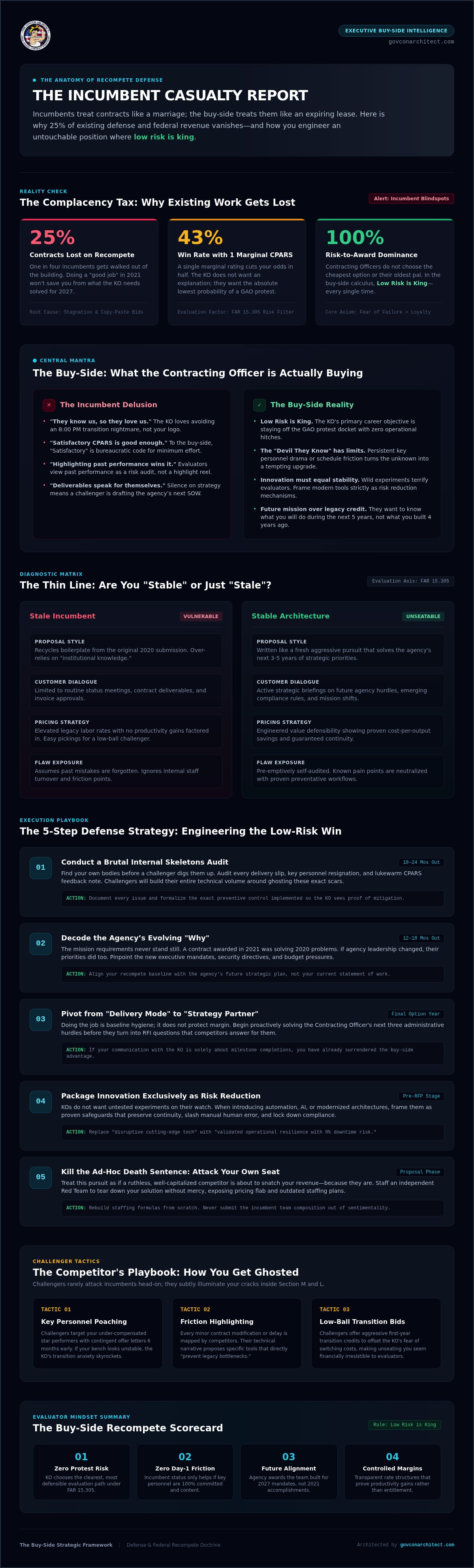
Incumbent contractors lose roughly 25% of the contracts they already hold. That's a quarter of your revenue vanishing because you got comfortable. If you have a single marginal CPARS rating on your record, your win rate on your own business collapses to a pathetic 43%. You think you're safe because you have the badge, but the buy-side is already looking for your replacement.
It's frustrating to watch a competitor try to buy your business with a low-ball price while you're doing the heavy lifting. You feel like the Contracting Officer should value your history, but they don't care about your feelings; they care about staying off the GAO protest docket. Low risk is king, and right now, your complacency is the biggest risk in the room.
This guide will help you build a clinical strategy for federal contract recompetes that treats your contract like a fresh kill. You'll learn to think like a KO and eliminate the hidden risks that get incumbents unseated. It's time to stop hoping for a renewal and start engineering a defense that makes unseating you look like a high-risk gamble for the government.
Key Takeaways
- Stop treating your contract like a lifelong marriage; the government is constantly looking for a reason to swipe right on a hungrier, cheaper competitor.
- Implement a clinical strategy for federal contract recompetes that prioritizes the Contracting Officer’s sanity, because a bored buyer is a buyer who starts looking for "fresh blood."
- Conduct a brutal internal audit to find your own skeletons before a challenger uses them to bury you during the source selection process.
- Avoid the "ad-hoc death sentence" by treating your recompete like a new pursuit, because we actually want you to keep your revenue instead of handing it to a low-baller.
The Complacency Trap: Why Incumbents Lose 25% of Recompetes
You think you're safe because you have the badge and the desk. You're wrong. Incumbents lose roughly 25% of recompetes because they fall into the complacency trap. This is a false sense of security that leads to sloppy proposal writing and a "copy-paste" mentality. Your strategy for federal contract recompetes cannot rely on institutional memory alone. The government isn't buying what you did in 2021; they're buying what you'll do in 2027.
Doing a good job is the bare minimum. It doesn't guarantee a win; it just keeps you from getting fired today. Recompete risk is the gap between current performance and future government requirements. The #1 reason incumbents lose is failing to address the evolving "Why" of the agency. If the mission changed and your approach didn't, you're an obstacle, not an asset.
The Buy-Side Reality Check on Performance
Contracting Officers (KOs) view a "satisfactory" CPARS rating as a red flag, not a badge of honor. It signals that you're doing just enough to stay compliant while the agency's needs grow more complex. Under the Federal Acquisition Regulation, KOs seek the lowest risk, not the oldest friend. During your final option year, you must pivot from delivery to strategy. If you aren't actively solving the KO's next three problems, a challenger will.
Signs Your Recompete is at Risk
Silence is the sound of a losing bid. If your only communication with the KO is about project deliverables, you've lost the "Buy-Side" advantage. You're likely ignoring the Reasons for Losing Government Contracts that apply specifically to incumbents who stop listening. Your competitors are already briefing the program office on how to fix the things you've ignored for four years. If you haven't seen an RFI in months, someone else is probably writing it for them.
The Buy-Side Reality: How KOs Evaluate the "Devil They Know"
Contracting Officers don't wake up wanting to fire you. They wake up wanting to avoid an administrative nightmare. A failed transition is a paperwork hellscape that keeps them at their desks until 8:00 PM. This is why "Low Risk is King" remains the central mantra of the buy-side. If you're the incumbent, you're the "devil they know." But if that devil is constantly causing schedule slips or key personnel drama, the unknown starts looking like a vacation.
When evaluators sit down with the FAR 15.305 proposal evaluation guidelines, they aren't looking for reasons to love you. They're looking for reasons to trust you won't break anything. Commercial firms often mistake past performance for a highlight reel. The insider knows it's actually a risk assessment. To score "innovation" without scaring the KO, you must frame every new idea as a proven stability measure, not a wild experiment.
The Evaluation of "Stale" vs. "Stable"
There's a thin line between being a reliable partner and being a stagnant contractor. Stability means you're consistent. Staleness means you're expensive and out of touch. If your strategy for federal contract recompetes hasn't evolved since the original award, you're a target. You need a Low Risk Bidder Strategy that proves you're still the most modern, efficient option available.
The Competitor’s Angle: How They Are Unseating You
Your competitors aren't just bidding lower prices; they're "ghosting" your weaknesses. They know exactly where you've stumbled over the last four years. Their proposals highlight how their specific processes eliminate the exact headaches you've been giving the agency. In a recompete, "Risk-to-Award" beats "Price-to-Win" every single time. If you want to see how the buy-side really views your current performance, you should schedule a strategy briefing before the RFP drops and your revenue evaporates.
The 5-Step Recompete Strategy to Maintain Low-Risk Status
Stop acting like you're married to the agency. You're on a series of high-stakes first dates, and you're about to get ghosted for a younger, cheaper firm that promises the world. A winning strategy for federal contract recompetes requires a clinical, five-step defense that treats your own success as a potential liability. We want you to keep your revenue, but that requires you to stop being lazy and start being strategic.
Start with a brutal internal audit. If you don't find your own skeletons, your competitor definitely will. Next, re-read the Statement of Work (SOW) as if you were a new bidder. You'll be shocked at the requirements you've "optimized" out of existence over the last few years. Then, update your Low Risk Architecture. The GAO testimony on contractor past performance proves that agencies prioritize future risk mitigation over past glory. Finally, treat the RFP like a first-time bid. Zero assumptions are allowed. If it isn't written in the proposal, the evaluator is legally required to pretend it doesn't exist.
Step 5: Leverage the Buy-Side Perspective
Interview your boots-on-the-ground team to find the "hidden" value you’ve delivered but haven’t documented. Your PMs likely saved the agency's neck ten times this year without a single line item on an invoice. To document "unpriced value," you must quantify how your specific, unbilled actions directly reduced the Contracting Officer's administrative burden or prevented a mission-critical schedule slip. This turns a "nice to have" history into a "must keep" future.
Systematic Win Rate Improvement
To how to systematically improve your federal contract win rate, you need to strip away incumbent arrogance. Our Capture & Proposal Sprint is the tactical tool you need to refresh a stale approach before the RFP drops. We help you think like a buyer so you can build a defense that makes unseating you look like a suicidal gamble for the government.
Defending Your Territory: Why Ad-Hoc Recompete Prep is a Death Sentence
Waiting for the RFP to drop before calling for professional help is a special kind of masochism. You're effectively handing your $10M contract to a challenger who has been pre-briefing the program office for eighteen months while you were busy "doing the work." "Proposal-only" support is a band-aid on a gunshot wound. If you ignored the capture phase, your strategy for federal contract recompetes is already dead on arrival. We want you to win, but we can't fix a year of silence in three weeks.
Commercial firms with $5M+ revenue often suffer from internal blindness; you're too close to the work to see the "stale" labels the KO is putting on your files. This is why our RETAINER · MONTHLY - Fractional Federal Strategy Advisor engagement requires a 3-month minimum commitment. Real defense isn't a 30-day proposal drill. It's a clinical realignment with the buy-side's shifting motivations. Low risk is king, and you can't prove stability with a rushed, ad-hoc response.
For firms facing an immediate threat, the PER‑PURSUIT · PROJECT - Capture & Proposal Sprint serves as your final defensive wall. It's the tactical tool to refresh your approach and prove you're still the most modern option. A solid strategy for federal contract recompetes turns your incumbency from a liability into an impenetrable fortress.
When to Bring in an Architect
Twelve months out is the "danger zone" for starting your defense. By this point, challengers are already shaping the PWS through RFI responses and technical briefings. Losing a $10M contract is a catastrophic failure; a strategy retainer is a rounding error by comparison. If you aren't actively defending your territory a year in advance, you're just a squatter waiting for an eviction notice.
Your Next Move
Stop guessing and start defending. You've worked too hard for five years to let a low-balling competitor snatch your revenue because you were too proud to get an outside reality check. It's time to get clinical about your survival.
Secure Your Fortress Before the Eviction Notice Arrives
Your current contract isn't a retirement plan; it's a target for every hungry challenger in the competitive landscape. We've seen too many established firms with $5M+ revenue lose their shirts because they treated the recompete like a victory lap instead of a high-stakes defense. The buy-side only cares about one thing: staying off the GAO protest docket by picking the option with the lowest risk.
If you aren't documenting unpriced value and auditing your own skeletons twelve months out, you're just waiting for a competitor to ghost your weaknesses. Building a clinical strategy for federal contract recompetes is the only way to prove you aren't stale. With 22 years of buy-side experience, we help you build a Low-Risk Focused Architecture that makes unseating you look like an administrative suicide mission.
We actually care about your success, but we won't lie to you: complacency is a choice. You've built something worth defending. Now, start acting like it.
Frequently Asked Questions
Is the incumbent always the preferred bidder in a federal recompete?
No, the incumbent is not always preferred; in fact, being the "devil they know" is only an advantage if you aren't currently giving the Contracting Officer a headache. If you've become stagnant or complacent, the buy-side will actively look for "fresh blood" to lower their administrative burden. Your strategy for federal contract recompetes must prove you're still the lowest risk, or the government will happily swipe right on a hungrier competitor.
How far in advance should I start my recompete strategy?
You should start your defense at least 12 to 18 months before the final option year ends. Waiting for the RFP to drop is a death sentence because your competitors are already in the program office shaping the new requirements. We recommend a strategy for federal contract recompetes that begins with a brutal internal audit a year out. This gives you time to fix performance gaps before they become disqualifying risks.
Can I use my current contract performance as a past performance reference?
Yes, and it is usually your strongest weapon if the ratings are clean. However, don't assume the evaluators will remember your "good work" if it isn't documented in CPARS. Since formal evaluations are mandatory for contracts exceeding $350,000 as of October 2025, you must ensure your current delivery data is quantifiable. We help you translate your daily wins into the technical language that Contracting Officers use to justify an award.
What is the "Incumbent Handicap" in federal contracting?
The "Incumbent Handicap" is the tactical disadvantage of being the predictable option. Challengers have spent years watching your mistakes, tracking your pricing through public databases, and ghosting your weaknesses in their proposals. If the Contracting Officer perceives you as "stale" or difficult to manage, your incumbency becomes a liability. You lose the benefit of the doubt the moment the government decides that a new transition is less painful than your continued delivery.
How do I handle a competitor who is undercutting my price on a recompete?
Stop trying to win a race to the bottom; instead, show the KO why a low-ball price equals high mission risk. In LPTA recompetes, the lowest bidder wins 89% of the time, but in best-value trade-offs, you win by proving the competitor's price is "unrealistic." Highlight the transition risks and service gaps that come with "buying the business." We help you frame your historical actuals as the only stable, low-risk path forward.