
Reality Check: 5 Myths About How to Win Federal RFPs in 2026

Article by
Nikki Gianni
Nikki Gianni is a seasoned business strategist and government contracts coach, dedicated to helping businesses successfully navigate the complexities of government contracting. With over 22 years of experience in Department of Defense contracting, including managing $20 billion in federal awards, Nikki has developed the innovative GovReady Blueprint™ Framework, a comprehensive 90-day program designed to prepare businesses to compete for and win lucrative contracts at the federal, state, and local levels. Nikki's approach emphasizes not just gaining contracts but also enhancing overall business profitability.
Before becoming a business owner, Nikki was active-duty Air Force for 10 years, then spent another 15 years as a civil servant with the DOD. Now she's an empty nester living in Southern California who loves spending time with her 22-year-old son, Lex and her 2 Mini Aussies, doing home improvement and crafts projects, and networking.
Your superior commercial product doesn't matter if the contracting officer views you as a high-risk liability. Most firms fail because they treat federal proposals like marketing brochures. They aren't. Learning how to win federal rfps in 2026 requires a shift from persuasion to clinical risk elimination. If you're tired of high proposal costs with zero ROI, it's time to stop guessing.
You've likely felt the frustration of complex evaluation criteria or the suspicion that a bid was already wired for an incumbent. It's a common pain point in a system that values procedural precision over flashy sales pitches. This article provides the necessary reality check. You'll learn to align your proposals with the specific risk criteria used by the buy-side and increase the efficiency of your bid/no-bid decisions.
We're debunking the commercial myths that lead to federal disqualification. By understanding the hidden mechanics of the evaluation process, you can transform your approach from a desperate gamble into a strategic victory. Here are the five myths you must abandon to secure your next contract.
Key Takeaways
Shift from selling innovation to proving stability. The government prioritizes risk mitigation and proven reliability over unproven commercial features.
Stop relying on SAM.gov as your primary source. The most successful bidders influence requirements 12 to 18 months before the official RFP release.
Master the buy-side evaluation process. Learn how to win federal rfps by aligning your technical data with specific contracting officer risk thresholds.
Move beyond simple compliance. A compliant bid is the minimum standard, but winning requires a strategy that secures "Superior" rather than "Marginal" ratings.
Treat your proposal as a technical specification rather than a sales brochure. Clinical data and methodology outperform marketing adjectives every time.
Table of Contents
Myth #2: The RFP Release is the Starting Point of the Competition
Myth #3: Compliance is the Key to Winning a Federal Contract
Myth #4: The Government Wants Your Most Innovative "Commercial" Solution
Myth #1: The Lowest Price Always Wins the Federal RFP
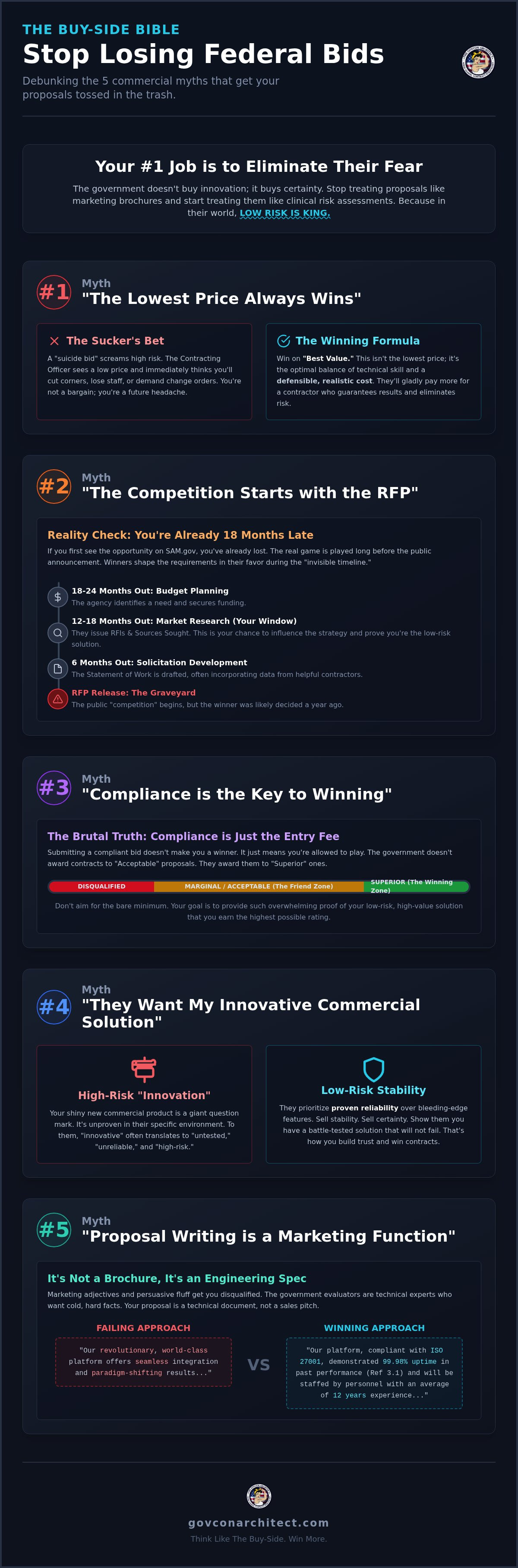
Stop thinking like a salesperson. Start thinking like a risk manager. In the federal market, the bottom line isn't the finish line. A low price is often a red flag rather than a competitive advantage. Contracting officers are trained to spot "suicide bids" from miles away. If your price is too low, you aren't a bargain. You're a liability.
The government buys on "Best Value." This means they're looking for the optimal balance between technical capability and cost. Price is a factor, but risk is the filter. A high-risk bidder with a low price is an automatic disqualification. The government would rather pay more for a firm that guarantees results than save money on a firm that might fail. This is the first hurdle in learning how to win federal rfps: you must justify your price through the lens of stability.
LPTA vs. Best Value Trade-Off
Lowest Price Technically Acceptable (LPTA) is reserved for commodities. It's for paper clips, fuel, and basic supplies. If you're selling specialized services or complex technology, you're likely operating on the Best Value Continuum. In this space, technical merit can outweigh price. The government frequently pays a premium for "superior" technical ratings because it reduces their operational risk. Commercial firms often underprice their bids to "get a foot in the door." This strategy backfires. It triggers risk alarms, signaling to the evaluator that you don't understand the complexity of the requirement.
The Buy-Side Perspective on Cost Realism
Contracting officers don't just look at the total number. They perform a clinical analysis of your labor rates, overhead, and profit margins. If your bid is significantly lower than the Independent Government Cost Estimate (IGCE), they suspect you're "buying the work." This suggests you'll cut corners, lose key personnel, or demand change orders once the contract begins. It signals a lack of financial stability and professional sobriety.
Cost realism is the government’s tool for spotting unsustainable bids.
To master how to win federal rfps, your pricing must be defensible. It must reflect a deep understanding of the work. You win by proving that your price is realistic, sustainable, and backed by a methodology that eliminates the government's fear of failure. Stability wins. Desperation loses.
Myth #2: The RFP Release is the Starting Point of the Competition
SAM.gov is a graveyard for latecomers. If the first time you hear about a requirement is through a public posting, you've already lost. The competition didn't start today. It started eighteen months ago. While you're downloading the attachments, your competitors are already finalizing their win themes. They've spent the last year shaping the requirements to fit their specific capabilities. This is the fundamental truth of how to win federal rfps: victory is secured during the capture phase, not the proposal phase.
The "Invisible Timeline" is where the contract is actually won. It spans 12 to 18 months of budget planning, market research, and requirement definition. During this window, the agency is looking for technical input. They're looking for ways to reduce risk. If you aren't in the room, you aren't part of the solution. You're just another bidder hoping for a miracle.
The Procurement Lifecycle Reality
Federal procurement follows a rigid, clinical cycle. It begins long before a solicitation number exists. Understanding this cycle is the difference between strategic bidding and blind luck. Use this breakdown to reset your expectations:
Budget Planning (18-24 Months Out): The agency identifies a need and secures funding.
Market Research (12-18 Months Out): The government issues Sources Sought notices and RFIs.
Solicitation Development (6 Months Out): The agency drafts the Statement of Work (SOW).
RFP Release: The public competition begins.
Sources Sought notices aren't optional paperwork. They're your first opportunity to influence the acquisition strategy. If you provide a compelling response, you can convince the agency to set the contract aside for your business category. This narrows the field before the RFP even hits the street.
Shaping the Requirement
Incumbents don't wait for the SOW. They help write it. By providing technical data during the RFI phase, they ensure the final RFP includes specific requirements that mirror their own profile. This isn't unethical; it's strategic risk mitigation. The government wants to know what works. If you can prove your methodology is the most stable, they'll build the requirement around it.
Positioning your firm as the only logical choice requires consistent engagement. Need an insider to help map these timelines? Our Monthly Retainer Support provides the strategic oversight needed to identify opportunities before they hit the public portal. Stop reacting to the market. Start shaping it. To truly master how to win federal rfps, you must dominate the pre-solicitation window.
Myth #3: Compliance is the Key to Winning a Federal Contract
Compliance is the floor. Strategy is the ceiling. Most firms believe that if they follow every instruction in the solicitation, they've done their job. They haven't. Compliance only ensures you aren't disqualified in the first round. It does nothing to ensure you actually win. A 100% compliant bid can still receive a "Marginal" or "Unacceptable" rating if it fails to address the underlying risks the agency is trying to mitigate.
There is a clinical difference between being "Responsive" and being "Competitive." Responsive means you checked every box. Competitive means you've positioned yourself as the lowest-risk solution. If you're simply checking boxes, you're aiming for a mid-tier score. In the federal market, second place is just the first loser. Mastering how to win federal rfps requires moving beyond the "Acceptable" threshold and into the "Superior" category.
Section L vs. Section M Alignment
Most bidders obsess over Section L. They worry about font sizes, margin widths, and submission portals. Section L tells you how to submit your bid. It's the administrative manual. Section M is the answer key. It contains the Evaluation Factors that the contracting officer will use to grade your proposal. If you focus on L and ignore M, you're writing a proposal for a clerk, not an evaluator.
Winning firms use the "Cross-Walk" technique. This involves mapping every sentence of the proposal directly to the scoring criteria in Section M. If the evaluator can't find your answer to a specific evaluation factor within five seconds, you've already lost points. We don't write for the reader. We write for the score sheet.
The Per-Pursuit Project Support Advantage
Basic compliance is easy. Strategic positioning is hard. Our Per-Pursuit Project Support is designed to move your proposal from a "technical pass" to a "strategic win." We don't just check boxes. We inject specific win themes that resonate with the agency's mission and the contracting officer's personal risk thresholds.
Every technical claim in your bid must be backed by verified proof points. Adjectives like "innovative" or "industry-leading" are fluff. They carry zero weight in a federal evaluation. We replace marketing jargon with clinical data and past performance metrics. This is the only way to secure the high-confidence ratings necessary for an award. To truly understand how to win federal rfps, you must treat every pursuit as a high-stakes architectural project, not a writing assignment.
Myth #4: The Government Wants Your Most Innovative "Commercial" Solution
Innovation is a buzzword that kills contracts. The federal government is not a venture capitalist. It is a massive, risk-averse bureaucracy. Bureaucracies fear change because change introduces variables. In this environment, "disruption" is synonymous with "failure." If you want to know how to win federal rfps, stop pitching your most advanced features. Start pitching your most proven results.
Unproven technology is a high-risk liability. A contracting officer's primary objective is mission success without a protest. Your "cutting-edge" commercial solution is just another point of potential failure. Lead with innovation, and you lead with risk. You must bridge the commercial-to-federal gap. What works for a tech startup often fails under the weight of federal security and compliance requirements. Your best commercial features are often federal flaws if they haven't been tested in a regulated environment.
Risk Mitigation as a Value Proposition
The goal of a contracting officer is simple: don't get fired and don't get protested. They value stability over speed. To win, you must frame your innovation as a tool for risk reduction. Does your software automate a manual process to eliminate human error? Does your methodology provide better oversight than the incumbent?
Stability certifications are your strongest evidence. FedRAMP, CMMC, and ISO standards aren't just technical hurdles. They are signals of institutional stability. Without these, your innovation is viewed as a security threat. To master how to win federal rfps, you must translate your technical superiority into the language of defensibility and mission assurance.
Leveraging Past Performance
Evaluators trust data. They don't trust promises. They prioritize what you did over what you say you can do. Commercial firms often fail here because they don't know how to translate private sector success into federal "Past Performance." Don't just list your clients. Map your commercial achievements to specific federal mission objectives.
Show the scale of your previous operations.
Demonstrate your history of meeting strict deadlines.
Provide verified data on your security protocols.
Highlight your financial stability during long-term projects.
Evaluators will verify your history. They are looking for a track record of stability, not a ceiling of potential. Positioning your commercial success for a federal audience requires a clinical, insider’s touch. Our Monthly Retainer Support helps you translate commercial innovation into the low-risk language that contracting officers demand. We turn your "innovation" into a defensible strategy that wins.
Myth #5: Proposal Writing is a Marketing Function
A federal proposal is not a sales brochure. It is a technical specification. If your writing is filled with adjectives like "world-class," "seamless," or "unparalleled," you've already failed. Evaluators don't buy feelings. They buy methodology and data. Adjectives don't win contracts. Structural integrity does. This is a common failure point for firms learning how to win federal rfps; they try to persuade when they should be documenting.
Marketing jargon is "fluff." To an evaluator, fluff is noise that hides a lack of substance. When a contracting officer sees a marketing-heavy technical volume, they stop reading. They assume you're compensating for a lack of technical depth. Winning requires a "Master Architect" approach. Your proposal must be a clinical briefing that proves you can execute the mission without oversight or error. Every sentence must serve a specific purpose in constructing a larger argument for your specialized expertise.
The Clinical Briefing Style
Adopt a tone of professional sobriety. Use short, staccato fragments and declarative statements. This simplifies the evaluator’s job. They have hundreds of pages to score. Don't make them hunt for the answer. We use a specific framework to ensure clarity and impact:
Problem: Define the government's specific pain point or operational risk.
Diagnosis: Explain why standard or incumbent approaches are failing to mitigate that risk.
Solution: Provide a data-driven, verifiable fix that ensures stability and mission success.
This framework replaces emotional persuasion with logical inevitability. It moves the conversation from "why we are great" to "why this is the only stable path forward." It signals that you are an elite insider who understands the hidden mechanics of the system.
The Strategic Retainer Strategy
Winning is a marathon of strategic alignment, not a sprint for a single RFP. If you start preparing when the solicitation drops, you're reacting. You aren't leading. Our Monthly Retainer Support ensures you are always bid-ready. This isn't about writing one document. It's about continuous advisory to align your firm with the government's buy-side evaluation process before the competition even begins.
Becoming a low-risk, compliant bidder is a process of refinement. It requires a veteran’s perspective to identify and fix structural weaknesses in your technical claims before they reach the evaluator. To master how to win federal rfps, you must move beyond the marketing department. You need a strategist who understands how external entities evaluate and perceive value. Logic wins. Hope is not a strategy.
Master the Mechanics of the Federal Award
Winning federal contracts isn't a matter of luck or bidding volume. It's a clinical exercise in risk elimination. You've seen the myths that lead to disqualification. You now know that price is secondary to stability. You understand that the competition starts long before SAM.gov flashes a new listing. To truly master how to win federal rfps, you must stop treating your proposals like sales brochures and start building them as technical specifications.
Federal procurement is a system with hidden mechanics. Navigating it requires an insider’s perspective to bridge the gap between commercial success and government requirements. We provide that bridge through 22 years of buy-side insider expertise and a clinical risk evaluation strategy. Our specialized support for commercial-to-federal market entry ensures your technical claims are backed by the stability evaluators demand. Don't waste another pursuit on a "marginal" rating.
Stop Bidding and Start Winning with GovCon Architect
The path to a "superior" rating is difficult. It requires precision and professional sobriety. With the right architectural approach, securing your next federal contract is a matter of strategy rather than hope.
Frequently Asked Questions
How do I win a federal RFP if I have no past performance?
You win by leveraging the past performance of your team or key personnel through a Teaming Agreement. If your firm lacks a federal track record, you must form a partnership with an established entity that lowers the government's perceived risk. You can also translate high-stakes commercial projects into federal "equivalent" performance by mapping your private sector success to specific mission objectives. The evaluator is looking for stability; a strong partner provides it immediately.
What is the most common reason federal proposals are disqualified?
Administrative non-compliance is the primary cause of immediate disqualification. This includes missing a submission deadline by seconds or ignoring a single font requirement in Section L. Beyond administrative errors, proposals fail because they don't align with the Section M evaluation factors. They focus on marketing adjectives when they should be documenting clinical technical specifications. If you don't follow the instructions exactly, the government stops reading.
Do I need a GSA Schedule to win a federal contract?
No, a GSA Schedule is not a mandatory requirement for all federal work. It's simply one of many "contract vehicles" the government uses to streamline the procurement process. While it simplifies buying for some agencies, many contracts are awarded on the open market or through agency-specific vehicles. You should identify your target agency's preferred buying method before investing the time and resources into a GSA Schedule.
How long does it typically take to win your first federal RFP?
Winning your first contract typically takes 12 to 24 months of consistent engagement. This timeline reflects the federal budget cycle and the 12-18 month "Invisible Timeline" of requirement shaping. Learning how to win federal rfps requires a commitment to the capture phase long before a solicitation is public. It's a marathon of strategic alignment rather than a quick commercial sales win.
What is the difference between a Contracting Officer and a Program Manager?
The Contracting Officer (CO) holds the legal authority to sign contracts and bind the government to spend money. The Program Manager (PM) is the end-user who defines the technical requirement and manages the daily work. To win, you must satisfy the PM’s technical mission while meeting the CO’s legal and risk thresholds. If the CO views you as a risk, the PM’s technical preference won't matter.
Can a small business really beat a large prime contractor on an RFP?
Small businesses beat large primes by leveraging set-aside categories and providing more specialized, low-risk solutions. Small business set-asides limit the competition to firms of your size, removing the large primes from the field entirely. By focusing on niche expertise and lower overhead, you can offer a "Best Value" proposition that a massive prime contractor cannot match. Precision beats scale in the federal market.
Is it worth responding to a "Sources Sought" notice?
Yes, responding to a Sources Sought notice is your primary opportunity to shape the final RFP. This is where the agency decides if the contract will be a small business set-aside or an open competition. If you don't provide technical input during this phase, you allow your competitors to "wire" the Statement of Work to their own strengths. How to win federal rfps begins with influencing the requirement during market research.
How much does it cost to hire a federal proposal consultant?
Costs vary significantly based on the level of strategic advisory and technical writing required. Most professional firms offer Monthly Retainer Support for long-term capture strategy or Per-Pursuit Project Support for specific, high-stakes bids. Avoid consultants who offer low flat fees without buy-side experience; they often provide basic compliance without the strategic risk mitigation needed to actually secure an award.