

Organizational Conflict of Interest Mitigation Plan: A Buy-Side Guide

Article by
Nikki Gianni
Nikki Gianni is a seasoned business strategist and government contracts coach, dedicated to helping businesses successfully navigate the complexities of government contracting. With over 22 years of experience in Department of Defense contracting, including managing $20 billion in federal awards, Nikki has developed the innovative GovReady Blueprint™ Framework, a comprehensive 90-day program designed to prepare businesses to compete for and win lucrative contracts at the federal, state, and local levels. Nikki's approach emphasizes not just gaining contracts but also enhancing overall business profitability.
Before becoming a business owner, Nikki was active-duty Air Force for 10 years, then spent another 15 years as a civil servant with the DOD. Now she's an empty nester living in Southern California who loves spending time with her 22-year-old son, Lex and her 2 Mini Aussies, Tony & Carmela, doing home improvement and crafts projects, and networking.
A plan that says “we’ll use a firewall” isn’t proof the firewall works. It’s a sentence with excellent posture. An organizational conflict of interest mitigation plan needs to answer the government buyer’s real question: what specific risk exists, and how will your controls contain it?
If you’re unsure whether a relationship, prior work, or access to sensitive information creates an OCI concern, you’re not alone. The hard part isn’t producing a polished document. It’s translating the solicitation’s language into practical controls, naming who is responsible, and showing how those controls will work.
This guide walks through how to identify the concern, assess its relevance to the procurement, and build a proportionate, solicitation-specific response. You’ll see how to document responsibilities, information barriers, and monitoring without leaning on generic promises. The goal is a defensible plan that helps the contracting officer evaluate risk, not a magic ticket to an award. Low risk is the point. Clear evidence beats confident wording every time.
Key Takeaways
- Distinguish organizational conflicts from individual conflicts, then identify what the buyer needs protected: impartial judgment, sensitive information, or confidence in the acquisition.
- Build an organizational conflict of interest mitigation plan around the specific concern, affected work, proposed control, accountable owner, and evidence, not generic policy language.
- Use a disciplined workflow to review solicitation instructions, map relevant relationships, assess risk, design controls, and document assumptions and open questions.
- Pressure-test the response against evaluator concerns and supporting evidence, drawing on Nikki Gianni’s 22 years of buy-side experience.
What an Organizational Conflict of Interest Means to a Federal Buyer
An organizational conflict of interest (OCI) is a condition involving an organization’s work, relationships, or access to information that could affect its judgment or give it an unfair competitive advantage. The buyer’s concern is practical: can the acquisition proceed with impartial judgment, protected information, and confidence in the process? A general introduction to conflict of interest can help clarify the underlying concept, but the specific concern depends on the procurement and its instructions.
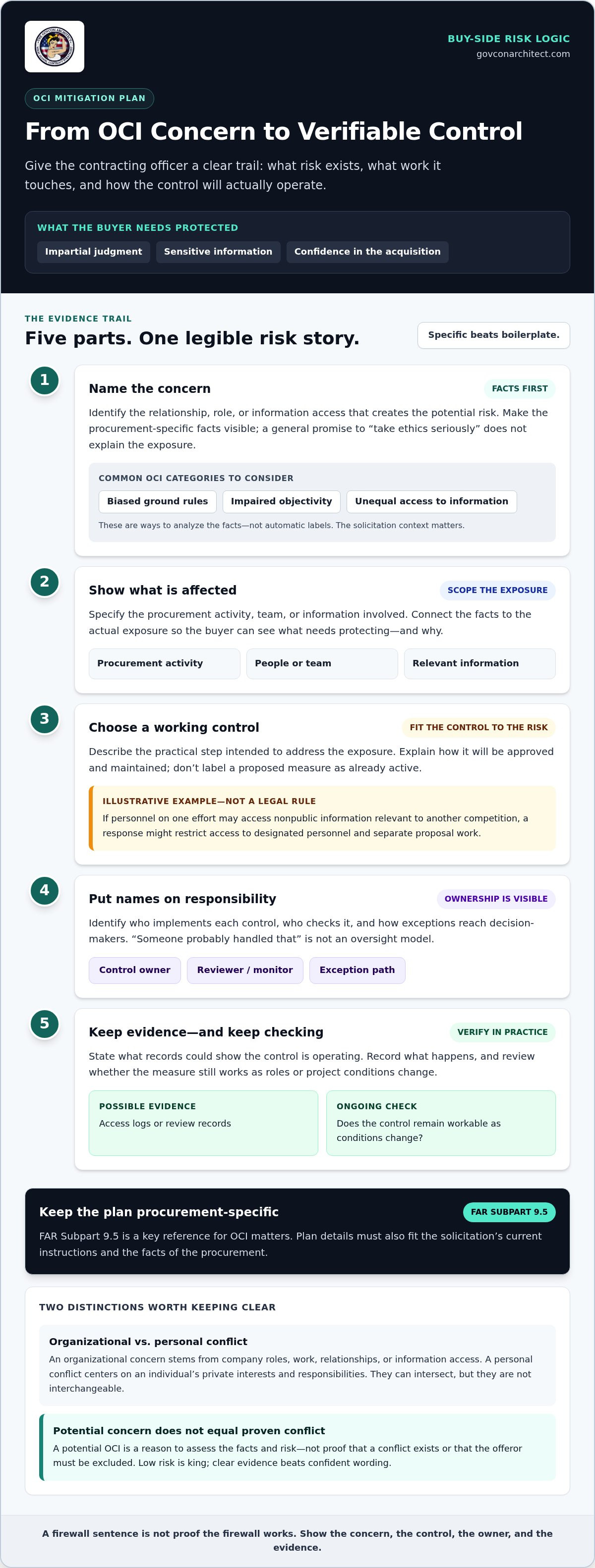
Commonly discussed OCI categories include biased ground rules, impaired objectivity, and unequal access to information. For example, a firm that helped shape requirements may later compete to fulfill them. A contractor may be asked to assess work connected to its own interests. Or access to nonpublic procurement information may create a competitive advantage. Treat these as ways to analyze the facts, not automatic labels. The applicable FAR text and solicitation context matter.
How OCI concerns differ from personal conflicts
An organization-level concern arises from the company’s roles, work, relationships, or information access. A personal conflict centers on an individual’s private interests and responsibilities. They can intersect, but they aren’t interchangeable. A company’s control plan won’t, by itself, explain an employee’s personal interest, and an employee disclosure won’t resolve every organizational risk. For the individual-level distinction, see guidance on avoiding personal conflicts in federal contracting.
Why the buyer needs a specific risk explanation
“We take ethics seriously” is reassuring as a sentiment. As a risk analysis, it’s about as useful as a locked door with no key policy. The contracting officer needs to understand which relationship creates which risk in this procurement, who or what is affected, and why the proposed response addresses it. Make that chain easy to follow: identify the facts, connect them to the exposure, then explain the control. Give the buyer something concrete to assess, not just a promise to admire.
A potential OCI is a reason to assess the facts and risk, not proof that a conflict exists or that the offeror must be excluded. An evidence-based approach to proposal risk mitigation starts with that distinction. A defensible organizational conflict of interest mitigation plan explains the concern in procurement-specific terms, then connects each control to the risk it is meant to manage. Low risk is king. Vague assurances don’t lower it.
What an Organizational Conflict of Interest Mitigation Plan Should Demonstrate
A credible plan gives the buyer a traceable line from concern to control. The Federal Acquisition Regulation (FAR) Subpart 9.5 is a key reference for OCI matters, but plan details must also fit the solicitation’s current instructions and the facts of the procurement. Don’t paste in corporate boilerplate and hope the contracting officer connects the dots. That’s their job, but making the risk legible is yours.
For each material concern, state:
- The concern: What relationship, role, or information access creates the potential risk?
- The affected work: Which procurement activity, team, or information is involved?
- The proposed control: What practical step is intended to address that risk?
- The accountable owner: Who implements the control and who monitors it?
- The evidence: What records could show the control is operating?
Connect each identified risk to a working control
Illustrative example, not a legal rule: If personnel supporting one effort may access nonpublic information relevant to another competition, a suitable response might restrict access to designated personnel and separate proposal work. Explain how access is approved, how the restriction is maintained, and what records, such as access logs or review records, could demonstrate that the control operates. Don’t describe a control as active if it’s still only proposed. Label its status plainly.
Every material risk needs a named control owner and evidence the buyer can verify. The control should fit the exposure. A grand-sounding firewall that nobody operates is just office décor with a compliance vocabulary.
Make responsibility and oversight visible
Name the person responsible for each control, the person who checks it, and the path for raising exceptions to decision-makers. Define what gets recorded and how the team will review whether the measure remains workable as roles or project conditions change. Clear oversight makes the plan easier to assess and maintain. It also makes it harder for a control to vanish into the organizational equivalent of “somebody probably handled that.”
For a sharper view of how risk logic should align with proposal decisions, use this federal proposal management and strategic risk guidance. If an independent pressure-test would help your team make the controls and supporting evidence clearer, schedule a conversation.
How to Build, Implement, and Maintain the OCI Mitigation Plan
An organizational conflict of interest mitigation plan must work beyond the proposal deadline. Build it around the current procurement, assign people to run the controls, and keep records showing what happens in practice. This workflow creates structure. It doesn’t replace solicitation instructions or qualified legal advice.
- Review the solicitation. Identify its OCI language, requested disclosures, submission format, and any agency-specific instructions. Use the current requirements for this procurement, not a template from a different pursuit.
- Map relevant relationships. Document pertinent work, roles, information access, and organizational relationships. Separate confirmed facts from assumptions.
- Assess each risk. Describe how a relationship could affect the work or create an advantage in this procurement. Record open questions for appropriate internal review instead of quietly promoting guesses to facts.
- Design controls. Choose measures that address the specific exposure. Define who acts, what they do, and how the control will be monitored.
- Document implementation. State whether each measure is proposed, approved, or operating. Identify supporting records and control owners.
- Review and update. Set a review interval suited to the controls and procurement. Revisit the plan after a material change in personnel, scope, information access, or relevant relationships.
Turn the plan into an operating record
A control that exists only in the plan is a promise, not proof. Depending on the measure, retain approval records, access logs, training records, or review documentation. Assign an owner to maintain each record and define who checks it, and when. Set the interval based on the control and procurement context. An arbitrary calendar reminder isn’t oversight.
Test whether the controls address the buyer’s concern
Read the plan as an evaluator would. Can they trace the concern to a control, see who owns it, and understand what evidence demonstrates it is working? If not, tighten the explanation before submission. The same low-risk logic applies across acquisition decisions, as outlined in this executive checklist for federal procurement risk mitigation.
Solicitation instructions and facts govern the response. Use this workflow as a planning aid, not a substitute for reviewing the applicable requirements or seeking qualified legal advice where needed.
When to Bring Buy-Side Strategy Into an OCI Response
An internal team may know the facts and still struggle to explain how those facts answer the buyer’s concern. That’s a good moment for a structured review through the buy-side lens. It can be especially useful when the OCI issue touches multiple teams, the proposed controls are difficult to evidence, or the response feels technically complete but disconnected from the opportunity.
What strategic review can help clarify
A focused review pressure-tests the logic: Does the explanation identify the concern raised by this procurement? Do the proposed controls address that concern? Can the buyer understand who will carry them out and what evidence supports the approach? Keep the review anchored to the solicitation and the organization’s actual circumstances. Treating every scenario alike is efficient only if your goal is generic language.
Nikki Gianni brings 22 years of buy-side experience as a government buyer, evaluator, awarder, and contract administrator. That perspective helps scrutinize a response through the evaluator’s lens: what risk remains, what evidence makes the control credible, and where does the proposal leave room for doubt? The purpose is practical alignment, not a prediction of the award decision.
Choose support that fits the pursuit
For ongoing strategic support, RETAINER · MONTHLY - Fractional Federal Strategy Advisor helps established firms examine pursuit decisions and response alignment over time. A review of an organizational conflict of interest mitigation plan can support clearer positioning, but strategy and preparation don’t guarantee an award or replace legal representation. They help your team make its reasoning and evidence easier for the government to assess.
This support is intended for established firms with $5M+ in annual revenue and 5+ years of proven delivery. If your firm meets that profile and is ready to pursue federal contracts deliberately, book a brief conversation about the situation and the opportunity. No magic words. Just a focused discussion of the risk and the response.
Make Your Next OCI Decision Deliberate
Your next move isn’t to make the organizational conflict of interest mitigation plan sound more confident. It’s to make the decision behind it more defensible. Before committing resources to a pursuit, ask whether the team can explain the remaining risk, support its position with evidence, and carry the proposed controls into actual operations. If those answers are still taking shape, pause and strengthen the approach. A rushed promise won’t calm a buyer’s risk concerns. Clear reasoning can.
Use the OCI response as part of a larger pursuit decision: does this opportunity fit your organization, and can you manage the exposure without weakening delivery or proposal execution? A buy-side perspective can help your team examine that judgment through the questions an evaluator may reasonably ask. It won’t guarantee an award or replace legal counsel. It can help you pursue with greater clarity and discipline.
Bring the real situation, not a polished fairy tale. A more grounded next step is within reach.
Frequently Asked Questions
What is an organizational conflict of interest mitigation plan?
An organizational conflict of interest mitigation plan records how a contractor proposes to address a specific concern tied to a procurement. It helps the buyer evaluate the company’s explanation against the opportunity’s requirements. For example, if an offeror previously supported related work, the plan should clarify what that work involved and how the current proposal handles the relevant exposure. The solicitation and applicable acquisition requirements determine what response is appropriate.
Does an organizational conflict of interest automatically disqualify a contractor?
No, a potential OCI should not be treated as an automatic disqualification. The facts, applicable requirements, solicitation instructions, and buyer’s assessment all matter. A contractor’s practical next step is to describe the situation accurately, avoid minimizing relevant facts, and explain the reasoning behind its proposed response. Don’t assume either that a concern ends the pursuit or that submitting a plan guarantees eligibility. Neither shortcut is sound risk management.
What should an OCI mitigation plan include?
An OCI mitigation plan should give the buyer enough information to assess the response in context. Beyond describing the concern, clarify whether proposed measures are already operating or still require implementation. For instance, if a plan relies on limiting access to project information, explain how the organization will put that restriction into practice and retain records that reflect the process. Confirm the solicitation’s instructions before deciding which details belong in the submission.
How often should an organizational conflict of interest mitigation plan be reviewed?
There is no single review interval that fits every plan. Set a schedule that reflects the controls and procurement, and trigger an earlier review when a relevant condition changes. A useful practice is to assign one person to record the change, identify which parts of the plan it may affect, and route unresolved questions for internal review. Keep dated versions so decision-makers can see which plan reflects current conditions.
Can an OCI mitigation plan guarantee a federal contract award?
No. A plan can explain the contractor’s position and proposed response, but it cannot guarantee selection. The buyer evaluates the submission in the context of the procurement and applicable requirements, alongside the other factors relevant to the acquisition. Treat the plan as part of a credible, well-supported proposal, not a magic key to award. Set expectations accordingly, then focus the team on accuracy, clear reasoning, and disciplined execution.