

NIST 800-171 Requirements for Contractors: The Buy-Side Reality Check

Article by
Nikki Gianni
Nikki Gianni is a seasoned business strategist and government contracts coach, dedicated to helping businesses successfully navigate the complexities of government contracting. With over 22 years of experience in Department of Defense contracting, including managing $20 billion in federal awards, Nikki has developed the innovative GovReady Blueprint™ Framework, a comprehensive 90-day program designed to prepare businesses to compete for and win lucrative contracts at the federal, state, and local levels. Nikki's approach emphasizes not just gaining contracts but also enhancing overall business profitability.
Before becoming a business owner, Nikki was active-duty Air Force for 10 years, then spent another 15 years as a civil servant with the DOD. Now she's an empty nester living in Southern California who loves spending time with her 22-year-old son, Lex and her 2 Mini Aussies, Tony & Carmela, doing home improvement and crafts projects, and networking.
Your System Security Plan isn't a technical manual. It's a risk assessment that tells a Contracting Officer exactly how much of a liability you are. Most firms treat cybersecurity like a root canal: painful, expensive, and something to be avoided until it's terminal. You're probably staring at those 110 controls and wondering how a mid-market firm with a $5M delivery history is supposed to survive the overhead. It's overwhelming. We get it.
But here's the reality check. Failing to meet the NIST 800-171 requirements for contractors is the fastest way to get your bid tossed before the technical review even starts. In the federal game, low risk is king. If you can't prove you're secure, you're a threat to the mission. We're going to stop the bleeding. This article provides a clinical roadmap to turn your compliance into a strategic weapon. You'll learn how the buy-side actually evaluates your SSP and POAMs, allowing you to position your firm as the safest bet in the room for those high-value federal primes.
Key Takeaways
- Understand why meeting NIST 800-171 requirements for contractors is the government's favorite way to kill high-risk bids before the technical experts even open your proposal.
- Stop treating your System Security Plan like a boring IT manual and start using it as your "proof of life" to Contracting Officers who are looking for any reason to say no.
- Learn how to scope your environment properly so you don't end up over-engineering your network or setting piles of cash on fire for controls you don't actually need.
- Turn your SPRS score into a strategic win theme that makes you the safest bet in the room for federal primes who are tired of babysitting high-risk subs.
The Gatekeeper: Why NIST 800-171 is the Floor for Federal Revenue
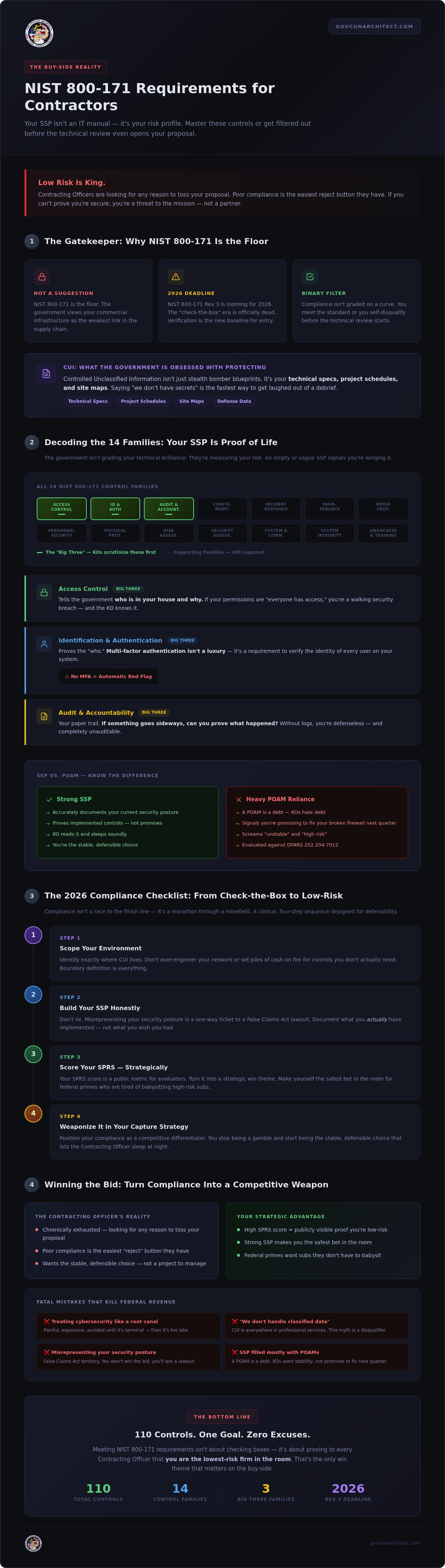
NIST 800-171 isn't a suggestion. It's the floor. The government doesn't care if you think your commercial network is "secure enough" for your private sector clients. To them, your unhardened router is a back door into their mission. If you don't meet the NIST 800-171 requirements for contractors, you aren't a partner; you're a liability. The "Buy-Side" reality is simple: the government is terrified of your network. They view your commercial infrastructure as the weakest link in the supply chain. With NIST 800-171 Rev 3 looming for 2026, the "check-the-box" era is officially dead. Verification is the new baseline for entry.
CUI: The Data the Government Is Obsessed With
Controlled Unclassified Information (CUI) isn't just top-secret blueprints for a stealth bomber. In professional services or specialty trades, it’s the technical specs, the project schedules, and the site maps. Many firms think they're safe because they don't handle "classified" data. That's a dangerous myth. Saying "we don't have secrets" is the fastest way to get laughed out of a debrief. If you can't identify CUI, you can't protect it. If you can't protect it, you're high risk. We want you to win, but you won't even get to the starting line if you treat data protection like an afterthought.
The Disqualification Factor
Contracting Officers (KOs) are chronically exhausted. They're looking for reasons to toss your proposal so they have fewer pages to read. Poor compliance is the easiest "reject" button they have. Compliance is a binary filter. When you fail to meet NIST 800-171 requirements for contractors, you make the KO's job easy by disqualifying yourself. By mastering these controls, you align with a strategic insider strategy. You stop being a gamble and start being the stable, defensible choice that lets the KO sleep at night.
Decoding the 14 Families: What Evaluators Look for in Your SSP
Your System Security Plan (SSP) is your proof of life. To a Contracting Officer, an empty or vague SSP is a signal that you're winging it. When you're managing the NIST 800-171 requirements for contractors, the government isn't grading your technical brilliance. They're measuring your risk. Specifically, they're looking at the DFARS 252.204-7012 compliance requirement to see if you can actually safeguard the data they give you. If your SSP is mostly a "Plan of Action and Milestones" (POAM), you're in trouble. A POAM is a debt. KOs hate debt. They want stability, not a promise to fix your broken firewall next quarter.
The 'Big Three' Control Families for Bidders
While there are 14 families, three are the heavy hitters for risk mitigation when meeting NIST 800-171 requirements for contractors:
- Access Control: This tells the government who is in your house and why. If your permissions are "everyone has access," you're a walking security breach.
- Identification and Authentication: This is about proving the "who." Multi-factor authentication isn't a luxury; it’s a requirement to verify the identity of every user on your system.
- Audit and Accountability: This is your paper trail. If something goes sideways, can you prove what happened? Without logs, you're defenseless.
The SSP vs. The Reality of Your Network
Don't lie. It's tempting to "check the box" to get through the evaluation, but misrepresenting your security posture is a one-way ticket to a False Claims Act lawsuit. Your SPRS score is now a public metric for evaluators. If you're struggling to translate your IT mess into a strategic win theme, you can get a reality check on your bid readiness before you submit. Low risk is king. If your network reality doesn't match your SSP, you aren't a contractor; you're a liability waiting for a subpoena. We want you to win, but we want you to stay out of court even more.
The 2026 Compliance Checklist: Moving from 'Check-the-Box' to Low-Risk
Compliance isn't a race to the finish line; it’s a marathon through a minefield. Most firms treat NIST 800-171 requirements for contractors as a list of chores to be ignored until a bid deadline looms. That’s a mistake that kills revenue. Moving from "check-the-box" to "low-risk" requires a clinical, four-step sequence designed for defensibility. Meeting the NIST 800-171 requirements for contractors is about proving you aren't a liability to the mission.
- Scoping: Map exactly where CUI enters, lives, and leaves your system. If you can’t see it, you can’t protect it. Don't secure ghosts.
- Gap Analysis: This is your infrastructure reality check. Identify the 110 holes in your bucket before you try to fill it with high-stakes federal work.
- Documentation: Draft an SSP and POAM that speak the language of a Contracting Officer. They want to see maturity, not just technical jargon.
- Implementation: Prioritize controls that mitigate the highest mission risk first. Stability is the goal.
Scoping: The $5M+ Firm's Biggest Mistake
We see it constantly with firms in the $5M range. They try to "boil the ocean" by making their entire commercial network compliant. It’s an expensive waste of capital. By isolating your federal work into a secure enclave, you significantly reduce your compliance overhead. This technical precision isn't just about IT; it directly supports your Federal Contract Financial Responsibility Determination. A firm that can't scope its own data is a firm the government views as a financial liability. In the buy-side world, precision equals stability. Stability equals wins.
Winning the Bid: Leveraging NIST 800-171 in Your Capture Strategy
Compliance is usually viewed as a cost center. That's a loser's mindset. In the federal market, meeting the NIST 800-171 requirements for contractors is your most potent sales tool. While your competitors are busy hiding their poor SPRS scores in the fine print, you should be using yours as a primary win theme. A high score isn't just a number; it’s a signal that you are the lowest-risk option in the room. Contracting Officers are human. They want to award contracts to firms that won't end up on the front page of the news for a massive data breach. They want to go home at 5 PM knowing their mission is safe.
Compliance as a Competitive Moat
Most firms in the $5M revenue bracket are currently winging it. They have a basic SSP and a prayer. By actually hardening your environment, you create a moat that your less-disciplined peers simply cannot cross. This is a core pillar of a sophisticated Federal Procurement Insider Strategy. When you talk to a KO, don't just quote the controls like a robot. Explain how your security posture ensures mission continuity. Show them you understand that their reputation is on the line as much as yours. We care about your growth, and that starts with being the most defensible bidder in the stack.
The 'Buy-Side' Advantage
At The GovCon Architect, we know that low risk is king. We don't care about "effort"; we care about results. The government doesn't award points for trying hard; they award contracts to the firm that provides the most stability for the best price. We help you align your technical compliance with the specific evaluation criteria KOs use to filter out high-risk liabilities. Stop guessing at your readiness and start positioning your firm as the elite, secure partner the mission requires.
Stop guessing at compliance. Book a 15-minute call to see how we build a low-risk capture strategy.
Stop Guessing and Start Dominating the Evaluation
You've spent years building a $5M+ firm. Don't let a poorly scoped network kill your growth. The government doesn't care about your effort; they care about their own survival. Meeting the NIST 800-171 requirements for contractors is the only way to prove you aren't a liability. We've shown you that scoping is where most firms bleed cash and that your SSP is actually your "proof of life" to a Contracting Officer.
I spent 22 years on the buy-side as a federal evaluator. I know exactly how KOs use these controls to thin the herd. We specialize in helping established firms navigate this bureaucracy without the guesswork. You have the delivery history; now you need the defensibility that makes you the obvious, low-risk choice.
You have the talent to deliver the mission. Let's make sure you have the security posture to win it. We're here to help you become the lowest-risk bidder in every room you enter.
Frequently Asked Questions
Is NIST 800-171 the same as CMMC 2.0 for contractors?
No, they aren't twins, but they're definitely siblings. NIST 800-171 is the actual set of 110 technical controls you must implement to protect data. CMMC 2.0 is the verification framework the government uses to make sure you aren't just making it up. If you want to meet the NIST 800-171 requirements for contractors, you're essentially building the foundation for your future CMMC certification. One is the standard; the other is the audit.
How much does it cost for a $5M firm to become NIST 800-171 compliant?
It depends on how much "technical debt" you've been ignoring. Costs vary based on your current infrastructure and how effectively you've scoped your environment. A firm that isolates its federal work into a secure enclave will spend significantly less than one trying to harden its entire commercial network. We focus on precision scoping to keep you from setting piles of cash on fire for unnecessary hardware you don't actually need to win.
Can I bid on federal contracts if I'm not 100% compliant yet?
Technically, yes, but you're walking into a trap. Most RFPs require you to have an active System Security Plan (SSP) and a score uploaded to the Supplier Performance Risk System (SPRS). If you have gaps, they must be documented in a Plan of Action and Milestones (POAM). However, from the buy-side perspective, a firm with a perfect score is a safe bet, while a firm with a POAM is a gamble.
What happens if a contractor fails a NIST 800-171 audit?
You lose the contract and potentially your reputation. Failing an audit or misrepresenting your security posture can lead to contract termination for default. Even worse, the government is using the False Claims Act to go after firms that lied about their compliance status. In this high-stakes environment, the government isn't looking for "good intentions." They're looking for stability and verified risk mitigation. If you're a liability, you're disqualified.
Do NIST 800-171 requirements apply to subcontractors too?
Yes, these requirements flow down the entire supply chain. If you handle Controlled Unclassified Information (CUI), the NIST 800-171 requirements for contractors apply to you, even if you're a third-tier sub. Primes are increasingly vetting their subs for security maturity because your failure becomes their breach. Being compliant isn't just a rule; it’s how you prove to a prime that you won't get their contract cancelled by being the weakest link.