

How to Win a Task Order on an IDIQ: The Buy-Side Playbook for 2026

Article by
Nikki Gianni
Nikki Gianni is a seasoned business strategist and government contracts coach, dedicated to helping businesses successfully navigate the complexities of government contracting. With over 22 years of experience in Department of Defense contracting, including managing $20 billion in federal awards, Nikki has developed the innovative GovReady Blueprint™ Framework, a comprehensive 90-day program designed to prepare businesses to compete for and win lucrative contracts at the federal, state, and local levels. Nikki's approach emphasizes not just gaining contracts but also enhancing overall business profitability.
Before becoming a business owner, Nikki was active-duty Air Force for 10 years, then spent another 15 years as a civil servant with the DOD. Now she's an empty nester living in Southern California who loves spending time with her 22-year-old son, Lex and her 2 Mini Aussies, Tony & Carmela, doing home improvement and crafts projects, and networking.
Holding a prime seat on a multi-award IDIQ feels great until you realize you bought an expensive hunting license that yields zero revenue. You burn brilliant engineering hours responding blindly to fast-turn solicitations, only to lose repeatedly to an embedded incumbent. It's exhausting. If you want to master how to win a task order on an IDIQ, you have to stop pitching commercial genius and start reading the room through the eyes of the source selection board.
We feel your frustration. It stings when technically superior solutions get scored as high risk by an agency evaluator. But on the Buy-Side, low risk is king; contracting officers use streamlined fair opportunity rules to eliminate surprises, not reward unproven novelty. In this guide, you will discover how federal buyers actually evaluate IDIQ task orders and master the systematic strategy required to win. We'll break down the qualification filters, buyer motivations, and pre-solicitation positioning needed to turn your contract vehicle into reliable revenue.
Key Takeaways
- An IDIQ contract seat is simply an administrative hunting license, meaning guaranteed funding only flows to firms that de-risk pursuits before solicitations drop.
- Source selection boards aren't shopping for flashy commercial experiments; on the Buy-Side, low risk is king, and evaluators score proposals based on defensible stability.
- Mastering how to win a task order on an IDIQ requires a disciplined four-step capture sprint with ruthless bid/no-bid filters to stop your team from burning hours on unwinnable fast turns.
- Long-term vehicle dominance demands institutional execution, turning initial task order wins into stellar performance ratings that systematically lock out incumbents.
The IDIQ Vehicle Trap: Why a Contract Seat Guarantees Zero Federal Revenue
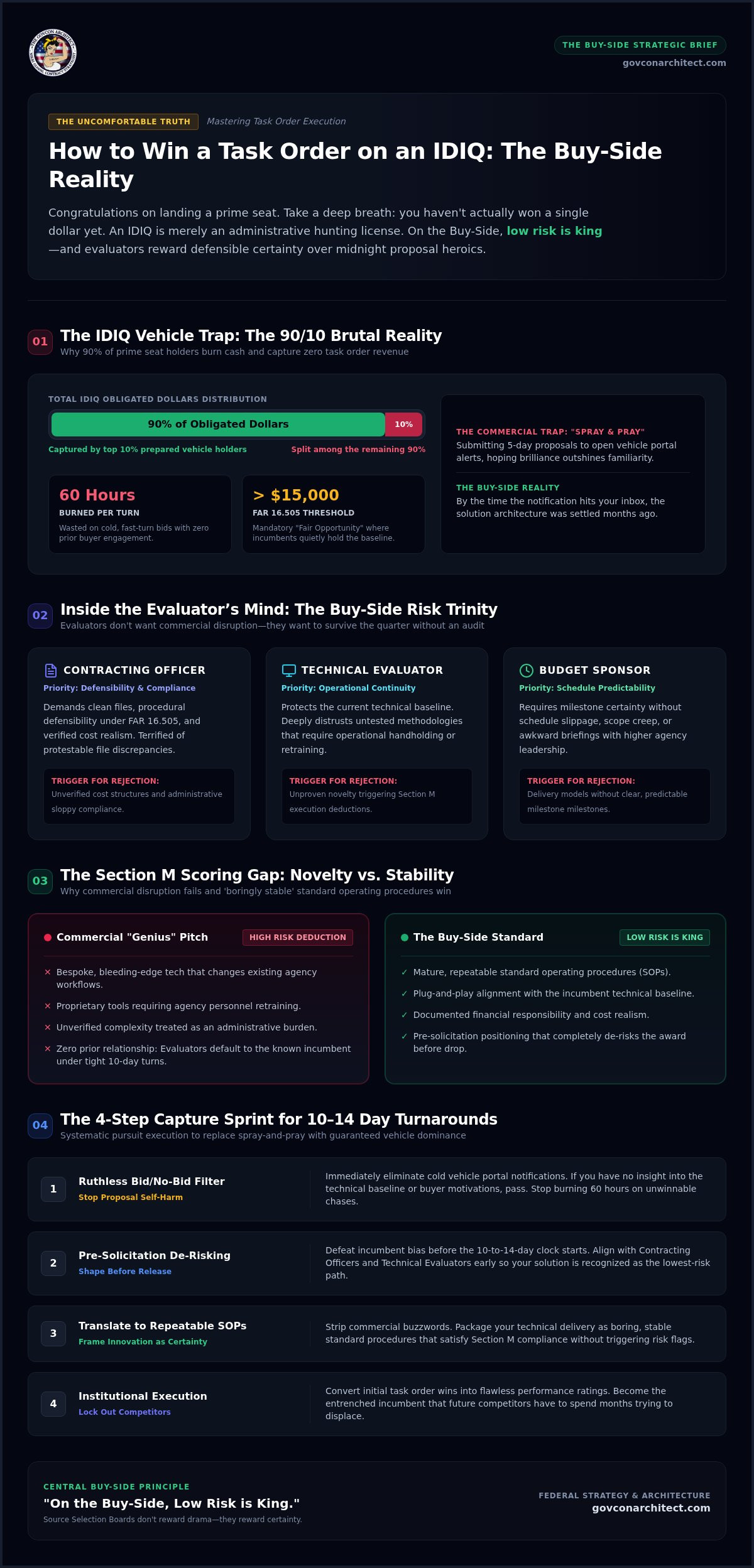
Congratulations on winning that master vehicle. Now, take a breath: you haven't actually won any revenue. An Indefinite Delivery, Indefinite Quantity (IDIQ) contract is simply an administrative hunting license; it merely buys you the legal right to compete. Across federal contracting, a brutal reality rules: roughly 10% of vehicle holders capture 90% of obligated task order dollars. Naive commercial leaders celebrate their award, only to burn valuable bid-and-proposal budgets chasing cold solicitations they never stood a chance of winning.
Understanding Fair Opportunity Under FAR 16.505
Under FAR 16.505, contracting officers must provide awardees a fair opportunity to compete for orders over $15,000. Sounds democratic, right? Don't be fooled. Contracting officers prioritize program stability above all else. With streamlined evaluation rules and statutory exceptions that accommodate urgency or logical follow-ons, buyers often shape statements of work around incumbent technical baselines. By the time an open solicitation hits your vehicle inbox, the solution architecture was likely settled months ago.
The True Cost of 'Spray and Pray' Bidding on Open Portals
Throwing five-day proposals at every portal notification is not a pipeline; it's operational self-harm. Commercial firms often mistake raw administrative compliance for an actual winning posture. You burn 60 engineering hours per turn while buyers quietly eliminate you using internal risk metrics and financial responsibility standards.
Learning how to win a task order on an IDIQ means stopping the blind portal scramble. Deciding how you win on the Buy-Side requires recognizing that low risk is king; evaluators reward known delivery integrity over midnight proposal heroics every single time.
Inside the Evaluator’s Mind: The Buy-Side Framework for Task Order Risk
Commercial firms love pitching disruption, proprietary patents, and bleeding-edge speed. Government evaluators simply want to survive the quarter without a program audit, a performance default, or an awkward briefing with leadership. On the Buy-Side, low risk is king.
Evaluation boards divide their scrutiny across three predictable viewpoints:
- The Contracting Officer: Demands procedural defensibility, clean files, and verified cost realism.
- The Technical Evaluator: Protects operational continuity and distrusts untested methodologies.
- The Budget Sponsor: Requires predictable delivery milestones without schedule slippage.
When you submit an unfamiliar commercial workflow, evaluators don't marvel at your ingenuity. They write you up as an execution risk.
Scoring Discrepancies: Innovation vs. Perceived Execution Risk
Bespoke commercial tech sounds impressive in boardrooms, but under Section M criteria, unverified complexity triggers immediate technical deductions. Evaluators use these standards to eliminate solutions that require administrative handholding. True mastery of how to win a task order on an IDIQ requires translating commercial innovation into mature, repeatable standard operating procedures. Frame your delivery as boringly stable. Evaluators don't reward drama; they reward certainty.
The Incumbent Advantage: Why Safe Choices Win Under Time Constraints
Two-week turnaround windows give evaluation panels zero bandwidth to take chances on unknown entities. Under tight deadlines, they default to the embedded incumbent because familiarity shields them from delivery failures. Defeating an entrenched competitor requires engineering your low-risk posture long before the request drops. That disciplined positioning is how you win. If your team is exhausted from burning hours on unwinnable chases, you can book a strategy session to structurally de-risk your pursuits.
How to Win a Task Order on an IDIQ: A 4-Step Capture and Proposal Framework
Forget traditional 90-day pursuit textbooks. Task order solicitations rarely afford you more than 10 to 14 days from release to submission. If you rely on automated scrapers to blast proposal slop or scramble to learn customer priorities after the RFP drops, you're toast. Mastering this process demands a fast, disciplined framework.
Step 1 & 2: Pre-Solicitation Intel Gathering and Ironclad Bid/No-Bid Qualification
Real capture occurs while the requirement is still an informal conversation. Engage agency program managers months before the task order surfaces. Learn what keeps them awake at night. If you lack direct insight into their operational bottlenecks, exercise self-control: do not bid. Walking away preserves precious internal capital. Applying systematic contract win rate strategies requires filtering out unwinnable pursuits so your team focuses strictly on high-probability targets.
Step 3 & 4: Risk-Proof Technical Architecture and Defensible Pricing
Once the solicitation drops, ditch corporate marketing fluff. Write directly to the performance work statement. Anchor your past performance citations to identical scope, scale, and agency complexity to neutralize evaluator anxiety. Structure pricing for defensibility rather than racing to the bottom; ridiculously low bids immediately signal technical incompetence on the Buy-Side. Show them an ironclad transition plan that guarantees day-one operational continuity. That is how to win a task order on an IDIQ.
Institutionalizing Task Order Wins: Scaling Revenue Across Federal Vehicles
Landing your first task order proves your model works. Now stop celebrating and institutionalize it. Moving from reactive bid-chasing to predictable revenue requires turning early project execution into an unassailable defensive moat across enterprise-wide Multi-Agency Contracts and agency-specific vehicles. Low risk is king, and consistency scales only when delivery builds structural reputation.
Transforming Past Performance into Incumbent-Level Clout
Every completed task order is strategic currency. Systematize your delivery data immediately to lock in exceptional Contractor Performance Assessment Reports (CPARs). On the Buy-Side, pristine CPARS ratings serve as your golden ticket. They provide the verified stability contracting officers crave, effectively neutralizing competitor advantages on neighboring pursuits. Deliver cleanly, document metrics ruthlessly, and turn established agency trust into recurring task order modifications where legally permissible.
Strategic Advisory vs. Reactive Overhead: The Retainer Model
Commercial leaders often panic after winning a vehicle seat, hiring bloated internal proposal departments that incinerate margins. That's burning cash just to look busy. You don't need five junior coordinators writing frantic compliance checklists; you need buy-side judgment.
Engaging a Fractional Federal Strategy Advisor on a monthly retainer provides executive-level reality checks without enterprise overhead. Seasoned advisors pressure-test your pursuit filters and eradicate disqualifying technical risks before your estimators draft final pricing. Ultimately, understanding how to win a task order on an IDIQ is not about bidding on everything. It's about engineering a disciplined pipeline that targets, de-risks, and captures high-probability work.
Turn Your Hunting License into Bankable Federal Revenue
Stop treating your IDIQ seat like a scratch-off ticket. When you understand how to win a task order on an IDIQ, you immediately stop incinerating your engineering team's weekends on blind RFQs. Remember the central reality of the Buy-Side: federal buyers don't hand awards to corporate daredevils. They select the partner who won't embarrass them in front of leadership. Low risk is king, and engineering that stability happens long before the solicitation hits the street.
GovCon Architect provides zero-fluff advisory grounded in 22 years of federal acquisition and evaluation experience. Tailored exclusively for commercial firms with $5M+ in revenue, we transform your technical capability into the lowest-risk bid in the room.
You have already built an exceptional commercial business. With the right buy-side discipline, you can finally capture the federal revenue your contract seat promised.
Frequently Asked Questions
Can you win an IDIQ task order without incumbent past performance on that vehicle?
Yes, but you must substitute vehicle tenure with direct past performance that matches the statement of work precisely. Evaluators fear transition failures above everything else. If you haven't delivered on that specific contract yet, your commercial track record and team credentials must prove zero operational learning curve. Low risk is king; show them that hiring your team carries identical programmatic stability to keeping the incumbent in place.
Why do government evaluators eliminate technically superior task order proposals?
Government evaluation panels don't reward technical flair if it introduces perceived delivery risk. Unfamiliar commercial methodologies, proprietary tech stacks, and aggressive timelines make evaluators nervous about audit exposure and project slippage. If your bid looks like an unproven science experiment, they will downgrade you under Section M criteria. Evaluators pick defensible, repeatable execution over clever corporate ambition every single day.
How much time do contractors typically get to respond to an IDIQ task order RFQ?
Most task order requests give contractors just 10 to 14 calendar days to respond. Because timeframes are compressed, trying to learn agency pain points after the notice drops is suicide. Understanding how to win a task order on an IDIQ means doing your homework months in advance. If you haven't engaged program managers or pre-qualified the pursuit before release, you're merely donating free labor to the evaluation board.
What is the difference between bidding on a standalone RFP and an IDIQ task order?
Standalone RFPs undergo exhaustive, full-and-open competition under FAR Part 15, taking months to evaluate. IDIQ task orders operate under streamlined FAR Part 16.505 fair opportunity rules with faster timelines and broader evaluator discretion. Additionally, protesting a task order award is severely restricted; civilian orders below $10 million and defense orders below $35 million generally cannot be protested at the GAO, giving contracting officers far more leeway.
How does FAR 16.505 fair opportunity affect who gets selected for a task order?
While FAR 16.505 mandates fair opportunity to compete on orders exceeding $15,000, it also grants contracting officers immense flexibility. Buyers don't have to conduct formal discussions or score proposals like standard contracts. They frequently tailor task order requirements around proven incumbent baselines to protect schedule stability. Discovering how to win a task order on an IDIQ requires positioning your firm as the obvious low-risk choice before the solicitation ever reaches your portal.