

How to Run a Federal Proposal Kickoff Meeting and Assign Roles

Article by
Nikki Gianni
Nikki Gianni is a seasoned business strategist and government contracts coach, dedicated to helping businesses successfully navigate the complexities of government contracting. With over 22 years of experience in Department of Defense contracting, including managing $20 billion in federal awards, Nikki has developed the innovative GovReady Blueprint™ Framework, a comprehensive 90-day program designed to prepare businesses to compete for and win lucrative contracts at the federal, state, and local levels. Nikki's approach emphasizes not just gaining contracts but also enhancing overall business profitability.
Before becoming a business owner, Nikki was active-duty Air Force for 10 years, then spent another 15 years as a civil servant with the DOD. Now she's an empty nester living in Southern California who loves spending time with her 22-year-old son, Lex and her 2 Mini Aussies, Tony & Carmela, doing home improvement and crafts projects, and networking.
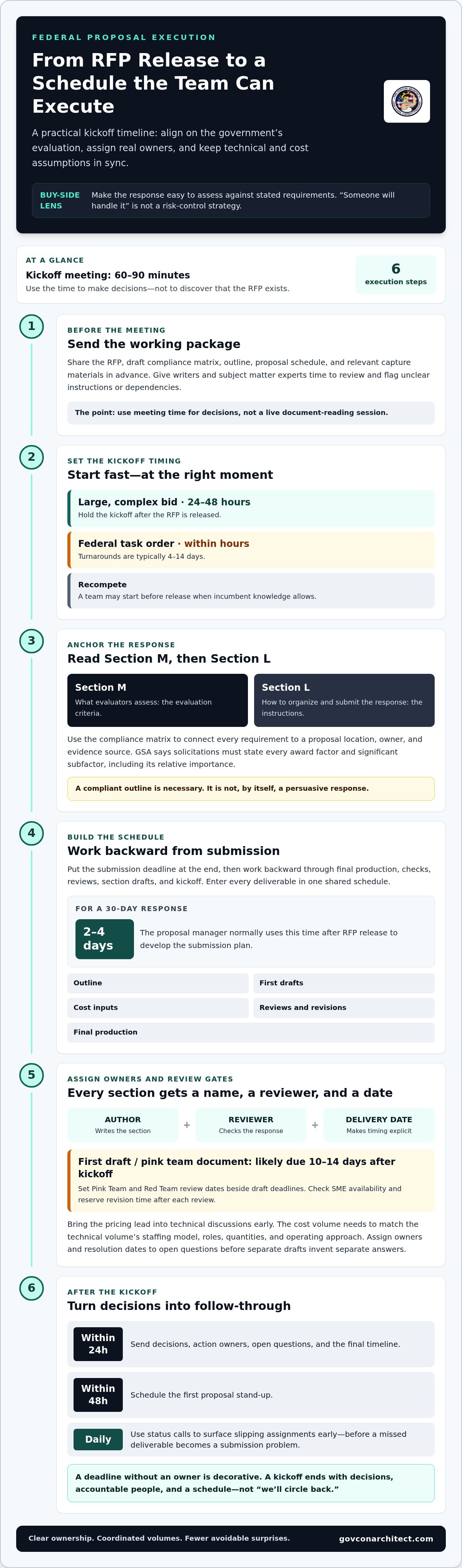
A federal proposal kickoff meeting agenda should align the team on the RFP, win strategy, compliance, section ownership, and schedule. For large, complex bids, hold the meeting 24 to 48 hours after the RFP is released; the kickoff formally starts proposal development after the bid/no-bid decision. Its job is to put execution in motion, not just give everyone another meeting invite.
A meeting that ends with “we’ll circle back” isn’t a kickoff. It’s calendar theater. The pressure is real: proposal work depends on clear ownership and coordinated technical and cost inputs, not good intentions and a heroic final sprint.
This guide explains how to assign writers, subject matter experts, reviewers, and other leads, then coordinate their work across proposal volumes. It covers the agenda items that matter, from evaluation criteria and win themes to review gates, action owners, and open questions. The goal is simple: leave with decisions, accountable people, and a schedule the team can execute.
Key Takeaways
- Send the RFP and draft compliance matrix before the meeting so the team can focus on decisions, not a first-time document reading.
- Review Section M evaluation criteria before Section L instructions to anchor the response in how the government will assess it.
- Bring the pricing lead into technical discussions early; assumptions that shape the solution can also shape cost.
- Give every proposal section a named author, reviewer, and delivery date. Clear ownership beats “someone will handle it.”
- Close with documented decisions, action owners, deadlines, and a process for resolving open questions.
What Is a Proposal Kick-Off Meeting?
A federal kickoff aligns proposal management, writing, and responsibilities with solicitation requirements, including Sections L and M; a standard business proposal kickoff may not have those federal instructions and evaluation criteria to organize around. Flag missed instructions, evaluation factors, and matrix gaps: according to the General Services Administration, solicitations must state every award factor and significant subfactor with its relative importance. Keep the kickoff to 60-90 minutes.
-
Set the Proposal Schedule
Build the proposal calendar backward from the submission deadline, then enter every deliverable in one shared schedule. For a 30-day response, the proposal manager normally spends 2 to 4 days after the RFP drops developing the submission plan. Set dates for the outline, first drafts, cost inputs, reviews, revisions, and final production. Check SME availability against each date. A deadline without an owner is decorative, not management.
-
Map Milestones and Review Deadlines
Assign review gates before writing begins, then connect each gate to an owner and a decision. Put Pink Team and Red Team dates beside draft deadlines, and confirm subject matter experts can support those reviews and final submission. A first draft, or pink team document, is likely due 10 to 14 days after kickoff. Reserve time after each review for revisions; feedback that arrives after the next gate is expensive commentary.
-
Work Backward from Key Milestones
Start at the submission deadline and work backward through production, final checks, color-team reviews, section drafts, and kickoff. For a large, complex bid, schedule kickoff 24 to 48 hours after RFP release. A recompete may start before release when incumbent knowledge allows. For federal task orders, meet within hours of receipt because turnarounds are typically 4-14 days. Check dependencies before locking dates.
After the meeting, send decisions, action owners, open questions, and the final timeline within 24 hours. Schedule the first proposal stand-up within 48 hours, then use daily status calls to surface slipping assignments early. That gives the proposal team a chance to correct the schedule before a missed deliverable becomes a submission problem.
Proposal assignments and integration of cost and technical volumes
Turn the win strategy and compliance matrix into named section assignments. Connect technical and cost work early, before separate drafts develop conflicting assumptions.
-
Assign Section Owners
Give every proposal section a named author, reviewer, and delivery date. Assign ownership based on the opportunity’s evaluation criteria and win themes, not just writing capacity. For example, the technical approach owner should map each response element to a requirement and flag dependencies involving staffing, schedule, or pricing. The capture lead keeps the win strategy visible; the proposal manager tracks assignments and resolves overlaps. Avoid assigning a section to “the team.” That usually means nobody owns it.
-
Define Responsibilities and Backups
Record each person’s responsibilities, deliverables, reviewer, and deadline in one assignment tracker. Name a backup for critical inputs, such as a subject matter expert’s technical details or the pricing lead’s cost assumptions. The backup should know which source material and decisions the primary owner controls. A name in a spreadsheet is not coverage. Confirm who can approve changes, consolidate comments, and submit each section. This prevents a late handoff from turning into a mystery novel.
Coordinate proposal volumes through shared assumptions. If the technical volume proposes a staffing model, the cost volume must use the same roles, quantities, and operating approach. Have the technical owner and pricing lead review those assumptions together before formal drafting. Track each open question with an owner and resolution date; otherwise, writers may develop different answers to the same opportunity. The government assesses the proposed solution, not the team’s internal explanations for inconsistent volumes.
Before the kickoff ends, confirm every section has an author, reviewer, and delivery date, and record unresolved dependencies. For a complex pursuit, align proposal roles and strategy before drafting turns assumptions into rework.
Proposal kickoff meeting agenda items
Build the agenda around decisions the proposal team needs to make, not a tour of familiar documents. A useful federal proposal kickoff meeting agenda moves from shared facts to response strategy, then closes with owners and open issues.
-
Share Information Before the Kickoff
Send the RFP, draft compliance matrix, outline, proposal schedule, and relevant capture materials before the meeting. The proposal manager should identify the opportunity, submission deadline, expected deliverables, and known customer needs. Writers and subject matter experts need time to review the package. A live meeting is a costly place to discover a file exists. Ask attendees to flag unclear instructions and dependencies in advance.
-
Review the Solicitation and Evaluation Criteria
Review Section M evaluation criteria first, then Section L instructions. Section M explains what evaluators assess; Section L explains how to organize and submit the response. Use the compliance matrix to connect each requirement to a proposal location, owner, and evidence source. Have the capture manager flag ambiguities or conflicts for resolution. A compliant outline is not the same as a persuasive response.
-
Align on Win Themes and Customer Needs
Ask the capture manager to present the win strategy, customer priorities, and supporting evidence. Agree on three to five win themes, then identify where each belongs in the outline. For example, a theme about reducing transition risk needs proof in the approach, staffing, and management sections, not just a slogan in the introduction. Confirm that writers can support every claim with a specific capability or past performance example.
-
Close with Decisions and Open Items
Use the final agenda segment to confirm assignments, review gates, communication rules, and unresolved questions. Pair each action item with a named owner and resolution deadline. Record decisions in the meeting notes, including changes to the outline or compliance matrix. The proposal team should leave knowing what to deliver next, where to store it, and who can resolve a blocker.
The GovCon Architect: Fractional Federal Strategy Advisor: Monthly Retainer Support
The GovCon Architect’s RETAINER · MONTHLY - Fractional Federal Strategy Advisor provides ongoing strategic guidance for firms navigating the federal marketplace. It helps leadership assess opportunities through the government’s buy-side lens, align proposal decisions with evaluation criteria, and manage risk across pursuits.
For a specific active bid, the PER-PURSUIT · PROJECT - Capture & Proposal Sprint provides targeted support for the opportunity and proposal. The right next step depends on whether your firm needs ongoing strategic guidance or focused support for a single pursuit.
Contact The GovCon Architect or visit govconarchitect.com to discuss your federal proposal needs.
Make the Next Pursuit More Defensible
A federal proposal kickoff meeting agenda matters beyond the meeting itself. Use each pursuit to improve how your team translates customer priorities into evidence, aligns commitments, and identifies delivery risks before they become proposal gaps. The government evaluates the offer, not the effort behind it. A clear, supportable response gives evaluators fewer reasons to question whether your team can perform.
Choose one improvement to carry into your next pursuit. Your capture strategy may need sharper customer insight, or technical and cost assumptions may need earlier alignment. Your team may also need a more consistent approach to the federal market. Improve the process deliberately; don’t wait for a deadline to expose the same weaknesses.
If you want strategic support tailored to your federal pursuits, take the next step when it makes sense for your team.
Build discipline one decision at a time. Your next bid can start stronger.