

How to Get on a GSA Schedule: The Buy-Side Reality Check for Established Firms

Article by
Nikki Gianni
Nikki Gianni is a seasoned business strategist and government contracts coach, dedicated to helping businesses successfully navigate the complexities of government contracting. With over 22 years of experience in Department of Defense contracting, including managing $20 billion in federal awards, Nikki has developed the innovative GovReady Blueprint™ Framework, a comprehensive 90-day program designed to prepare businesses to compete for and win lucrative contracts at the federal, state, and local levels. Nikki's approach emphasizes not just gaining contracts but also enhancing overall business profitability.
Before becoming a business owner, Nikki was active-duty Air Force for 10 years, then spent another 15 years as a civil servant with the DOD. Now she's an empty nester living in Southern California who loves spending time with her 22-year-old son, Lex and her 2 Mini Aussies, Tony & Carmela, doing home improvement and crafts projects, and networking.
Most "experts" treat a GSA Schedule like a golden ticket, but for an established firm, it's often just an expensive paperweight. You didn't build a five-million-dollar company by collecting participation trophies. You're here because you want a legitimate, long-term revenue channel. Learning how to get on a GSA Schedule isn't actually about the paperwork. It's about a high-stakes strategy where you stop acting like a solicitor and start acting like a solution. The government doesn't want more vendors. They want fewer headaches.
It's exhausting to deal with "certification mills" that promise the moon but leave you with a contract that sits idle. I get it. You've spent years delivering real results, and now you're stuck in a loop of conflicting advice. Here is the reality check: low risk is king. In this briefing, you'll learn how to think like a government buyer to prove you're the safest bet in the room. We're moving past the fluff of Refresh #33 to look at the clinical mechanics of a successful award. It's time to build a defensible path to the federal market.
Key Takeaways
- Stop treating the MAS like a lottery ticket and start positioning your firm as the government’s lowest-risk asset through the Buy-Side lens.
- Master the tactical path of how to get on a GSA Schedule by providing the clinical, structural evidence that Contracting Officers actually demand.
- Navigate the scrutiny of pricing and financial audits to prove your $5M+ firm is a stable, long-term partner that won't flake mid-contract.
- Transition from "awarded" to "winning" by recognizing your schedule is just a hunting license that requires a sophisticated capture strategy to produce results.
The GSA Schedule Reality Check: It Is Not a Lottery Ticket
A GSA Schedule isn't a prize for showing up; it’s a high-stakes bridge between your commercial success and the federal vault. Managed by the General Services Administration (GSA), the Multiple Award Schedule (MAS) exists for one reason: to make the government’s life easier. From the Buy-Side, a Contracting Officer (KO) isn't looking to give you a "chance." They're looking to offload administrative risk. By using a schedule, they bypass the open-market chaos and buy from pre-vetted, stable entities. If you don't look stable, you don't get the keys.
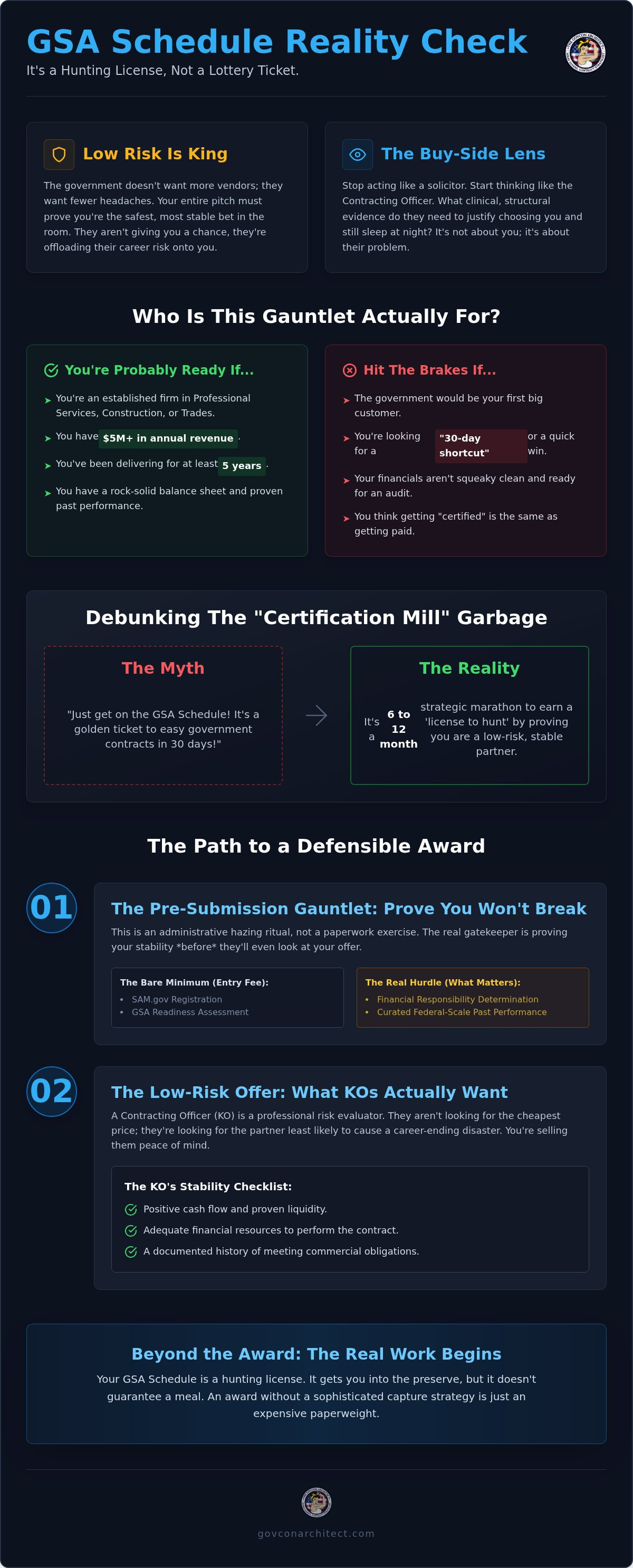
Here is the hard truth that "certification mills" won't tell you: if your firm hasn't hit $5M in revenue or hasn't been delivering for at least five years, you aren't ready for this gauntlet. Learning how to get on a GSA Schedule is a waste of your time if you can't prove you're a low-risk asset. The government hates being someone's first customer. They want to see that you’ve already survived the commercial world before they trust you with taxpayer dollars. Don't fall for the "just get certified" fluff. You're building a defensible revenue channel, not collecting a sticker for your website.
Who Is the GSA Schedule Really For?
Established firms in Professional Services, Construction, and Specialty Trades are the primary beneficiaries here. The government views first-time bidders as a liability. If you can't demonstrate what you need to bid through years of past performance, the KO will see you as a risk to their career. Low risk is king, and your balance sheet is your best witness.
The Myth of the 30-Day Shortcut
Low-tier consultants love promising a quick win. It's a lie. A strategic, low-risk submission typically takes 6 to 12 months. Rushing the process of how to get on a GSA Schedule leads to disqualification or, worse, a schedule that sits idle because you didn't align your pricing with the Buy-Side reality. We're playing the long game here.
Step 1: The Pre-Submission Gauntlet and Risk Alignment
Before you even think about the technical proposal, you have to survive the administrative hazing ritual. Registering on SAM.gov and completing the GSA Readiness Assessment are the bare minimum. If you can’t handle these, you definitely aren’t ready for the big leagues. We don’t provide these basic services because, frankly, if you need help with a login, you shouldn't be bidding on forty-billion-dollar vehicles. These are just the entry fee. The real work begins with proving you won't break under the weight of a federal contract.
The real gatekeeper is stability. A Federal Contract Financial Responsibility Determination is the first major hurdle for commercial firms looking at how to get on a GSA Schedule. The government wants to see your balance sheet. They need to know you won't vanish mid-project because your cash flow dried up. It’s not personal; it’s preservation. Your past performance curation is equally critical. Don’t just list every project you’ve ever done. Pick the ones that demonstrate federal-scale complexity. Show them you’ve managed the structural weight of large-scale commercial delivery. If you're unsure where you stand, a readiness check can reveal the gaps before the government does.
The Buy-Side Logic of Financial Scrutiny
A Contracting Officer (KO) isn't just a bureaucrat. They are a professional evaluator of risk. When they look at your fiscal disclosures, they are looking for red flags that suggest instability. Low risk is king in federal procurement. If your debt-to-equity ratio looks like a horror movie, the KO will pass. They need to sleep at night knowing their award won't end up in a remedial audit because your firm went dark. When you're mapping out how to get on a GSA Schedule, remember that the KO is looking for:
- Positive cash flow and liquidity.
- Adequate financial resources to perform.
- A history of meeting commercial obligations.
Prove your stability, and you prove your value. You aren't just selling services; you're selling the peace of mind that comes with a reliable partner.
Step 2: Building a Low-Risk Offer That KOs Actually Want
If you think pricing is just about listing your commercial rates, you're about to lose your shirt. The government doesn't just want a discount; they want to ensure you aren't a flight risk. When figuring out how to get on a GSA Schedule, you'll encounter the Commercial Sales Practices (CSP) and the Price Reduction Clause (PRC). These aren't just paperwork hurdles. They are the government's way of tethering your federal pricing to your commercial behavior. If you give a "best price" to a commercial client, the government wants to know why they aren't getting it too. It’s a clinical evaluation of your market position.
Your technical proposal needs to move beyond the "we can do it" fluff that fills most bids. A Contracting Officer (KO) needs structural evidence of your success. They are looking for proof that you are a "responsible" contractor under FAR Part 9. This means you have the integrity, resources, and technical skills to actually deliver. To understand how these evaluators separate the pros from the amateurs, check out our Federal Procurement Insider Strategy. They aren't looking for the most optimistic marketing pitch. They are looking for the lowest-risk choice in the room.
Negotiating Your Most Favored Customer (MFC) Price
The government’s goal is to secure the Most Favored Customer (MFC) price. This doesn't mean you have to work for free. It means you have to justify your pricing through the lens of value and stability. If your commercial rates are higher because of specific risks or overhead, explain that. A KO would rather pay a fair price for a stable company than a "cheap" price for a firm on the brink of collapse. When you show them the logic behind your numbers, you stop being a vendor and start being a strategic partner. This is the real secret of how to get on a GSA Schedule without sacrificing your margins.
Beyond the Award: Why the Schedule Is Only the Starting Line
Congratulations. You’ve successfully navigated how to get on a GSA Schedule and have a shiny contract number to show for it. Now put the champagne away. Most firms treat the award like a finish line, but in reality, you’ve just bought an expensive hunting license. If you don't have a capture strategy, your schedule is just a digital paperweight. The government doesn't browse GSA Advantage looking for new friends; they use it to find the lowest-risk path to a solution they already know they need.
To move the needle, you must master tools like eBuy to find opportunities that actually fit your five-million-dollar footprint. This isn't a passive game. It’s a relationship game played with clinical data and aggressive risk mitigation. This is why a RETAINER · MONTHLY - Fractional Federal Strategy Advisor is a requirement, not a luxury. You need an insider to ensure your long-term win rates don't crater because you’re guessing at what a Contracting Officer wants to see. We care about your success, which is why we won't let you settle for a "participation trophy" contract.
Capture Management for Schedule Holders
Stop waiting for the phone to ring. Passive maintenance is a slow death. You need to move from "having a schedule" to actively pursuing task orders. Ad-hoc bidding on every random RFP is a high-risk strategy that leads to team burnout and a zero percent win rate. Real capture management involves identifying the "Buy-Side" motivations months before the solicitation hits the wire. If you aren't shaping the requirement, you're just providing cover for the incumbent.
How to Scale Your Federal Revenue
Scaling requires transitioning from a one-off win to a consistent, predictable revenue stream. It’s about building structural integrity into your federal sales machine. You’ve already proven you’re an established player; now prove you can dominate the field. Ready to stop guessing? Book your 15-minute get-to-know-you call with The GovCon Architect.
Weaponize Your Commercial Success for the Federal Market
You’ve built a five-million-dollar powerhouse; don't let it stall by treating the MAS like a bureaucratic participation trophy. Understanding how to get on a GSA Schedule is about demonstrating structural integrity to a skeptical evaluator. Nikki Gianni brings 22 years of Buy-Side experience to help you bridge the gap between merely having a contract and actually winning task orders. We focus on established firms because the government only buys from those who have already proven they won't break under pressure.
Low risk is king in this arena. You are the safest bet in the room, provided you stop guessing and start executing a clinical strategy. Our RETAINER · MONTHLY - Fractional Federal Strategy Advisor support starts at $3,500 per month for firms ready to dominate. It's time to stop collecting paper and start collecting revenue.
You’ve already done the hard work of building a real business. Now let’s make sure the government knows exactly why you’re the most stable partner they’ll ever find.
Frequently Asked Questions
How long does it actually take to get a GSA Schedule in 2026?
It typically takes between 6 and 12 months for a strategic, low-risk submission to reach award. While some "shortcut" consultants promise 30 days, the reality of MAS Refresh #33 in 2026 involves heavy scrutiny of supply chain risk and pricing data. Rushing the process of how to get on a GSA Schedule usually leads to a rejection. You want to do it once and do it right; anything else is just expensive hope.
What are the minimum revenue requirements for a GSA Schedule?
Technically, the GSA requires two years in business, but we don't touch firms with less than $5M in annual revenue and five years of delivery. From the Buy-Side, anything less is a high-risk liability. Once awarded, you must achieve $100,000 in sales within the first five years to keep the vehicle. If you aren't already a commercial heavyweight, the government isn't interested in being your first experiment.
Can I get a GSA Schedule if I am a new business with no commercial experience?
Absolutely not. The federal government is the most risk-averse buyer on the planet. They don't want to fund your startup's learning curve. To learn how to get on a GSA Schedule, you first need a solid five-year track record of commercial delivery. If you have no commercial experience, you have no past performance, which means you have no evidence that you won't flake out mid-contract. Stable firms only, please.
What is the most common reason GSA Schedule offers are rejected?
Rejection usually boils down to pricing inconsistencies and financial instability. If your Commercial Sales Practices (CSP) don't align with your offer, or if your balance sheet looks like a disaster zone, the Contracting Officer will kill the deal. They use Class Deviation CD-2026-03 and other metrics to verify you aren't a risk. If you can't prove you're fiscally sound and offer a fair price, you're out.
Do I need a lawyer or a consultant to get on a GSA Schedule?
You don't need a lawyer for the application, but you definitely need an insider strategist. Paperwork consultants just fill out forms that likely lead to a "hunting license" with zero sales. We provide a RETAINER · MONTHLY - Fractional Federal Strategy Advisor to ensure your schedule is built for revenue, not just compliance. You need someone who understands the clinical mechanics of how evaluators actually score your stability and price.