
How to Get 8(a) Certified: The Buy-Side Strategy for High-Growth Firms (2026)

Article by
Nikki Gianni
Nikki Gianni is a seasoned business strategist and government contracts coach, dedicated to helping businesses successfully navigate the complexities of government contracting. With over 22 years of experience in Department of Defense contracting, including managing $20 billion in federal awards, Nikki has developed the innovative GovReady Blueprint™ Framework, a comprehensive 90-day program designed to prepare businesses to compete for and win lucrative contracts at the federal, state, and local levels. Nikki's approach emphasizes not just gaining contracts but also enhancing overall business profitability.
Before becoming a business owner, Nikki was active-duty Air Force for 10 years, then spent another 15 years as a civil servant with the DOD. Now she's an empty nester living in Southern California who loves spending time with her 22-year-old son, Lex and her 2 Mini Aussies, Tony & Carmela, doing home improvement and crafts projects, and networking.
Why would a Contracting Officer risk their career on your $5 million firm just because you have a shiny new badge? Your 8(a) certification isn't a lottery ticket, and if you treat it like one, you're just wasting paper. You’ve likely spent months listening to generic advice that promises "easy" federal millions, only to find yourself confused by how KOs actually view your business. Developing a real 8(a) certification federal contracting strategy is the only way to avoid the certification-to-nowhere pipeline. I get it, and honestly, you deserve a strategy that actually respects your five years of hard-earned delivery.
This article flips the script. I'll show you how to position your firm as the low-risk, high-stability solution that federal buyers actually crave by focusing on the "Buy-Side" perspective. We are moving past the fluff to analyze the hidden mechanics of the 2026 landscape. We will cover strategic alignment, risk-mitigation tactics, and the clinical reality of sole-source thresholds. It’s time to stop hoping for a win and start architecting one.
Key Takeaways
- Stop treating the certification like a lucky break and start building an 8(a) certification federal contracting strategy that positions your firm as a low-risk asset.
- Understand the "Buy-Side" motivation: Contracting Officers use 8(a) set-asides to reduce their own administrative risk and workload, not to hand out charity.
- Validate your $5M+ revenue and five-year delivery history to ensure you’re entering the program as a high-growth contender rather than a desperate hopeful.
- Master the capture method to identify sole-source opportunities and build strategic relationships before requirements ever touch the public marketplace on SAM.gov.
The 8(a) Reality Check: Why "Just Getting Certified" is Bad Advice
Listen, getting the badge is the easy part. The hard part is actually doing something with it. Most firms treat the 8(a) like a lottery ticket, waiting for the government to back a dump truck of cash into their driveway. Newsflash: the dump truck is empty. Your 8(a) certification federal contracting strategy must be built on the reality that the government doesn't care about your badge. They care about their own career safety. If you can't prove you're stable, you're a liability. Commercial success isn't just a bonus; it's the only thing that makes your badge worth the paper it's printed on. I want you to win, but I won't lie to you about the work required.
The $5M+ Threshold: Why established firms win bigger
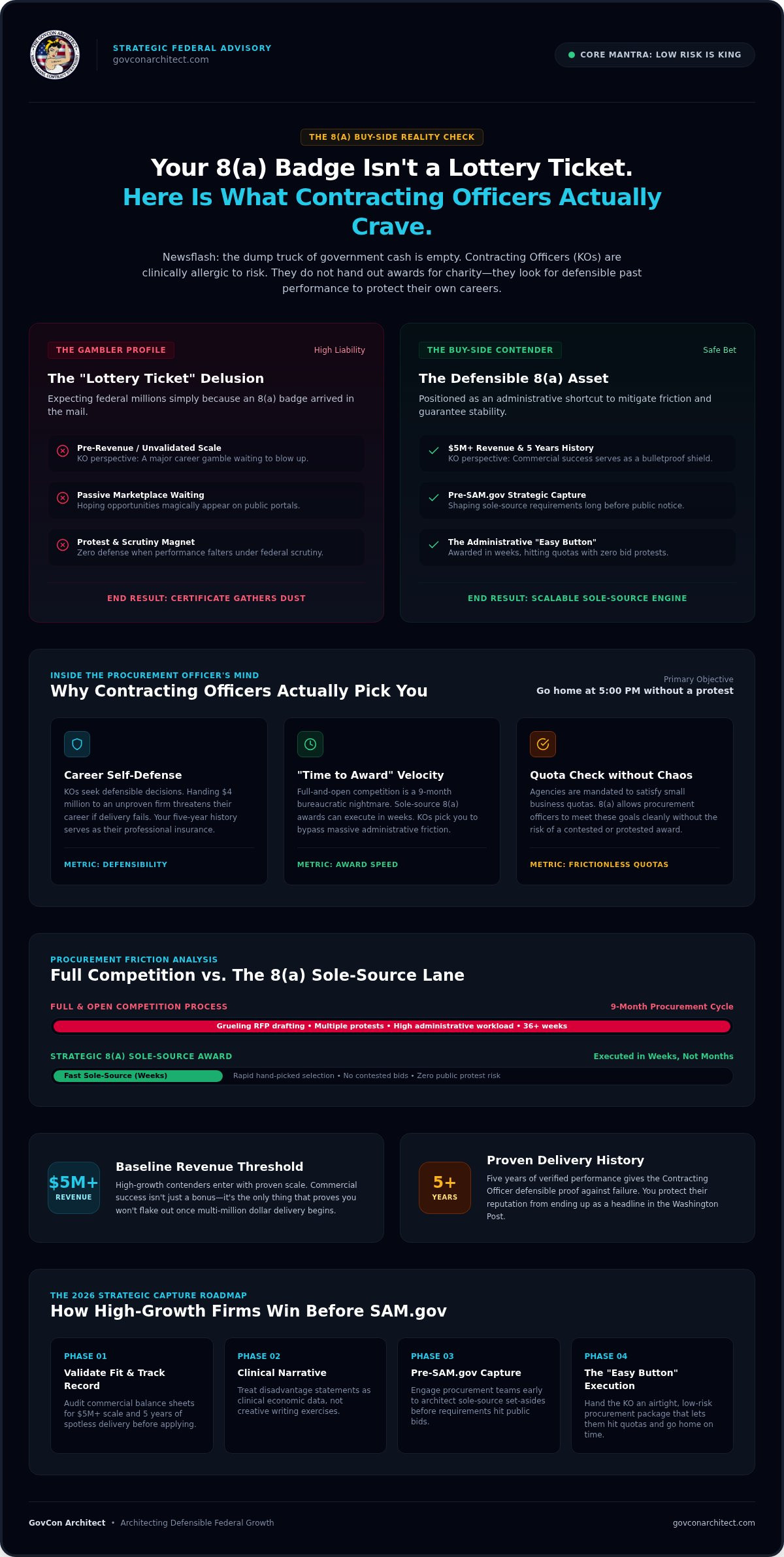
Contracting Officers (KOs) are clinically allergic to risk. If you have $5 million in revenue and five years of proven delivery, you're a safe bet. If you’re pre-revenue, you’re a gamble. High-growth firms succeed because they already know how to deliver; a solid 8(a) certification federal contracting strategy just gives them a faster lane. Before you dive in, you need to know what do you need to bid on a federal contract to ensure your foundation is actually solid and won't crumble under the first sign of scrutiny.
The "Buy-Side" Mantra: Understanding the Government’s Motivation
The 8(a) Business Development Program wasn't created because the government felt like being charitable. It exists as an administrative "Easy Button." KOs use it to bypass the grueling full-and-open competition process while still meeting their small business goals. From the Buy-Side, the 8(a) is a risk-mitigation tool. It allows them to hand-pick a competent firm without a nine-month procurement cycle. They want to go home at 5 PM without a protest on their desk. If you don't position yourself as that low-risk solution, you're just another firm with a useless certificate gathering dust.
The Buy-Side Secret: How KOs Use 8(a) to Mitigate Risk
KOs don't wake up wanting to give you money. They wake up wanting to avoid a mess. The SBA 8(a) Business Development Program isn't a social program in the eyes of a procurement officer; it's a shortcut through the bureaucratic nightmare of full-and-open competition. When a KO chooses an 8(a) firm, they're choosing speed and reduced administrative friction. A sole-source award can happen in weeks, not months. That "Time to Award" metric is how they're measured. If you align your 8(a) certification federal contracting strategy with their need for efficiency, you stop being a beggar and start being a partner. It’s about making their job easier, which, frankly, is the only reason they’ll ever pick up your call.
Thinking Like a Government Buyer
Your certification is a tool to solve their procurement headache. They see a way to satisfy small business quotas without the risk of a massive, contested bid. It’s about more than just eligibility; it's about being the safe choice. You need to master a low risk bidder strategy to show them you won't flake out once the contract starts. They want to know that if they hand you $4 million, the project won't end up as a headline in the Washington Post. Your job is to provide that peace of mind.
Risk Evaluation: The Hidden Mechanics
KOs look for defensible decisions. If you have five years of commercial delivery and $5M+ in revenue, you are defensible. They use your past performance as a shield against potential failure. If you're serious about scaling, you might want to get a professional set of eyes on your approach. Your commercial track record is your greatest asset in proving that low risk is king. It’s the difference between being a high-growth contender and just another name in a database. I care about your success, but you have to give the KO a reason to trust you.
How to Get 8(a) Certified: The Strategic Roadmap for 2026
Applying for the program without a plan is a death sentence for your time. Your 8(a) certification federal contracting strategy starts long before you log into the SBA portal. First, validate your "Fit." If you aren't hitting $5M+ in revenue with 5+ years of delivery, you're likely not ready to handle the scale the government expects. Second, the "narrative" for social and economic disadvantage isn't a creative writing exercise. It’s a clinical demonstration of how specific obstacles impacted your business growth. If you can't back it up with data, don't submit it. I care about your success, but I won't watch you waste a year on a fantasy.
Precision is mandatory. The 1010-series forms require surgical accuracy. One discrepancy in your ownership structure or financial history can trigger a rejection that sidelines you for a year. Finally, your 8(a) Business Plan is your roadmap for the next nine years. Treat it like the high-stakes operating manual it is, not a school project you finished at 2 AM. A successful 8(a) certification federal contracting strategy requires you to be a stable asset before the government ever sees your name.
The "Fit" Check: Are You Ready for the 8(a) Program?
Stop looking for a "30-day shortcut." They don't exist in a system designed to weed out the weak. If you're hunting for a quick badge to save a failing firm, you’ve already lost. High-growth firms use this time to conduct a Federal Bid Readiness Assessment to ensure their internal systems can actually handle a federal audit. You need to be elite before you even think about applying.
Pre-Certification Strategy: The "Before" Phase
Low risk is king. This mantra applies to your application as much as your bids. Under FAR Subpart 19.8 governing 8(a) contracting, the government needs to see that you are a responsible entity. This means your financial responsibility, including lines of credit and clean balance sheets, must be bulletproof. You are proving to the SBA, and eventually the KO, that you won't vanish mid-contract. It's about structural integrity, not just eligibility.
Scaling Your Win Rate: Using 8(a) to Dominate the Market
Winning in the federal market isn't about being the loudest voice in the room; it's about being the most reliable one. If you're waiting for opportunities to hit SAM.gov, you've already lost to the firm that spent six months building the requirement with the KO. A sophisticated 8(a) certification federal contracting strategy prioritizes capture management over reactive bidding. You need to leverage your status to get in front of buyers before the solicitation is drafted. This is where a federal procurement insider strategy becomes your competitive moat. It’s about being the solution they didn't know they needed yet. I’m here to make sure you don't just participate; I want you to take over.
The Post-Certification Sprint
Your first 12 months in the program are a high-stakes race. KOs are watching to see if you're a serious player or just a certificate collector. You need to align your responses perfectly with Sections L and M of the RFP, using your 8(a) status to simplify their evaluation process. This isn't the time for guesswork. Engaging a Fractional Federal Strategy Advisor: Monthly Retainer Support ensures your growth is structured and defensible. We focus on the long-term architecture of your win rate, not just the next bid. Speed is good, but stability is what gets you paid.
Winning the Sole-Source
The "Buy-Side" conversation is an art. You don't ask for a sole-source because you "earned" it; you offer it because it mitigates the agency’s risk. Position your firm as the logical choice that saves them nine months of procurement drama. When you execute a Capture & Proposal Sprint...Win that Bid, you aren't just writing a document; you're proving that low risk is king. Show them that picking you is the safest decision they'll make all year. I care about your bottom line, and that means playing the game at an elite level.
Architecting Your Federal Dominance
You didn't build a $5 million firm by chasing lottery tickets, so don't start now. The 8(a) program is a high-stakes risk-mitigation vehicle, not a participation trophy. By centering your 8(a) certification federal contracting strategy on the "Buy-Side" perspective, you position your firm as the low-risk solution that Contracting Officers are desperate to find. We've covered the roadmap from clinical application precision to aggressive capture management. It’s about being a stable asset that makes the government’s job easier. You have the delivery history; now you just need the specialized, no-fluff strategy to weaponize it.
I’ve spent 22 years on the Buy-Side watching firms fail because they lacked a reality check. You don’t have to be one of them. I specialize in helping $5M+ commercial firms navigate this complex system with professional sobriety. Let’s build a federal presence that is structurally sound and ready for 2026. You’ve put in the work to grow this far; let's make sure the government sees exactly why low risk is king. You’ve got this.
Frequently Asked Questions
What is the revenue requirement for 8(a) certification in 2026?
The SBA doesn't set a hard minimum revenue for the 8(a) program, but for firms serious about a high-growth 8(a) certification federal contracting strategy, the $5M revenue mark is the point where you actually become a low-risk asset. If you’re pulling in less, you’re often just a liability in the eyes of a Contracting Officer. We focus on established firms because they have the structural integrity to handle federal delivery without collapsing.
How long does it actually take to get 8(a) certified for established firms?
Expect the administrative slog to take anywhere from six to twelve months once you hit submit. However, the real work happens during the "Before" phase where you clean up your financials and past performance narrative. There are no 30-day shortcuts here. If you want to win, you have to play the long game. We recommend a 6 to 12-month runway to ensure your strategy is bulletproof before the clock starts ticking.
Can I get 8(a) sole-source contracts immediately after certification?
Technically, yes, but only if you did the capture work months ago. Sole-source awards don't just fall from the sky because you have a new badge. You need to position yourself as the logical, low-risk choice long before the requirement hits the street. KOs use the 8(a) program as an "Easy Button" to avoid friction. If you haven't built trust yet, your certification is just a piece of paper gathering digital dust.
Is the 8(a) certification worth it for firms already doing $10M+ in commercial revenue?
It’s not just worth it; it’s a strategic multiplier. Firms with $10M+ in revenue are exactly what the government wants: stable and low risk. At this level, your 8(a) certification federal contracting strategy becomes a surgical tool to bypass competitions and secure sole-source awards. You already have the delivery engine. Now you’re adding a fast lane. It’s about scaling your commercial success into a predictable federal revenue stream without the usual bureaucratic headache.
What are the most common 8(a) application mistakes that lead to disqualification?
Most firms fail because of sloppy 1010-series forms or a "narrative" that reads like a bad novel instead of a clinical business case. Discrepancies in ownership control and lack of financial responsibility are the primary killers. The SBA needs to see that you are a responsible entity that won't flake out mid-contract. Precision is mandatory. If your paperwork doesn't show that low risk is king, they’ll toss your application immediately.