
Government Contract Competitive Analysis: A Strategic How-To for Commercial Firms

About the Author, Nikki Gianni
Nikki Gianni is a seasoned business strategist and government contracts coach, dedicated to helping businesses successfully navigate the complexities of government contracting. With over 22 years of experience in Department of Defense contracting, including managing $20 billion in federal awards, Nikki has developed the innovative GovReady Blueprint™ Framework, a comprehensive 90-day program designed to prepare businesses to compete for and win lucrative contracts at the federal, state, and local levels. Nikki's approach emphasizes not just gaining contracts but also enhancing overall business profitability.
Before becoming a business owner, Nikki was active-duty Air Force for 10 years, then spent another 15 years as a civil servant with the DOD. Now she's an empty nester living in Southern California who loves spending time with her 22-year-old son, Lex and her 2 Mini Aussies, doing home improvement and crafts projects, and networking.
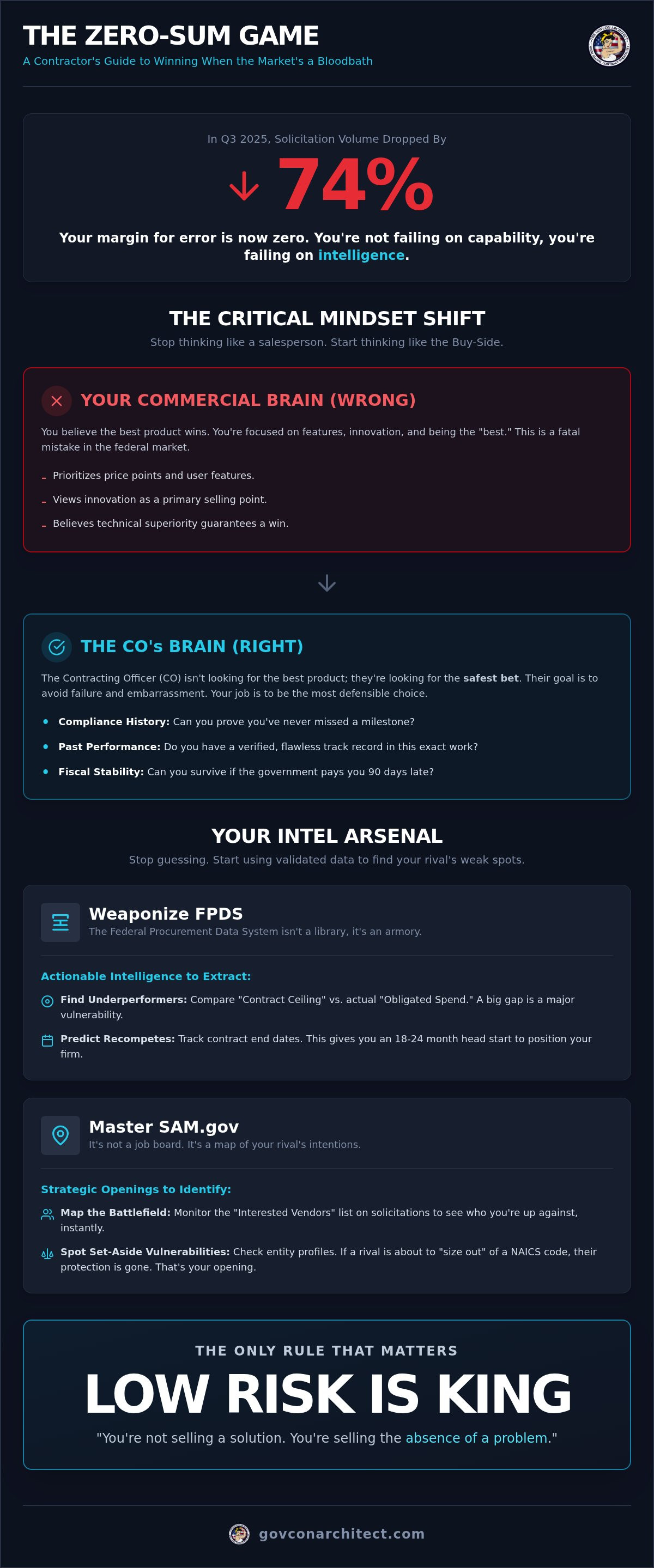
The federal market isn't just getting tighter. It's a zero-sum game of risk mitigation. In the third quarter of 2025, solicitation volume dropped by a staggering 74 percent. This means your margin for error has effectively vanished. To survive, your government contract competitive analysis must move beyond basic tracking. If you're still losing to incumbents despite having superior technology, you aren't failing on capability. You're failing on intelligence.
You likely feel that some bids are "wired" for a specific firm long before the RFP hits the street. It's a common diagnosis in this high-stakes environment. To win, you must master a clinical process that identifies exactly why a Contracting Officer perceives your rival as the safer bet. This isn't about hope. It's about data-driven positioning.
This guide provides a repeatable framework for federal market intelligence that turns competitor strengths into liabilities. We'll show you how to find reliable pricing data and identify the specific structural weaknesses in an incumbent's armor. This is the blueprint for positioning your firm as the lowest-risk choice in a $793 billion marketplace.
Key Takeaways
Stop competing on product features and start evaluating rivals through the clinical lens of Contracting Officer risk criteria.
Master the "Intelligence Stack" by leveraging FPDS and SAM.gov to extract validated, high-stakes competitor performance data.
Execute a four-step government contract competitive analysis to identify and exploit the specific structural weaknesses of incumbent firms.
Transition from raw market intelligence to tactical implementation by aligning your capture strategy with proven federal risk-mitigation standards.
Table of Contents
Beyond the Surface: What Government Contract Competitive Analysis Actually Means
The Intelligence Stack: Where to Find Validated Federal Competitor Data
The Risk-Based Framework: Evaluating the Incumbents Vulnerabilities
How to Execute a Federal Competitive Analysis in 4 Tactical Steps
From Intelligence to Implementation: Turning Analysis into a Winning Pursuit
Beyond the Surface: What Government Contract Competitive Analysis Actually Means
Most firms approach the federal market with a commercial mindset. They think the best product wins. They're wrong. In this ecosystem, being the best is secondary to being the safest. Government contract competitive analysis is not a beauty contest. It's a forensic evaluation of how a Contracting Officer (CO) perceives your rivals' ability to deliver without embarrassment.
The CO isn't looking for a partner to change the world. They're looking for a vendor who won't get them fired. If you don't understand the risk profile your competition presents, you've already lost the bid. You're competing against reputations, not just spec sheets.
The Buy-Side Reality Check
Contracting Officers operate in a high-stakes environment. Failure is public. Success is expected. They are incentivized by risk avoidance. Innovation is often seen as a liability because it introduces variables. Your intelligence gathering must focus on defensibility. You need to provide the CO with the evidence required to justify choosing you over an incumbent. Federal competitive analysis is a clinical risk-mitigation exercise designed to prove your firm is the most defensible choice for an award. The government procurement process values stability over brilliance.
Commercial vs. Federal Analysis: The Critical Split
Commercial market research prioritizes price points and user features. It's surface-level. Effective government contract competitive analysis requires a deeper dive into structural integrity. You aren't just looking at what a competitor sells. You're looking at their operational skeleton.
Compliance History: Have they missed milestones on previous task orders?
Past Performance: Do they have a verified track record in this specific NAICS code?
Fiscal Stability: Can they float the payroll for 90 days if the government delays payment?
You also have to account for the "Invisible Competitor." This is the firm that doesn't show up in your standard market scans but has spent years building agency affinity. They are the baseline for risk. Your job is to shift that baseline. If you can't identify why the CO trusts them more than you, your proposal is just noise. You aren't selling a solution. You're selling the absence of a problem.
The Intelligence Stack: Where to Find Validated Federal Competitor Data
Intelligence is not an accident. It is the result of a methodical data extraction process. While agencies like the GAO provide high-level spending reports, they don't help you win specific pursuits. You need granular data. You need the Intelligence Stack. Successful government contract competitive analysis requires moving beyond surface-level summaries to find the raw truth of how your rivals operate.
Weaponising FPDS for Competitor Profiling
The Federal Procurement Data System (FPDS) is your most vital asset. It holds the raw history of every contract action. With the current FPDS interface updates for 2026, the system is more responsive, but the data remains complex. Use NAICS codes to filter for specific rival activity. Don't just look at the award amount. Look at the "Contract Ceiling" versus the actual obligated spend.
If a rival has a $50 million ceiling but only $10 million spent with six months left, they are underperforming. That is a vulnerability. Tracking end dates is equally critical. It allows you to predict recompete windows 18 to 24 months in advance. This is where your market research and competitive analysis must begin. If you aren't tracking when a rival's contract expires, you're reacting, not leading. You're already behind.
SAM.gov: Beyond Opportunity Tracking
SAM.gov is often misused as a simple job board. For an elite strategist, it's a map of intent. Monitor the "Interested Vendors" list on active solicitations. This is your first look at who you are up against. Check entity profiles for changes in small business status. If a rival is about to "size out" of a specific NAICS code, they are about to lose their set-aside protection. That is your opening.
Note the current SAM.gov data export limitations. You cannot rely on bulk downloads for deep analysis. You must be surgical. Evaluate how often a competitor engages in pre-solicitation activities like Industry Days or RFIs. High engagement signals a bid that may be "wired" for them. Low engagement signals a target of opportunity for you.
USASpending.gov provides the visual flow of federal dollars. It helps you see which sub-agencies are funneling money to specific rivals. For deeper forensic work, Freedom of Information Act (FOIA) requests are the tactical heavy lift. They can uncover redacted proposal details or previous pricing structures. If the data feels overwhelming, our Monthly Retainer Support provides the ongoing intelligence required to stay ahead of the curve. You need more than data; you need a diagnosis.
The Risk-Based Framework: Evaluating the Incumbents Vulnerabilities
The incumbent is your primary obstacle. In the federal ecosystem, the incumbent represents the status quo. They are the baseline for risk. To win, you don't just need to be better. You must prove that staying with them is more dangerous than switching to you. This is the core of a sophisticated government contract competitive analysis. You aren't just looking for what they do well. You're looking for structural cracks.
Performance gaps are rarely advertised. Since you can't access a rival's private CPARS (Contractor Performance Assessment Reporting System) files, you must look at public proxies. Look for "stop-work" orders in the data. Scan for contract modifications that reduced scope. These are clinical indicators of failure. If an incumbent has high key personnel turnover, they're bleeding institutional knowledge. A Contracting Officer sees a departing Project Manager as a red flag. Use that. If the team that won the work isn't the team doing the work, the risk profile has changed.
The Incumbents Dilemma
Complacency is a silent killer in federal contracting. Many incumbents stop innovating once they have the award. They rely on "safe" but outdated technological debt. This is your entry point. If their solution is based on legacy systems from years ago, emphasize the security risks of their stagnation. You aren't just offering new tech. You're offering a path away from their obsolescence.
GAO protest records are another diagnostic tool. They don't just track who won or lost. They document exactly where an incumbent's internal processes failed under scrutiny. If a rival has a history of "corrective actions" after a protest, they have a documented weakness in their proposal or execution logic. That is a vulnerability you can exploit in your own win themes. It proves their internal systems are prone to error.
Pricing Intelligence: The Race to the Realistic Bottom
Price to Win (PTW) is not a race to be the cheapest. It's a race to be the most credible. Use GSA schedules to identify the "floor" pricing for your competitors. This tells you their minimum viable margin. If a rival is "buying the work" by bidding significantly below their established GSA rates, they're creating a performance risk. They'll eventually have to cut corners to stay profitable.
Contracting Officers are wary of low prices that don't align with the Statement of Work. In a market where federal contract spending reached $793 billion in FY 2025, the government isn't just looking for savings. They're looking for execution. If you undercut a rival too aggressively, you signal that you don't understand the mission. Your government contract competitive analysis should help you find the "realistic bottom." This is the price point that's low enough to be competitive but high enough to be defensible. Position your price as an investment in stability, not a bargain-bin gamble.
How to Execute a Federal Competitive Analysis in 4 Tactical Steps
Data is noise until it's processed. Executing a government contract competitive analysis requires more than a spreadsheet. It requires a clinical workflow that moves from raw numbers to tactical positioning. If you don't have a repeatable process, you're just guessing. In a market where solicitation volume is down 74 percent, guessing is a luxury you can't afford.
Step 1 & 2: Data Aggregation and Profiling
Start by defining the landscape. Use NAICS codes for the broad industry and PSC codes for specific task precision. Selecting the correct PSC code is the only way to isolate specific service delivery from broad industry noise. Once filtered, build a competitor matrix. Focus on the top three rivals who show the highest agency affinity.
You are looking for "Agency Capture." This occurs when a specific firm has embedded itself so deeply into a sub-agency that they've become the default choice. Track their award volume over the last three fiscal years. If their obligations are increasing while their performance metrics are stagnant, they are ripe for a challenge. You need to know who owns the relationship before you try to disrupt it.
Step 3 & 4: Shadow Evaluation and Ghosting
The most effective way to beat a rival is to grade them. Conduct a "Shadow Evaluation" using the RFP Section M criteria. This is the CO's scorecard. If you were the evaluator, where would you find risk in your competitor's past performance? Do they have a history of cost overruns? Are they struggling with key personnel turnover? Document these gaps. They are the foundation of your capture strategy.
Finally, synthesize this intelligence into a "Ghosting" strategy. Ghosting is the art of highlighting your strengths while subtly exposing a rival's weaknesses without ever naming them. If you know the incumbent is using outdated legacy systems, you emphasize your "modern, low-maintenance architecture" as a risk-reduction theme. You make the CO worry about the rival's flaws by making your own stability undeniable. This tactical approach to government contract competitive analysis transforms raw intelligence into a defensive shield for your proposal. For firms needing a deep dive on a specific contract, our Per-Pursuit Project Support provides the surgical analysis required to win.
From Intelligence to Implementation: Turning Analysis into a Winning Pursuit
Analysis is a tool, not a trophy. If your government contract competitive analysis stays buried in a PDF on a shared drive, you've wasted your resources. Capture is the implementation phase of intelligence. It's where you align your pursuit team with the clinical "Low-Risk" criteria that Contracting Officers actually use to justify an award. In a market where the federal government committed $793 billion for contracts in FY 2025, the stakes are too high for passive observation. You must turn data into a tactical advantage.
The Reality of Pursuit Management
Competitive intelligence often delivers a hard truth: the RFP is "wired" for a specific rival. This is a diagnosis, not a defeat. When your analysis reveals a requirement set that only the incumbent can meet, you must pivot immediately. You have two tactical options. You can team with the rival as a subcontractor to gain an agency footprint. Or, you can make the most difficult decision in capture: the "No-Bid."
Using intelligence to walk away saves your B&P budget for targets where you have a structural advantage. Most firms fail because they pursue every solicitation with equal effort. Elite firms use data to filter for winnable work. If the incumbent has perfect past performance and a deep relationship with the CO, and you lack a disruptive "risk-reduction" angle, don't bid. You aren't losing an opportunity. You're preserving resources for a fight you can actually win. Strategy is as much about what you don't do as what you do.
Partnering for the Win
High-stakes bids require more than internal assumptions. They require verification from someone who has sat on the other side of the table. An elite advisor provides a buy-side reality check that internal teams often miss due to "capture blindness." They validate your competitive assumptions and ensure your win themes resonate with the CO’s need for professional defensibility. If your proposal doesn't provide the CO with the evidence they need to defend the award in a protest, you've failed.
Our Monthly Retainer Support ensures your firm never misses a competitor move. We track the shifts in the landscape so you can focus on service delivery. For specific, high-value opportunities, surgical analysis is non-negotiable. You need to know exactly how the evaluator will score your rival's weaknesses. You must ensure your next bid is defensible with Per-Pursuit Project Support. Analysis is the foundation. Capture is the result. Stop guessing and start winning through clinical precision.
Secure Your Position as the Safest Bet
Winning in the federal market requires a fundamental shift in perspective. You've seen that raw data is useless without a clinical framework. Successful government contract competitive analysis isn't about tracking every move your rival makes; it is about diagnosing why a Contracting Officer perceives them as lower risk than your firm. You must move from passive intelligence to aggressive, data-driven capture.
The federal ecosystem is unforgiving to those who rely on commercial marketing fluff. It demands structural integrity and procedural precision. With 22 years of buy-side experience, we understand the hidden mechanics of federal evaluation. We specialize in low-risk bidder strategy, providing the professional sobriety needed to win high-stakes contracts. You don't need more hope. You need a defensible path to award that survives the scrutiny of a protest.
The margin for error is gone. It's time to stop reacting to the market and start architecting your own success. Your firm has the capability; now you need the clinical advantage to prove it.
Stop guessing and start winning with a GovCon Strategic Advisory Retainer
Strategic Intelligence: Frequently Asked Questions
How do I find out who won a specific government contract?
Search FPDS.gov or USASpending.gov using the solicitation number or the specific agency name. Contract awards are public record. These platforms provide the awardee name, the total obligated value, and the period of performance. Don't rely on third-party aggregators if you need raw, unmanipulated data for a clinical assessment.
What is the best tool for government contract competitive analysis?
The best tool is a methodical intelligence stack rather than a single platform. You must use FPDS for historical award data and SAM.gov for active pursuit tracking. Integrating these sources into a formal government contract competitive analysis framework is the only way to move from raw data to actionable win themes.
Can I see a competitor’s actual proposal through FOIA?
You can request a proposal through the Freedom of Information Act, but expect heavy redactions. The government protects proprietary technical secrets and specific labor rates under Exemption 4. You'll likely receive the table of contents, executive summary, and general management plan. It's a tactical heavy lift that provides a glimpse into their structural approach.
How much does it cost to do a proper federal competitive analysis?
The cost is measured in the risk of failure versus the investment in intelligence. Proper analysis requires either significant internal labor hours or specialized external advisory. Wasting a massive bid and proposal budget on a pursuit you never had a chance to win is the real cost of skipping this clinical process.
What are NAICS codes and why do they matter for competitor research?
NAICS codes are the classification system used to group industries for federal procurement. They are the primary filter for competitor research. If you don't know which codes your rivals dominate, you can't accurately assess their agency affinity or market share. Precision here prevents your team from wasting effort on irrelevant data sets.
How do I know if a government contract is "wired" for an incumbent?
A "wired" RFP often contains technical specifications that mirror an incumbent's proprietary solution or legacy architecture. Look for exceptionally short response windows or requirements for specific past performance that no outsider could realistically possess. If the solicitation feels like a biography of your competitor, the award is likely pre-determined.
Is it legal to track competitor pricing in federal contracting?
Tracking competitor pricing is perfectly legal when using public data sources. GSA Advantage and the CALC tool provide transparent looks at labor rates and schedule pricing. Ethical government contract competitive analysis relies on these public records to determine the realistic price to win without violating any procurement integrity regulations.
How often should I update my competitive intelligence profile?
Update your intelligence profiles quarterly at a minimum. Federal priorities and competitor certifications shift rapidly within the fiscal year. For high-priority bids, you need a per-pursuit update to account for recent incumbent performance failures or new teaming arrangements. Stale data is a liability in a high-stakes environment.