
Government Bid Protest Prevention Strategy: A Strategic Checklist

Article by
Nikki Gianni
Nikki Gianni is a seasoned business strategist and government contracts coach, dedicated to helping businesses successfully navigate the complexities of government contracting. With over 22 years of experience in Department of Defense contracting, including managing $20 billion in federal awards, Nikki has developed the innovative GovReady Blueprint™ Framework, a comprehensive 90-day program designed to prepare businesses to compete for and win lucrative contracts at the federal, state, and local levels. Nikki's approach emphasizes not just gaining contracts but also enhancing overall business profitability.
Before becoming a business owner, Nikki was active-duty Air Force for 10 years, then spent another 15 years as a civil servant with the DOD. Now she's an empty nester living in Southern California who loves spending time with her 22-year-old son, Lex and her 2 Mini Aussies, doing home improvement and crafts projects, and networking.
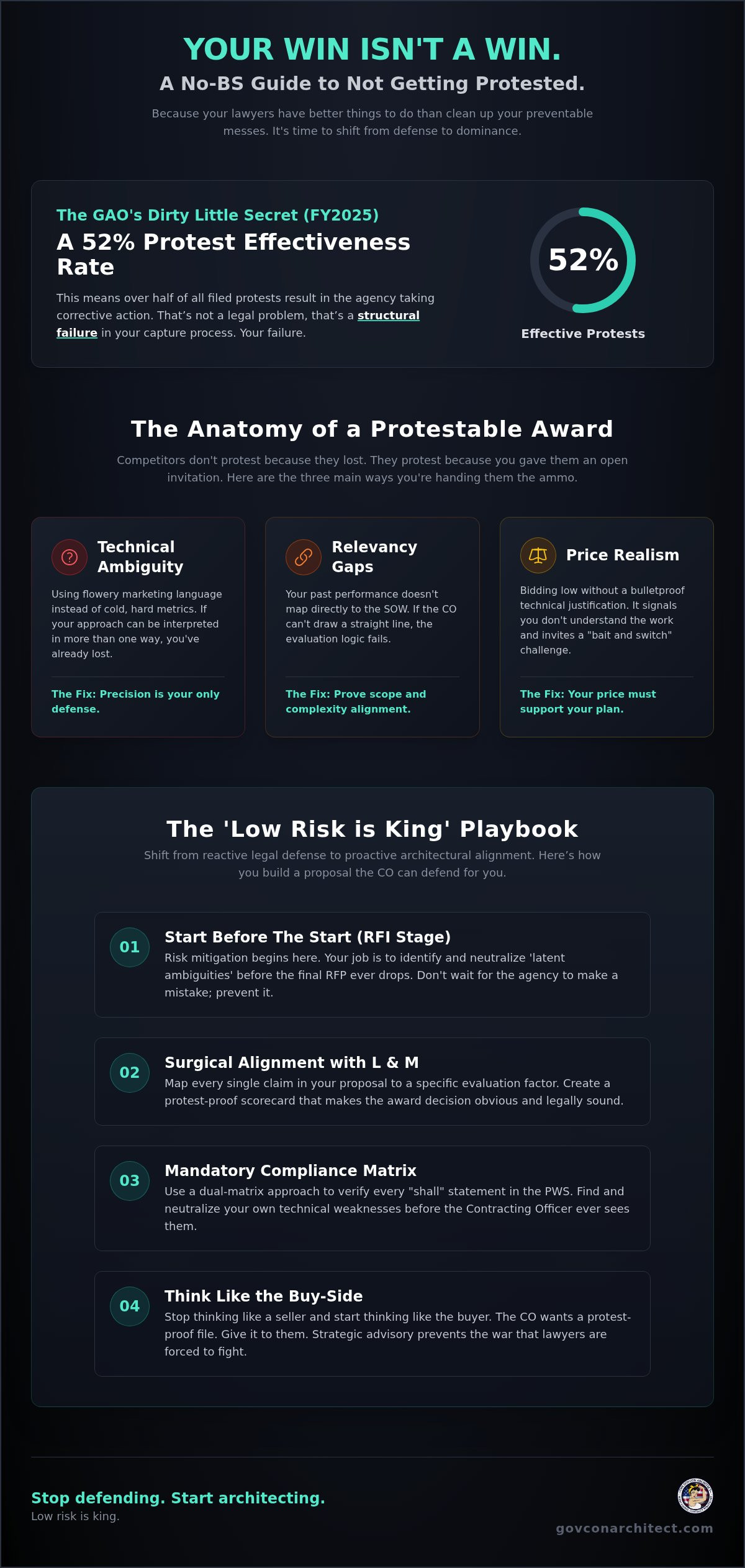
Your win isn't a win until the performance period begins. In fiscal year 2025, the GAO reported a 52 percent protest effectiveness rate. This means over half of all filed protests resulted in the agency taking corrective action or the GAO sustaining the challenge. For most firms, a protest is a legal crisis. For the elite, it's a predictable failure of the capture process. Implementing a robust government bid protest prevention strategy is the only way to protect your hard-won revenue from technicalities and unreasonable evaluation claims.
You've likely felt the sting of a delayed contract start or the drain of high legal fees while defending an award. It's a high-stakes environment where a single minute can result in a dismissal. We'll show you how to shift from reactive defense to proactive risk mitigation. This briefing provides a strategic checklist designed to make your proposals defensible and lower your risk profile in the eyes of the Contracting Officer. We're moving past the "hope for the best" approach to a clinical, insider-driven methodology for a clean award.
Key Takeaways
Protests are a symptom of an indefensible evaluation. If your proposal logic is structurally unsound, you have already lost the contract.
Risk mitigation begins at the RFI stage. Identifying latent ambiguities before the final RFP closes eliminates the grounds for future legal challenges.
A successful government bid protest prevention strategy requires surgical alignment with Sections L and M. Map every claim to a specific evaluation factor to create a protest-proof scorecard.
Rigorous compliance is mandatory. Use a dual-matrix approach to verify every "shall" statement and neutralize technical weaknesses before the CO sees them.
Shift your perspective from legal defense to buy-side architectural alignment. Strategic advisory prevents the war that lawyers are forced to fight.
Table of Contents
Why Bid Protests Are a Structural Failure, Not a Legal One
A bid protest is not an inevitable legal hurdle. It is a symptom. It signals that your proposal or the resulting evaluation was structurally unsound. Competitors don't just protest because they lost. They protest because you gave them a reason to win in the courtroom. A successful government bid protest prevention strategy treats the proposal as a technical blueprint, not a marketing document. If the logic is brittle, the award will break.
The U.S. Government Accountability Office (GAO) adjudicates based on the written record. If the Contracting Officer (CO) cannot point to a clear, documented rationale for your selection, the file is defenseless. You aren't just selling to a customer. You're building a legal case for your own victory. The CO wants a protest-proof file as much as you do. They want to award the contract and start the work. When you provide a proposal that is difficult to evaluate, you force them into a position of vulnerability.
Prevention begins in the pursuit phase. This happens months before the RFP hits the street. If you're waiting for the final solicitation to think about defensibility, you're already behind. You must identify the "protest triggers" early. This requires an insider's understanding of how the buy-side perceives risk. You must become a low-risk bidder long before the evaluation begins.
The Anatomy of a Protestable Award
Logic gaps are the primary entry point for protesters. In fiscal year 2025, unreasonable technical evaluations remained a top reason for sustained protests. These failures usually fall into three distinct categories:
Technical Ambiguity: Using flowery language instead of precise metrics. If your approach can be interpreted in multiple ways, you've invited a challenge. Precision is the ultimate defense.
Relevancy Gaps: Past performance that doesn't map directly to the Statement of Work. If the CO can't prove the work is similar in scope and complexity, the evaluation logic fails.
Price Realism: Bidding low without technical justification. If your price doesn't support your staffing plan, it signals a lack of understanding. It's a "bait and switch" risk that competitors will exploit.
The Cost of Reactive Defense
Waiting for a protest to hire a lawyer is a failed strategy. It's too late. The damage is already done. Strategic advisory is the preventative measure that saves on future legal costs. Consider the actual impact of a reactive posture:
Unnecessary Burn: Legal fees for a protest defense are pure overhead. They don't improve your solution or build your brand.
Time-to-Revenue: A protest triggers an automatic stay of performance. Every day spent in litigation is a day of lost revenue. For many firms, this delay lasts 100 days or more.
Reputational Risk: Agencies hate delays. If your award is constantly embroiled in protests due to technicalities, you become a "high-risk" partner. The CO will remember the headache, not the win.
Pre-Award Tactics: Winning Before the RFP Closes
The win doesn't happen at the award ceremony. It happens months earlier during the RFI and Draft RFP stages. Most contractors treat these early documents as administrative noise. They are actually the foundation of a successful government bid protest prevention strategy. If you wait for the final solicitation to address flaws, you've already lost the legal high ground. You must identify and clarify "Latent Ambiguities" before the RFP closes. A latent ambiguity is a hidden defect in the solicitation that only becomes apparent after the award. Waiting to challenge it later is a recipe for dismissal.
Timeliness is the most unforgiving rule in the federal market. The GAO Bid Protests forum enforces strict deadlines. Protests based on solicitation improprieties must be filed before the bid opening or the closing date for proposals. If the agency's requirements are vague, biased, or contradictory, you must act. This might mean filing a pre-award protest to correct a flawed solicitation. It's a strategic move to ensure the competition is fair and the evaluation is defensible from the start.
Engaging the Draft RFP
The Draft RFP is your chance to audit the agency's logic. Look for evaluation criteria that are "ripe for protest." These are often subjective terms that allow for inconsistent scoring. If Section M is vague, the CO's evaluation will be vulnerable to "unreasonable technical evaluation" claims. Request clarifications that force the CO to define their scorecard. Ensure the requirements reflect your unique, low-risk strengths. You're not just asking for help; you're de-risking the entire pursuit. Professional Per-Pursuit Project Support ensures these clarifications are handled with strategic precision.
The Q&A as a Strategic Tool
The Q&A process is a battlefield, not a help desk. Use it to build an administrative record that favors your firm. Draft questions that highlight competitor weaknesses without ever mentioning their names. If a competitor's pricing model is unsustainable, ask for clarification on price realism. If their technical approach relies on unproven methods, ask for strict "Key Personnel" experience requirements. Every answer the CO provides becomes part of the record. This record is what the GAO will review if a protest is filed. By forcing the agency to clarify its interpretation early, you box out the grounds for a competitor's future challenge. You are creating a protest-proof environment before the first proposal page is even written.
De-Risking the Evaluation: Aligning with Section L & M
Section L tells you how to pack the box. Section M tells you how the box is graded. Most firms fail because they write to the instructions in Section L but ignore the scoring criteria in Section M. This disconnect is where competitors find their "unreasonable evaluation" arguments. A clinical government bid protest prevention strategy requires a one-to-one mapping of every technical claim to an evaluation factor. If a claim doesn't directly support a scoring element, it's noise.
Evaluators are often overwhelmed and under-resourced. They are reading dozens of proposals under tight deadlines. If you force them to hunt for information, they'll miss it. Or worse, they'll interpret it incorrectly. Structural clarity eliminates "Evaluator Fatigue." You must provide the exact language the Contracting Officer (CO) needs for the Source Selection Decision Document (SSDD). If the SSDD is weak, the award is vulnerable. As noted in the Bid Protest FAQs, agencies are legally bound by the evaluation scheme disclosed in the RFP. If your proposal doesn't mirror that scheme, the agency's evaluation of your bid cannot be defended.
Structural Integrity in Proposal Writing
Mirror the solicitation language exactly. If the RFP asks for a "Quality Control Plan," don't call it a "Performance Excellence Strategy." Intentional mirroring prevents misinterpretation claims during the evaluation. Use explicit cross-referencing between your technical and cost volumes to ensure total consistency. A single discrepancy in labor hours between volumes is a protest trigger that competitors will exploit. Our solution meets the Low-Risk threshold for Factor 1 by utilizing a 100% verified staffing model that matches the labor categories defined in Section L.
Past Performance as a Shield
Relevancy is not a suggestion; it's a metric. Define your past performance relevancy more strictly than the RFP requires. Don't just say you did the work. Provide verified data points including contract value, period of performance, and specific SOW matches. This leaves no room for evaluator discretion. If you have negative CPARS, don't hide them. Address them with a proactive narrative that explains the mitigation and corrective actions taken. Neutralizing a weakness is better than letting a competitor weaponize it during a protest. You are building a record of stability that is difficult for any "interested party" to challenge.
The Executive Checklist for Protest-Proof Proposals
Submission is not the end. It is the beginning of the evaluation phase. Before you transmit your files, you must perform a cold, clinical audit. A successful government bid protest prevention strategy requires an executive-level checklist that looks for structural vulnerabilities. You are looking for reasons to disqualify yourself. If you don't find them, your competitors certainly will.
Start with a Compliance Matrix. This is binary. Every "shall," "must," and "will" in the RFP must be addressed with specific evidence. Do not rely on narrative fluff. Map the requirement to the page and paragraph. If the evidence is missing, the proposal is non-compliant. Protesters love non-compliance. It is the easiest path to a sustained protest because it removes agency discretion. The U.S. Government Accountability Office (GAO) rarely grants leeway on mandatory requirements.
Next, build a Risk Matrix for your own solution. Identify your technical weaknesses. Every solution has them. If your staffing plan is lean, explain why it is sufficient. If your past performance is in a slightly different niche, bridge the gap with data. You must also apply a Competitor Lens. Red Team your proposal from the perspective of a rival's legal counsel. Where would they attack? If the logic feels thin to you, it will look like a target to them. Finally, apply the "Reasonableness" Test. The price-to-technical trade-off must be air-tight. The CO needs a clear path to justify your selection in the Source Selection Decision Document. Give them the verbatim logic they need to defend your price.
The Final Review: A Clinical Briefing
The smallest errors cause the largest delays. Verify all mandatory certifications and "Pass/Fail" items. Ensure Key Personnel resumes match the SOW requirements exactly. If the RFP requires 10 years of experience and your candidate has nine, you have created a protest trigger. Check for clerical errors in your pricing tables. A simple math mistake can signal a lack of technical understanding. This gives a protester the "unreasonable cost evaluation" ground they need to freeze your contract. For high-stakes pursuits, our Per-Pursuit Project Support provides the continuous oversight needed to catch these failures before they reach the CO.
Post-Award Debriefing Strategy
The debriefing is a tool for deterrence. Use it to signal strength. If you appear confident and your logic is sound, you discourage frivolous filings. Be professional but guarded. Answer the required questions. Do not provide extra ammunition. Your goal is to show the competition that the agency followed the rules and your win was earned. Identify the "Protest Trigger" in their behavior. If they focus on a specific technical factor, they're looking for a gap. Close it by showing the structural integrity of your approach. If you look like an easy target in the debrief, a protest is almost guaranteed.
Beyond Legal: Why Strategic Advisory Is Your Best Defense
Lawyers are trained to fight the battle once the shots are fired. Strategic advisors ensure the war never starts. If you are relying on legal counsel to save an award, your government bid protest prevention strategy has already failed. Litigation is reactive. It is expensive. It is a drain on your executive focus. A "Master Architect" operates on the buy-side of the table. They understand the hidden mechanics of the evaluation room. They know what a Contracting Officer (CO) needs to see to feel safe signing your award. You don't just need a compliant bid. You need a defensible one.
Alignment with the buy-side perspective is the ultimate protest deterrent. When your proposal mirrors the internal evaluation logic of the agency, you become the low-risk choice. This isn't about marketing fluff. It is about procedural precision. By identifying risk triggers in the pursuit phase, an advisor removes the hooks that competitors use to hang a protest. This clinical approach transforms your capture process from a gamble into a calculated victory. It requires 22 years of federal advisory experience to see the gaps that an evaluator sees. Without that perspective, you're just guessing.
Strategic Advisory vs. Legal Representation
The difference is timing and focus. Legal representation focuses on the litigation after the GAO filing. Strategic advisory focuses on the proposal before the submission. One is a cost center; the other is a revenue protector. We don't offer legal services. We offer structural integrity. Through our Monthly Retainer Support, we help firms build a culture of risk awareness. This ongoing oversight ensures that every pursuit follows a battle-tested framework. You aren't just winning a contract. You are building a reputation as a stable, low-risk partner. This is the foundation of long-term federal success. Advisory focuses on the proposal. Legal focuses on the wreckage.
Next Steps for High-Stakes Bidders
Assess your current bid readiness. Look at your last three debriefings. If the agency found "weaknesses" or "deficiencies" that you didn't see coming, your process is broken. You are vulnerable. Integrating protest prevention into your standard capture process is not optional. It is a requirement for high-level competition. You must audit your technical claims against the scorecard before the CO ever sees them. Stop betting on hope. Start relying on logic. Our Per-Pursuit Project Support provides the clinical analysis needed to de-risk your most important bids. Optimize your next pursuit with GovCon Architect and secure your revenue with an insider-driven strategy.
Secure the Performance Period, Not Just the Award
A contract award is a liability until performance begins. In a high-stakes environment, hope is not a strategy. A robust government bid protest prevention strategy ensures your proposal isn't just winning; it's defensible. You've learned how pre-award engagement and surgical alignment with Section M create a protest-proof record. Structural integrity in your technical claims is the only way to bypass "unreasonable evaluation" challenges that freeze your revenue.
Stop treating protests as a legal inevitability. They are failures of architectural alignment. By the time a lawyer is involved, you're already losing time and capital. We use 22 years of federal buy-side experience and a clinical risk evaluation methodology to audit your bid through the eyes of the Contracting Officer. Our authoritative insider strategy moves your firm from a high-risk gamble to a stable, low-risk selection. It's time to build proposals that survive the scrutiny of the GAO by being impossible to challenge from the start.
Secure your win with professional Pursuit Project Support. Your next major award deserves a foundation that cannot be shaken. Success is a choice made during capture.
Frequently Asked Questions
What is the most common reason for a government bid protest?
Unreasonable technical evaluations are the primary driver. In fiscal year 2025, the GAO cited this as a top ground for sustained protests. It occurs when an agency deviates from its own evaluation scheme. If the written record doesn't support the score, the award is vulnerable. Competitors exploit these logic gaps to freeze your contract.
Can a bid protest be prevented during the RFP phase?
Yes. Prevention is a capture function. You must identify latent ambiguities during the RFI and Draft RFP stages. Use the Q&A process to force the agency to clarify vague terms. A proactive government bid protest prevention strategy neutralizes threats before the proposal is even submitted. If the solicitation is clear, the evaluation is harder to challenge.
What is the difference between a pre-award and post-award protest?
Timing and grounds are the differentiators. Pre-award protests challenge the solicitation itself and must be filed before the closing date. Post-award protests challenge the evaluation or award decision. These are typically filed within 10 days of the award or 5 days after a debriefing. Missing these windows results in immediate dismissal by the GAO.
How does the Contracting Officer evaluate risk in a proposal?
They look for structural integrity. COs evaluate whether your technical approach is precise and your price is realistic. They want an award that is easy to justify in the Source Selection Decision Document. If your logic is thin, the risk of a protest sustain increases. They prefer bidders who provide a clean, defensible path to award.
Does hiring a strategic consultant help defend against protests?
Advisors prevent the war; lawyers fight it. Strategic advisory ensures your proposal is built on a defensible foundation. By aligning with buy-side criteria, you lower your risk profile. This makes it harder for competitors to find a technicality to exploit. We focus on the proposal's architectural alignment so you don't end up in a courtroom.
What should I do if a competitor protests my contract award?
Intervene and support the agency immediately. While the CO defends the process, you must defend your solution. Provide the evidence that proves the evaluation was reasonable. A clean award depends on a proposal that is already built to withstand legal scrutiny. Don't leave the defense entirely to the agency's counsel.
How much does a typical bid protest cost a contractor?
Costs are measured in time and capital. Beyond legal fees, you face an automatic stay of performance. This delays revenue for 100 days or more. Keeping key personnel on standby while the GAO deliberates creates a massive financial drain. Most firms fail to calculate the opportunity cost of a delayed contract start.
Is a bid protest worth the time and effort for a commercial firm?
It depends on the grounds. If the agency clearly failed to follow the RFP, a protest is a necessary tool for revenue protection. However, the GAO sustain rate was 14 percent in 2025. The goal is to be the winner who doesn't get protested. Strategic alignment is always more profitable than litigation.