

Finding Federal Teaming Partners: Low-Risk Buy-Side Strategy

Article by
Nikki Gianni
Nikki Gianni is a seasoned business strategist and government contracts coach, dedicated to helping businesses successfully navigate the complexities of government contracting. With over 22 years of experience in Department of Defense contracting, including managing $20 billion in federal awards, Nikki has developed the innovative GovReady Blueprint™ Framework, a comprehensive 90-day program designed to prepare businesses to compete for and win lucrative contracts at the federal, state, and local levels. Nikki's approach emphasizes not just gaining contracts but also enhancing overall business profitability.
Before becoming a business owner, Nikki was active-duty Air Force for 10 years, then spent another 15 years as a civil servant with the DOD. Now she's an empty nester living in Southern California who loves spending time with her 22-year-old son, Lex and her 2 Mini Aussies, Tony & Carmela, doing home improvement and crafts projects, and networking.
The wrong teaming partner can turn a credible federal bid into a risk memo with your name on it. Finding teaming partners for federal bids isn’t a networking exercise. It’s a Buy-Side risk decision. The government doesn’t award points for a crowded org chart. It wants evidence that the team can perform, comply, and deliver without creating new problems.
If you’re concerned about a partner’s compliance, need to meet a small-business set-aside requirement, or lack past performance in a new niche, take that concern seriously. A weak partner doesn’t fill a gap. It adds one, sometimes with a polished capability statement. The buyer is looking for a team that makes the work more defensible, not more complicated.
This article explains how to identify, vet, and secure partners who strengthen your bid from the government’s point of view. You’ll learn how to assess fit, verify relevant capabilities, and build a repeatable teaming strategy that supports contract performance and reduces perceived risk.
Key Takeaways
- Read the solicitation’s evaluation criteria to pinpoint capability gaps before approaching a partner. Guessing isn’t a capture strategy.
- When finding teaming partners for federal bids, prioritize verified capability, relevant past performance, and a clear fit with the requirement.
- Choose the teaming structure deliberately. A prime-subcontractor arrangement and a joint venture have different levels of complexity, so match the structure to the bid and your ability to manage it.
- A signed agreement won’t rescue a weak proposal contribution. Set clear expectations for partner data calls and technical inputs so the team presents a coherent, credible offer.
The Buy-Side Reality: Why Teaming is a Risk Mitigation Strategy
Teaming isn’t a buddy system. It’s a legal and technical framework for showing the government how your combined team will manage delivery risk. The Contracting Officer needs a defensible award and a credible path to successful performance. A partner who adds complexity without reducing a documented risk is not an asset. They’re extra paperwork with a logo.
That’s the Buy-Side reality behind why commercial success can fail in federal bids. Federal buyers evaluate evidence against the solicitation, not confidence, charm, or an impressive commercial origin story.
The “Low Risk is King” Philosophy
Past performance matters because it helps the buyer judge whether the team has delivered relevant work before. A strong partner can add evidence your firm lacks, but only if the partner’s experience matches the requirement and its role on this bid is clear. A joint venture legal structure is one formal way firms may combine capabilities, though the right structure depends on the pursuit.
Relevant partner experience may strengthen the evaluation evidence, but no partner can guarantee a rating. The solicitation’s evaluation method controls. Your proposal must connect the partner’s past results to the work this team will actually perform.
Teaming for Compliance vs. Teaming for Capability
Compliance and capability solve different problems. For a set-aside, verify that the proposed structure and roles align with eligibility and performance requirements. A partner’s status alone doesn’t make the arrangement compliant. For a capability gap, identify the missing technical expertise, experience, or other requirement, then confirm the partner can credibly supply it.
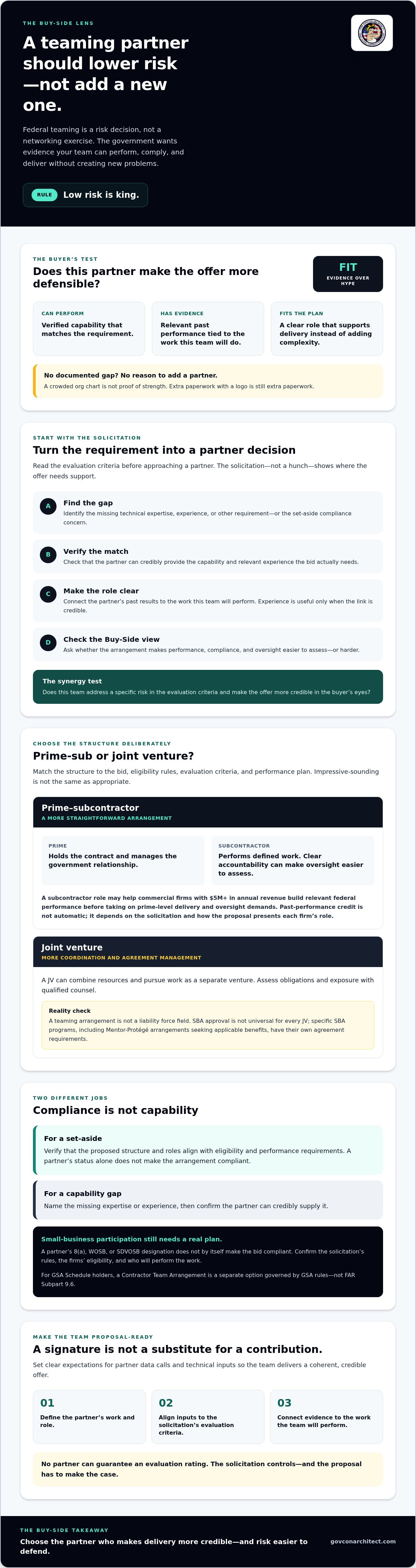
Teaming synergy means aligning two firms to address a specific risk identified in the solicitation’s evaluation criteria. That is the test for finding teaming partners for federal bids: does this partner make the offer more credible and lower risk in the buyer’s eyes? If not, keep looking.
Teaming Frameworks: Choosing Your Federal Marriage
Pick the structure that fits the requirement, not the one that sounds most impressive at a networking event. A prime-subcontractor arrangement can be a straightforward option: the prime holds the contract and manages the government relationship, while the subcontractor performs defined work. Clear accountability can make oversight easier for the Buy-Side to assess. It doesn’t erase the prime’s responsibilities or make a weak partner safe.
These arrangements sit within the contractor team framework described in FAR Subpart 9.6. For commercial firms with $5M+ in annual revenue, starting as a subcontractor may help build relevant federal performance before taking on prime-level delivery and oversight demands. Past-performance credit depends on the solicitation and how the proposal presents each firm’s role. It isn’t automatic.
Prime-Sub vs. Joint Venture: A Reality Check
A joint venture can combine resources and pursue work as a separate venture, but it brings more structural coordination and agreement management than a straightforward prime-sub relationship. Each firm should assess its obligations and exposure with qualified counsel. A teaming arrangement is not a liability force field. SBA approval isn’t a universal requirement for every JV. Specific SBA programs, including Mentor-Protégé arrangements seeking applicable benefits, have their own agreement requirements. Match the structure to the bid’s eligibility rules, evaluation criteria, and performance plan.
The Small Business Teaming Advantage
Partnering can help a team compete for opportunities involving 8(a), WOSB, or SDVOSB participation, but a partner’s designation doesn’t, by itself, make the bid compliant. Confirm the solicitation’s rules, the firms’ eligibility, and who will perform the work. For GSA Schedule holders, a Contractor Team Arrangement is a separate option governed by GSA rules, not FAR Subpart 9.6.
For the Buy-Side logic behind evaluation alignment, see this low-risk bidder strategy. If you’re finding teaming partners for federal bids and weighing structures for a live pursuit, a strategy conversation about your bid may help clarify the risks before you commit.
A Strategic How-To for Finding Teaming Partners for Federal Bids
Finding teaming partners for federal bids starts with the solicitation, not a database search. Read Sections L and M to identify the submission instructions, evaluation criteria, and requirements your firm can’t credibly meet alone. A partner should close a specific gap the government will evaluate. A polished profile that doesn’t map to the solicitation is a distraction.
- Search with purpose. Use SBA’s Dynamic Small Business Search (DSBS) to identify firms by relevant capabilities and business status. Treat search results as leads, not endorsements. The SBA contracting assistance programs page can help clarify which official programs may support small-business partnerships.
- Check the delivery record. Review SAM.gov records and, where useful, historical award data in FPDS.gov to see who has performed similar work and which firms appear alongside established competitors. A designation may matter to eligibility, but it doesn’t prove the partner can deliver.
- Stress-test execution. Check applicable exclusion or debarment records, financial stability, relevant past performance, and any required facility clearance. Ask whether the firm has the people, resources, and financial capacity to perform its proposed role. A partner should be able to support its claims with evidence, not just a list of capabilities.
- Put the deal in writing. Have qualified counsel review a teaming agreement that clearly addresses scope, responsibilities, proposal inputs, information handling, and what happens if the pursuit changes. A handshake is not a risk-control plan.
The Buy-Side Vetting Test
Don’t stop at capability keywords. Test whether the partner’s past performance supports the exact work it will perform, whether its people and resources are available, and whether its financial position can sustain its role. That’s how you make a more informed teaming decision: choose evidence and delivery capacity over wishful matchmaking.
Engineering the Win: Managing the Team for the Capture Sprint
A signed Teaming Agreement gets the relationship on paper. It doesn’t produce a compliant, persuasive proposal. The real work is coordinating people, evidence, and deadlines so the buyer sees one credible delivery team.
Start with a proposal kick-off. Assign owners for each requirement, set deadlines for partner data calls, and specify the format and evidence needed. Don’t ask for “a few technical details” and hope for brilliance. Give your partner the question, page limit, evaluation criterion, and due date. Then review the response for substantiation, consistency, and relevance before it enters the draft.
The Proposal Kick-Off: One Team, One Voice
The government evaluates the submitted offer, not the good intentions behind it. A unified proposal should explain how each firm’s role supports the same performance approach. Align terminology, commitments, and past-performance examples. Otherwise, the result reads like a Frankenstein document: technically assembled, regrettably alive, and difficult to trust.
Handle price-to-win discussions with care. Keep analysis grounded in your own independent costs, assumptions, and proposed pricing. Don’t use teaming discussions to coordinate prices, bids, customers, or market allocation with competitors. Because the facts matter, consult qualified antitrust counsel before discussing sensitive pricing or competitive information.
Positioning for the Award
The GovCon Architect’s PER-PURSUIT · PROJECT – Capture & Proposal Sprint provides targeted support for a specific federal opportunity and bid submission. Founder Nikki Gianni brings 22 years of Buy-Side experience, informing how a team’s roles, evidence, and approach can be framed against contracting-officer risk concerns. The goal isn’t simply to submit together. It’s to make the complete offer easier for the government to evaluate and trust.
Build a Team the Government Can Trust
Federal buyers aren’t looking for the most enthusiastic group photo. They’re looking for a team they can defend selecting. Finding teaming partners for federal bids means thinking past the handshake and asking whether your strategy gives the buyer a clear, credible reason to trust the award.
GovCon Architect works with commercial firms with $5M+ in annual revenue and 5+ years of proven delivery through its RETAINER · MONTHLY – Fractional Federal Strategy Advisor service. Founder Nikki Gianni brings 22 years of Buy-Side experience to the hard question behind every pursuit: what makes this team a lower-risk choice? The focus is on practical strategy for firms ready to compete, not on promising an award.
“We’ll figure it out after award” is not a strategy, however confidently it’s delivered.
You’ve already built a business capable of delivering. Give your federal strategy the same care, and show the buyer a team that’s ready for the work.
Frequently Asked Questions
Is a Teaming Agreement legally binding for a federal bid?
It can be, depending on the agreement’s language, applicable law, and circumstances. The title isn’t magic; the actual terms determine what the companies have committed to do. Define obligations, proposal contributions, and what happens if the pursuit changes, then have qualified counsel review the document. For finding teaming partners for federal bids, clarity is better than discovering your “understanding” was only understood by you.
Can I use my teaming partner’s past performance if I am the Prime?
Possibly, if the solicitation permits it and your proposal explains the partner’s relevant work and role. Don’t present their record as yours or assume evaluators will connect the dots for you. Show how the partner’s experience relates to the requirement and what work they’ll perform. The solicitation’s evaluation rules decide how that evidence counts, not the confidence level of your cover letter.
What is the difference between a Subcontractor and a Teaming Partner?
A Teaming Partner is a company collaborating with another firm on a pursuit, often under a teaming agreement. A subcontractor is a firm that performs part of the contract for the prime under a subcontract. One describes the pursuit relationship; the other describes a role in performance. A company can be both. Labels matter less than clear responsibilities, because ambiguity is a poor project manager.
Does the government have to approve my teaming partners?
There’s no blanket requirement for advance government approval of every teaming partner. FAR Subpart 9.6 requires contractor team arrangements to be disclosed in the offer, while the solicitation or contract may set additional conditions. Subcontract consent or approval can depend on the contract terms and circumstances. Check the actual documents before making assumptions.
How much of the work must the Prime contractor perform in a set-aside bid?
For service contracts set aside for small businesses, the prime must perform at least 50% of the cost of contract performance itself, excluding materials, under the applicable limitations on subcontracting rule. Don’t carry that figure over to every contract type. Confirm the solicitation and applicable clauses, then map work and costs carefully. The spreadsheet may be less exciting than the win, but it can help protect it.