
Federal Proposal Support: The Insider’s Guide to Low-Risk Bidding (2026)

Article by
Nikki Gianni
Nikki Gianni is a seasoned business strategist and government contracts coach, dedicated to helping businesses successfully navigate the complexities of government contracting. With over 22 years of experience in Department of Defense contracting, including managing $20 billion in federal awards, Nikki has developed the innovative GovReady Blueprint™ Framework, a comprehensive 90-day program designed to prepare businesses to compete for and win lucrative contracts at the federal, state, and local levels. Nikki's approach emphasizes not just gaining contracts but also enhancing overall business profitability.
Before becoming a business owner, Nikki was active-duty Air Force for 10 years, then spent another 15 years as a civil servant with the DOD. Now she's an empty nester living in Southern California who loves spending time with her 22-year-old son, Lex and her 2 Mini Aussies, doing home improvement and crafts projects, and networking.
Compliance is a baseline, not a win strategy. Most firms invest heavily in federal proposal support only to be eliminated because they look like a liability. They follow every instruction in Section L. They mirror the requirements in Section M. Yet, they still lose. The reason is clinical. The government doesn't buy solutions. It buys the absence of risk.
You know the frustration of high bid costs and stagnant win rates. It's difficult to watch commercial success fail to translate into federal contract awards. You understand the technical requirements, but the Contracting Officer’s evaluation process remains a black box. This guide shifts your focus from checking boxes to engineering a low-risk profile.
You'll learn how to align your pursuit with the internal mechanics of the buy-side. We'll break down the structural requirements for a defensible bid in 2026. This is your briefing on how to stop bidding and start winning.
Key Takeaways
- Stop treating bids as writing assignments. Architect a proposal that satisfies the internal mechanics of the federal buy-side evaluation process.
- Shift your perspective to the Contracting Officer’s lens. Their primary goal is risk mitigation, not finding the "best" solution.
- Elite federal proposal support provides a clinical diagnosis of your bid-readiness. Identify when you need strategic advisory versus simple tactical surge capacity.
- Replace hope with logic. Use a structural framework to eliminate perceived liability and build a proposal that stands up to professional scrutiny.
Defining Federal Proposal Support: More Than Just Technical Writing
Federal proposal support is not a clerical exercise. It is a structural engineering project. Most firms treat an RFP like a creative writing assignment. They focus on flow, adjectives, and marketing fluff. This is a fatal mistake. In the federal arena, the government does not want to be "sold." It wants to be reassured. True federal proposal support is the strategic alignment of your firm's internal capabilities with the government's specific risk-evaluation criteria.
You are not just filling in boxes. You are constructing a defensible narrative for the Contracting Officer (CO). A writer fixes your grammar. A pursuit strategist fixes your win probability. One is tactical; the other is mission-critical. Commercial marketing fails in this environment because it relies on persuasion. Federal procurement relies on verification. If your proposal reads like a brochure, it will be discarded as a liability.
The Core Components of Strategic Support
Compliance is your entry ticket, not your victory lap. Meeting the requirements of Section L and Section M is the absolute baseline. If you fail here, you are eliminated before the evaluation even begins. Strategic support decodes these sections to identify the hidden "win themes" that the CO actually values. Section L tells you how to package the bid. Section M tells you how you will be graded. You must architect your response to mirror the evaluation factors exactly. Risk mitigation is the primary driver behind every award decision. Your proposal must demonstrate, with clinical precision, that choosing your firm represents the lowest possible risk to the agency’s mission.
Common Failure Points in In-House Proposals
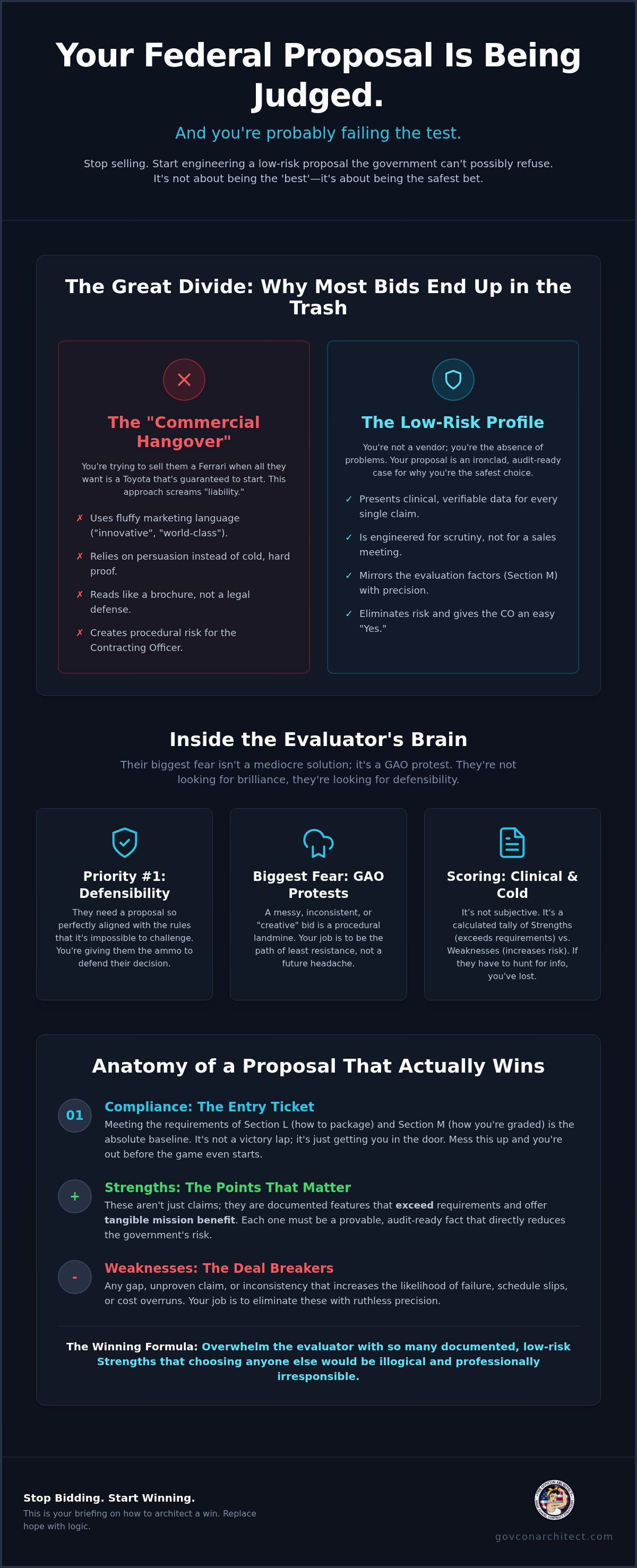
Many firms suffer from a "Commercial Hangover." They use sales-heavy language that works in the private sector but triggers red flags for federal evaluators. Words like "innovative" or "industry-leading" are meaningless without objective verification. If you can't prove it with data, don't say it. Another common failure is a lack of buy-side perspective. You must anticipate the evaluator's objections before they occur. This requires an insider's understanding of how a CO views a bid. If your past performance mapping doesn't align perfectly with the RFP requirements, you are leaving the door open for a "neutral" or "marginal" rating. You don't win on effort. You win on structural integrity and the total elimination of perceived risk.
The Contracting Officer’s Lens: How Risk Evaluation Dictates Success
The government does not award contracts to the "best" company. It awards them to the company that is hardest to fire. After you hit submit, your proposal moves into a clinical evaluation environment. Here, the Contracting Officer (CO) isn't looking for brilliance. They are looking for defensibility. With 22 years of buy-side experience, we've seen how the evaluation room actually functions. It is a tally of strengths and weaknesses based on strict procedural rules. Every sentence you write is either a point of stability or a potential liability.
Strategic federal proposal support requires an intimate understanding of these internal mechanics. Evaluators are often overworked and highly risk-averse. Their biggest fear isn't a mediocre solution; it's a GAO protest. If your proposal is messy, inconsistent, or overly creative, you represent a procedural liability. You must position your firm as the path of least resistance. This is not about persuasion. It's about providing the CO with the exact documentation they need to justify an award to your firm.
Evaluator Psychology 101
Innovation is a double-edged sword. In a federal RFP, "new" often translates to "unproven." COs value procedural sobriety. They need a proposal that follows the rules so perfectly that it's impossible to challenge in court. Scoring is not a subjective feeling. It's a calculated tally of specific factors.
- Strengths: Features that exceed requirements in a way that offers tangible mission benefit.
- Weaknesses: Any gap that increases the likelihood of failure, schedule slippage, or cost overruns.
Translating Requirements into Defensibility
Stop writing for the end-user. The technical expert who will eventually use your service is rarely the person scoring your compliance. You are writing for the CO and the Source Selection Evaluation Board (SSEB). They need evidence, not enthusiasm. Replace phrases like "we believe we can" with "verified data from [Project X] confirms." Every claim must be an audit-ready fact. If your technical narrative says one thing and your price volume implies another, you've created a disqualifying conflict. For firms serious about high-stakes pursuits, per-pursuit project support offers the clinical "reality check" needed to ensure your bid is bulletproof before it reaches the CO's desk. A rigorous internal audit is your last line of defense against hidden risk factors.
Strategic vs. Tactical Support: Choosing the Right Pursuit Model
Not every bid requires a complete overhaul. Some need muscle; others need a brain. Understanding the difference between tactical surge capacity and strategic advisory is the first step toward a higher win rate. Many firms waste capital on federal proposal support that solves the wrong problem. They hire technical writers to fix grammar when the underlying pursuit strategy is fundamentally flawed. You must diagnose your firm's specific gaps before committing resources.
Tactical support is about surge capacity. It's the desktop publishing, the high-volume writing, and the administrative heavy lifting. It ensures you meet the deadline and remain compliant with font sizes or margin requirements. This is necessary, but it's not sufficient for winning. Strategic support is the high-level advisory on capture management. It's the clinical analysis of your win themes and the alignment of your commercial success with the government’s risk-evaluation criteria. A hybrid approach often yields the highest ROI. It combines the speed of tactical execution with the professional sobriety of a master architect’s oversight.
Per-Pursuit Project Support
Per-Pursuit Project Support is a surgical strike. It involves a deep-dive analysis of a single, high-value opportunity where the stakes are absolute. We don't just fill in boxes. We align your technical solution with the agency’s specific mission goals. This requires a clinical understanding of the buy-side evaluation process. We look for the hidden risks in your narrative that an evaluator might use to disqualify you. By optimizing your individual bid to meet exact CO criteria, we transform your proposal from a "compliant" document into a defensible, low-risk winner.
Monthly Retainer Advisory
Elite federal contractors don't wait for the RFP to start winning. They use Monthly Retainer Advisory to maintain continuous alignment with federal procurement standards. This model focuses on building a long-term "Capture" strategy rather than reacting to deadlines. It’s about structural integrity. We provide an ongoing risk assessment of your firm's market position and identify potential liabilities in your past performance mapping. This proactive approach ensures your firm is viewed as a safe, reliable partner long before the solicitation is released. It turns federal proposal support from a seasonal expense into a permanent competitive advantage.
Key Indicators of Elite Federal Proposal Support
Elite federal proposal support is not found in a software suite or a template library. It lives in the strategic intellect of your advisors. If your team doesn't understand the internal government evaluation process from the inside, they're just guessing. True support requires a buy-side perspective. This is why we rely on 22 years of experience sitting on the other side of the table. It's the difference between hoping you're compliant and knowing you're defensible. You need a clinical diagnosis of your bid-readiness before you commit significant capital to a pursuit.
Direct communication is non-negotiable. An elite advisor provides a reality check, not a pep talk. They identify your structural weaknesses with clinical precision. If your consultant avoids the hard truths about your past performance or technical gaps, they're a liability. You don't pay for optimism. You pay for the total elimination of evaluator doubt. The focus must remain entirely on risk-centric methodology. Every sentence in your proposal should serve a single purpose: removing the Contracting Officer’s reasons to say "no."
What to Avoid in a Consultant
Avoid the "Generalist" trap. Some firms claim to write everything from commercial advertisements to technical manuals. This lack of focus is a red flag. Federal procurement is a specialized ecosystem with its own language and risk triggers. If a consultant doesn't start their process with Section M evaluation criteria, they're just technical writers. You should also stay away from firms that offer legal representation in protests or grant writing services. These are distinct disciplines that distract from the core mission of proposal architecture. Over-promising win rates is another warning sign. Success is a result of structural integrity and logical alignment, not magic formulas.
The Architecture of a Winning Team
A winning team requires more than just Subject Matter Experts (SMEs) and proposal managers. While SMEs provide the technical details, they often lack the "procurement-speak" necessary to satisfy a CO. You need a Strategic Advisor who acts as a master architect. This role bridges the gap between technical capability and evaluator requirements. Insider status is your most valuable asset in this pursuit. It provides the context that external competitors simply don't have. This perspective is critical during the "Capture" phase to shape the narrative and anticipate objections before the RFP is even released.
For firms ready to move beyond basic compliance, our Monthly Retainer Support provides the continuous strategic briefing needed to dominate high-stakes pursuits.
Engineering Your Win: Aligning Pursuit with Agency Evaluation
Winning is a logical outcome of a well-architected pursuit. It is not a matter of luck. Hope is a liability in the federal market. If you rely on a "good" technical solution to carry the day, you have already failed. We treat federal proposal support as a structural engineering task. Every claim must be verified. Every response must be defensible. The goal is to make the Contracting Officer's decision easy. You do this by removing every possible reason for a "no." This requires a total shift from commercial marketing to procurement-ready data.
We use a clinical Problem-Diagnosis-Solution framework for every bid.
- Problem: Your commercial narrative is too soft for federal evaluators. It relies on persuasion rather than proof.
- Diagnosis: You are failing to address the specific risk triggers hidden in Section M. You are meeting requirements but not mitigating doubt.
- Solution: We reconstruct your offering. We align your commercial success with federal evaluation criteria to ensure your bid is viewed as the lowest-risk option.
The GovCon Architect Methodology
We move beyond basic compliance. Compliance keeps you in the game. Insider positioning wins it. We leverage 22 years of buy-side experience to look at your bid through the evaluator's eyes. We don't care about marketing fluff. We care about logic. We care about stability. Our methodology is clinical. We strip away the adjectives. We replace them with verified data and strategic management principles. This is not a service. It is a briefing on how to survive the evaluation room. We prioritize structural integrity because results value logic over effort.
Take Action: Secure Your Federal Future
Stop guessing how the government evaluates you. The 2026 fiscal year will reward firms that prioritize structural integrity over bid volume. Procurement trends show a tightening focus on past performance verification and supply chain stability. In this environment, the cost of bidding is too high to pursue contracts with a "marginal" win probability. Identify your highest-value pursuits now. Don't wait for the RFP to find out your past performance mapping is incomplete. Assess your bid-readiness today. Align your strategy with GovCon Architect today.
Architect Your Path to the Winner's Circle
The federal landscape in 2026 demands more than meeting basic requirements. It requires the total elimination of perceived liability. Effective federal proposal support transforms your commercial capabilities into a defensible, low-risk narrative that satisfies the clinical standards of a Contracting Officer. You've seen how the buy-side evaluates every sentence for potential weakness. Now, it's time to apply that logic to your own pursuits.
GovCon Architect provides the strategic advisory necessary to navigate this complex system. Led by Nikki Gianni, a 22-year federal buy-side veteran, we focus on aligning your firm with the internal mechanics of procurement. We don't offer marketing fluff. We offer structural integrity and professional sobriety. Your commercial success is the foundation; our expertise is the architecture that makes it awardable.
Stop guessing how your bid will be scored. Secure an elite insider briefing for your next federal pursuit. You have the technical solution. We ensure the government has no reason to reject it. Build with confidence and win with logic.
Frequently Asked Questions
What is the difference between proposal writing and federal proposal support?
Proposal writing is a clerical exercise focused on grammar, formatting, and meeting deadlines. Strategic federal proposal support is an architectural process that aligns your technical capabilities with government risk-evaluation criteria. One ensures the document is readable; the other ensures the bid is defensible, awardable, and logically sound from a buy-side perspective.
How do Contracting Officers evaluate risk in a federal bid?
Evaluators look for procedural sobriety and mission stability. They tally strengths and weaknesses based on Section M criteria to determine the likelihood of project failure or a GAO protest. A low-risk bidder provides clinical proof of reliability and verified data rather than relying on optimistic marketing claims or unproven innovations.
Why do commercial firms often fail in their first federal pursuits?
Failure usually stems from the "Commercial Hangover." Firms rely on persuasive sales language that triggers red flags for risk-averse evaluators. They fail to understand that the government buys the absence of risk, not the most "innovative" pitch. Without an insider's view, commercial firms often miss the hidden procedural triggers that lead to immediate disqualification.
When should a firm hire a federal proposal support consultant?
Engagement should occur during the capture phase, long before the RFP is released. Waiting until the solicitation drops limits your ability to shape the narrative or identify technical gaps. Professional federal proposal support is most critical for high-stakes, "must-win" pursuits where your internal team lacks direct buy-side experience or surge capacity.
Can proposal support help if we don't have incumbent status?
Yes. Strategic support identifies the incumbent's "performance debt" or visible liabilities within the agency. By architecting a proposal that addresses these specific pain points with verified solutions, you position your firm as the safer, lower-risk alternative. You win by proving the incumbent represents a higher mission risk than your transition plan.
What are the most common reasons for federal bid disqualification?
Most disqualifications result from non-compliance with Section L instructions or internal narrative conflicts. If your technical volume promises a solution that your price volume doesn't support, you represent a structural liability. Evaluators discard bids that lack verified past performance data or ignore mandatory evaluation factors outlined in the RFP.
Does federal proposal support include legal representation for protests?
No. Strategic proposal support focuses on bid architecture and risk mitigation to prevent the need for a protest. Legal representation for protests is a separate discipline handled by specialized law firms. Our objective is to ensure your bid is so defensible and logically sound that it survives any professional scrutiny or challenge.
How much does professional federal proposal support typically cost?
Costs vary based on the complexity of the pursuit and the depth of intervention required. Engagement models typically include Monthly Retainer Support for long-term capture alignment or Per-Pursuit Project Support for individual, high-stakes bids. You should evaluate the investment against the total contract value and the cost of losing a critical pursuit due to structural flaws.