
Federal Proposal Development Consulting: A Reality Check for Commercial Firms

Article by
Nikki Gianni
Nikki Gianni is a seasoned business strategist and government contracts coach, dedicated to helping businesses successfully navigate the complexities of government contracting. With over 22 years of experience in Department of Defense contracting, including managing $20 billion in federal awards, Nikki has developed the innovative GovReady Blueprint™ Framework, a comprehensive 90-day program designed to prepare businesses to compete for and win lucrative contracts at the federal, state, and local levels. Nikki's approach emphasizes not just gaining contracts but also enhancing overall business profitability.
Before becoming a business owner, Nikki was active-duty Air Force for 10 years, then spent another 15 years as a civil servant with the DOD. Now she's an empty nester living in Southern California who loves spending time with her 22-year-old son, Lex and her 2 Mini Aussies, doing home improvement and crafts projects, and networking.
Technical superiority is a baseline. It is not a differentiator. In the federal market, the government does not buy the best solution. It buys the lowest risk. Most commercial firms treat federal proposal development consulting as an administrative task. They focus on compliance and marketing fluff. They ignore the buy-side's obsession with stability and procedural precision. This mistake is especially costly under the 2026 Revolutionary FAR Overhaul, where scrutiny on contractor stability has never been higher.
You've likely felt the impact of high bid costs with zero ROI. You're confused by Contracting Officer logic. You're tired of being disqualified for hidden risk factors that seem to appear out of nowhere. We're going to change that. You'll learn how to move beyond basic compliance. We'll show you how to align your proposals with federal risk evaluation criteria to increase your win rate. This is a reality check on the repeatable framework required to lower your risk profile and capture high-value pursuits.
Key Takeaways
Understand that compliance is binary; it is the minimum requirement to stay in the race but never the reason you win.
Shift your strategy from selling technical superiority to neutralizing the Contracting Officer’s three pillars of risk: performance, price, and administrative.
Leverage specialized federal proposal development consulting to align commercial strengths with the clinical evaluation logic of federal buy-side veterans.
Evaluate whether your firm requires a monthly retainer for long-term infrastructure or per-pursuit support for high-stakes, immediate deadlines.
Implement a "No-Bid" reality check to protect your ROI by identifying unwinnable pursuits before capital is deployed.
Table of Contents
The Federal Proposal Reality Check: Why Compliance Is Only the Floor
Decoding the Contracting Officer’s Risk Evaluation Framework
Strategic Support Models: Monthly Retainers vs. Per-Pursuit Consulting
How to Build a Defensible Federal Proposal: A Step-by-Step Framework
The Federal Proposal Reality Check: Why Compliance Is Only the Floor
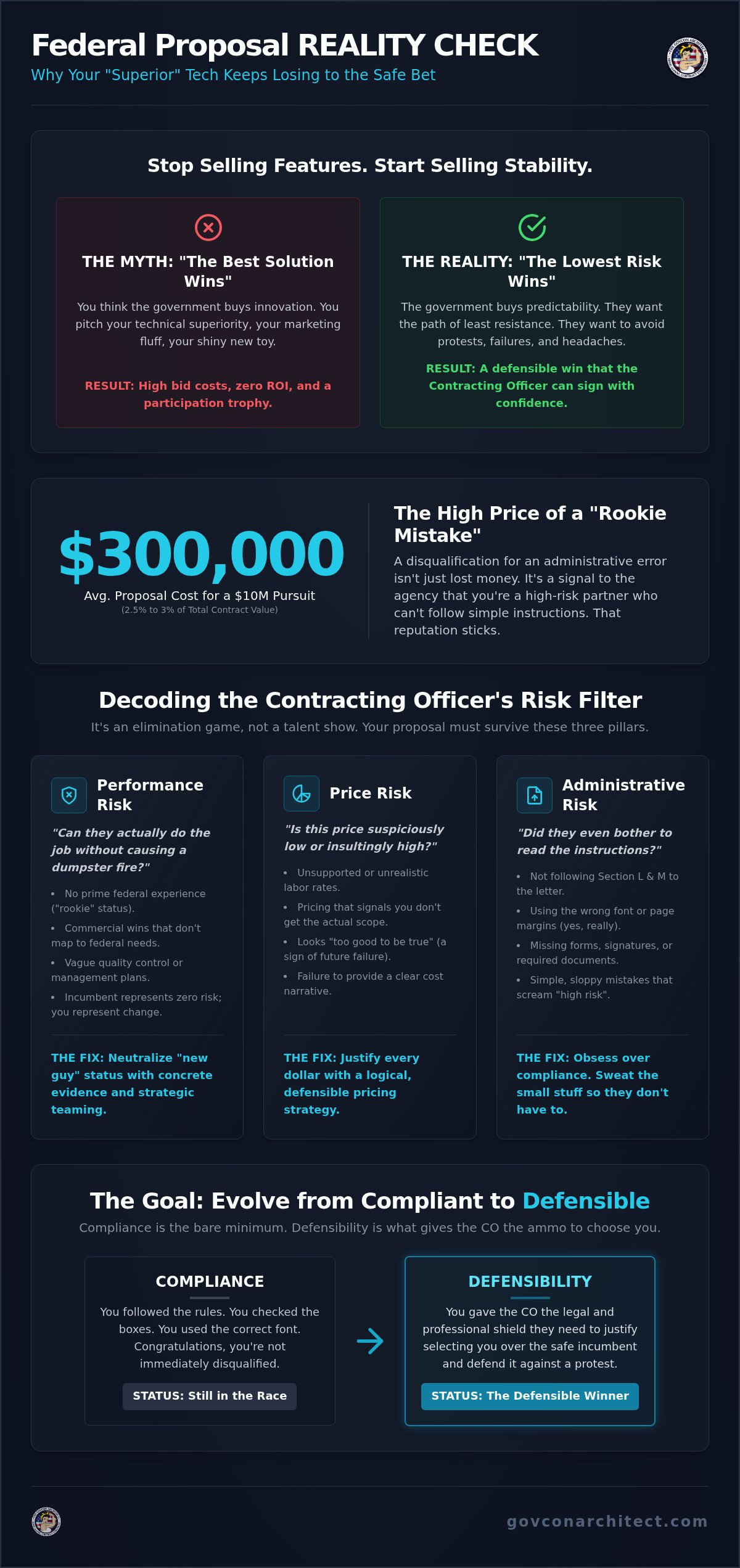
Compliance is binary. You're either compliant or you're disqualified. There is no middle ground. Many commercial firms approach a Request for Proposal (RFP) as a creative writing exercise. This is a strategic failure. In the 2026 federal market, defined by the Revolutionary FAR Overhaul (RFO), the government is moving toward extreme streamlining. They aren't looking for the most impressive marketing deck. They're looking for the path of least resistance. Effective federal proposal development consulting recognizes that a proposal is a legal document designed to survive a clinical evaluation, not a brochure meant to inspire.
Technical superiority often loses to the "Ghost of the Incumbent." This happens because the incumbent represents zero performance risk. Your superior solution represents change. To a Contracting Officer, change is a liability. Unless your proposal explicitly deconstructs and neutralizes that perceived risk, your technical edge is irrelevant. High-stakes bidding requires a shift in perspective. You must stop selling features and start selling stability. If you don't, you're just participating in a "bid and pray" strategy that drains resources without yielding results.
The Compliance vs. Defensibility Gap
Compliance means you followed the instructions in Section L and M. You used the correct font. You mapped your response to the requirements. Defensibility is different. It's the legal and professional shield the Contracting Officer (CO) needs to justify selecting you over a safe, known incumbent. If the CO can't defend your win to their superiors or in a potential protest, you won't win. Period. Specialized federal proposal development consulting bridges this gap. It translates your commercial value into a clinical, risk-mitigated narrative that a CO can sign off on with confidence.
The High Stakes of Federal Pursuits
The cost of failure in 2026 is staggering. Industry data indicates that preparing a solutions proposal now costs between 2.5% and 3% of the total contract value. For a $10M pursuit, you're looking at a $300,000 investment. A single disqualification for a "rookie" administrative mistake does more than burn cash. It damages your reputation with the agency. It signals that you're a high-risk partner who can't follow instructions. A consultant's primary role is to prevent the systemic failures that lead to these quiet, expensive exits. We move the needle from "hopeful entrant" to "defensible winner."
Decoding the Contracting Officer’s Risk Evaluation Framework
The government does not award contracts to the "best" company. They award to the company that is least likely to fail. To a Contracting Officer (CO), every commercial firm is a variable. They use Section M of the solicitation as a clinical filter to eliminate volatility. If your proposal focuses on technical brilliance but ignores administrative stability, you've already lost. Understanding the Federal Acquisition Regulation proposal evaluation process is the first step in moving from a vendor to a defensible contractor. This is where elite federal proposal development consulting shifts the focus from marketing to risk mitigation.
COs evaluate every bid through three rigid pillars: Performance Risk, Price Risk, and Administrative Risk. They're looking for reasons to disqualify you. It's an elimination game, not a talent show. If your proposal contains a single "risk trigger," such as an unsupported labor rate or a vague quality control plan, the evaluator will stop reading. They need a paper trail that protects them from protests and performance failures. Anticipating these unwritten evaluation criteria requires a buy-side perspective. You can't guess what a CO wants; you have to know how the system is built to reject you. Engaging a specialist with buy-side experience is often the only way to see these hidden tripwires before you submit.
Performance Risk and Past Performance
Commercial success does not equal federal capability in the eyes of an evaluator. If you've never held a prime federal contract, you're a high performance risk. You must map your commercial wins to specific federal requirements with clinical precision. If the gap is too wide, use strategic teaming. Subcontracting to an established incumbent can neutralize your "rookie" status. We identify the specific triggers in your technical approach that suggest you don't understand the government’s operational environment. We then rewrite those sections to reflect stability and procedural discipline.
Price Realism vs. Price Reasonableness
Being the "low-cost leader" is often a death sentence in federal pursuits. A price that is too low triggers a "Price Realism" red flag. The CO assumes you don't understand the work and will eventually fail or request a price increase. Your pricing must be defensible. It must be high enough to prove you can retain talent, but low enough to be "reasonable." Your cost volume must never contradict your technical volume. If you propose a senior-level solution at junior-level rates, the evaluator will flag the inconsistency as a major performance risk. We ensure your financial and technical narratives are perfectly aligned.
Strategic Support Models: Monthly Retainers vs. Per-Pursuit Consulting
Engagement models in the federal space aren't about budget. They're about readiness. Most commercial firms fail because they treat federal pursuits as isolated events. They aren't. They are data points in a long-term relationship with the government. Professional federal proposal development consulting provides the framework to manage these data points effectively. While the SBA's federal contracting guide outlines the regulatory landscape, it won't help you build a defensible pipeline. You need a model that matches your current operational maturity.
Choosing between Monthly Retainer Support and Per-Pursuit Project Support is a strategic decision. One focuses on infrastructure; the other focuses on execution. Scaling fast in the 2026 federal market often requires a hybrid approach. You need the stability of a long-term strategy combined with the surgical precision of pursuit-specific expertise. Waiting until an RFP drops to find help is a reactive failure. Success requires you to be proactive.
When to Choose Monthly Retainer Support
Monthly Retainer Support is for firms serious about long-term growth. It's about alignment. You can't fix a broken risk profile in thirty days. This model allows for continuous risk assessment of your business development pipeline. We help you build a low-risk brand identity before the government ever sees your name on a bid. It ensures your internal processes evolve alongside the 2026 federal procurement standards. This is the path to becoming a preferred, low-risk bidder.
When Per-Pursuit Project Support is Mandatory
Sometimes, you just need a win on a high-value target. Per-Pursuit Project Support is a tactical intervention. It's designed for high-complexity bids with tight windows. When you have thirty days to prove your worth, there's no room for error. This support model includes:
Requirement Decomposition: Breaking down Section L and M into a clinical compliance matrix.
CO Alignment: Optimizing individual proposals to meet exact Contracting Officer requirements.
Red Team Reviews: Providing a final, clinical analysis from a buy-side perspective to identify hidden risk triggers.
This model ensures your "must-win" opportunities are defensible and risk-mitigated.
How to Build a Defensible Federal Proposal: A Step-by-Step Framework
Winning a federal contract is a structural challenge, not a creative one. Most commercial firms start writing before they understand the evaluation logic. This leads to high bid costs and zero ROI. A defensible proposal requires a clinical framework that prioritizes risk mitigation over marketing fluff. High-level federal proposal development consulting replaces the standard "hope and pray" method with a five-step architecture designed for the 2026 procurement environment. If your process doesn't start with a cold analysis of your ability to win, you're already burning capital.
The framework begins with a "No-Bid" reality check. If you can't prove you're the lowest-risk option before you pick up a pen, don't spend a dime. Step 2 is requirement decomposition. You must break Sections L and M into a clinical compliance matrix that accounts for every "shall," "must," and "will." Step 3 is risk-first outlining. Your headers should mirror the evaluator’s anxiety points. Step 4 is evidence-based writing. You must replace commercial adjectives with verifiable performance data. Finally, Step 5 is the buy-side review. This isn't a grammar check. It is a simulation of a federal evaluation panel designed to find hidden failure points before the government does.
The Art of the Compliance Matrix
The compliance matrix is the most important document in your pursuit. It is the roadmap for the evaluator. If a Contracting Officer can't find your answer to a specific requirement in five seconds, they'll mark you as non-compliant. We use the matrix to guide the CO through a low-risk narrative. Every requirement is mapped to a specific page and paragraph. This level of procedural precision makes it easy for the government to defend your selection and nearly impossible for competitors to overturn it in a protest.
Drafting the Technical Volume
Commercial firms often fall into the "Commercial Trap." They submit standard sales decks that focus on innovation rather than stability. In the federal space, your technical volume must align with government mission requirements and procedural stability. It should be clear, impactful, and clinical. If you're serious about high-stakes pursuits, you need a partner who understands how the buy-side evaluates value. Engage our per-pursuit project support to ensure your technical narrative is built on a foundation of defensibility.
Transitioning to a Low-Risk Bidder with GovCon Architect
The federal marketplace is not a place for amateurs. It is a clinical environment where the government prioritizes stability over innovation. Most firms fail because they hire writers when they need architects. Professional federal proposal development consulting must be rooted in the buy-side perspective. At GovCon Architect, we don't just draft responses. We engineer defensible submissions. We use 22 years of buy-side experience to align your commercial strengths with the rigid criteria used by federal Contracting Officers. We understand the hidden mechanics of the system because we helped build them.
Hope is not a strategy. Winning in 2026 requires a cold, calculated approach to risk mitigation. We move your firm beyond the "bid and pray" cycle. We focus on the structural integrity of your pursuit. We ensure your past performance, pricing, and technical approach leave no room for evaluator doubt. This is how you dominate. This level of specialized federal proposal development consulting is what separates winners from also-rans. We value results over effort and logic over hope. Every sentence we write serves a specific purpose in constructing a larger argument for your specialized expertise.
Our Methodology: The Master Architect Approach
We identify systemic failure points before they reach the government’s desk. Most proposal processes are broken by administrative sloppiness or a lack of strategic advisory. We don't operate like high-volume agencies. We don't focus on the quantity of your bids. We focus on the defensibility of your path to award. Our approach is clinical. We diagnose the gaps in your current infrastructure and provide the structural corrections necessary to survive a federal evaluation panel. Results-oriented firms choose us because we provide a reality check that other consultants avoid. We're blunt about the difficulty of the environment but certain about the path to success.
Your Path to a Federal Win
Your journey to success starts with an honest assessment of your bid readiness. The 2026 fiscal year will reward firms that prioritize stability and procedural precision. Engaging with strategic advisory is the first step in lowering your risk profile. You need to know if you're ready to win before you deploy capital. We help you align with the 2026 SBA size standard adjustments and the ongoing FAR modernization efforts with clinical precision. If you're serious about high-level competition, it's time to move beyond standard methods. Schedule a briefing with GovCon Architect to evaluate your strategy and secure your position in the federal marketplace.
Dominate the Federal Market Through Strategic Precision
The federal landscape is built on a foundation of risk rejection. Success requires you to move beyond administrative compliance and adopt a clinical, buy-side mindset. You've seen why technical superiority isn't enough to beat established incumbents. You now understand that your pricing must survive a realism check and your narrative must be defensible to the Contracting Officer.
Transitioning your commercial success into the government sector is a high-stakes evolution. Most firms fail because they treat federal proposal development consulting as a writing task rather than a structural alignment. We leverage 22 years of buy-side experience to build your low-risk bidder profile. Our clinical risk-mitigation framework is designed specifically for commercial firms ready to navigate the 2026 procurement cycle with certainty.
Stop relying on hope as a capture strategy. It's time to engineer your path to award with a partner who has operated behind the scenes of the bureaucracy. Secure Your Federal Win Strategy with GovCon Architect. Your firm is capable of winning high-value pursuits. Let's ensure the government agrees.
Frequently Asked Questions
What exactly does a federal proposal development consultant do?
A consultant deconstructs complex solicitations and translates your commercial value into a defensible, low-risk narrative. Effective federal proposal development consulting focuses on identifying hidden failure points in Section L and M before the government does. We ensure every requirement is met with clinical precision to protect the Contracting Officer from performance risk and potential protests.
We act as a bridge between your technical expertise and the government’s evaluation logic. This involves requirement decomposition, risk-first outlining, and simulating a buy-side review. We don't just write; we engineer a submission that mirrors the evaluator’s specific anxiety points.
How much does federal proposal consulting typically cost in 2026?
In 2026, the total cost to prepare a federal solutions proposal typically ranges between 2.5% and 3% of the contract value. Staff augmentation bids are lower, averaging approximately 1.5% of the total pursuit value. These figures represent the internal and external resources required to meet the government's rigorous evaluation standards.
Firms should view these costs as an investment in risk mitigation. A failed bid for a $10M contract can result in a $300,000 loss in preparation costs alone. Specialized support ensures that this capital is deployed toward a defensible, high-probability win rather than a disqualified effort.
Why do commercial firms often fail their first federal bid?
Commercial firms fail because they prioritize technical brilliance over procedural compliance. They often submit marketing-heavy documents that ignore the clinical instructions found in the RFP. The government does not buy the most innovative product; it buys the most stable and compliant option that presents the least risk to the agency.
Failure also stems from a lack of understanding regarding "government-speak." Commercial value propositions don't always translate to federal mission requirements. Without a buy-side perspective, firms miss the hidden tripwires in Section M that lead to immediate disqualification.
What is the difference between capture management and proposal development?
Capture management is the strategic process of qualifying an opportunity and positioning your firm before the RFP drops. It is about influence and intelligence gathering. Proposal development is the clinical execution of the bid itself once the solicitation is public. It is about defensibility and strict adherence to regulations.
Capture is where you decide if a pursuit is winnable. Proposal development is where you prove it. Both are necessary, but they require different skill sets. Capture is proactive and relationship-based, while proposal development is reactive and procedurally driven.
Can a consultant help if we don't have federal past performance?
Yes. A consultant identifies strategic teaming partners to neutralize your status as a new entrant. We map your commercial successes to federal requirements with surgical precision. This shifts the narrative from "inexperienced vendor" to "highly capable commercial innovator with a low-risk delivery model."
We help you leverage the past performance of subcontractors or joint venture partners to meet the government's stability criteria. The goal is to prove that your commercial track record is a reliable predictor of federal success. We bridge the experience gap through clinical documentation and risk-mitigation strategies.
How long does the federal proposal development process take?
Federal solicitations usually provide a 30-day window for a response. However, a defensible proposal requires a development cycle that begins months before the RFP is released. The final 30 days are reserved for clinical decomposition and surgical drafting based on the final requirements.
Rushing the process leads to administrative errors that trigger disqualification. A clinical response requires at least four weeks of intensive work. This includes multiple review cycles to ensure your narrative is perfectly aligned with the Contracting Officer's evaluation framework.
Do I need a consultant for every single bid?
No. You should leverage federal proposal development consulting for high-value pursuits where the cost of failure exceeds your risk tolerance. Once we establish a repeatable, low-risk framework for your firm, your internal team can manage routine task orders. Specialized support is for complex, must-win opportunities.
We recommend using consultants for surgical strikes on critical deadlines or when entering a new agency. As your federal maturity grows, you'll distinguish between bids that require elite architectural support and those that are standard administrative exercises. Strategic advisory is about maximizing ROI on your most important pursuits.
What is a 'low-risk bidder' in the eyes of the government?
A low-risk bidder is a firm that provides absolute certainty of performance and administrative stability. In the eyes of a Contracting Officer, this means zero errors in Section L compliance, a defensible pricing structure, and a technical approach that mirrors their mission requirements. You are the option that won't cause a protest or a performance failure.
The government values predictability over technical superiority. To be low-risk, your proposal must prove you have the financial, technical, and administrative infrastructure to deliver exactly what was promised. You win by being the safest choice for the evaluator to defend to their superiors.