
Federal Procurement Insider Strategy: The Buy-Side Reality Check

Article by
Nikki Gianni
Nikki Gianni is a seasoned business strategist and government contracts coach, dedicated to helping businesses successfully navigate the complexities of government contracting. With over 22 years of experience in Department of Defense contracting, including managing $20 billion in federal awards, Nikki has developed the innovative GovReady Blueprint™ Framework, a comprehensive 90-day program designed to prepare businesses to compete for and win lucrative contracts at the federal, state, and local levels. Nikki's approach emphasizes not just gaining contracts but also enhancing overall business profitability.
Before becoming a business owner, Nikki was active-duty Air Force for 10 years, then spent another 15 years as a civil servant with the DOD. Now she's an empty nester living in Southern California who loves spending time with her 22-year-old son, Lex and her 2 Mini Aussies, doing home improvement and crafts projects, and networking.
Your commercial excellence is irrelevant if you're a liability in the eyes of a Contracting Officer. Most firms treat federal bids like marketing brochures, focusing on "best-in-class" features and "innovative" solutions. It's a fundamental mistake. The government doesn't buy the best solution. It buys the one least likely to fail. This misalignment is why high-performing companies see their bids discarded before the evaluation truly begins.
You've likely felt the sting of a "technically unacceptable" rating despite having a superior product. You've wasted hundreds of hours on proposals that never had a chance because they didn't speak the language of risk. It's time for a reality check. To win, you must adopt a federal procurement insider strategy that shifts your focus from selling value to systematically mitigating perceived risk.
You'll learn the hidden mechanics of buy-side risk evaluation and how to align your bid with government tolerance. We're breaking down the clinical metrics used to disqualify commercial bidders and providing a repeatable framework to ensure your proposal survives the first cut. This isn't about marketing fluff. It's about structural integrity and defensibility.
Key Takeaways
Understand why the government prioritizes stability over innovation and how to reposition your commercial strengths as low-risk assets.
Execute a federal procurement insider strategy that aligns your proposal with the specific risk-avoidance metrics used by Contracting Officers.
Master the deconstruction of Section L & M to uncover the hidden evaluation criteria that commercial firms frequently overlook.
Identify and neutralize the red flags in your corporate profile that lead to immediate disqualification during the technical review phase.
Build a repeatable winning framework that replaces the high-cost failure of one-off bidding with long-term strategic stability.
Table of Contents
The Reality Check: Why Commercial Strategies Fail in Federal Procurement
Architectural Precision: Building Your Long-Term GovCon Foundation
The Reality Check: Why Commercial Strategies Fail in Federal Procurement
Commercial success is a vanity metric in the public sector. Your revenue, your brand recognition, and your disruptive technology mean nothing to a Contracting Officer. In the commercial world, you win by being better, faster, and more innovative. In the federal world, those same traits often signal instability. The government does not buy the best solution; it buys the one least likely to fail. This is the fundamental disconnect that bankrupts promising federal divisions.
To win at this level, you need a federal procurement insider strategy that prioritizes verification over persuasion. Understanding the federal procurement process requires a total psychological shift. You aren't selling a product. You're selling a lack of risk. If your proposal looks like a marketing brochure, you've already lost. Marketing relies on emotion and promise. Federal evaluation relies on clinical evidence and historical stability. If you're still trying to "market" your firm, you're providing the evaluator with reasons to disqualify you for lack of substance.
The Innovation Trap
Innovation is a liability until proven otherwise. To a Contracting Officer, "cutting-edge" is a synonym for "untested." Every unproven feature in your bid represents a potential point of failure that could jeopardize their career. Commercial firms often lead with their newest capabilities, but in a structured RFP environment, being too different is dangerous. Your value proposition must be anchored in what is known and repeatable. A successful federal procurement insider strategy frames innovation as a controlled evolution of a stable, existing process rather than a radical departure from the status quo.
The Compliance vs. Strategy Gap
Most firms mistake compliance for a winning strategy. It isn't. Compliance is the floor; it's the bare minimum required to keep your proposal from being thrown in the trash. Following every instruction in the RFP only gets you to the starting line. The gap between a compliant bid and a defensible one is where the actual competition happens. While compliance satisfies a checklist, strategy satisfies the evaluator's inherent fear of a protest or a performance failure. Compliance proves you can read; strategy proves you can perform without oversight. A compliant bid meets the requirements, but a defensible bid eliminates the evaluator's professional risk.
The Buy-Side Lens: How Contracting Officers Evaluate Risk
To win, you must see the world through the eyes of the person signing the award. The Contracting Officer (CO) is not looking for a partner. They are looking for an insurance policy. Their primary objective is job security through risk avoidance. A failed contract is a career-ending event. A successful contract is simply doing their job. This asymmetry defines the entire evaluation process. Every decision made by the CO is governed by the Federal Acquisition Regulation. This framework mandates a clinical approach to risk. For contracts exceeding the Simplified Acquisition Threshold of $350,000, the scrutiny becomes absolute.
Implementing a federal procurement insider strategy means providing the CO with the documentation they need to defend an award to your firm. In closed-door sessions, the "Best Value Tradeoff" is rarely about finding the most features. It's about identifying the point where the risk of failure is lowest for the price offered. COs fear the Government Accountability Office (GAO) more than they fear a slightly higher price tag. They need a decision that is "protest-proof." If you can't prove your stability, you're a liability they won't sign off on.
Risk Metric 1: Financial and Operational Stability
Your back-office systems matter as much as your front-end solution. The government evaluates your "commerciality" through a federal prism. If your accounting systems aren't audit-ready or your HR processes lack structure, you're a high-risk entity. Chaos in the back office suggests chaos in project delivery. Firms that fail to align their operations with these expectations often benefit from Monthly Retainer Support to build long-term strategic defensibility. You must demonstrate that your firm can survive a federal audit before you're trusted with a federal mission.
Risk Metric 2: Past Performance as a Predictor
Past performance is the credit score of federal contracting. The government uses the Contractor Performance Assessment Reporting System (CPARS) to de-risk the present. If you have a limited federal history, you're an unknown variable. You must translate commercial success into "Relevant Experience" by mapping your private sector achievements to specific federal requirements. Don't just list clients. Detail the scope, complexity, and risk mitigation strategies used in those engagements. You need to prove that your commercial excellence is repeatable in a high-stakes government environment. Verification is the only currency that matters here.
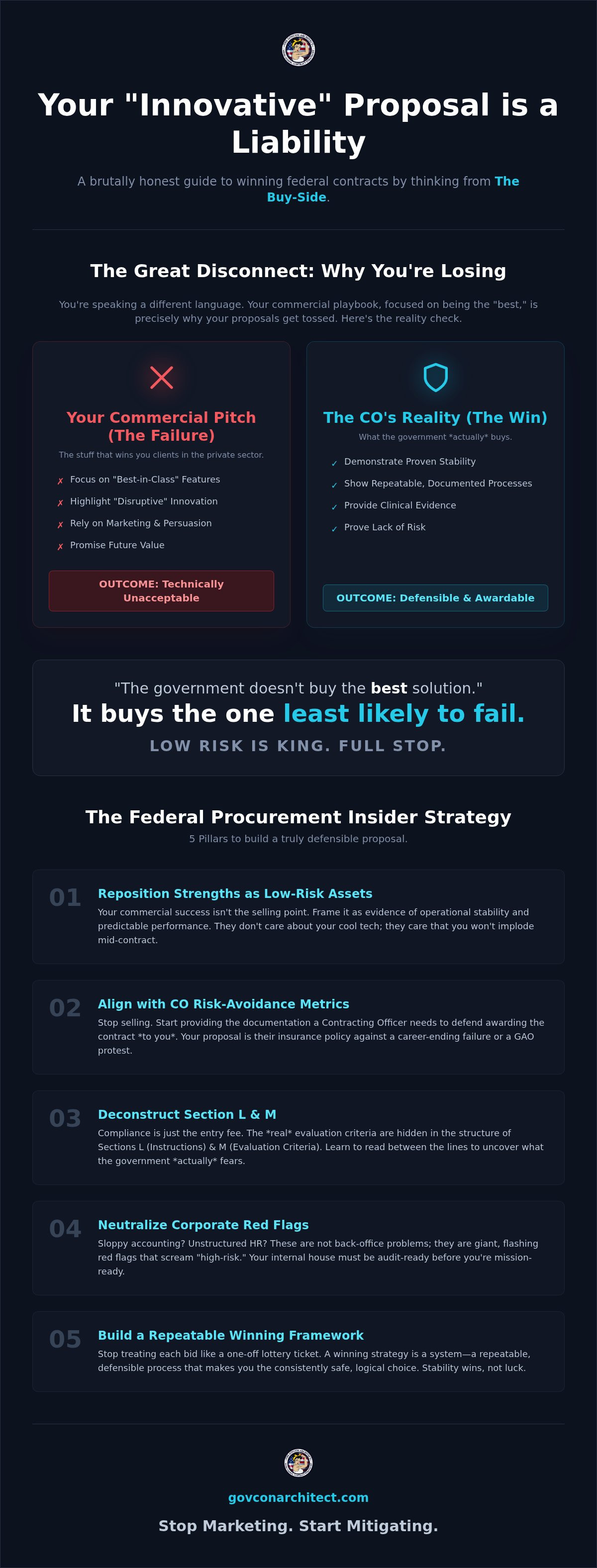
5 Pillars of a Federal Procurement Insider Strategy
Winning a federal contract is not an accident of good writing. It is the result of architectural precision. If you're waiting for the RFP to hit SAM.gov before you start your preparation, you've already lost the pursuit. You need a federal procurement insider strategy that begins months before the solicitation exists. This strategy moves your firm from a reactive bidder to an active participant in the procurement lifecycle. It replaces hope with a clinical, repeatable framework for success.
The architecture of a winning bid rests on five specific pillars:
Early Engagement: Shaping the requirements before they are finalized.
Section L & M Deconstruction: Understanding the hidden mechanics of the evaluation.
Low-Risk Narrative: Building defensibility into every technical and financial claim.
Competitive Intelligence: Systematically identifying and exploiting the incumbent's performance gaps.
Pursuit Management: Coordinating high-stakes inputs into a unified, professional briefing.
Influencing the Requirements
The pre-RFP phase is where the playing field is leveled or tilted. Use Requests for Information (RFIs) and Industry Days to shape the final technical requirements. This isn't about unfair advantages. It's about educating the government on what a stable, low-risk solution actually looks like. If you can influence the evaluation criteria to favor your specific stability metrics, you've won half the battle. Waiting for the final release means you're playing a game where the rules were likely written by your competitors.
Decoding Section L and M
Section L contains the instructions. Administrative errors here are the fastest way to receive a "non-responsive" determination. Section M defines the evaluation criteria. This is the CO’s scorecard for your risk level. You must deconstruct these sections to understand how the government will weigh your technical approach against your price. Every paragraph in your proposal must serve a dual purpose: meeting the requirement and building a narrative of stability. The government's focus on How Contracting Officers Evaluate Risk through systems like SPRS means your narrative must be backed by verifiable performance data. Don't just claim you are reliable. Provide the data that proves it. Your goal is to make it impossible for the CO to choose anyone else without increasing their own professional risk.
Finally, your federal procurement insider strategy must include a cold-blooded assessment of the incumbent. Every current contractor has "scars"-missed deadlines, budget overruns, or personnel turnover that the government remembers. You don't name the competitor. You simply highlight how your firm's architecture prevents those specific failures. This transforms the incumbent's history into your competitive advantage.
Tactical Risk Mitigation: Becoming the Safe Bet Candidate
Standardization is your armor. In the federal marketplace, a unique proposal structure is a liability. Evaluators are often reviewing dozens of bids against a rigid scorecard. If they can't find your answers in the expected sequence, they won't go looking for them. Your federal procurement insider strategy must begin with a response framework that mirrors the evaluation patterns found in Section M. You need to map every technical claim to a specific risk mitigation factor. This clinical approach ensures the Contracting Officer (CO) can easily defend your selection during a closed-door session.
Your commercial profile is likely full of red flags. Rapid scaling, high employee turnover, or a lack of government-grade accounting systems are immediate disqualifiers for high-stakes contracts. You must identify these vulnerabilities before the government does. Neutralizing these risks requires a shift from reactive bidding to proactive infrastructure building. Firms that achieve long-term success often utilize Monthly Retainer Support to continuously align their internal operations with federal risk metrics. This isn't about looking good on paper. It's about being structurally sound before the pursuit begins.
Teaming for Risk Reduction
Teaming is a strategic calculation, not a social exercise. If your firm lacks a specific past performance requirement, you sub it out. If the contract is a small business set-aside and you're a large firm, you look for a strategic partner to prime. Using a partner with a specific socioeconomic status or a robust federal history lowers the government's friction. It de-risks the award. Joint Ventures (JVs) offer even more protection but require a higher level of legal and operational precision. Choose your partners based on their ability to fill your risk gaps, not just their technical skills.
The Internal Audit: Pre-Bid Readiness
The most important decision you'll make is the "No-Bid" decision. Pursuing a federal contract is an expensive exercise in capital allocation. If your internal systems aren't "Government Grade," you're wasting money. Conduct a Federal Bid Readiness Assessment to evaluate your accounting, HR, and security protocols. If your back office can't handle a DCAA audit, you aren't ready for a prime contract. A disciplined federal procurement insider strategy recognizes when a pursuit is a waste of capital. Winning requires knowing when your architecture is strong enough to survive the scrutiny of a $350,000 Simplified Acquisition Threshold buy or a multi-million dollar full-and-open competition.
Architectural Precision: Building Your Long-Term GovCon Foundation
One-off bidding is a death sentence for commercial margins. It's a gamble, not a business plan. Commercial firms often treat federal pursuits as side projects or "nice-to-have" revenue streams. This approach ensures a high burn rate and a near-zero win rate. You cannot capture a significant share of the $793 billion federal contract market awarded in FY 2025 with a part-time effort. Success requires a federal procurement insider strategy that integrates federal pursuits into your core business development lifecycle. You aren't just looking for a single award. You are building a permanent, defensible foundation for growth.
Integrating these pursuits means moving away from reactive responses to SAM.gov postings. You need to identify and influence opportunities 18 to 24 months before they hit the street. This is where Per-Pursuit Project Support becomes critical for high-value opportunities. It provides the surgical precision needed to deconstruct a specific RFP and align your technical approach with the Contracting Officer's inherent risk tolerance. GovCon Architect leverages 22 years of buy-side experience to ensure your commercial excellence is translated into federal stability. We don't guess what the government wants. We understand the hidden mechanics of the evaluation room.
The Retainer Advantage
Continuous alignment beats reactive bidding every time. Monthly Retainer Support allows you to build an "Insider" perspective directly into your C-suite decision-making. You stop making operational choices that accidentally disqualify you from future work. A strategic advisor is significantly cheaper than the sunk cost of a lost $50M contract. You are buying the ability to see the board from the other side. This is about architectural precision. It's about ensuring your firm is the only logical, low-risk choice before the first page of the proposal is even written. We turn your commercial strengths into verified federal assets.
Next Steps: From Commercial to Federal Leader
The transition from a commercial firm to a federal leader is a 12-month journey. Expect the first six months to be a period of intense structural correction. You will audit your systems. You will refine your narrative. You will stop using marketing fluff in favor of clinical evidence. The final reality check is simple: the federal market is brutal to the unprepared and the optimistic. It is highly rewarding to the disciplined and the strategic. Success is a choice of architecture over effort. Logic over hope. Secure your federal future with GovCon Architect advisory.
Securing Your Position in the Federal Marketplace
Federal contracting isn't a marketing contest. It's a risk elimination exercise. The buy-side reality is governed by job security and procedural precision. Your commercial success is only a baseline. To win, your federal procurement insider strategy must be the differentiator. You must move from presenting features to providing clinical proof of stability. Evaluators don't want to be impressed; they want to be safe.
Winning requires an authoritative risk-mitigation framework. This is the core of successful commercial-to-federal transitions. You need to align your operations with the metrics that actually matter to a Contracting Officer. Whether you are navigating a $350,000 simplified acquisition or a high-stakes pursuit, the path to a defensible award remains the same. It takes 22 years of buy-side expertise to see the mechanics that others miss.
Stop guessing. Start building. Architect your federal win strategy with Nikki Gianni and transform your firm into a safe-bet candidate. The system is complex, but the logic for success is absolute. Your federal future starts with architectural precision.
Frequently Asked Questions
What is the most common reason commercial firms lose federal bids?
Misalignment with government risk tolerance is the primary failure point. Commercial firms often lead with innovation and marketing fluff rather than clinical evidence of stability. They treat the RFP like a sales brochure. The government doesn't buy the best product; it buys the one least likely to cause a career-ending failure for the Contracting Officer. If you don't speak the language of risk mitigation, your bid is dead on arrival.
How does a Contracting Officer define "risk" during a procurement?
Risk is the probability of performance failure, financial instability, or legal protest. A Contracting Officer evaluates your firm's ability to deliver exactly what is promised without oversight. They look for "Government Grade" systems and verified past performance. Every unproven feature in your proposal is a red flag. A successful federal procurement insider strategy focuses on neutralizing these perceptions by providing data-driven proof of operational stability.
Can a commercial firm win a federal contract without prior government experience?
Yes, but you must translate commercial excellence into "Relevant Experience." The government won't take your word for it. You need to map private sector achievements to specific federal requirements with clinical precision. This often requires strategic teaming or joint ventures to fill past performance gaps. Winning without a federal track record is a matter of architectural alignment rather than just having a superior commercial product.
What is the difference between Section L and Section M in an RFP?
Section L provides administrative instructions, while Section M defines the evaluation criteria. Section L tells you how to format your bid to avoid immediate disqualification. Section M is the scorecard the government uses to rank your proposal. You must deconstruct both to understand how points are awarded. While Section L is about compliance, Section M is where you execute your federal procurement insider strategy to prove you are the safe bet.
How long does a typical federal procurement insider strategy take to implement?
A full structural correction typically takes 12 months. This timeline accounts for auditing internal systems, refining your narrative, and influencing the pre-RFP phase. Federal procurement is a long-game marathon. Short-term, reactive bidding leads to high burn rates and low win rates. You need several months of consistent alignment to move from a commercial outsider to a credible, low-risk federal candidate.
Is it better to hire a full-time federal sales team or a strategic consultant?
Strategic consultants are the better initial investment. A full-time sales team will fail if they don't have a defensible, low-risk architecture to sell. Consultants provide the "Master Architect" perspective needed to build the foundation. Once your systems are audit-ready and your risk-mitigation framework is in place, you can scale with a sales team. Starting with sales before strategy is a waste of capital.
How can I find out why my bid was disqualified?
Request a formal post-award debrief immediately. This is your legal right under the Federal Acquisition Regulation. The debrief provides the clinical reasoning behind your technical rating and identifies specific weaknesses in your proposal. Don't treat it as a grievance session. Use it as a diagnostic tool to fix your internal architecture for the next pursuit. It's the only way to get a direct look at the buy-side evaluation.
What is "Capture Management" and why is it critical for federal wins?
Capture management is the systematic process of influencing a procurement before the RFP release. It's about shaping requirements and building relationships with the buy-side stakeholders. If you wait for the solicitation on SAM.gov, you're already behind. Effective capture ensures that when the RFP finally drops, the evaluation criteria are already aligned with your firm's specific strengths and stability metrics.