
Federal Opportunity Assessment Framework: The Insider’s Reality Check for 2026

Article by
Nikki Gianni
Nikki Gianni is a seasoned business strategist and government contracts coach, dedicated to helping businesses successfully navigate the complexities of government contracting. With over 22 years of experience in Department of Defense contracting, including managing $20 billion in federal awards, Nikki has developed the innovative GovReady Blueprint™ Framework, a comprehensive 90-day program designed to prepare businesses to compete for and win lucrative contracts at the federal, state, and local levels. Nikki's approach emphasizes not just gaining contracts but also enhancing overall business profitability.
Before becoming a business owner, Nikki was active-duty Air Force for 10 years, then spent another 15 years as a civil servant with the DOD. Now she's an empty nester living in Southern California who loves spending time with her 22-year-old son, Lex and her 2 Mini Aussies, doing home improvement and crafts projects, and networking.
Most federal contractors treat SAM.gov like a high-stakes lottery. They believe that a higher volume of bids will eventually lead to a win. It won't. If you're tired of wasting resources on proposals that are dead on arrival, you need a federal opportunity assessment framework that prioritizes risk over hope. You've felt the frustration of losing to a competitor without knowing why. You're exhausted by the sheer volume of RFPs that lead to nothing but "not selected" notifications.
Winning in 2026 requires a shift from optimism to clinical analysis. This framework is built on 22 years of buy-side experience. It's designed to help you stop chasing ghosts and start identifying the bids you're actually positioned to win. We'll break down the specific risk criteria Contracting Officers use to disqualify firms. You'll gain a repeatable process to align your strategy with the hidden mechanics of the federal system. It's time to stop bidding and start winning.
Key Takeaways
Shift your focus from bidder capability to government risk perception to avoid immediate disqualification.
Understand the three pillars of buy-side risk—technical, financial, and procedural—that determine contract awards.
Implement a clinical federal opportunity assessment framework to filter out unwinnable pursuits and preserve your capture budget.
Identify the reality behind incumbency and price points to avoid common strategic pitfalls in Best Value procurements.
Apply a repeatable gap analysis against Section M criteria to ensure your proposal aligns with Contracting Officer expectations.
Table of Contents
Why Most Federal Opportunity Assessment Frameworks Lead to Disqualification
The Buy-Side Lens: How Contracting Officers Actually Evaluate Risk
Myth vs. Reality: 5 Lies About Federal Opportunity Selection
Beyond the Framework: Tactical Pursuit Support for High-Stakes Bids
Why Most Federal Opportunity Assessment Frameworks Lead to Disqualification
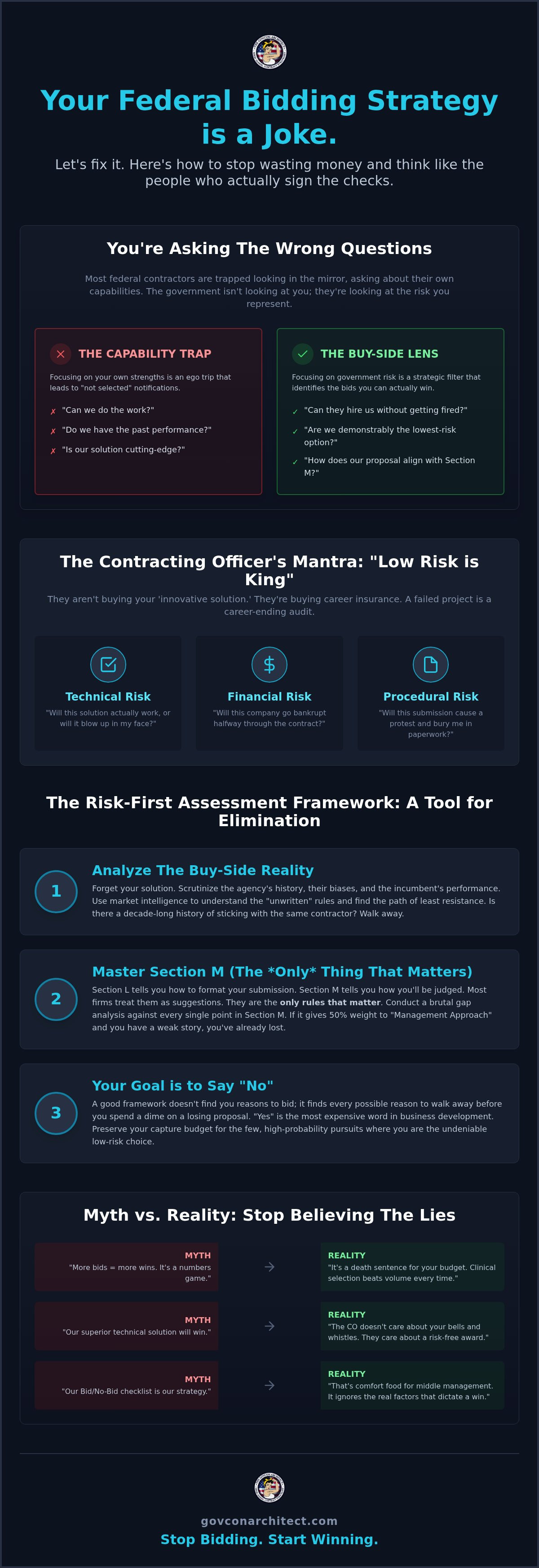
Most firms fail because they look inward. They ask if they have the staff, the tools, and the past performance to do the work. This is the "Capability Trap." In the 2026 market, being qualified is just the entry fee. A true federal opportunity assessment framework isn't a mirror for your ego. It's a strategic filter designed to identify where the government sees the least risk. If you only focus on your ability to perform, you're ignoring the 80% of the battle that happens inside the mind of the evaluator.
A clinical federal opportunity assessment framework is a tool for elimination. It identifies low-risk, high-probability pursuits by analyzing the buyer's perspective. Most frameworks lead to disqualification because they emphasize bidder capability rather than government risk perception. Chasing everything is a death sentence for your capture budget. In a high-stakes environment, your goal isn't to find reasons to bid. Your goal is to find every possible reason to walk away before you spend a dime on a proposal.
The Failure of the Bid/No-Bid Checklist
Standard checklists are comfort food for middle management. They feel productive, but they lack teeth. These "check-the-box" exercises often ignore the nuances of the federal procurement process. Generic lists fail to account for agency-specific biases or historical buying patterns that dictate who actually wins. If an agency has a decade-long history of sticking with incumbents, a "Yes" on a generic checklist is a lie. In federal business development, "Yes" is often the most expensive word in your vocabulary. It commits your best people to a losing battle while your competitors focus on winnable targets.
The Disconnect Between BD and the Contracting Officer
Your Business Development team sells features. They talk about "innovation" and "cutting-edge" solutions. The Contracting Officer (CO) doesn't care about your bells and whistles. The CO cares about procedural integrity and liability. They want to know if they can hire you without getting fired. Standard frameworks often focus on Section L, which tells you how to bid. They ignore Section M, which tells you how you're actually judged. This disconnect is why many firms get disqualified despite having a superior technical solution. The shift from "Can we do it?" to "Can they hire us without risk?" is the difference between a wasted submission and a signed contract.
The Buy-Side Lens: How Contracting Officers Actually Evaluate Risk
Contracting Officers (COs) operate under a mandate of risk mitigation. They aren't looking for the most innovative solution or the flashiest technology. They are looking for the lowest risk of failure. Given the scale of federal government spending on contracts, the oversight is intense. A failed project isn't just a lost dollar; it's a career-ending audit. This is the baseline reality of the federal market. If you don't understand it, you're just guessing.
A federal opportunity assessment framework that ignores these realities is a liability. If you evaluate opportunities based on how much you like your own solution, you've already lost. You must view every pursuit through three specific pillars: technical, financial, and procedural risk. Technical risk asks if your solution will break. Financial risk asks if your company will go under mid-contract. Procedural risk asks if the CO will face a protest because of your submission. This is where federal market intelligence consulting becomes vital. It provides the data to see the "unwritten" requirements that a CO uses to weed out high-risk bidders.
Technical Risk: Beyond the Statement of Work
Performance history is the first hurdle. But "relevance" is a subjective trap. A CO doesn't care if you scaled a commercial startup to high revenue. In fact, that might be a risk factor. Can you handle the DCAA audits? Do you understand the security protocols? Commercial success often signals a lack of federal procedural discipline. Evaluating your past performance through the lens of agency-specific relevance is non-negotiable. A CO looks for similarity in scope, size, and complexity. If you haven't operated in their specific technical environment, you are a technical risk. Your federal opportunity assessment framework must identify these gaps before you commit resources.
Procedural Risk: The Section L and M Reality
Section L tells you how to submit. Section M tells you how you'll be scored. Most bidders treat these as suggestions. They aren't. They are the only rules that matter. A risk-first assessment weights these factors above your own technical desires. If Section M gives 50% weight to "Management Approach" and you spend 90% of your proposal on technical innovation, you've failed. You're signaling that you don't follow instructions. This is a procedural red flag.
You need to adopt a "Low-Risk Bidder" mindset. This involves aligning your corporate structure with federal expectations before the RFP drops. For high-stakes pursuits, leveraging Per-Pursuit Project Support can help bridge the gap between your capabilities and the CO's risk threshold. It's about clinical alignment, not marketing fluff. Success in 2026 requires moving from a capability-first approach to a risk-first strategy.
Myth vs. Reality: 5 Lies About Federal Opportunity Selection
The federal market is littered with the corpses of firms that followed conventional wisdom. They believed the myths, ignored the data, and treated the federal opportunity assessment framework as a formality. Success requires a clinical rejection of these five common lies. If you don't strip away the marketing fluff, you'll continue to burn capital on pursuits you were never meant to win.
Myth 1: "The lowest price always wins." Reality: In Best Value procurements, the government pays a premium for lower risk. Price is secondary to the Contracting Officer's peace of mind.
Myth 2: "Incumbency is an unbeatable advantage." Reality: Incumbents often become complacent and procedurally sloppy. Agencies frequently seek "new blood" to fix stagnant performance.
Myth 3: "SAM.gov is the only source of truth." Reality: If you first discover an opportunity on SAM, you're already late. The requirements were likely shaped months ago by firms that were in the room early.
Myth 4: "Technical excellence outweighs compliance." Reality: A single missing signature or an incorrectly formatted table cancels a billion dollar solution. Compliance is the floor. It's not optional.
Myth 5: "We can fix our weaknesses during the proposal phase." Reality: You can't write your way out of a structural gap. Assessment happens before the pen hits the paper. If you're weak, walk away.
Exposing the "Volume Game" Fallacy
Most firms believe that more bids lead to more wins. This is a strategic failure. Submitting 10 "okay" bids is worse than submitting two "perfect" ones. High volume leads to burned out proposal teams and diluted past performance. When you chase everything, you master nothing. Clinical analysis shows that the ROI of a "No-Bid" decision is often higher than a desperate submission. A disciplined federal opportunity assessment framework forces you to protect your resources for the 20% of opportunities where you have a genuine competitive edge.
The Truth About Federal Market Intelligence
Market intelligence is not just a list of leads. It's a diagnostic tool for risk. Many firms buy lead lists and call it "strategy." Real intelligence is the data that tells you how a buyer behaves when the pressure is on. It reveals agency-specific biases and historical spending patterns that aren't in the RFP. "Insider" knowledge is actually just superior data analysis of buy-side behavior. Federal market intelligence is the foundation of a defensible bid strategy. Without it, you're just gambling with your firm's future.
Implementing a Risk-First Opportunity Assessment Framework
Execution is where most firms fail. They have the intent, but they lack the clinical discipline to walk away. Implementing a risk-first federal opportunity assessment framework requires a departure from traditional business development. You aren't looking for reasons to bid. You're looking for reasons to protect your capital. This process must be repeatable, objective, and entirely detached from the emotional desire to "just get a win."
Step 1: Intelligence Gathering. Move beyond SAM.gov. Leverage federal market intelligence consulting to identify the agency’s actual pain points. If you don't know the problem the CO is trying to solve, you can't assess your risk of failing to solve it.
Step 2: Gap Analysis. Open Section M. Compare your current capabilities against every single evaluation factor. If you cannot prove 100% alignment, you have a gap. Gaps are risks.
Step 3: Risk Scoring. Assign a clinical score to technical, financial, and procedural risks. Use a scale of 1 to 5. A high score in any category should be a red flag, not a challenge to overcome in the writing phase.
Step 4: The Kill Switch. Establish non-negotiable criteria. If the incumbent has a 95% satisfaction rating or the agency requires a specific clearance you don't hold, the "Kill Switch" triggers an immediate No-Bid.
Step 5: Alignment Briefing. Present the opportunity to the C-suite. This is not a sales pitch. It's a risk-mitigation exercise. If you can't defend the bid with data, don't submit it.
Weighting the Evaluation Criteria
Not all requirements are equal. Your federal opportunity assessment framework must weight scores based on the RFP’s Section M. If technical approach is "significantly more important" than price, your scoring model must reflect that hierarchy. You must also distinguish between Price-to-Win and Cost-to-Execute. Winning a contract you can't afford to perform is a slow-motion bankruptcy. This is especially critical for GWACs and IDIQs, where the initial win is just a license to hunt. For firms looking to institutionalize this rigor, our Monthly Retainer Support provides the ongoing refinement necessary to stay ahead of 2026 procurement trends.
The Role of Past Performance in Selection
The government doesn't care about your potential. They care about your history of not failing. Use your framework to identify which past performance citations are actually "relevant" to the CO. Relevance is defined by scope, size, and complexity. If you're using teaming partners to fill capability gaps, you're introducing new procedural risk. The CO will evaluate the risk of your partnership as much as your technical solution. If your collective past performance doesn't meet the "Low Risk" threshold, walk away. It's better to save your resources for a fight you can actually win.
Beyond the Framework: Tactical Pursuit Support for High-Stakes Bids
A framework is a tool. It's not a strategy. Even the most robust federal opportunity assessment framework is useless without the "Master Architect" perspective to execute it. You need to understand how to turn clinical data into a winning narrative. This is where strategic advisory separates the contenders from the also-rans. Most firms stop at the checklist. We start there.
Our Per-Pursuit Project Support is designed for high-stakes bids where failure isn't an option. We don't just help you bid; we ensure you're positioned to win. We take the risk factors identified in your assessment and neutralize them before the government sees them. We transform your submission from a list of capabilities into clinical proof of low risk. This is how you move from being a participant to being the inevitable choice.
For firms committed to long-term dominance, our Monthly Retainer Support offers continuous framework refinement. The 2026 federal market is shifting. Thresholds are changing. Evaluation trends are evolving. You can't rely on a static checklist from three years ago. You need a living strategy that adapts to the current buy-side reality. We provide the ongoing oversight to ensure your pipeline remains high-probability and low-risk.
Becoming a Low-Risk Bidder
GovCon Architect specializes in aligning your commercial strengths with federal risk evaluation criteria. Most commercial firms fail because they don't know how to translate their success into the language of the Contracting Officer. They lead with innovation. We lead with stability. We bridge the gap between your technical excellence and the government's need for procedural security.
The transition from a commercial firm to an elite federal contractor is a structural one. It requires strategic confidence. You should know you're the low-risk choice before the CO even reads your executive summary. We provide the insider mechanics to ensure your corporate structure and past performance citations are bulletproof. We remove the guesswork from the federal opportunity assessment framework and replace it with clinical certainty.
Next Steps for Executive Leadership
Review your current win rate. If you're winning less than 30% of your submitted bids, your selection process is broken. You have "Risk Gaps" that are draining your resources and demoralizing your team. It's time for a reality check. Stop treating the federal market like a volume game and start treating it like a precision strike.
Schedule a clinical briefing to audit your current federal opportunity assessment framework. Stop guessing which bids are winnable. Start using 22 years of buy-side experience to filter your pipeline. Your capture budget is too valuable to waste on "maybe."
Optimize your federal pursuit strategy with GovCon Architect.
Secure Your Competitive Edge for 2026
The federal landscape doesn't reward effort. It rewards the absence of risk. You've seen why a high volume of bids is a recipe for failure; true success lies in the clinical elimination of unwinnable pursuits. By shifting your focus from bidder capability to the Contracting Officer's risk perception, you align your firm with the internal mechanics of the government's decision-making process. This isn't about hope. It's about data-driven selection.
Adopting a rigorous federal opportunity assessment framework is the only way to protect your capture budget in a high-stakes environment. It ensures you only commit resources when you're the inevitable low-risk choice. With 22 years of buy-side experience, we specialize in helping commercial firms navigate this complex transition through an authoritative risk-mitigation methodology. Stop guessing and start executing with precision.
Master the federal market with GovCon Architect’s strategic advisory. You already possess the technical excellence. Now, apply the strategic discipline required to win at the highest level.
Frequently Asked Questions
What is a federal opportunity assessment framework?
A federal opportunity assessment framework is a strategic filter used to identify low-risk, high-probability pursuits. It moves beyond internal capability checks. It focuses on how the government perceives your firm's stability and technical relevance. It is a clinical tool designed to protect your capture budget by eliminating unwinnable bids early.
How does a risk-based framework differ from a standard bid/no-bid checklist?
Standard checklists are internal and subjective. They often focus on whether a firm wants the work. A risk-based framework is external and clinical. It evaluates technical, financial, and procedural liabilities from the Contracting Officer's perspective. It looks for reasons to walk away rather than excuses to bid.
Why is Section M so critical in the opportunity assessment phase?
Section M contains the evaluation factors. It's the government's grading rubric. Assessing an opportunity without a weighted analysis of Section M is gambling. This section dictates the hierarchy of importance. It tells you if a superior technical approach can actually overcome a higher price point.
Can a commercial firm win federal contracts without prior government experience?
Yes. Success depends on neutralizing risk perception. Commercial firms must align their strengths with federal evaluation criteria. You must prove that your commercial success doesn't introduce procedural or financial instability. Strategic alignment turns your commercial innovation into a low-risk federal asset.
How much time should we spend on opportunity assessment for a single RFP?
Assessment must be fast and clinical. Spending four to eight hours on a deep-dive federal opportunity assessment framework review can save $50,000 in wasted proposal costs. The objective is a quick, data-driven "no" or a calculated, defensible "yes" before the pen hits the paper.
What is the role of federal market intelligence consulting in this process?
It provides the buy-side data missing from the RFP. This includes agency spending patterns, incumbent performance history, and unwritten pain points. Intelligence turns a generic assessment into a diagnostic tool. It allows you to see the competitive landscape through the eyes of the Contracting Officer.
What are the most common reasons for federal bid disqualification in 2026?
Procedural errors and risk-heavy past performance remain the primary killers. In 2026, Contracting Officers prioritize stability over innovation. Firms are often disqualified for missing administrative requirements in Section L or failing to prove relevance in scope and complexity within their past performance citations.
How does GovCon Architect help with the opportunity assessment process?
We apply 22 years of buy-side experience to audit your pipeline. Through Per-Pursuit Project Support and Monthly Retainer Support, we use an authoritative risk-mitigation methodology. We ensure you only chase bids where you are positioned as the inevitable, low-risk choice. We remove the guesswork from your strategy.