

Federal Contract Relationship Management: Build Trust Without Mistaking Access for Strategy

Article by
Nikki Gianni
Nikki Gianni is a seasoned business strategist and government contracts coach, dedicated to helping businesses successfully navigate the complexities of government contracting. With over 22 years of experience in Department of Defense contracting, including managing $20 billion in federal awards, Nikki has developed the innovative GovReady Blueprint™ Framework, a comprehensive 90-day program designed to prepare businesses to compete for and win lucrative contracts at the federal, state, and local levels. Nikki's approach emphasizes not just gaining contracts but also enhancing overall business profitability.
Before becoming a business owner, Nikki was active-duty Air Force for 10 years, then spent another 15 years as a civil servant with the DOD. Now she's an empty nester living in Southern California who loves spending time with her 22-year-old son, Lex and her 2 Mini Aussies, Tony & Carmela, doing home improvement and crafts projects, and networking.
Federal buyers need credible information that helps them make a lower-risk purchase. That’s the difference between federal contract relationship management and collecting business cards as if they were a procurement strategy.
It’s reasonable to wonder which stakeholders matter, what to ask, and where the line sits between strategic engagement and chasing special access. Government engages with industry to understand capabilities and make informed buying decisions, not to give a vendor an inside track. A useful relationship respects that purpose. No secret handshake required.
This article explains how to build disciplined, ethical engagement habits, understand buyer priorities, and connect what you learn to defensible pursuit and bid decisions. You’ll also learn how to identify relevant stakeholders without treating every meeting as progress. The standard is simple: be clear, consistent, and useful. Access may open a conversation, but evidence, fit, and low-risk credibility make it worth having.
Key Takeaways
- Use federal contract relationship management to learn what the agency needs, not to mistake a full calendar for pursuit strategy.
- Identify stakeholders by their role and relevance to the acquisition. Different contacts offer different perspectives and do not have identical authority.
- Give every interaction a clear learning objective, document what you learn, and reassess whether the pursuit still fits.
- Build trust through consistent, relevant engagement and proven delivery. “Insider access” is no substitute for a credible, low-risk bid.
What Federal Contract Relationship Management Actually Means
Federal contract relationship management is deliberate, professional engagement that helps a firm understand an agency’s needs, mission context, and acquisition priorities. Government procurement is a structured process for purchasing goods and services, not a friendship contest with a contract at the finish line. Relationships can improve your understanding, but they don’t grant privileged access, influence, or a guaranteed advantage.
The purpose is to learn about the buyer’s needs. Ask relevant questions, listen carefully, and use what you learn to assess whether your capabilities fit the stated requirement. Then check your assumptions against market research and official acquisition information. Relationships support sound pursuit decisions. They don’t replace solicitation compliance or a clear, credible proposal.
How Is Relationship Management Different From Networking?
Networking collects contacts. Relationship management gives each interaction a purpose. Before a meeting or event, decide what you need to learn. For example, you might want to understand how the agency describes a capability gap or what delivery concern matters most. Afterward, send a concise note that reflects the conversation and identifies any appropriate next step. Skip generic “just checking in” messages. Respect boundaries, share relevant information, and don’t press for nonpublic details or special treatment.
Why Does the Buy-Side Perspective Matter?
Government buyers need to make decisions they can support. They consider mission fit, confidence in a contractor’s ability to execute, and whether delivery risk is understood and managed. A polished conversation can provide context, but it can’t substitute for evidence of proven performance, clear communication, and a proposal that addresses the requirement.
Keep engagement focused on understanding buyer priorities, not persuading anyone to bypass the process. Ask yourself: can you connect what you learned to a better-informed pursuit decision or a more responsive bid? If not, the interaction may have been pleasant, but that doesn’t make it strategic.
How Federal Stakeholders, Acquisition Context, and Trust Fit Together
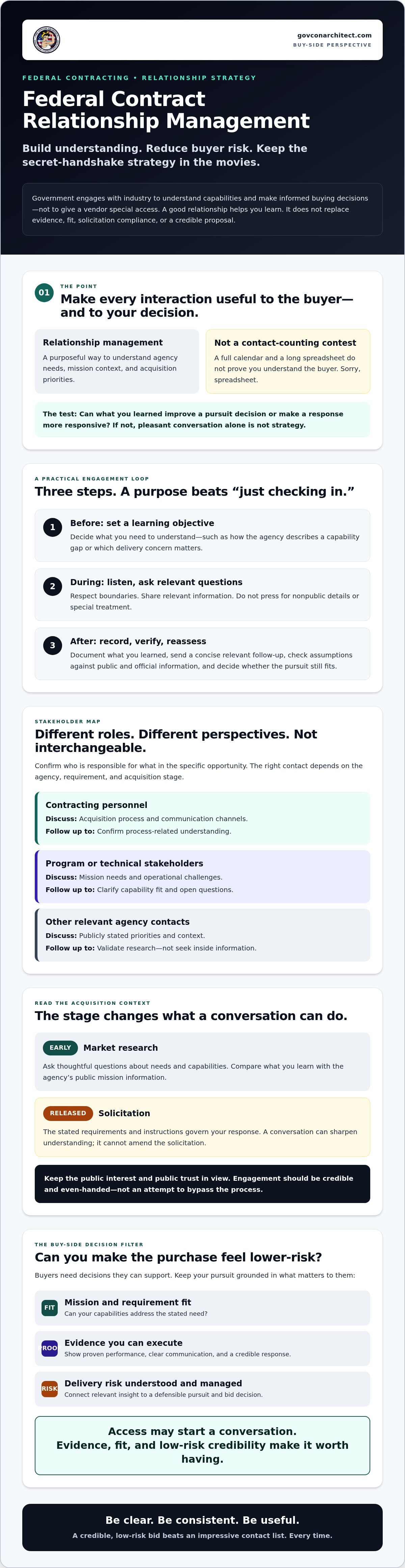
A federal pursuit rarely has one stakeholder who can explain every part of a requirement. Contracting personnel, program or technical stakeholders, and other relevant contacts may each offer a different perspective. Their roles and authority aren’t interchangeable. Before shaping your engagement plan, confirm who is responsible for what in the specific opportunity.
Start with the agency’s public mission information and the acquisition stage. Early market research is a chance to ask thoughtful questions about needs and capabilities. Once a solicitation is released, its stated requirements and instructions govern your response. A conversation can sharpen your understanding, but it cannot amend the solicitation. The guiding principles for the Federal Acquisition System emphasize serving the public interest and maintaining public trust. That’s why credible, even-handed engagement matters.
Whom Should a Federal Contractor Build Professional Relationships With?
Build relevant professional contacts around the work, not an imagined org chart. For each opportunity, use available acquisition information and appropriate conversations to verify stakeholder roles. The right contact depends on the agency, requirement, and stage. A broad contact list may look impressive in a spreadsheet, but it doesn’t show whether you understand the buyer.
| Stakeholder perspective | Useful discussion focus | Follow-up purpose |
|---|---|---|
| Contracting personnel | Acquisition process and communication channels | Confirm process-related understanding |
| Program or technical stakeholders | Mission needs and operational challenges | Clarify capability fit and open questions |
| Other relevant agency contacts | Publicly stated priorities and context | Validate research, not solicit inside information |
What Can Relationship-Building Tell You About Buyer Priorities?
Compare public mission information with what you learn through appropriate conversations. Look for practical context: what outcome matters, what execution concerns may affect the work, and which assumptions need verification. That’s useful federal market intelligence, not a substitute for the solicitation. Record the insight, check it against official information, and decide whether your firm can credibly reduce buyer risk.
If you need a structured sounding board for a pursuit, you can discuss your federal strategy. Keep the objective clear: better-informed decisions, not special access.
A Practical Federal Contract Relationship Management Process
Good federal contract relationship management depends on a repeatable workflow, not a growing contact list. The University of Maine’s Basics of Federal Contracting describes the process as a relationship with the sponsor. Keep that relationship professional and anchored to the work.
- 1. Define the pursuit. Name the opportunity or market objective, then list what your firm needs to verify before investing further effort.
- 2. Identify relevant stakeholders. Confirm who can speak to the mission, technical need, or acquisition process for this pursuit.
- 3. Prepare. Review public agency information and opportunity context. Set one learning objective and write focused questions.
- 4. Engage. Briefly explain your relevant delivery experience, ask your prepared questions, and listen. Don’t fish for undisclosed requirements.
- 5. Document. Record appropriate, non-sensitive observations, open questions, commitments, and follow-up actions. Separate confirmed facts from assumptions.
- 6. Reassess. Compare what you learned with documented requirements, your capabilities, competition, and delivery risk. Decide whether to advance, adjust, or stop.
How Should You Prepare for a Government Stakeholder Conversation?
Do the homework first. Review public mission information and the opportunity context, then prepare a concise explanation of your relevant delivery experience. Be specific about what you want to learn. For example, ask whether your understanding of an operational challenge matches what the agency has publicly described. Preparation respects the buyer’s time and keeps the conversation from turning into a pitch marathon.
How Do You Turn Engagement Into Better Pursuit Decisions?
Use conversations to sharpen your questions and research, then test what you learn against documented requirements. Don’t treat a hint, impression, or friendly exchange as an undisclosed requirement. If evidence changes your view of fit or execution risk, update your bid/no-bid decision, capture priorities, or proposal evidence. A disciplined federal contract capture plan development process connects those findings to action.
Build a Sustainable Relationship Strategy Without Chasing “Insider Access”
More contacts don’t automatically create stronger positioning or a better bid. A crowded address book can still leave you guessing about the agency’s needs. Sustainable federal contract relationship management means showing up consistently with relevant questions, accurate information, and evidence your firm can deliver. The goal is to reduce buyer uncertainty, not collect proximity to decision-makers.
What Does Credible, Low-Risk Engagement Look Like?
Keep your capability claims accurate. Use relevant delivery evidence, follow through on what you say, and make commitments your team can meet. If your experience doesn’t match the requirement, don’t dress the gap up as a “strategic adjacency.” Buyers need a clear view of fit and execution risk. Align your evidence with the government bid evaluation criteria, then let the facts do the heavy lifting.
When Can Strategic Advisory Help Maintain Consistency?
Ongoing monthly guidance can help established firms maintain pursuit discipline across opportunities. Support for one defined pursuit can focus on that opportunity’s capture and proposal decisions. These are different needs, not interchangeable labels for “more meetings.” Choose the support that fits the work in front of you.
The GovCon Architect brings a buy-side perspective informed by founder Nikki Gianni’s 22 years as a government buyer, evaluator, awarder, and contract administrator. That experience can inform strategy and help firms assess how buyers view credibility and risk. It is guidance, not privileged access or an award guarantee. The firm is suited to commercial businesses with at least $5M in annual revenue and five years of proven delivery.
Make Every Federal Relationship Earn Its Place
Strong federal contract relationship management isn’t about collecting contacts or hoping familiarity turns into an advantage. It’s disciplined buyer learning: identify relevant stakeholders, engage with a clear purpose, and check what you learn against documented requirements. Then use verified insight to make better pursuit decisions and show the government why your firm is a credible, low-risk choice.
Consistency matters more than access. Accurate claims, relevant delivery evidence, and reliable follow-through build confidence. The government needs a sound basis for its decisions, not another contractor trying to charm its way around the work.
GovCon Architect offers monthly strategic guidance for firms navigating the federal marketplace and targeted support for specific contract pursuits. Founder Nikki Gianni brings 22 years of buy-side experience as a government buyer, evaluator, awarder, and contract administrator. That perspective can help you assess your approach without pretending relationships guarantee results.
Build trust the right way. Book a 15-minute get-to-know-you call with GovCon Architect to discuss a more deliberate, credible approach to your next federal pursuit.
Frequently Asked Questions
What is federal contract relationship management?
Federal contract relationship management is deliberate, professional engagement that helps a firm understand an agency’s mission, needs, and acquisition context. It isn’t a route to privileged information or a promise of influence. The goal is to learn enough to assess fit, ask better questions, and make sound pursuit decisions. Relationships support research and proposal planning; they don’t replace solicitation requirements or evidence of delivery capability.
How do federal contractors build relationships with government agencies?
Federal contractors build relationships by engaging relevant stakeholders with a clear purpose and respect for professional boundaries. Review public agency information first, prepare focused questions, and explain relevant experience accurately. After each conversation, document appropriate observations, open questions, and follow-up actions. Avoid contact for contact’s sake. A useful interaction should improve your understanding of the agency’s stated needs or help you determine whether your firm can credibly meet them.
Who should a company build relationships with when pursuing a federal contract?
Build professional relationships with stakeholders relevant to the specific agency, requirement, and acquisition stage. Contracting personnel may provide context about the acquisition process, while program or technical stakeholders may help clarify operational needs. Other contacts may offer useful public mission context. Their roles and authority differ, so verify responsibilities for each opportunity rather than assuming one person represents every part of the buying process.
Can relationships help a company win a federal contract?
Relationships can help a company understand buyer priorities and make better-informed pursuit decisions, but they can’t guarantee an award. The government needs a defensible basis for its decision. Your proposal still must address the solicitation, demonstrate relevant capability, and give evaluators confidence in your ability to perform. Treat conversations as a way to sharpen research and clarify fit, not as a substitute for compliant, persuasive proposal evidence.
How do you build government relationships without seeking special access?
Keep engagement transparent, relevant, and grounded in public information and stated requirements. Set a learning objective for each conversation, ask appropriate questions, and don’t seek nonpublic details or exceptions to the process. Follow up professionally and make only realistic commitments. Consistent, accurate communication helps demonstrate that your firm understands the buyer’s need and takes delivery risk seriously. No secret handshake required, and that’s a good thing.