
Federal Bid Disqualification Factors: Why 'Good Enough' is a Fatal Bid Strategy

Article by
Nikki Gianni
Nikki Gianni is a seasoned business strategist and government contracts coach, dedicated to helping businesses successfully navigate the complexities of government contracting. With over 22 years of experience in Department of Defense contracting, including managing $20 billion in federal awards, Nikki has developed the innovative GovReady Blueprint™ Framework, a comprehensive 90-day program designed to prepare businesses to compete for and win lucrative contracts at the federal, state, and local levels. Nikki's approach emphasizes not just gaining contracts but also enhancing overall business profitability.
Before becoming a business owner, Nikki was active-duty Air Force for 10 years, then spent another 15 years as a civil servant with the DOD. Now she's an empty nester living in Southern California who loves spending time with her 22-year-old son, Lex and her 2 Mini Aussies, Tony & Carmela, doing home improvement and crafts projects, and networking.
The federal government doesn't care about your "industry-leading" technical solution if you can't follow basic instructions. It sounds harsh. I know. But the Buy-Side isn't looking for a soulmate. They're looking for the lowest risk. You've likely spent fifty thousand dollars on a proposal only to have it tossed because of a missing signature. It feels like a lottery. It isn't. The house always wins when you ignore the clinical reality of FAR compliance.
Understanding federal bid disqualification factors is the difference between a contract award and a "non-responsive" letter that ruins your month. I've seen too many good firms lose money to silly administrative errors. We're going to dive into the evaluator's mindset to show you why they're looking for reasons to delete your PDF before lunch. You'll learn how to build a bulletproof submission process and stop wasting time on bids that are dead on arrival. Let's get serious about winning.
Key Takeaways
- The Buy-Side isn't looking for a partner; they're looking for a reason to say "no" to reduce their own liability. Learn why the government’s obsession with low risk means your bid is an elimination target from the moment it hits their inbox.
- Master the federal bid disqualification factors that turn expensive proposals into paperweights. From the "late is late" rule to unacknowledged amendments, we'll show you the administrative landmines that kill bids in 60 seconds or less.
- Your commercial reputation is worthless if you ignore the rigid instructions in Section L and M. We’ll explain why the government views your "standard business practices" as a fatal lack of discipline rather than a sign of expertise.
- Adopt a defensive bidding strategy using a Compliance Matrix and a Red Team Review to find the flaws you're too close to see. Stop gambling on "good enough" and start submitting proposals that are legally and technically unassailable.
The Buy-Side Reality: Why Compliance is the Government's First Cut
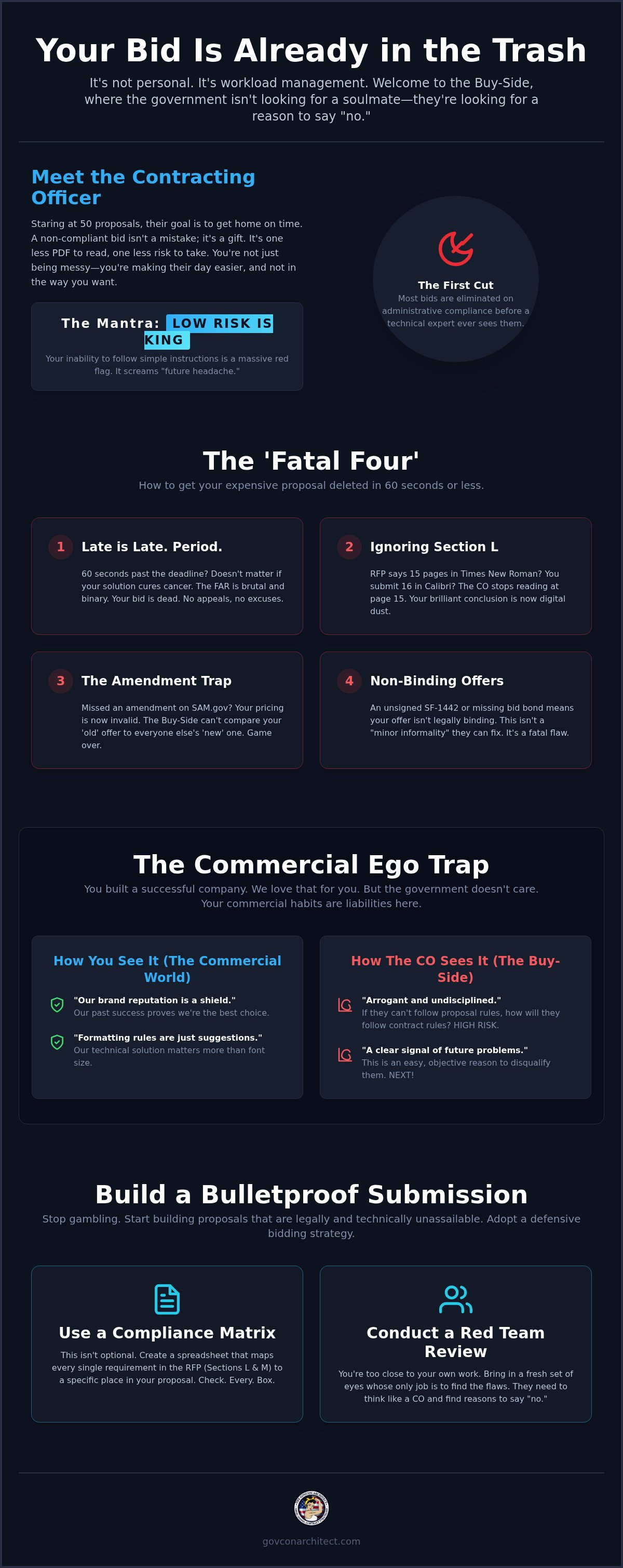
I want you to win. I really do. But your "revolutionary" technical solution is currently sitting in a digital trash bin because you forgot to acknowledge a minor amendment. Welcome to the Buy-Side. In this world, a Contracting Officer (CO) staring at 50 proposals isn't looking for a soulmate. They're looking for a reason to say "no" so they can go home before 6:00 PM. It’s not personal; it’s workload management.
The Burden of Choice and Workload Management
The U.S. government procurement process is designed to be efficient for the buyer, not the bidder. COs use administrative reviews as a high-speed filter to thin the herd. Finding a "non-responsive" bid provides instant psychological relief. It's one less file to evaluate and one less potential protest to document. When you ignore federal bid disqualification factors, you aren't just being "a bit messy." You're giving the CO a gift: the gift of a lighter workload.
Risk as a Disqualification Factor
In federal contracting, low risk is king. If you can't follow simple instructions in Section L, why would the government trust you to manage a multi-million dollar project? A missing signature or an incorrect font size isn't just a typo. To the CO, it's a red flag signaling future performance risk. They view administrative sloppiness as a legal vulnerability. Aligning with a low risk bidder strategy means realizing that compliance is a test of your discipline. If you fail the "follow directions" test, you never even make it to the "show us your solution" phase. Most bids die in the first hour of review before a technical expert even sees them. Don't let your hard work be a casualty of the first cut.
The 'Fatal Four' Federal Bid Disqualification Factors
You can have the best team in the world, but if you're 60 seconds late, you're dead. FAR 52.215-1 is the executioner here. It's binary. It's brutal. It's the Buy-Side. If the RFP says 15 pages and you submit 20, the CO will literally stop reading at page 15. Your summary? Gone. Your price logic? Irrelevant. They aren't trying to be mean; they're trying to be fair to the 49 other people who followed the rules. In their world, low risk is king.
The Amendment Trap
Missing a material amendment is a classic way to trigger federal bid disqualification factors. If the government changes the scope, perhaps by adding a requirement for a specific security clearance or shifting the delivery schedule, and you don't acknowledge it, your pricing is technically invalid. The Buy-Side cannot compare your "old" price to everyone else's "new" price. Monitoring SAM.gov is a daily survival task, not a weekly chore. You wouldn't ignore a text from your spouse; don't ignore an update from the agency.
The SF-1442 and Legal Binding
An unsigned SF-1442 or a missing bid bond makes your offer legally non-binding. According to the Federal Acquisition Regulation on bid rejection, the CO has zero wiggle room here. They cannot "clarify" a missing signature after the deadline because that would allow you to walk away from the deal without penalty. It’s a fatal non-responsiveness issue, not a "minor informality." Avoid these common federal proposal writing mistakes by treating every checkbox as a legal landmine. If you want an expert eye to audit your next submission before the CO finds a reason to toss it, a Capture & Proposal Sprint can help you lock down compliance.
The Commercial Trap: Why Success Fails in Federal Bids
You’ve built a $10M company. You’ve got the best reputation in the city. I love that for you. I really do. But the government doesn’t care about your commercial ego. In the federal world, your past success is irrelevant if you treat the RFP like a rough draft. This is where established firms bleed money. They assume their brand is a shield. It isn't.
Commercial Ego vs. Federal Rigidity
Commercial giants often fail because they view Section L instructions as suggestions. They ignore font sizes or volume structures because they believe their technical brilliance speaks for itself. It doesn't. The Buy-Side sees a font violation as a psychological profile. If you can’t follow a margin rule, why would they trust you with a complex safety regulation? The Code of Federal Regulations on disqualification isn't a bedtime story. It’s the baseline. Administrative rigidity is the CO’s way of verifying that you are disciplined enough to handle taxpayer dollars. Sloppiness is a risk they won't take.
Section L & M: The Only Rules That Matter
Section L tells you how to write the bid. Section M tells you how they’ll grade it. If you don't map your proposal to these criteria, you're inviting federal bid disqualification factors to destroy your ROI. You need a low risk bidder strategy that prioritizes compliance over marketing fluff. This isn't a creative writing contest. It's a structural integrity test.
Don't get cute with pricing either. "Unbalanced pricing", where you front-load costs to help your cash flow, scares the government. They see it as a liability if the contract is terminated early. Similarly, the "Just Get Certified" myth is a dangerous distraction. Certifications are just entry tickets. They don't protect you from administrative disqualification if you miss a signature. Low risk is king, and compliance is your only shield.
Break Into the Federal Market...Without Guessing
Building a Low-Risk Submission: Defensive Bidding Strategy
Stop treating your proposal like a creative writing project and start treating it like a structural engineering feat. If you want to neutralize federal bid disqualification factors, you need a defensive strategy that assumes the evaluator is looking for a reason to kill your bid. Because they are. I'm telling you this because I want you to stop setting money on fire. Winning isn't about being the "best"; it's about being the most unassailable.
The Compliance Matrix as a Strategic Asset
Your first move is building a Technical Proposal Compliance Matrix. This isn't just a fancy checklist. It’s a map of every "shall," "must," and "will" buried in the RFP. If the solicitation asks for a specific font in a specific table, the matrix catches it. It forces your team to align with Section L before a single word of the technical solution is written. This is how you transition from a "good enough" bidder to a low-risk asset.
Eliminating the 'Lottery' Mindset
Firms with $5M+ revenue can't afford a "lottery" mindset. Hope is a terrible business model. You need evidence-based architecture. This involves a Red Team Review where fresh, cynical eyes hunt for "disqualification triggers" you’ve grown blind to. Follow that with a "Buy-Side" audit: read your own bid through the eyes of a CO who has a headache and 40 other files to grade. If you find a single reason to say "no," fix it. Sometimes, the smartest move is bringing in a Fractional Federal Strategy Advisor to serve as your defensive coordinator. It’s significantly cheaper than losing a multi-million dollar contract because of a missing signature. Low risk is king. Build accordingly.
Stop Gambling on Compliance and Start Architecting Your Wins
The federal market isn't a lottery. It's a high-stakes engineering project where the government is actively looking for any excuse to delete your proposal. We've covered the brutal reality of the Buy-Side. You now know that federal bid disqualification factors like late submissions and unacknowledged amendments are the fastest ways to set fifty thousand dollars on fire. You're too successful to lose because of a font size or a missing signature.
It’s time to move past the "hope and pray" method. You need a systematic approach that prioritizes low risk above all else. Led by Nikki Gianni, we bring 22 years of Buy-Side experience to firms with $5M+ revenue who are tired of being "almost" winners. There are no shortcuts here; just strategic architecture that makes you the safest bet in the room. I’ve seen enough "good enough" bids fail to know that you deserve a better result.
You’ve got the delivery expertise. Let’s make sure the government actually gets to read about it. You’re doing great work. Let’s get you the contract to match.
Frequently Asked Questions
Can a contractor fix a compliance error after the bid is submitted?
No, you typically cannot fix a material compliance error once the clock strikes zero. The government isn't your high school teacher; they won't let you turn in a missing signature for partial credit. Unless it's a minor informality, the Buy-Side will toss it to keep the process fair. This is why low risk is king. One oversight is enough to trigger federal bid disqualification factors that end your pursuit instantly.
What is the penalty for submitting a federal bid even one minute late?
The penalty is absolute rejection. There is no "grace period" in federal contracting. If the deadline is 2:00 PM and your email lands at 2:01 PM, you’re out. FAR 52.215-1 makes it clear that late proposals won't be considered unless very specific, rare exceptions apply. The Contracting Officer doesn't want to hear about your internet lag. To them, being late is a sign that you’re a high-risk liability.
Does the government have to tell me why my bid was disqualified?
Yes, you have a right to know, but you have to ask. If you're disqualified, you should request a debriefing immediately. The government is required to provide the basis for their determination, but they won't chase you down to explain it. Understanding these federal bid disqualification factors is vital for your post-game analysis. It’s the only way to stop making expensive mistakes and finally align with the Buy-Side.
What is the difference between a 'non-responsive' and 'non-responsible' bidder?
A "non-responsive" bidder failed the "follow directions" test on the proposal itself. You missed a signature or ignored a page limit. A "non-responsible" bidder might have submitted a perfect proposal but lacks the financial resources or delivery history to perform the work. Think of it this way: responsiveness is about the paperwork; responsibility is about the business. The Buy-Side needs both to feel safe enough to award the contract.
How can I find out if my competitors were disqualified for the same factors?
You can use the Freedom of Information Act (FOIA) or review public protest records to see where others tripped up. While the government won't hand over proprietary secrets, the reasons for rejection in a public award notice are often visible. It’s clinical research for the serious bidder. Instead of guessing why you lost, look at the patterns. If the same factors keep killing bids in your industry, you know exactly what to avoid.