

Federal Agency Engagement Strategy: How to Stop Being a High-Risk Nuisance

Article by
Nikki Gianni
Nikki Gianni is a seasoned business strategist and government contracts coach, dedicated to helping businesses successfully navigate the complexities of government contracting. With over 22 years of experience in Department of Defense contracting, including managing $20 billion in federal awards, Nikki has developed the innovative GovReady Blueprint™ Framework, a comprehensive 90-day program designed to prepare businesses to compete for and win lucrative contracts at the federal, state, and local levels. Nikki's approach emphasizes not just gaining contracts but also enhancing overall business profitability.
Before becoming a business owner, Nikki was active-duty Air Force for 10 years, then spent another 15 years as a civil servant with the DOD. Now she's an empty nester living in Southern California who loves spending time with her 22-year-old son, Lex and her 2 Mini Aussies, Tony & Carmela, doing home improvement and crafts projects, and networking.
Your capability statement is currently serving as expensive digital wallpaper in a Contracting Officer's deleted items folder. It's harsh, but it's the truth. Most firms treat their federal agency engagement strategy like a cold-call floor at a shady brokerage. You're focusing on "selling" instead of solving. You aren't a partner yet. You're just a high-risk nuisance. The government doesn't want to be sold to. They want to be de-risked.
We get it. It's exhausting to watch your emails vanish into a bureaucratic black hole while you waste hours at networking events that yield nothing but cold coffee. You feel ignored because you haven't given them a reason to pay attention. This article will show you how to flip the script by adopting a "Buy-Side" mindset where low risk is king. We'll break down a predictable framework for securing agency meetings and explain the clinical "why" behind their behavior. It's time to position your firm as the safe, defensible choice they actually want to hire.
Key Takeaways
Stop acting like a door-to-door salesman. Agencies don't buy products; they buy the total absence of problems.
Learn to navigate the Buy-Side hierarchy by understanding that the Contracting Officer is a professional risk manager, not your friend.
Execute a federal agency engagement strategy that uses market intelligence to identify where you're actually needed instead of shouting into the void.
Ditch the generic capability statement templates that scream "amateur" and learn to present your firm as a defensible, low-risk asset.
Table of Contents
What is a Federal Agency Engagement Strategy? (Hint: It’s Not a Sales Pitch)
Avoiding the 'Capability Statement' Trap: High-Value Tactics
What is a Federal Agency Engagement Strategy? (Hint: It’s Not a Sales Pitch)
Your marketing deck is adorable, but it's likely hurting your feelings and your bank account. A real federal agency engagement strategy isn't about flashy slogans or "growth hacking." It's the systematic process of reducing a Contracting Officer's perceived risk. In the complex landscape of public administration, the person holding the pen has one primary objective: avoid a career-ending disaster. If hiring you looks like a gamble, you lose. Every single time.
This brings us to the Buy-Side mantra. Agencies don't buy your "innovative solutions." They buy the total absence of problems. In federal circles, "marketing" is a dirty word because it signals high risk and low substance. While commercial business relies on "relationship building," federal success depends on building trust through compliance and structural stability. You aren't there to be their friend; you're there to be their safest bet.
The Reality Check: Why They Aren't Calling You Back
Stop treating the government like a commercial client. Their "why" isn't profit; it's survival. If you've fallen for the "just get certified" lie, let's clear that up now. A certification is a ticket to the stadium, not a guaranteed touchdown. In fact, your commercial success can actually look like risk to a federal evaluator. If you haven't aligned with a low-risk bidder strategy, you just look like a firm that doesn't know how to follow the rules. You're being ignored because you look dangerous, not because you're small.
The Buy-Side Hierarchy: Who You Actually Need to Engage
Stop wasting your breath on the wrong people. A successful federal agency engagement strategy requires clinical precision in identifying who actually holds the power. You are looking for the "Buy-Side" decision makers, not the professional greeters at networking booths who hand out brochures and empty promises.
The Contracting Officer (KO): The only person who can legally bind the government. They are risk managers with warrants. They don't care about your "vision." They care about defensibility and procedural integrity.
The Contracting Officer’s Representative (COR): The technical expert. They have to live with your performance. Their fear is a failed project that makes them look incompetent to their superiors.
The Program Manager: The person with the actual headache. They have the budget and the requirement. They need a solution that won't blow up in their face six months from now.
If your firm is doing $5M+ in revenue, the Small Business Liaison is often a cul-de-sac. They are helpful for beginners, but you aren't a beginner. You need to engage the people who are actually evaluated on project outcomes. To refine your federal agency engagement strategy, you might want to explore our strategic advisory support.
Understanding the Evaluator's Fear
KOs are terrified of bid protests. A protest means the procurement stops, the lawyers move in, and their professional judgment is publicly questioned. This is why "low risk is king." They will choose the boring, stable firm over the "innovative" wild card every time. Your engagement must prove you are the safe choice. Use Section L&M of the solicitation as your roadmap. It tells you exactly how they will grade you. Understanding Government Bid Evaluation Criteria: The Buy-Side Reality Check is essential for anyone tired of losing to "safe" incumbents.
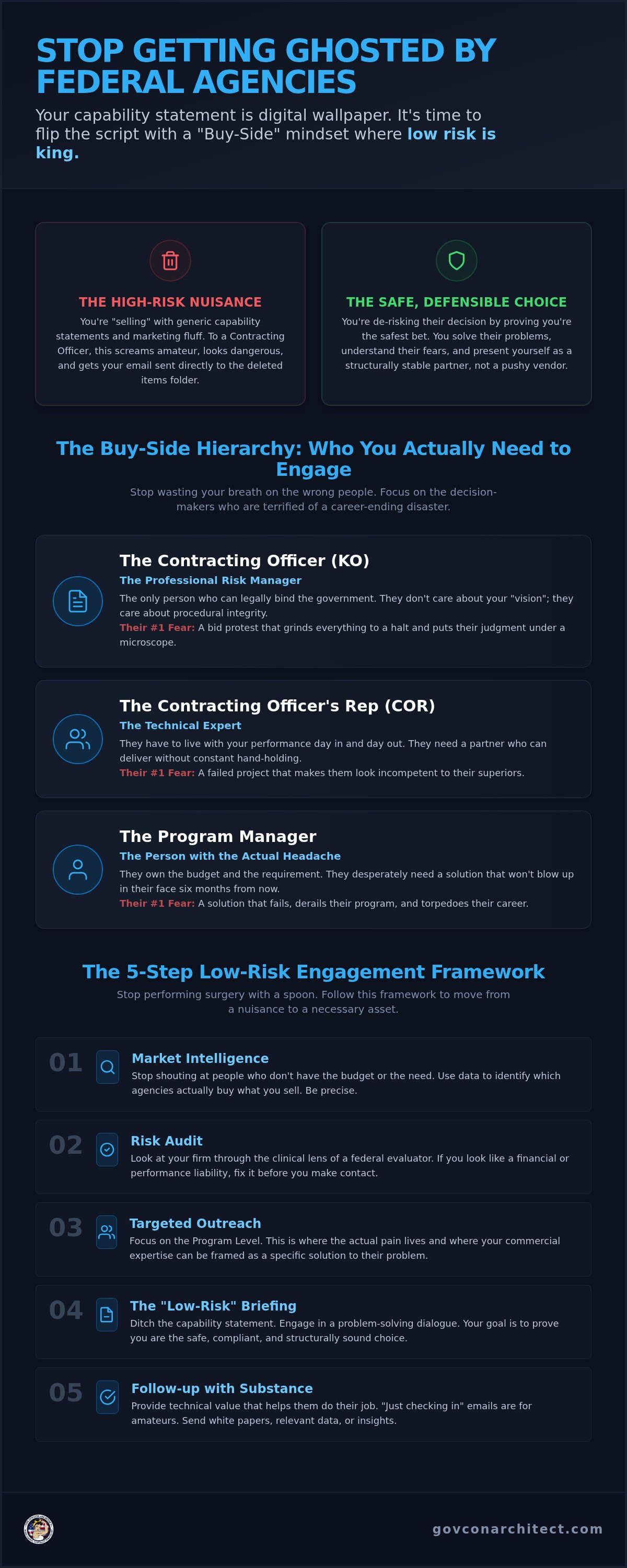
The 5-Step Low-Risk Engagement Framework
Executing a federal agency engagement strategy without a framework is like trying to perform surgery with a spoon. It's messy, painful, and nobody survives. To win, you must stop acting like a vendor and start acting like a solution to a bureaucrat's worst nightmare. This five-step process is designed to move you from a nuisance to a necessary asset.
Step 1: Market Intelligence. Identify which agencies actually buy what you sell. Stop shouting at people who don't have the budget.
Step 2: Risk Audit. Evaluate your firm through the clinical lens of a federal evaluator. If you look like a liability, fix it before you speak.
Step 3: Targeted Outreach. Focus on the Program Level. This is where the actual pain lives and where your commercial expertise matters most.
Step 4: The "Low-Risk" Briefing. Ditch the capability statement. It's a high-risk signal. Engage in a problem-solving dialogue instead.
Step 5: Follow-up with Substance. Provide technical value. "Just checking in" emails are for amateurs and stalkers.
Phase 1: Intelligence Over Instinct
Most firms waste thirty days hunting for shortcuts that lead to a dead end. Spend ninety days on Federal Market Intelligence Consulting instead. It is faster to walk the correct path than to sprint through a minefield. Intelligence tells you which doors are unlocked and which ones are rigged with alarms.
Schedule your fractional strategy briefing
Phase 2: The Art of the Meeting
When you finally get the meeting, don't sell. A sophisticated federal agency engagement strategy ensures the KO feels safe, not pitched. Address their regulatory constraints upfront. Show them you understand the why behind their rigid procedures. When you demonstrate that you're a low-risk partner who respects the system, the conversation shifts from "can we hire them?" to "how do we hire them?"
Avoiding the 'Capability Statement' Trap: High-Value Tactics
Capability statements are often the participation trophies of the GovCon world. If yours looks like a generic Canva template, you're signaling to the buyer that you're a high-risk amateur. A sophisticated federal agency engagement strategy requires you to ditch the fluff. Contracting Officers don't care about your "passion for excellence." They care about whether you'll still be in business when the project hits a snag in year three.
Transitioning from a "vendor" to a strategic partner means moving into the role of a Fractional Federal Strategy expert. You aren't there to sell a product; you're there to de-risk a mission. For established firms with over $5M in revenue, your commercial history is your shield. Five plus years of delivery proves you have the structural integrity to handle the bureaucracy. Use that commercial success to show the government that hiring you is the safest decision they'll make all year.
GovCon isn't a scratch-off lottery ticket. It's a long-term commitment. Real results take six to twelve months of disciplined engagement. If you're looking for a thirty-day shortcut, you're in the wrong room. If you're looking to build a defensible, multi-million dollar federal practice, you're exactly where you need to be.
Strategic Positioning for $5M+ Firms
Your five-year track record is proof that you aren't a "fly-by-night" operation. Leverage that stability. By aligning your firm with a Low Risk Bidder Strategy, you shift the narrative from what you do to how safely you do it. Stop guessing and start winning with the RETAINER · MONTHLY – Fractional Federal Strategy Advisor. You've done the hard work of building a real company. Now, let's make sure the government knows it.
Stop Guessing and Start Building a Defensible Practice
Stop treating federal contracting like a blind date and start treating it like a high-stakes architectural project. You've built a successful $5M+ commercial firm; don't let a weak federal agency engagement strategy make you look like a liability. Remember that on the Buy-Side, the Contracting Officer is looking for the path of least resistance. They want a partner who respects their regulatory handcuffs and delivers without drama.
We specialize in helping established firms navigate this bureaucracy using 22 years of direct buy-side experience. Our Fractional Federal Strategy Advisor support starts at $3,500 per month and is built specifically for leaders who value results over effort. You don't need more networking events; you need a defensible framework that proves you're the safe choice. You have the delivery history to win. Now you just need the strategy to get the right person to see it.
Book a 15-minute 'get-to-know-you' call to build your Buy-Side strategy
You've already done the hard part by building a real business. Let's make sure the government finally recognizes the asset you've created.
Frequently Asked Questions
How do I get a meeting with a federal Contracting Officer?
Focus on solving a specific pain point rather than selling a service. Identify the program manager or technical lead who owns the problem first. KOs are gatekeepers of risk; they won't meet if they think you're just another vendor fishing for info. Present yourself as a low-risk solution with a proven commercial track record of $5M+ in revenue. If you look like a safe bet, the door opens.
What is the difference between marketing and federal agency engagement?
Marketing is about making people want what you sell, while a federal agency engagement strategy is about proving you can survive the bureaucracy. Marketing often signals high risk because it focuses on fluff and promises. Engagement is a clinical, systematic process of reducing an evaluator's fear. It’s about structural integrity, compliance, and demonstrating that your firm is the most defensible choice for the person signing the contract.
Why does the government care more about 'low risk' than low price?
A cheap contract that fails is a career-ending disaster for a Contracting Officer. If your bid is low but your delivery is risky, the KO faces bid protests and administrative nightmares. Low risk is king because the government buys the absence of problems. They would rather pay a fair market price for a firm with 5+ years of experience than save a few dollars on a "fly-by-night" operation.
Do I need a capability statement to engage a federal agency?
You need the information it contains, but you don't need a generic template. Most capability statements are digital wallpaper that KOs ignore. Instead of relying on a static document, focus on a high-value dialogue that addresses specific agency needs. We don't provide templates because we focus on real strategy. Your commercial delivery history and structural stability are far more important to a buyer than a fancy PDF.
How long does it take to see results from a federal engagement strategy?
Real results in the federal market typically take 6 to 12 months of disciplined effort. This isn't a scratch-off lottery ticket or a 30-day shortcut. Building a defensible federal revenue stream requires a minimum 3-month commitment just to align your internal structures. We recommend a longer horizon because the procurement cycle is slow and methodical. Success comes to those who prioritize strategic stability over quick, amateur wins.