

DCAA Audit Readiness for Small Business: A 2026 Checklist

Article by
Nikki Gianni
Nikki Gianni is a seasoned business strategist and government contracts coach, dedicated to helping businesses successfully navigate the complexities of government contracting. With over 22 years of experience in Department of Defense contracting, including managing $20 billion in federal awards, Nikki has developed the innovative GovReady Blueprint™ Framework, a comprehensive 90-day program designed to prepare businesses to compete for and win lucrative contracts at the federal, state, and local levels. Nikki's approach emphasizes not just gaining contracts but also enhancing overall business profitability.
Before becoming a business owner, Nikki was active-duty Air Force for 10 years, then spent another 15 years as a civil servant with the DOD. Now she's an empty nester living in Southern California who loves spending time with her 22-year-old son, Lex and her 2 Mini Aussies, Tony & Carmela, doing home improvement and crafts projects, and networking.
A last-minute audit binder isn’t readiness. It’s paperwork cosplay, and the tabs won’t distract anyone from processes that don’t match the records. DCAA audit readiness for small business means keeping financial records, timekeeping, cost allocation, and supporting evidence consistent in day-to-day operations, not scrambling to make them look tidy at the eleventh hour.
It’s reasonable to wonder which records matter, where gaps hide, and who should fix them before a review exposes a process held together by good intentions and a spreadsheet called “final-final.” This checklist gives you a practical way to organize relevant evidence, test for weak points, and assign follow-up. It’s a readiness tool, not a compliance determination or a promise about an audit outcome.
Operational discipline matters beyond an audit, too. Government buyers evaluate risk because they need confidence that a contractor can perform, document, and manage the work. A credible evidence trail helps support that low-risk picture. The checklist covers core readiness areas, then connects the operational picture to federal strategy through the Buy-Side perspective.
Key Takeaways
- DCAA audit readiness for small business depends on repeatable practices and evidence that supports how your accounting processes work, not a binder polished for show.
- Review the timekeeping, labor distribution, and approval records relevant to your contract and circumstances. Don’t assume every item applies to every contractor.
- Map applicable obligations, compare related records, log gaps, and assign an owner and next step to each corrective action.
- Keep accounting-system readiness separate from bid strategy. Buyers look for documented credibility and manageable execution risk, not confidence alone.
DCAA Audit Readiness for Small Business: What the Checklist Can, and Cannot, Tell You
A binder can look immaculate and still leave the central question unanswered: can your team explain how its accounting practices work and support that explanation with reliable evidence? Readiness isn’t document decorating. It’s repeatable processes followed in practice, with records that make the work traceable rather than mysterious.
DCAA audit readiness for small business means being able to explain and substantiate the accounting practices relevant to your circumstances. The Defense Contract Audit Agency is part of the wider federal oversight picture. The Defense Contract Audit Agency (DCAA) overview provides background on the agency. What applies to your company, and what a review may cover, depends on your contract and circumstances. Review contract terms and current authoritative guidance before treating a checklist item as an obligation.
Why the word “small” does not remove the need for evidence
Company size alone doesn’t tell you which contract-specific requirements apply. A small contractor may still need to explain how relevant costs are recorded and how its practices support the work. The government has a practical reason to examine evidence: buyers need a defensible basis for assessing performance and financial risk. Start with the requirements tied to your contract, not rules of thumb that sound reassuring because they’re simple.
Separate audit readiness from federal bid readiness
Accounting-process evidence shows how your financial practices work. Proposal compliance is about following the solicitation’s instructions. Evaluator-facing positioning explains why your offer is credible and manageable. These disciplines can support one another, but they aren’t interchangeable. Strong records won’t repair a proposal that misses a requirement, and polished proposal language won’t fix unsupported accounting practices.
A checklist can flag questions and expose gaps. It cannot certify compliance, determine which requirements apply, or predict an audit result. Treat it as a diagnostic tool, not a magic stamp. For the broader strategy question, a federal contract readiness assessment can help connect operational credibility with your federal-market position.
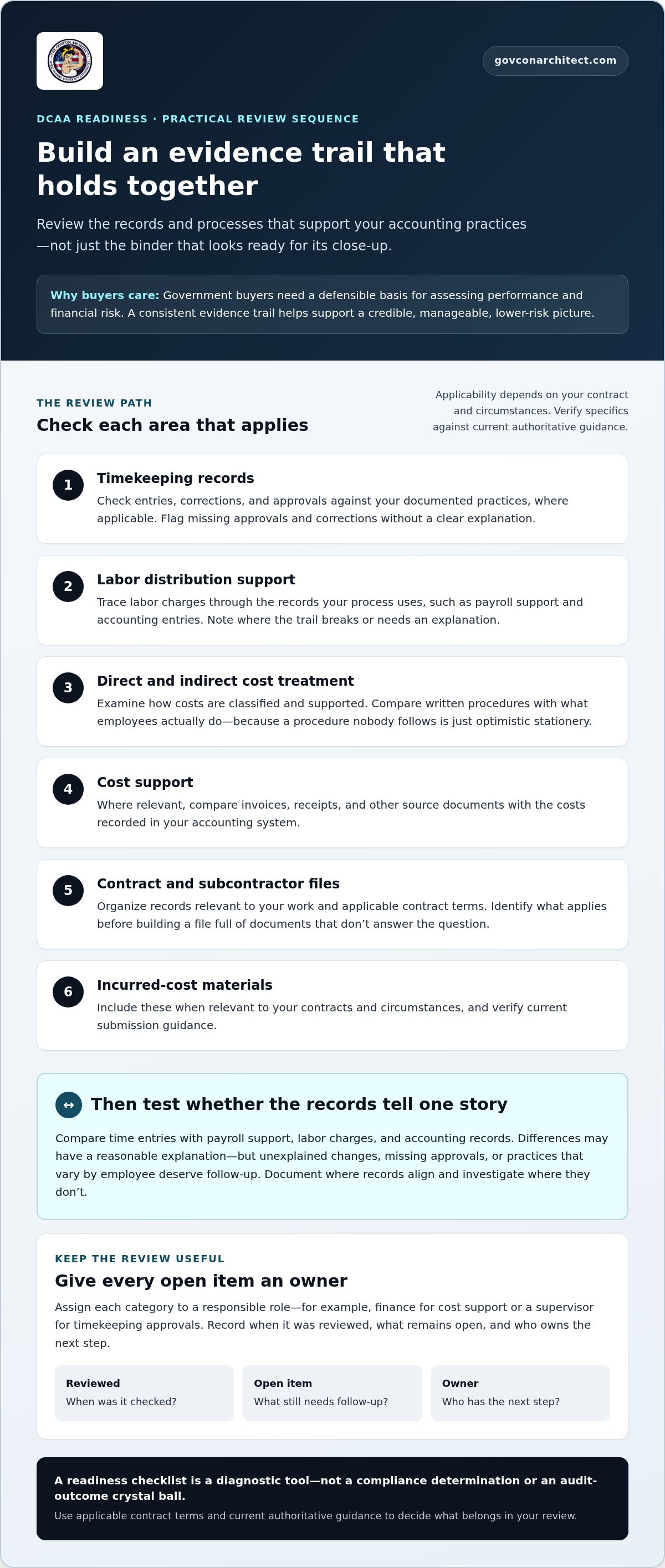
DCAA Audit Readiness Checklist: The Records and Processes to Review
Use this as a review tool, not a universal list of requirements. Which records matter depends on your contract and circumstances. Check the specifics against current authoritative guidance, including Official DCAA guidance and resources. Then review the areas that apply:
- Review timekeeping records: Check whether entries, corrections, and approvals follow your documented practices, where applicable. Look for missing approvals and corrections that don’t have a clear explanation.
- Review labor distribution support: Trace labor charges through the records your process uses, such as payroll support and accounting entries. Note where the trail breaks or needs an explanation.
- Review direct and indirect cost treatment: Examine how costs are classified and supported. Compare written procedures with what employees actually do.
- Review cost support: Where relevant, compare invoices, receipts, and other source documents with the costs recorded in your accounting system.
- Review contract and subcontractor files: Organize records relevant to your work and applicable contract terms. Identify what applies before building a file full of documents that don’t answer the question.
- Review incurred-cost materials: Include these when relevant to your contracts and circumstances, and verify current submission guidance.
Test whether records tell one consistent story
Compare time entries with payroll support, labor charges, and accounting records. Differences may have a reasonable explanation, but unexplained changes, missing approvals, or procedures that vary by employee deserve follow-up. The goal isn’t to make every file look identical. It’s to understand and document where records align, and to investigate where they don’t.
Assign owners and preserve a review trail
Assign each category to a responsible role, such as finance for cost support or a supervisor for timekeeping approvals. Record when it was reviewed, what remains open, and who owns the next step. Evidence discipline means keeping records organized, traceable, and consistent with the process your team actually follows.
This checklist supports DCAA audit readiness for small business, but it isn’t a compliance determination. If you’re also working to align operational credibility with federal pursuit strategy, you can discuss your federal strategy priorities.
How to Run a DCAA Readiness Self-Check Without Creating False Confidence
A useful self-check is a controlled review, not a ceremony where everyone declares victory because the folder has subfolders. For DCAA audit readiness for small business, use a sequence that makes assumptions visible and gives unresolved issues somewhere to go.
- Map applicable obligations. Review contract terms and current guidance to identify the requirements and records that apply. DCAA’s resources for small businesses can help you find agency information, but your contract and circumstances still matter.
- Collect evidence. Gather the relevant records and procedures for each process under review. Note where each item is stored and who maintains it.
- Test consistency. Compare related records with each other and with actual practices. Where appropriate under the contract and applicable guidance, review records from relevant periods rather than relying on one convenient example.
- Log gaps. Record unsupported entries, missing evidence, unclear procedures, or inconsistent execution. Don’t invent a pass score. Prioritize weaknesses that remain unresolved or lack supporting evidence.
- Assign actions. Name an accountable owner, document the corrective action and status, and set a next review date.
Use a simple tracker to keep the review operational:
| Process | Evidence location | Owner | Observed gap | Next review date |
|---|---|---|---|---|
| Timekeeping | System or file reference | Responsible role | Specific issue or none observed | Date |
When the self-check finds a gap
Classify the problem before prescribing a fix. Missing documentation means evidence isn’t available. Unclear procedures mean expectations aren’t defined well enough. Inconsistent execution means practice doesn’t match the process. Record the issue, potential operational impact, accountable owner, corrective action, and status. A clear diagnosis beats a vague “needs work” note every time.
Keep the checklist in its lane
A completed checklist doesn’t prove compliance or guarantee an audit result. It helps organize questions and actions. To connect operational findings with broader federal positioning, explore a federal readiness assessment.
From DCAA Readiness to Low-Risk Federal Positioning: What Comes Next
Accounting-system readiness and bid strategy solve different problems. One supports confidence in relevant accounting practices. The other positions a specific offer against an opportunity’s requirements and evaluation criteria. Both can inform a credible, low-risk posture, but neither replaces the other. A neat file cabinet is not a proposal strategy. Tragic, but true.
| Area | Purpose | Evidence | Decision owner |
|---|---|---|---|
| Accounting-system readiness | Explain and support relevant accounting practices | Applicable records, procedures, and supporting documentation | Internal finance or accounting leadership |
| Bid strategy | Align an opportunity and proposal with buyer requirements and evaluation criteria | Solicitation analysis, offer strategy, and substantiated claims | Company leadership and pursuit team |
The Buy-Side reality: evaluators need documented credibility to assess whether a company can execute and manage performance risk. Confidence matters less than evidence. If your operating practices support a claim about capacity, staffing, or delivery, make the connection clear and defensible. For a closer look at how buyers assess proposals, use this government bid evaluation criteria guide.
When operational evidence becomes part of the broader strategy
DCAA audit readiness for small business is an operational discipline, not a federal bid strategy. But substantiated practices can help support claims about execution. The GovCon Architect brings a Buy-Side perspective to federal strategy, aligning pursuit decisions with government risk evaluation and evaluator criteria. The firm works with established commercial businesses with $5 million or more in annual revenue and at least five years of proven delivery.
Choose a strategic next step, not a magic-binder fantasy
Ongoing advisory can guide federal strategy over time. Pursuit-specific support focuses on an individual opportunity and bid submission. The GovCon Architect offers both through RETAINER · MONTHLY - Fractional Federal Strategy Advisor and PER-PURSUIT · PROJECT - Capture & Proposal Sprint. The right approach depends on your business and the strategic support you need. No binder can do the thinking for you.
Turn Readiness Into Your Next Strategic Move
Your next move isn’t chasing a mythical perfect binder. It’s deciding what your evidence says about the business you’re building and what needs attention before that story is tested. Treat DCAA audit readiness for small business as one part of making federal work a credible, well-managed revenue channel.
That’s where the Buy-Side lens matters. Government decision-makers need defensible reasons to trust a contractor with performance. Nikki Gianni brings 22 years of Buy-Side experience, including work as a government buyer, evaluator, awarder, and contract administrator. Her federal strategy guidance focuses on government risk evaluation and alignment with contracting-officer criteria, not audit execution. Clear-eyed advice, not binder-shaped fairy tales.
If your company has at least $5 million in annual revenue and five or more years of proven delivery, the next step is a conversation about connecting your capabilities with a deliberate federal strategy. You don’t have to solve every open question before starting a useful conversation.
Frequently Asked Questions
Does every small business with a federal contract face a DCAA audit?
No. Having a federal contract doesn’t mean every small contractor faces the same audit or review. The type and scope can depend on the contract, the contractor’s circumstances, and applicable guidance. A pre-award accounting-system survey and a review of costs after performance, for example, address different questions. Check your contract terms and current authoritative guidance rather than assuming an audit is automatic or impossible.
What records should a small business organize for DCAA audit readiness?
Organize records that support the accounting practices relevant to your contract, such as timekeeping, labor charges, cost support, and documented procedures. For DCAA audit readiness for small business, make retrieval practical: use consistent file names, identify record periods, and keep source documents traceable to the related accounting entry. That way, a reviewer isn’t left playing detective across inboxes, desktops, and folders named “miscellaneous-final.”
How often should a business review its DCAA audit readiness?
There isn’t one review schedule that fits every contractor. Set an internal cadence that reflects your contract obligations and processes, then revisit relevant controls when something changes, such as accounting procedures, systems, or staff responsibilities. If the person who approves labor changes, for instance, check that actual practice and documentation still line up. Don’t wait for an audit notice to find out the handoff broke.
Can a completed DCAA readiness checklist guarantee a successful audit?
No. A checklist can help your team spot missing support or inconsistent procedures, but it can’t promise an audit outcome. A completed form also can’t establish that records are accurate or that employees follow the process consistently. Treat checklist responses as review notes, verify the underlying evidence, and resolve open issues. Confidence is welcome; treating a checked box as a verdict is not.
How is DCAA audit readiness different from federal bid readiness?
DCAA audit readiness concerns whether relevant accounting practices and records can be explained and supported. Bid readiness concerns whether your company can pursue an opportunity and submit a responsive, credible offer. Documented labor practices may support operational credibility, while a proposal must still follow the solicitation’s instructions and explain its approach. One doesn’t substitute for the other, though both can inform a sound federal strategy.