

Contracting Officer Risk Assessment: The Buy-Side Reality Check

Article by
Nikki Gianni
Nikki Gianni is a seasoned business strategist and government contracts coach, dedicated to helping businesses successfully navigate the complexities of government contracting. With over 22 years of experience in Department of Defense contracting, including managing $20 billion in federal awards, Nikki has developed the innovative GovReady Blueprint™ Framework, a comprehensive 90-day program designed to prepare businesses to compete for and win lucrative contracts at the federal, state, and local levels. Nikki's approach emphasizes not just gaining contracts but also enhancing overall business profitability.
Before becoming a business owner, Nikki was active-duty Air Force for 10 years, then spent another 15 years as a civil servant with the DOD. Now she's an empty nester living in Southern California who loves spending time with her 22-year-old son, Lex and her 2 Mini Aussies, Tony & Carmela, doing home improvement and crafts projects, and networking.
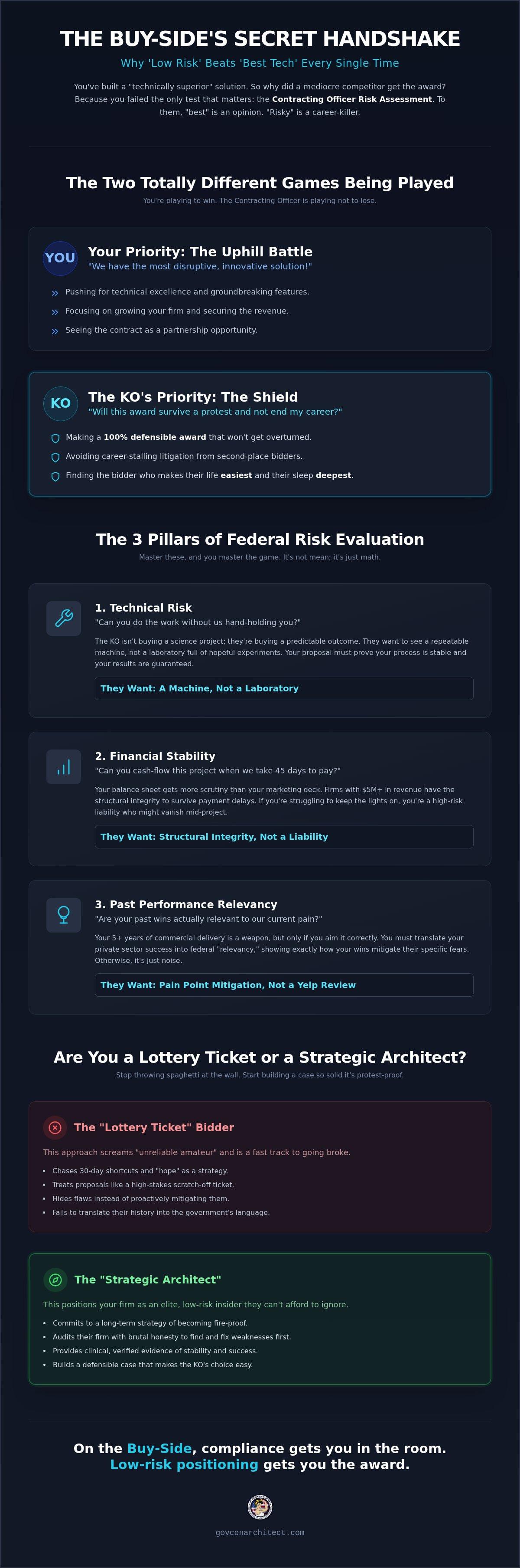
The federal government isn't looking for the smartest kid in the room. They're looking for the one who won't burn the house down. You've likely poured months and a small fortune into a "technically superior" bid, only to watch a mediocre competitor walk away with the award. It's infuriating. It's also entirely predictable. Your failure wasn't the technical solution. It was your contracting officer risk assessment profile. To a buyer, "best" is a subjective opinion. "Risky" is a career-killer.
I get it. You're tired of the black box and the high cost of losing. It's exhausting to play a game when you don't know the rules. Here's the reality check: "low risk" is the only metric that actually wins contracts. I'm going to pull back the curtain on the hidden mechanics of the Buy-Side. You'll learn how evaluators judge your stability and why being "fire-proof" beats being "innovative" every time. We'll explore the 2026 Revolutionary FAR Overhaul and provide a clear framework to make your next proposal completely defensible against protests.
Key Takeaways
- Realize the government doesn't actually want your "disruption"; they want an award that survives a protest without giving the Contracting Officer a career-ending migraine.
- Master the contracting officer risk assessment by proving you aren't a liability, because on the Buy-Side, being "fire-proof" is the only metric that actually wins.
- Stop treating your proposals like a high-stakes scratch-off ticket and start auditing your firm’s delivery history with the clinical precision of a strategic architect.
- Commit to a long-term strategy that positions your $5M+ firm as an elite insider rather than chasing 30-day shortcuts that scream "unreliable amateur."
The Contracting Officer’s Secret Motivation: Protest Avoidance
Stop thinking of the government as a customer looking for a partner. They aren't. They're a bureaucracy looking for a shield. A risk assessment is the process of ensuring a firm won’t fail or cause a legal headache. For the Contracting Officer (KO), this isn't a check-the-box exercise; it's a survival tactic. When they sit down to evaluate your bid, they aren't dreaming about your "disruptive innovation." They're worrying about their career.
On the Buy-Side, the KO has one primary goal: make a defensible award. They don't get a bonus for picking the most innovative solution. They get a legal bill and a career stall if the award gets overturned. This is why "low risk is king." If your proposal is technically brilliant but legally fragile, you're a liability. Your job is to hand them the evidence they need to justify picking you over the incumbent or the "safe" giant.
The Psychology of the Buy-Side
Awarding a contract to a commercial firm requires a massive burden of proof. The KO has to document exactly why you are the safest choice. Technical excellence is a baseline requirement, but protest-proof defensibility is the actual win condition. If you want to understand low-risk bidder strategy, you have to understand that the KO is terrified of litigation. It's not personal; it's professional self-preservation.
Consider the difference in priorities. You see a chance to grow your $5M+ firm. The KO sees a potential contracting officer risk assessment failure that could lead to a GAO protest. They need to sleep at night knowing the second-place bidder can't sue their way into your seat. Give them the clinical, verified evidence that your delivery is stable. Be the bidder who makes their life easy, not the one who makes them work for it.
Decoding the 3 Pillars of Federal Risk Evaluation
Stop chasing certifications like they're rare Pokémon cards. A set-aside status is a door-opener, not a contract-closer. If you want to survive a contracting officer risk assessment, you have to master the three pillars: technical, past performance, and financial. The government doesn't care about your mission statement. They care about whether you'll be out of business by Q3. It's not mean; it's just math.
Technical risk boils down to a simple question: Can you actually do the work without the government holding your hand? Per the FAR guidelines on the Management of risk, the KO is looking for operational stability. If your proposal smells like "figuring it out as we go," you're dead in the water. They want to see a machine, not a laboratory. They need to know that your process is repeatable and your results are predictable.
Financial Stability vs. Technical Capability
The KO assesses your balance sheet with more scrutiny than your marketing deck. Can you cash-flow a major project when the government takes 45 days to pay? Established firms with $5M+ in revenue have a natural advantage here. You have the structural integrity to survive a payment delay. If you're struggling to keep the lights on, you're a high-risk liability. It's a brutal reality check, but it's the only one that matters on the Buy-Side.
The Past Performance Trap
Your 5+ years of commercial delivery is your strongest weapon, provided you don't frame it like a Yelp review. You must translate commercial success into federal "relevancy." This means showing how your private sector wins mitigate specific government pain points. Without this translation, your experience is just noise. If you're serious about shifting from a "lottery ticket" bidder to a strategic architect, you need a Low Risk Bidder Strategy that maps your history to their future. If this feels overwhelming, you can always check our availability for a strategy session.
Tactical Strategy: How to Become a Low-Risk Bidder
Are you a "lottery ticket" bidder or a strategic architect? Most firms throw spaghetti at the wall and hope it sticks. That's a great way to go broke. To survive a contracting officer risk assessment, you have to audit your firm with brutal honesty. If you have a weakness, find it before the KO does. Proactive mitigation isn't just smart; it's a requirement under FAR 39.102 Management of Risk. Don't hide the flaws. Address them. Show them exactly how you've already solved the problem they're worried about. Compliance gets you into the room; low-risk positioning gets you the award.
Aligning with Section L & M
You need to use a Technical Proposal Compliance Matrix to force the evaluator's hand. On the Buy-Side, evaluators are usually overworked and underpaid. They don't want to hunt through 50 pages of marketing fluff to find your brilliance. They want to copy-paste your strengths directly into their evaluation report. If you align your proposal with clinical precision to their specific criteria, you become the path of least resistance. That is how you win.
The Reality Check for Commercial Firms
Commercial firms often fail because they try to "sell" the government. Stop it. The government doesn't want to be sold; they want to be reassured. You must stop bidding like a commercial entity and start bidding like a federal insider. Understanding what do you need to bid on a federal contract is about more than just a list of documents. It's about a fundamental shift in how you present your structural integrity to the contracting officer risk assessment team. We care about your success, but we won't lie to you about the work it takes.
The Buy-Side Advantage: Why Strategy Beats Hope
Hope is a liability in federal contracting. If you're waiting for an RFP to drop before you think about risk, you've already lost. Most firms treat the federal market like a slot machine. They pull the lever, lose their shirt, and wonder why the machine is "rigged." It's not rigged; you're just playing the wrong game. For firms with $5M+ revenue, the only way to beat the contracting officer risk assessment is through a sustained, clinical strategy.
The "30-day shortcut" is a myth designed to sell templates to desperate people. Real alignment with the Buy-Side takes a 6-12 month commitment. You aren't just writing a proposal; you're re-architecting your firm's perceived value. This is why our RETAINER · MONTHLY – Fractional Federal Strategy Advisor exists. It provides the continuous alignment necessary to ensure the KO sees a zero-risk solution every time.
Choosing Your Level of Support
We don't do "one size fits all" because your pursuits aren't generic. At The GovCon Architect, our monthly retainer starts @$3,500/mo with a 3-month minimum. This is for leaders who are done with guessing and ready for a professional briefing on how the system actually works. For specific high-value pursuits, our PER‑PURSUIT · PROJECT – Capture & Proposal Sprint ensures your bid is bulletproof and defensible. Our 22 years of evaluator experience stops the bleeding before it starts.
Final Reality Check: Are You Actually Ready?
We are very picky about who we help because we care about results over effort. If you don't have $5M in revenue and 5 years of proven delivery, you aren't ready for this level of play. Your contracting officer risk assessment profile shouldn't be left to chance. But if you've done the work and you're tired of losing to inferior competitors, it's time to change your architecture. Stop betting on hope and start relying on logic. It's much better for your blood pressure.
Book a 15-minute get-to-know-you call with Nikki Gianni
Build Your Defensible Architecture
The federal market isn't a place for the faint of heart or the unprepared. You've seen the mechanics now. A contracting officer risk assessment is a defensive wall; your job is to make sure you aren't the one getting hit. We've covered why "low risk is king" and how the Buy-Side prioritizes protest-proof awards over technical flair. For firms with $5M+ revenue, winning isn't about luck. It's about clinical precision and structural integrity.
With 22 years of buy-side experience and billions in contracts awarded, we know exactly what evaluators are looking for when they audit your firm. Stop chasing the 30-day shortcut and start building a strategy that actually survives a protest. You have the delivery history; now you just need the architecture to prove it.
You've done the hard work of building a $5M+ business. Don't let a "high risk" label kill your federal growth. You've got the goods, so let's make sure the government knows it too.
Frequently Asked Questions
How does a Contracting Officer define a "low-risk" bidder?
A low-risk bidder is a firm that provides a defensible award the Contracting Officer can justify without losing sleep over a potential protest. It's not about being the "best"; it's about being the most stable and predictable choice. On the Buy-Side, this means having the financial depth, technical precision, and proven delivery history that makes you fire-proof. When you align your proposal with the contracting officer risk assessment criteria, you become the safest bet.
Can a commercial firm win a federal contract without prior government experience?
Yes, you can win, but you have to stop acting like a commercial amateur and start acting like a federal insider. Your 5+ years of proven commercial delivery is your strongest asset if you frame it correctly. The government values commercial success, but they need to see how that success translates into their specific regulatory environment. We help $5M+ firms bridge this gap by architecting a proposal that highlights stability over generic marketing fluff.
What are the most common risk factors that lead to bid disqualification?
Disqualification usually happens because a firm smells like a "lottery ticket" bidder rather than a strategic partner. Common red flags include weak financial responsibility, lack of technical depth, or failing to map the proposal to Section M evaluation criteria with clinical precision. If the KO thinks they'll have to hold your hand through the project, you're a high-risk liability. We focus on eliminating these weaknesses through a clinical audit of your firm's structural integrity.
How much does a federal contracting strategy retainer cost?
Our RETAINER · MONTHLY – Fractional Federal Strategy Advisor starts @$3,500/month. This requires a minimum 3-month commitment because real strategy isn't a 30-day shortcut. For firms serious about the federal channel, we recommend a 6-12 month engagement for optimum results. This isn't a cost; it's an investment in a defensible architecture that stops you from wasting hundreds of thousands on failed proposals. We aren't here for the casual "quick win" crowd who hates logic.
Why is past performance so critical in a Contracting Officer risk assessment?
Past performance is the government's crystal ball. In a contracting officer risk assessment, your history is the only reliable indicator of your future behavior. The KO needs to know that you've navigated complex delivery before and didn't leave a trail of legal headaches. For firms with $5M+ revenue, your 5-year track record proves you have the staying power to survive a federal project's unique financial and operational demands without causing a scene.