
Contracting Officer Risk Assessment: Myths vs. Buy-Side Reality

Article by
Nikki Gianni
Nikki Gianni is a seasoned business strategist and government contracts coach, dedicated to helping businesses successfully navigate the complexities of government contracting. With over 22 years of experience in Department of Defense contracting, including managing $20 billion in federal awards, Nikki has developed the innovative GovReady Blueprint™ Framework, a comprehensive 90-day program designed to prepare businesses to compete for and win lucrative contracts at the federal, state, and local levels. Nikki's approach emphasizes not just gaining contracts but also enhancing overall business profitability.
Before becoming a business owner, Nikki was active-duty Air Force for 10 years, then spent another 15 years as a civil servant with the DOD. Now she's an empty nester living in Southern California who loves spending time with her 22-year-old son, Lex and her 2 Mini Aussies, doing home improvement and crafts projects, and networking.
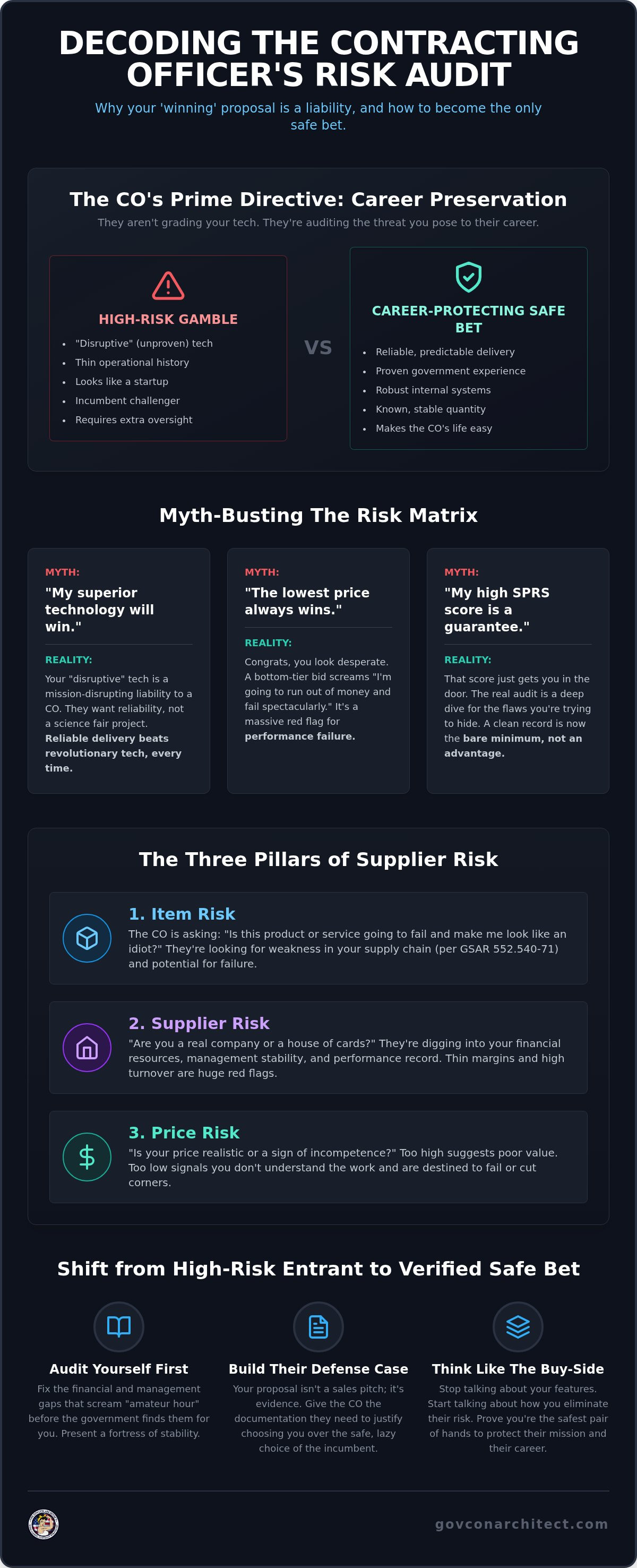
Your proposal isn't being graded on technical merit alone. It's being audited for the threat it poses to a Contracting Officer's career. To the buy-side, every award is a potential liability. If you're tired of receiving disqualification notices without clear feedback, you're likely failing the contracting officer risk assessment before they even finish your executive summary. It's a reality check most firms aren't prepared for. Logic, not hope, wins here.
We understand the frustration of navigating SPRS scores and the anxiety of competing against an entrenched incumbent. You want to be seen as the obvious choice, not a high-stakes gamble. This briefing pulls back the curtain on the hidden psychological and regulatory risk factors that determine if a CO signs your contract or shreds your bid. We will examine the 2026 GSA supply chain monitoring shifts and the data-driven CPARS overhaul to help you identify hidden risk triggers in your own proposals. You'll learn how to stop being just another "qualified" bidder and start being the "safe bet" that protects the government's interests and the CO's reputation.
Key Takeaways
Recognize that a contracting officer risk assessment is a career-protection exercise. Learn to identify the hidden triggers that signal a high-stakes liability to the evaluator.
Go beyond the SPRS score. Understand how the government actually weights price risk and supplier reliability to determine your final standing.
Deconstruct the low-price myth. Discover why a bottom-tier bid often signals performance failure rather than competitive value to a seasoned CO.
Audit your internal systems before the government does. Fix the financial and management gaps that lead to automatic disqualification during the responsibility determination.
Shift from a high-risk entrant to a verified "safe bet." Apply buy-side logic to ensure your proposal survives the final cut and secures the award.
Table of Contents
The Invisible Hurdle: Decoding the Contracting Officer Risk Assessment
Beyond SPRS: How the Government Actually Scores Your Reliability
Myth-Busting the Risk Matrix: What Really Disqualifies Commercial Bids
Tactical De-Risking: Shifting from High-Risk Entrant to Safe Bet
The Invisible Hurdle: Decoding the Contracting Officer Risk Assessment
Your technical score is a vanity metric if your risk profile is toxic. Most commercial firms treat the federal bidding process as a meritocracy of technology. It isn't. It's a clinical evaluation of liability. Every award is a potential career threat for the person holding the pen. If you don't understand how the buy-side evaluates your company's stability, you're essentially gambling on your growth strategy.
A contracting officer risk assessment is a subjective evaluation backed by objective data. It's the process where a CO determines the likelihood of contract failure before a single dollar is obligated. This isn't a courtesy check. It is a mandatory step under FAR Part 9 (Responsibility) and FAR Part 15 (Source Selection). While a general risk assessment identifies potential hazards, the government's version is focused on one thing: mission continuity. A CO's goal is to avoid a failed contract that results in a sustained protest or a humiliating Cure Notice. If your proposal doesn't proactively address these fears, you've already lost.
Superior technology often fails this assessment. Why? Because innovation is inherently risky to a bureaucrat. A firm with a "disruptive" solution but no government-specific operational history is a red flag. The CO isn't looking for the best tech; they're looking for the most reliable delivery. If your internal systems look like a startup and your compliance record is thin, you're a high-risk gamble they can't afford to take.
The CO's Prime Directive: Career Preservation
A CO's performance is measured by the stability of their portfolio. No one gets promoted for awarding a contract that ends in litigation or a performance default. Selecting a new entrant requires massive amounts of additional documentation and oversight. It's a workload burden. If you're a "risky" pick, the CO has to justify that choice to their superiors and the Small Business Administration. Your proposal must make it safe for the CO to choose you over the incumbent. The incumbent is a known quantity. You are a variable. Variables get shredded during the evaluation process.
Regulatory Foundations vs. Practical Application
FAR 9.104-1 outlines the general standards for responsible prospective contractors. The regulation asks if you have adequate financial resources, a satisfactory performance record, and the necessary organization and experience. These are the floors, not the ceilings. In practice, COs use "discretionary authority" to interpret these vague risk factors. They look at your management plan and see potential for turnover. They look at your thin margins and see a bankruptcy risk. They aren't just checking boxes. They are building a defensible case for why they won't be fired if your company fails to perform. If you haven't provided the evidence to support that defense, your bid is dead on arrival.
Beyond SPRS: How the Government Actually Scores Your Reliability
Numerical scores are a comfort blanket for bureaucrats. They aren't a guarantee of award. While the Supplier Performance Risk System (SPRS) provides a baseline, a contracting officer risk assessment looks through the data to find the flaws you're trying to hide. A high score might get you past the initial gate, but it won't survive a deep dive into your technical logic. If your proposal lacks structural integrity, the CO will flag you as a "paper tiger." You look impressive on a dashboard, but you're likely to fail in the field.
By mid-2026, the overhaul of the CPARS system has fundamentally shifted how reliability is measured. Positive performance is now assumed. The system focuses exclusively on verifiable, negative performance events. This means a clean record is the baseline, not a competitive advantage. COs are no longer reading subjective "Excellent" ratings; they're looking for documented failures in a standardized scoring mechanism. If your history has even one documented failure, your risk profile spikes instantly.
The Three Pillars of Supplier Risk
Evaluation isn't a single metric. It's a three-pronged clinical analysis designed to protect the agency:
Item Risk: Is the product or service prone to failure? Under the July 2026 GSA Supply Chain Risk Monitoring clause (GSAR 552.540-71), COs have explicit authority to evaluate supply chain risks pre-award. If your components or logistics are unstable, you're a liability.
Price Risk: An unrealistically low bid is a major red flag. It signals a lack of understanding or a firm desperate enough to cut corners. In the buy-side mindset, low price often equals high performance risk.
Supplier Risk: This is an audit of your management depth. Do you have the financial "oxygen" to survive a 60-day payment delay? If your financials are thin, you don't have the capacity to deliver.
The 'Responsibility Determination' Trap
The final hurdle is the "Responsibility Determination." This is where the CO decides if you have the actual capacity to perform. Firms with thin past performance often stumble here. They have the tech but lack the federal muscle memory required for high-stakes execution. You must prove you can manage the bureaucracy as well as the contract. If your narrative doesn't address how you'll mitigate specific operational risks, the CO will assume you haven't identified them. You can use Per-Pursuit Project Support to audit your responsibility narrative before submission. It's better to find the gaps in your logic yourself than to have a CO use them to disqualify your bid.
Myth-Busting the Risk Matrix: What Really Disqualifies Commercial Bids
Fairness is a legal requirement, not an evaluation strategy. Commercial firms often enter the federal market believing that a superior product and a compliant checklist ensure success. They are wrong. A contracting officer risk assessment is designed to filter out the "technically acceptable" firms that pose a long-term management burden. If you're operating on myths, you're building your proposal on a fault line.
The first myth is that the lowest price always wins. In reality, an aggressively low price is often a disqualifying signal. It tells the CO that you don't understand the cost of federal compliance or that you're "buying the contract" with the intention of filing claims later. The second myth is that compliance equals low risk. Compliance is merely the floor. It's the entry fee. Reliability is the ceiling, and it's measured by your ability to handle the unexpected without a mission failure.
Finally, stop assuming incumbents are untouchable. While they have the "safe bet" advantage, they also suffer from incumbent fatigue. If an incumbent has become complacent or expensive, a CO is often looking for a reason to pivot. However, they will only pivot to a firm that proves it is less risky than the status quo. Commercial firms accidentally trigger "High Risk" flags in Section L and M by using marketing language where clinical, procedural evidence is required. If your proposal looks like a sales deck, it will be treated as a liability.
Price Realism vs. Price Reasonableness
COs distinguish between these two metrics with surgical precision. Price reasonableness asks if the government is overpaying. Price realism asks if you can actually perform at that rate without going bankrupt. If your bid is "unbalanced"—meaning you've front-loaded costs or under-quoted labor—you've signaled future instability. A cheap bid is a mathematical race to the bottom that threatens contract stability, while a low-risk bid is a strategic investment in verified delivery and mission continuity.
The Past Performance Paradox
Commercial success does not equal federal reliability. A CO doesn't care that you've scaled a SaaS platform in the private sector if you can't demonstrate an understanding of NIST standards or agency-specific reporting. You must translate your commercial KPIs into federal language. Focus on "Quality of Product" and "Schedule Adherence" rather than "Customer Satisfaction." If you're a new entrant with no federal history, don't fear a "Neutral" rating. Under FAR 15.305, you cannot be penalized for a lack of past performance, but you must still provide "Responsibility" data that proves you have the financial and management depth to survive the contract lifecycle.
Tactical De-Risking: Shifting from High-Risk Entrant to Safe Bet
Hope is not a strategy. Verification is. If you want to survive a contracting officer risk assessment, you must build a proposal that functions as a risk-mitigation machine. This requires a clinical audit of your internal infrastructure before the government does it for you. You are no longer just a vendor. You are a strategic partner proving your structural integrity through logic and evidence.
Step 1: The Self-Assessment Audit
Audit your SPRS profile immediately. Incorrect data in the Supplier Performance Risk System is a self-inflicted wound. Ensure your self-certifications, particularly your NIST SP 800-171 compliance following the July 13, 2026, CMMC Phase II pause, are documented and defensible. Identify "Single Points of Failure" in your project team. If your technical lead is the only person who understands the mission requirements, you are a performance risk. Diversify your expertise or use strategic sub-contracting to build a "Confidence Narrative" that suggests organizational stability rather than individual brilliance.
Step 2: Crafting the Mitigation Narrative
Don't hide your risks. Acknowledge them and provide a "Response Plan." If you lack specific federal past performance, neutralize that gap with clinical metrics. Show, don't tell. Use your Quality Management System (QMS) to prove reliability. If you maintain a 99.8% on-time delivery rate in the commercial sector or have a zero-defect audit history, these are your proof points. Logic dictates that a stable organization produces stable results. Make that logic undeniable for the evaluator by providing a clear roadmap of how you will handle potential disruptions.
Step 3: Strategic Alignment via Retainer
Risk management isn't a one-time event. It's a continuous posture. CO criteria shift constantly as new regulations, like the July 2026 GSA Supply Chain Risk Monitoring clause, become standard practice. Maintaining a low-risk profile between bid cycles requires constant alignment with the buy-side perspective. You can leverage Monthly Retainer Support to ensure your internal systems and pursuit strategies remain optimized. Stay ready so you don't have to get ready when the next high-stakes RFP drops. Strategic positioning is about being the "safe bet" long before the proposal is ever written.
Strategic Alignment: Leveraging Buy-Side Expertise to Win
Winning a federal contract isn't an act of luck. It's a result of superior architecture. Most firms spend their energy on the technical volume while ignoring the invisible gatekeeper: the contracting officer risk assessment. You can't win if you're viewed as a liability. To move from a "qualified" bidder to a "safe bet," you must stop guessing and start architecting your pursuit strategy from the buy-side out.
The GovCon Architect advantage is built on a simple premise: we think like the person holding the pen. Nikki Gianni’s 22 years of buy-side experience provides more than just regulatory knowledge. It provides a blueprint of the internal pressures, career anxieties, and procedural hurdles that drive a CO's decision-making. We don't just help you follow the FAR; we help you navigate the unwritten rules of risk mitigation that determine who gets the award and who gets a debrief.
Your risk profile isn't a static score you receive from a database. It is a narrative you control. If you don't proactively define your reliability, the CO will define it for you based on their own biases and the government's increasingly rigid data-driven metrics. Strategic alignment means ensuring every word in your proposal serves to lower the CO's blood pressure. Logic, not hope, is the only way to survive the final cut.
The Reality Check Approach
We provide a direct, authoritative analysis of your proposal’s red flags. We identify the "Commercial Amateur" language that signals a lack of federal muscle memory. Flowery marketing adjectives like "innovative," "world-class," or "passionate" are useless. In a high-stakes evaluation, they are distractions. We replace fluff with clinical, procedural evidence. Our diagnosis of your pursuit strategy focuses on structural integrity. If your management plan has a single point of failure or your pricing looks unrealistic, we flag it before the government does. Clinical precision wins awards; marketing fluff wins nothing.
Your Next Moves in the Federal Market
Stop bidding blindly and start managing perception. The federal market in 2026 is less forgiving than ever. With automated CPARS reporting and intensified supply chain monitoring, your margin for error has vanished. You need an ally who understands the hidden mechanics of the system. Whether you require Per-Pursuit Project Support for a specific high-value bid or Monthly Retainer Support to maintain long-term risk alignment, the goal remains the same: total de-risking.
Don't leave your growth to chance. Contact GovCon Architect for a strategic briefing that aligns your firm with the buy-side reality. It's time to build a proposal that the government can't afford to shred. Secure your buy-side advisory today and take control of your federal future.
Own the Narrative or Be Defined by the Risk
Federal growth is not a game of chance. It's a game of perception and career preservation. You've learned that a contracting officer risk assessment is the invisible barrier between your proposal and a signed contract. Compliance is merely the entry fee. To win, you must prove you are the safe bet by addressing price realism, supply chain stability, and management depth with clinical precision.
Stop guessing what the government wants. We provide the authoritative "Reality Check" consulting your firm needs to survive the evaluation. With 22 years of buy-side federal experience, we help you achieve strategic alignment with the exact criteria COs use to filter out high-risk bidders. Each bid is a high-stakes investment. Don't waste yours on a narrative that doesn't account for the evaluator's perspective.
Take control of your firm's reputation. Architect your low-risk federal strategy with GovCon Architect. It's time to build a pursuit strategy that survives the buy-side audit and secures your federal future. Success is certain when you lead with logic.
Frequently Asked Questions
What is a contracting officer risk assessment?
A contracting officer risk assessment is the mandatory evaluation process used to determine if a prospective contractor can successfully perform a contract. It is governed by FAR Part 9 for responsibility and FAR Part 15 for source selection. The goal is to identify potential failure points before award to protect the agency from defaults, protests, or mission delays.
How does the Supplier Performance Risk System (SPRS) impact my bid?
SPRS provides the numerical baseline that contracting officers use to evaluate your reliability and price risk. For DoD acquisitions, COs are required to review these scores to identify patterns of delivery failure or unrealistic pricing. While a high score is necessary for entry, it is rarely sufficient to secure an award without a strong technical narrative.
Can a new contractor be rated as 'High Risk' just for being new?
No, under FAR 15.305, contractors without relevant past performance must be given a "Neutral" rating. They cannot be penalized for being new. However, a neutral rating creates a documentation burden for the CO. You must overcome this by providing clinical evidence of your organizational capacity and management depth to prove you are a safe bet.
What is the difference between price risk and supplier risk?
Price risk evaluates whether your bid is unrealistically low, which signals a potential performance failure or future claim. Supplier risk focuses on your organizational stability, including financial health and management depth. One measures the "what" of the bid, while the other measures the "who" of the firm. Both are critical to the final award decision.
How can I improve my SPRS score before an RFP drops?
Improve your score by auditing your current data for inaccuracies and challenging documented errors through the proper agency channels. Ensure your NIST SP 800-171 self-assessment is current and uploaded. Since the system focuses on negative events, maintaining a clean record of on-time delivery is the most effective long-term strategy for risk mitigation.
What are the most common red flags for a Contracting Officer?
Common red flags include unbalanced pricing, thin financial margins, and high turnover in key personnel. COs also flag proposals that use generic marketing language instead of procedural evidence. If your proposal suggests you don't understand the cost of federal compliance, you are immediately categorized as a high-risk liability.
Does having a monthly retainer with a consultant help lower my risk?
Yes, maintaining Monthly Retainer Support ensures your firm stays aligned with shifting CO criteria and regulatory updates. Continuous oversight allows for proactive audits of your internal systems before an RFP is even released. This long-term posture transforms your firm from a high-risk entrant into a verified, stable partner for the government.
What happens if a Contracting Officer determines my bid is 'High Risk'?
If a contracting officer risk assessment results in a "High Risk" determination, your bid will likely be disqualified or result in a "Non-Responsibility" determination. For small businesses, this may trigger a referral to the SBA for a Certificate of Competency. In most cases, it simply means your proposal is shredded in favor of a safer, more reliable alternative.